
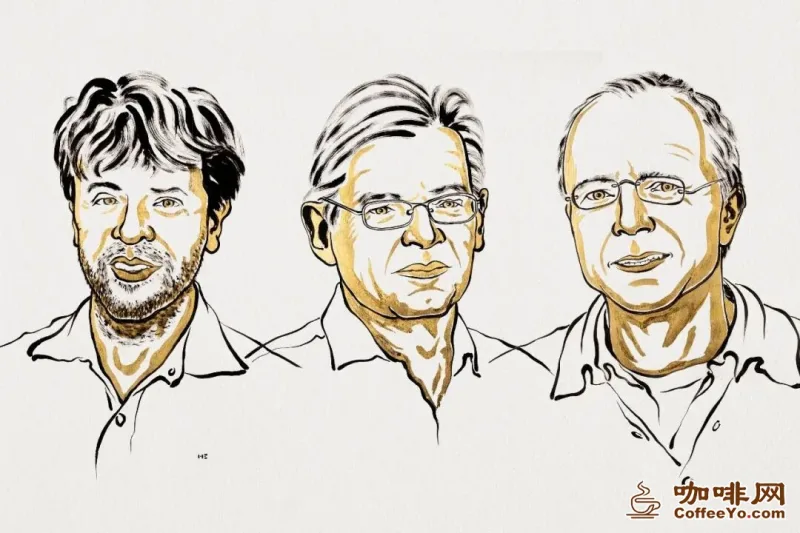
At a Glance (China Coffee Network): The 2026 Nobel Prize in Physiology or Medicine went to Karl Deisseroth, Peter Hegemann and Georg Nagel for optogenetics; one laureate, Georg Nagel, once ran a cafe called Cafe Chaos before returning to the lab.

Three Nobel laureates lived completely different lives, yet they ultimately converged at the same destination: making light a tool for understanding life and exploring treatment.
Written by: Ling Jun, Wang Hang
After graduating from university, Georg Nagel did not choose to pursue a doctorate. He first went to Switzerland to teach, then co-opened a coffee shop named Cafe Chaos in downtown Konstanz, Germany, with a friend – literally translated, “Chaos Cafe.” He later wrote this experience into his autobiography. Today, this former cafe owner has gained a new identity: Nobel laureate. On October 5, the 2026 Nobel Prize in Physiology or Medicine was announced, awarded to American scientist Karl Deisseroth, German scientists Peter Hegemann and Georg Nagel, for their “discovery of light-gated ion channels and optogenetics.” This is a technology that lets scientists study nerve cells with light, and its contributors present several rather different life stories: one paused his academic climb to open a cafe; one wanted to be a writer from childhood but became a psychiatrist; and another spent years pursuing a seemingly tiny question – why does Chlamydomonas swim toward light? First a cafe, then back to the lab. Born in 1953 in southern Germany, Nagel was the eldest of five children. At age five he developed a severe bone inflammation and underwent multiple surgeries. While his siblings went skiing, Nagel tinkered with science experiment kits at home, sparking his interest in science. Georg Nagel (Image source: Shaw Prize official website).

After high school, Nagel entered the University of Konstanz and earned a biology degree. But after graduation he felt unprepared for a doctorate, so he taught at a private high school in Switzerland and co-opened the Cafe Chaos in downtown Konstanz. Later, Nagel underwent another surgery, and the bone inflammation that had troubled him since childhood was finally brought under control. Thereafter, his university teacher Ernst Bamberg, who was heading to Frankfurt to set up a new research group, invited him along. Nagel accepted and went to the Max Planck Institute for Biophysics in Frankfurt, Germany, to learn how to record the faint currents across cell membranes and study how ions cross them. It was also here that he first met Hegemann, a doctoral student who often came to do experiments. In 1988, Nagel received his doctorate from Goethe University Frankfurt. He then did postdoctoral research at Yale University and Rockefeller University in the United States, and in 1992 returned to the Max Planck Institute for Biophysics as a group leader. The electrophysiology experience accumulated over the years later proved useful. To answer Hegemann’s question – whether a certain protein in green algae could itself be opened by light, forming a channel for ions to pass through – Nagel imported the corresponding gene into African clawed frog oocytes, measured the current under light, and turned the hypothesis into a testable experiment. The two later confirmed channelrhodopsin-1 and channelrhodopsin-2, the latter of which became an important tool for optogenetics. The psychiatrist who wanted to be a writer. Born in 1971 in Boston, USA, Karl Deisseroth. His father was a physician and professor, his mother a high-school chemistry teacher. Influenced by an intellectual family atmosphere, Deisseroth loved reading from an early age – poetry, essays and science books alike – and hoped to become a writer. Karl Deisseroth (Image source: Stanford Medicine).
In 1988, Deisseroth was admitted to Harvard University; in 1992 he graduated magna cum laude with a bachelor’s degree in biochemical sciences. He then entered Stanford University’s MD-PhD program, earning a PhD in neuroscience and a medical degree. During medical training, Deisseroth had planned to become a neurosurgeon, but a patient he saw during his psychiatry rotation changed his choice. Deisseroth realized that mental illness still held many unsolved mysteries and that patients urgently needed help. Here he could try to understand why the brain malfunctions, why a person feels happy or sad. He later completed his psychiatry residency at Stanford and established his own lab in 2004. In 2005, with collaborators Edward S. Boyden and Feng Zhang, he published research triggering nerve-cell firing at millisecond scale using blue light. The desire to write never faded. In 2021, Deisseroth published Projections: A Story of Human Emotions, weaving literary character stories, scientific knowledge and personal experience to explore human emotion and behavior, giving the psychiatrist’s clinical observations a more humanistically colored form of expression. In a Stanford Medicine interview, Deisseroth said the book’s final draft took about five years, written from 2015 to 2020, always after his children fell asleep, late into the night. According to another Stanford report, he also prepares lunch for his kids and takes them to school on ordinary days. For this research-clinician, clinical work confronts him with patients’ emotional and behavioral struggles, lab tools let him probe the cellular activity behind these phenomena, and literature lets him try to tell the human inner world to more people. Obsessed with why Chlamydomonas swims toward light. Born in December 1954 in Munster, Germany, Peter Hegemann. His parents, grandfather and maternal grandfather were all physicians, yet he alone was drawn to chemistry. From 1975 to 1980, Hegemann studied chemistry at the University of Munster and the Ludwig Maximilian University of Munich, then joined the Max Planck Institute of Biochemistry, studying light-sensitive proteins under Dieter Oesterhelt, earning his doctorate in 1984. Peter Hegemann (Image source: Chemical & Engineering News).

At the time, Hegemann studied a light-driven protein that transports chloride ions. This training left him with a question that would run through the following decades: how does life turn light into a signal cells can use? From 1985 to 1986 he did postdoctoral research at Syracuse University in the United States, then returned to the Max Planck Institute of Biochemistry to lead a research group. The object that truly gripped him for the long term was Chlamydomonas. This single-celled organism adjusts its swimming direction based on light to find a spot suitable for photosynthesis. What does it use to sense light? And how does light change its movement? Hegemann recorded that Chlamydomonas’s light response is extremely fast. He suspected the link between “sensing light” and “opening ion channels” was more direct than previously thought. But finding this protein was not easy; after long experiments, he worked with Nagel to test candidate genes in other cells, finally confirming the role of channelrhodopsin. In 1993, Hegemann became professor of biochemistry at the University of Regensburg, and in 2005 moved to Humboldt University of Berlin as professor of experimental biophysics. From chemistry, biochemistry and plant physiology to neuroscience applications, his research kept extending along the question of light-sensitive proteins. Later, more scientists began using similar proteins to study complex brain activity. In a 2023 interview with Chemical & Engineering News (under the American Chemical Society), Hegemann still stressed the value of basic research: only by first understanding the properties of light-sensitive proteins can other scientists develop new tools based on them. The birth of the Nobel. The three researchers’ work ultimately converged on one common question: can light precisely change the activity of specified nerve cells? Nerve cells in the brain communicate via electrical signals. Ion channels in the cell membrane are like gates letting charged particles in and out; when these “gates” open affects whether the cell sends a signal. Hegemann and Nagel found a gate in Chlamydomonas that can be opened directly by light. To use this discovery in brain science required one more step: introduce the gene that makes this light-sensitive protein into nerve cells so the corresponding channels also appear on the cell membrane. Then scientists can use light of appropriate wavelength to change cell activity. Genes determine which cells install the tool; light determines when to activate it – this is the basic idea of optogenetics. In 2005, Deisseroth and colleagues demonstrated the method’s feasibility in cultured nerve cells. By 2007, researchers sent light through thin optical fibers into the brains of living mice, stimulating specific nerve cells in the motor cortex and inducing whisker movement. Invisible neural signals became observable behavioral changes. Its most important value is letting scientists further probe causation. Seeing a group of cells active when an animal does something is still not enough to know what they actually do. Now researchers can select a type of cell, change its activity at a specific moment, and see whether memory-, movement- or emotion-related behaviors change accordingly. An experiment in memory research illustrates this well. In 2012, Susumu Tonegawa’s team, collaborating with Deisseroth, tagged a group of active nerve cells in the hippocampus when mice underwent fear learning, and made them express channelrhodopsin. Later, when the mice were placed in another environment, the researchers used light to reactivate this group of cells and observed the mice showing freezing responses related to fear memory. This result showed that reactivating a specific cell population is enough to evoke the corresponding memory-related behavior. The abstract question “where is memory” began to be studied through concrete cells and experiments. Similar methods have been used to explore the neural circuits behind pain, reward, feeding and social behavior. For medicine, these studies let disease mechanisms be dissected more finely: which cells participate in a symptom, which connections might be intervention targets, and how to affect the target circuit while minimizing interference with other functions. It first changed how we understand the nervous system, and also provided experimental basis for finding treatment directions. In the visual field, optogenetics has already entered human research. In 2021, Nature Medicine reported a patient who had gone blind from retinitis pigmentosa and, after optogenetic therapy combined with dedicated glasses, recovered partial visual function. Such diseases damage the retina’s light-sensing cells. The research team delivered the gene for another light-sensitive protein into the patient’s still-living retinal ganglion cells, enabling them to respond to light. The dedicated glasses convert external images into appropriate light stimulation and project it onto the retina, letting these cells send signals to the brain. After training, the patient could perceive, locate, count and touch some objects while wearing the glasses. This is still partial visual recovery, yet it shows a new path: when the original light-sensing cells are damaged, can other surviving cells take on part of the light-sensing task? This path is still advancing. In 2025, an open-label phase II study involving six Stargardt disease patients reported improvement in some visual indicators after treatment; the light-sensitive protein used works under ambient light without dedicated glasses. But it is worth noting that broader clinical application still requires larger controlled studies to confirm how long the effect lasts, which patients benefit, and long-term safety. From algae to humans, optogenetics has been a relay from discovering light-sensitive proteins, measuring channel currents and controlling nerve cells to exploring clinical application. Its value lies both in helping humans understand the brain and in making the recovery of certain lost functions a medically testable proposition.
Reprint Notice & Disclaimer
- This article has been edited and compiled by China Coffee Network. The information and images therein come from public sources and the copyright belongs to the original author. This reprint is intended solely for information sharing within the coffee industry and does not represent the views of this website; all data and opinions are subject to the original article. Our thanks to the original author for creating and sharing it.
- For matters concerning content licensing, attribution, copyright or otherwise, please contact us promptly and we will verify and cooperate in handling them as soon as possible. We also welcome coffee origins, brands and industry media to exchange ideas and contribute articles.
- Contact China Coffee Network: Tel 400-0000-641 (+86-18288016826) | Email 405854472@qq.com | Address: Jinghong, Xishuangbanna, Yunnan Province / Tieling, Liaoning Province
Related Reading
 How ‘Sea-Flavored’ Coffee Blooms Across Dongtou
- Health Guide: How to Enjoy Your Coffee the Healthy Way
 Study: Regular Coffee and Tea May Lower Dementia Risk, but More Is Not Better
 Frontline Story: A ‘Mobile City Coffee Bar’ Arrives by the Grand Canal
 Yantai’s Wind Tastes of Coffee
 In Zhenyuan, a Cup of Coffee and a Waiting Train







 Liaoning ICP Security No. 21122402000217