
The National Day golden week has just passed. Looking back at the holiday, where did young people take their coffee? The answer is not Beijing, Shanghai, Guangzhou, Shenzhen, Suzhou or Hangzhou. As county-town tourism heats up, coffee shops have become a popular stop for young travellers. According to the 2026 Mid-Autumn and National Day Travel Trend Forecast, by mid-September searches for “treasure towns” and “niche destinations” had jumped 178 percent month on month, bookings for county travel products were up 42 percent year on year, and visitors spent an average of 3.2 more days in county areas. Those extra 3.2 days were meant for slowing down. As the golden week began, platform data confirmed it further: Qunar data show hotel booking heat in popular county towns up 32 percent year on year, with bookings in some small cities more than ten times higher.
People who are not rushing from place to place have to find somewhere to sit, and this Mid-Autumn and National Day they sat down, more and more often, in a coffee shop in a county town.
At ten in the morning on Paifang Street in Chaozhou the sun has not yet climbed above the arcades. Steam rises from the rice-roll shop at the mouth of the lane; a girl from Shenzhen sits on a plastic stool with a plate of rice rolls drizzled with pickled-radish oil in front of her and an iced latte in the cup holder at her right hand. Not long ago the picture would have felt a little out of place: the standard Chaozhou morning is kung fu tea. Now the smell of coffee drifts down the same lane as the braised aroma of beef balls under the arcades, and neither upstages the other.
“After walking around the old town my legs ached, and I just wanted somewhere to sit for a while,” she said. At the next table a couple were posing with their coffee cups against an arcade pillar.
“Finding a coffee” is turning from a standard move on the way to work into a fixed part of the travel experience.
Part Two
Coffee is following the crowd further afield.
Xinhuanet, together with Kuaimen, recently released the China Coffee Heat Map, using data to observe the regional distribution and consumption trends of China’s coffee market. The map draws the picture in three dimensions: the top ten cultural tourism cities by stores, the top ten cultural tourism cities by growth, and the top ten by coffee density around scenic areas. All three point the same way: China’s coffee consumption scenes are becoming more diverse, moving from core cities to more popular tourist destinations.
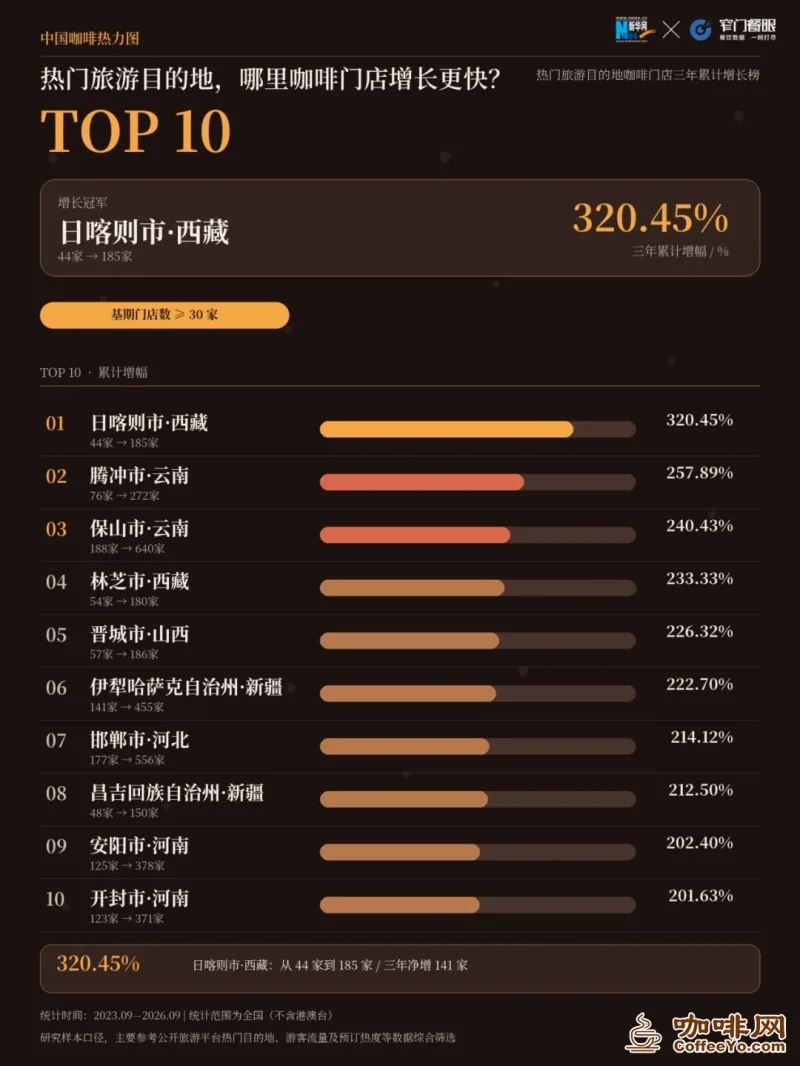
Data from the China Coffee Heat Map show that as of 15 October 2025 there were 254,730 coffee shops nationwide, with Guangdong, Zhejiang and Jiangsu in the top three. What is really interesting is the per capita figure: measured as coffee shops per 10,000 people, Lhasa ranks first nationally with 9.47, Nyingchi second with 7.53 and Lijiang third with 7.18.
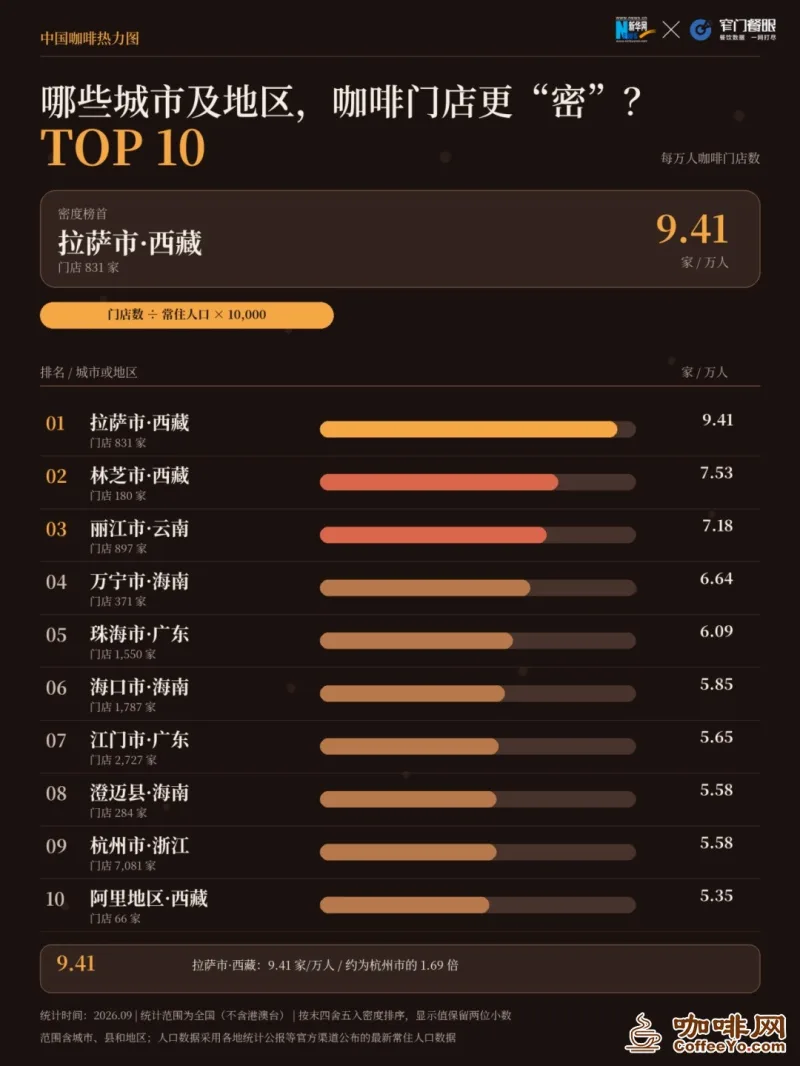
In popular tourist destinations coffee is not “the daily routine of city people” but “the daily routine of visitors”.
The consumption side shows the same huge potential. In the past year China sold about 11 billion cups of freshly ground coffee, of which Luckin sold 4.1 billion: one in every three cups comes from Luckin. In the National Day holiday just past Luckin’s weekly cup volume exceeded 100 million, reflecting continued release of coffee demand. Behind that demand is the ever denser store network of coffee chains, constantly extending the service radius of coffee consumption. From core business districts to community corners, scenic areas and transport hubs, coffee is becoming more convenient and accessible: buying a cup no longer requires a special trip but is gradually becoming an everyday purchase that can happen at any time.
Part Three
How exactly does coffee take root in a city?
The answer comes readily from the way coffee brands have penetrated diverse consumption scenes by combining with cultural tourism.
Luckin, the country’s largest coffee chain, recently launched a “coffee holiday roaming” campaign taking Chaozhou, Dehong and Lhasa as destinations to explore local coffee and cultural tourism routes.
Chaozhou: coffee has not diluted the Chaoshan flavour. On Paifang Street and Jiadi Lane the density of coffee shops is now so high that “every two hundred metres you smell roasting again”, and the most authentic way to drink it is “rice rolls with coffee”. This is not novelty-seeking: as a famous hometown of overseas Chinese, Chaozhou saw earlier generations bring coffee tins back to the kitchen stove more than a century ago. Standing alongside beef hotpot, kung fu tea and the arcades of the old town, it is a way of life in which the old and the new share the same table.
Ruili: a cup that carries the story of a border. Check in at the Jiegao national gate in the morning and stroll along the Ruili River in the afternoon; coffee is the hidden thread along this route. Yunnan is China’s leading coffee-producing region, and Ruili still keeps century-old mother coffee trees. Order a pour-over of local beans and you taste not only the flavour of the coffee but the story of an entire border line.
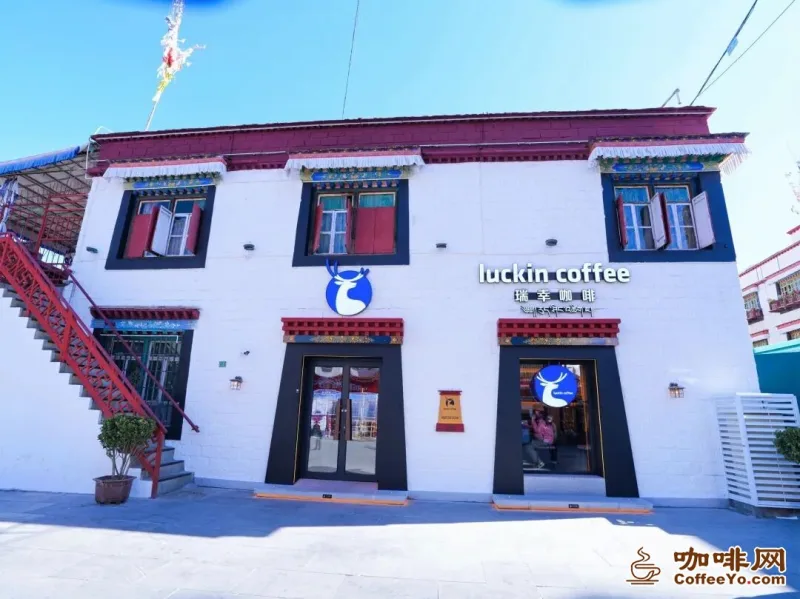
Lhasa: as the highland city with the highest coffee density in the country, distinctive Luckin stores designed with Tibetan architecture, colours and patterns bring coffee consumption further together with Tibetan culture and the cityscape, offering visitors a new scene in which to experience Lhasa.
Part Four
If these three city samples show how coffee settles into a city, the next place shows how far coffee can travel.
Sayram Lake in Xinjiang, known as “the last tear of the Atlantic”, is beside a Luckin store at Kele Yongzhu that has become the “most beautiful store” in visitors’ photographs. At more than two thousand metres the wind is cool; a hot coffee is both warmth against the chill and a small ritual of having been there, with the lake and the cup in one frame.
Part Five
Back to Jiangsu, a place that tells the coffee story both in its busiest scenic areas and in its quietest industries.
Kuaimen data show Jiangsu ranks third nationally with 19,729 coffee shops. What is special about Jiangsu’s coffee story is that it lives both in the busiest scenic areas and in the quietest industries.
Suzhou is the most typical sample and also holds the “roots” of Jiangsu’s coffee industry. According to Manbang big data, 90,000 tonnes of green coffee were transported into Suzhou in 2022, the highest in the country; Luckin Coffee’s Jiangsu roasting base has been completed and put into operation in Kunshan, coffee beans flow from Suzhou to the whole country, and coffee cups are handed to visitors beside classical gardens. More importantly, Suzhou is building a full-chain ecosystem around the “coffee industry”, from green bean trading and distribution to research and roasting, brand sales and equipment manufacturing: on one side a highland of coffee equipment research supported by manufacturing strengths, on the other a cup of coffee within easy reach in garden scenic areas, with industry and scene running in parallel in the same city.
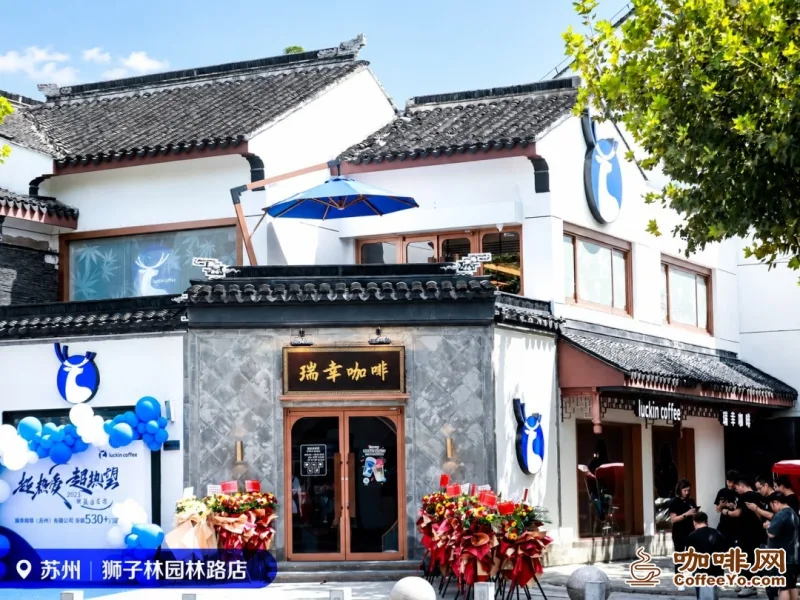
This year Luckin’s stores in Jiangsu have passed three thousand. Most noteworthy is the store on Yuanlin Road by the Lion Grove Garden, Luckin’s first “leisure store” in a Suzhou scenic area: arched doorways divide the space in symmetrical array, begonia windows use material and light to create contrasting brightness, and the walls and floor are designed with stone patterns. Beside the white walls and dark tiles of the scenic area there is now somewhere to sit and drink a cup slowly.
To the north, the counters at Confucius Temple, Laomendong and Yilu Road in Nanjing never lack a queue on holidays; to the south, the aroma of coffee also drifts along Nanchang Street in Wuxi, Pishi Street in Yangzhou and Xijindu in Zhenjiang. The cup of coffee Jiangsu people looked for this National Day probably did not require going far: it was right beside the scenic area.
Part Six
Back to the question at the beginning: where did young people take their coffee this National Day?
The answer is not at any single coordinate. It appears under the arcades of Chaoshan, beside the Ruili River, and also in small highland towns, lakeside scenic areas and the lanes of old cities. Coffee consumption extends wherever travel goes.
What the China Coffee Heat Map tries to answer is not only “where stores open” but what changes are taking place in Chinese coffee today. The answer is becoming clear: it is leaving the office towers of core cities and entering county towns, scenic areas, borders and highlands, gradually turning from a trend in first- and second-tier cities into the daily routine of many more towns.
China’s new coffee map is thus extending outwards, and this National Day every person who casually bought a cup of coffee on their journey is a coordinate on that map. Perhaps they were just tired and wanted a rest, perhaps they simply wanted to hold on to something familiar in a strange city.
And so a cup of coffee has blended into holiday roaming, and into more and more people’s daily lives.
Reprint Notice & Disclaimer
- This article has been edited and compiled by coffeeyo.com and reprinted from China Economic Times Network, “This National Day, Young People Took a Slow-Charge Holiday in Coffee Shops”. The copyright of the original text belongs to China Economic Times Network and the original author. This reprint is intended solely for information sharing within the coffee industry and does not represent the views of this website; all data and opinions are subject to the original article. Our thanks to the original author for creating and sharing it.
- Read the original: China Economic Times Network, “This National Day, Young People Took a Slow-Charge Holiday in Coffee Shops”
- For matters concerning content licensing, attribution, copyright or otherwise, please contact us promptly and we will verify and cooperate in handling them as soon as possible.
- Contact coffeeyo.com: Tel 400-0000-641 (+86-18288016826) | Email 405854472@qq.com | Address: Jinghong, Xishuangbanna, Yunnan Province
Related Reading
 ‘All-Ice’ Coffee Goes Viral! Will the Next Hit Be Your Personal Favorite?
- Hong Kong’s Dyee Coffee Lands in Qianhai, Building a Specialty Pour-Over Outpost
 Ken Yue Coffee Opens Egg-Tart Pop-Up in Hangzhou: Sweet Craft, Reinvented Classics
 World Cup Enters the Breakfast Slot: Can Coffee-Tea Brands Turn Traffic into Orders?
- ICE Agricultural Futures Mostly Rise at Close; Coffee Futures Up 3.28%
- ‘Sleep Cafés’ Become a New Favorite Among Seoul Office Workers





 Liaoning ICP Security No. 21122402000217