


At a Glance (China Coffee Network):As super-stores grow ever larger, MINISO’s trial of coffee needs more reasons to make consumers stay.
As super-stores grow ever larger, MINISO’s trial of coffee needs more reasons to make consumers stay.
This article was originally published by Hongcan Network. Author: Hua Yinglong; Editor: Qianjun.
‘Is MINISO selling coffee now too?’
Recently, a consumer posted photos on social media showing that coffee, baked goods and other products had appeared inside a MINISO store in Guangzhou, drawing outside attention.
A field visit by Hongcan Network found that this SUPER MINISO, which has introduced coffee and dessert business, is located in the Junchao Center in the Financial City of Tianhe District, Guangzhou, a newly opened large mixed-use shopping mall. The store sits at the mall’s west-gate entrance and is also MINISO’s first SUPER MINISO store in Guangzhou.
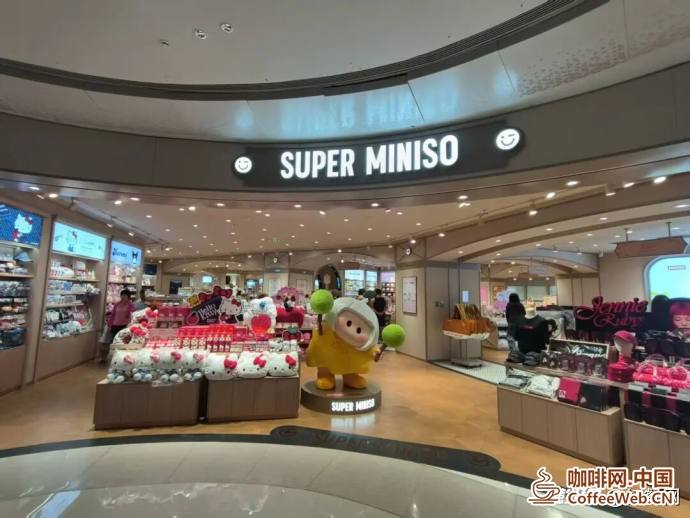
The store is mainly divided into upper and lower floors. The first floor is mainly split into a trendy-toy blind-box zone and a coffee-and-dessert zone, with the two areas connected in space; one must first pass through the SUPER MINISO trendy-toy blind-box zone before entering the coffee-and-dessert zone. The second floor is larger, covering multiple consumption areas such as trendy-toy IPs, fun living and fashion outfits.
As for the coffee-and-dessert business, in terms of product structure it mainly offers two categories: baked goods and drinks.
Among them, the baked products are mainly the Basque series, with 5 products launched, priced concentrated between 28 and 39 yuan. On the drinks side, four major categories are set up: specialty coffee, specialty signature drinks, Gelato Perfume Coconut and the zero-caffeine series.
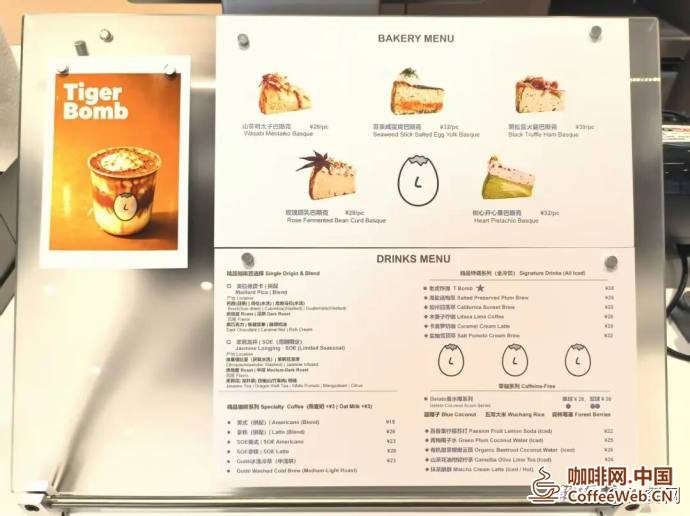
Specialty coffee offers two choices, blends and SOE single-origin beans; among them the basic blended Americano is priced at 19 yuan and the blended latte at 26 yuan, while seasonal limited products such as jasmine Longjing SOE and washed cold brew have also been launched. The signature series is mainly cold drinks, priced between 26 and 38 yuan.
However, unlike earlier online speculation, the coffee-and-dessert business launched by this MINISO store is not a self-operated business.
A staff member of the dessert shop told Hongcan Network that its brand is named ‘Rizuo Tianwu’ and that it is currently running a co-branded cooperation with MINISO. Regarding the cooperative relationship, the staff said the two are indeed currently carrying out a co-branded cooperation, but whether it will continue in future still depends on observing the results of this cooperation. It is understood that the dessert brand was founded in 2020 and has currently opened two stores in Guangzhou.
In addition, according to Consumer Reports, MINISO’s official side had also previously responded that the coffee and dessert businesses do not belong to MINISO’s self-operated business, but are a venue-cooperation project of individual SUPER MINISO stores, and are not a nationwide new-business layout that MINISO is advancing.
Although MINISO has not yet formally entered the baking and dessert business, whether it will try further in the future is still worth watching.
As early as 2023, MINISO proposed a brand-upgrade strategy, and super-stores like SUPER MINISO, as an important part of the upgrade strategy, face an urgent problem for this big-store model: how to continuously enrich consumption content, improve customer experience and raise the frequency of customer visits.
As of the first quarter of 2026, MINISO has opened 61 super-stores, and it is expected to surpass 100 globally within the year.
These ‘park-style’ stores usually have two to three floors of space, with an average area of about 1,200 square meters; some consumers say ‘you simply can’t finish browsing them’.
Against this background, consumption scenes such as coffee and baking may become a kind of supplement that improves the customer experience. During long browsing sessions, consumers need space to rest and linger, and for trendy-toy retail centered on IP and interest consumption, raising the frequency of visits and dwell time itself also holds important value.
Moreover, MINISO currently not only owns a self-operated IP system but has also established long-term cooperation with many classic IPs. If it further explores coffee, desserts and other businesses in future, IP could also become an important source of product differentiation. For example, self-owned IPs could launch regular products, while partner IPs could continuously create freshness through limited editions and co-branded items.
As a reference, Pop Mart — likewise a trendy-toy giant — already began exploring related businesses early. In 2024, Pop Mart opened ‘Molly’s Dessert House’ inside its own city theme park; in 2025 POP Bakery was launched as an independent brand, and then in May this year it opened its first directly operated store in Aranya, Qinhuangdao.
For trendy-toy companies, the dining business is becoming an attempt to extend consumption scenes and enrich brand experience, and there are precedents in other industries too.
Typical cases include home-furnishing giant IKEA, which has long run self-operated restaurants; the variety-goods brand MUJI, which launched Cafe MUJI selling coffee, bread and other products; and clothing brand Uniqlo, which also has its own coffee shop, UNIQLO COFFEE.
Behind these cross-industry attempts lies a shared business logic: using high-frequency dining consumption to drive low-frequency core business, using a sense of experience to make up for product homogenization, and trading dwell time for more chances to close a sale.
The same holds for MINISO’s lightweight attempt this time. The trendy-toy industry is not only a retail business, but a business about emotional value. In the future, how to create more consumption touchpoints and raise user stickiness may matter more than simply expanding stores.
MINISO has also started selling coffee? ”
Reprint Notice & Disclaimer
- This article has been edited and compiled by China Coffee Network. The information and images therein come from public sources and the copyright belongs to the original author. This reprint is intended solely for information sharing within the coffee industry and does not represent the views of this website; all data and opinions are subject to the original article. Our thanks to the original author for creating and sharing it.
- For matters concerning content licensing, attribution, copyright or otherwise, please contact us promptly and we will verify and cooperate in handling them as soon as possible. We also welcome coffee origins, brands and industry media to exchange ideas and contribute articles.
- Contact China Coffee Network: Tel 400-0000-641 (+86-18288016826) | Email 478203668@qq.com
Related Reading
 Asia Pacific Connection in a Cup of Coffee
- A Cup of Coffee Connecting Asia-Pacific
 ICE agricultural futures main contracts mostly closed higher, while coffee futures rose 1.84%
 The coffee market is experiencing two extremes! Arabica inventory drops to 27 year low, but Robusta plummets to two-week low
 Financial Observation: Why is Generation Z from the United States flocking to coffee and tea shops in China
 ‘All-Ice’ Coffee Goes Viral! Will the Next Hit Be Your Personal Favorite?


 Liaoning ICP Security No. 21122402000217