
Brief (coffeeyo.com): A café opposite Zhejiang University’s Zijingang Campus sold just 200 cups of coffee in its first six months, yet helped launch 14 tech startups. Run by a team of researchers and investors, the West Lake Science Café is less a coffee shop than a “third space” where academics, founders and capital meet as equals.
Chao News client. By Fang Li, with correspondent Zhang Yiyun.
Cafés near universities are nothing unusual — but one that has helped spawn 14 technology startups in the space of six months, over nothing more than a cup of coffee, is probably in a class of its own.
In October 2025, a small shop called the West Lake Science Café opened opposite the south gate of Zhejiang University’s Zijingang Campus. The team behind it is a group of multi-hyphenate young professionals from Tsinghua, Zhejiang University and other leading schools, skilled in technology transfer and innovation investment. With the backing of Hangzhou’s Xihu District and Jiangcun Subdistrict, they set out to build “a café that does not feel like a café” — a place where conversation between academia, industry and research could happen naturally.
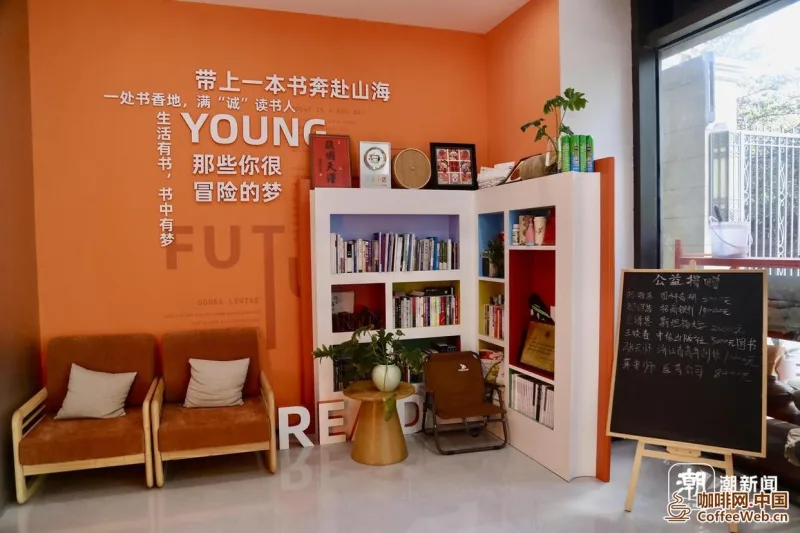
Photo by Fang Li.
An “innovation bean” takes root where academia meets everyday life
Most first-time visitors cannot help wondering: this is meant to be a café, so why are the walls covered in academic papers, and why are founders’ profiles and research fields scrolling across the screens? “Coffee” and “science and technology” would seem to have little to do with each other, yet at the West Lake Science Café the two are bound tightly together.
Qiu Guoliang, co-founder of the café and a council member of the Hangzhou Zhejiang University Alumni Association, has lived and worked in Xihu District for nearly thirty years and is deeply attached to the place. He came from a humanities background, while most of his fellow founders are scientists — some steeped in technology transfer, others focused on innovation investment. That blending of the humanities and the sciences mirrors the café itself: a rational technical core wrapped in the warmth of human exchange.
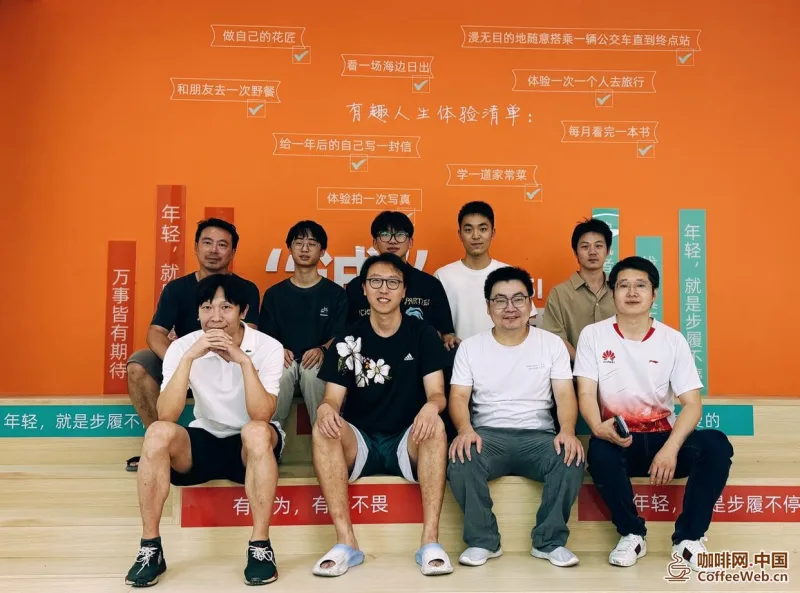
The café’s “circle of friends”. Photo provided by the interviewees.
“We were inspired by the Zhejiang Provincial Association for Science and Technology’s ‘Science Café’ model and set this up with the support of Xihu District and Jiangcun Subdistrict,” Qiu says. “The goal was a lightweight platform for innovation.” The café’s purpose is therefore clear: it does not make its money from coffee, but from connecting people and resources.
The location, too, was deliberate: near Zijingang Campus, in the heart of Hangzhou’s densest concentration of innovation, ringed by universities and research institutes and thick with scientific talent, yet right beside the lived-in Chengyuan community. “We wanted the high-value connections between the innovation chain, the industrial chain, the capital chain and the talent chain to happen naturally, over a cup of coffee,” Qiu says.
So in October 2025 this “always room to sit and talk” café began trial operation — part café, part drawing room, part incubator, part home for scientists and engineers.
Papers on the walls, coffee at the counter — and ideas colliding at any moment
Step inside and the 600-square-metre, two-storey building hums with a distinctly scientific atmosphere. On the ground floor, beside the bar, reproductions of a dozen or so journal papers are on display, every one of them from someone in the café’s “circle of friends”.
Behind the bar a young man is bent over a brew, his hands practised. His name is Ma Rui, a postdoctoral researcher at the University of Cambridge. After finishing his master’s in 2018 he studied in the Netherlands and then Britain, working on chip development. In late 2025, Ma Rui and Zhang Ziyao, another Cambridge PhD, came to the West Lake Science Café. One cup of coffee later, the two had decided to start a company in Hangzhou.
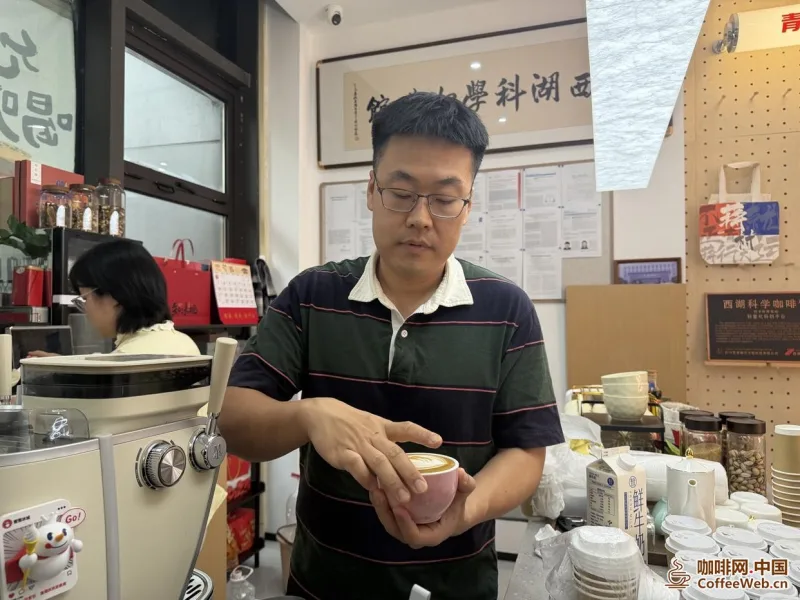
Ma Rui. Photo provided by the interviewee.
Within a month, Shiwei Sensing had taken root in the tech-incubation zone on the café’s second floor. Upstairs the lights are bright and the desks neatly lined up — flexible workspace set aside for early-stage teams. “Startups that depend heavily on nearby university and research resources are a very good fit here,” explains an official from Jiangcun Subdistrict. “As they grow, we can link them to the 36 office buildings and business parks in the area to give them more room to expand.”
Amusingly, Ma Rui is not just a tenant founder but one of the café’s volunteers as well. “There are professional baristas on staff, but when work is quiet those of us who are coffee enthusiasts lend a hand,” he says. Among the volunteers busy behind the bar are people from the tech sector, returnees from the University of Melbourne and the Technical University of Munich, and researchers from investment firms and institutes — pulling shots and talking projects at the same time.
“A lot of people assume a café is somewhere to switch off and stare into space. Ours is different,” Qiu says. Laboratories and offices, to his mind, carry a built-in hierarchy: there is bound to be distance between supervisor and student, investor and founder. Over a coffee in a café, though, a professor and a maker can talk as equals, and capital and technology can sit at the same table and thrash things out. It is precisely that level gaze and that ease that let ideas which might otherwise have stalled in an email thread or a meeting room find their way into the world.
Just 200 cups in six months — but 14 companies brewed
What has made the West Lake Science Café’s name is not, in truth, the coffee, but the collaborations struck in its easy-going atmosphere.
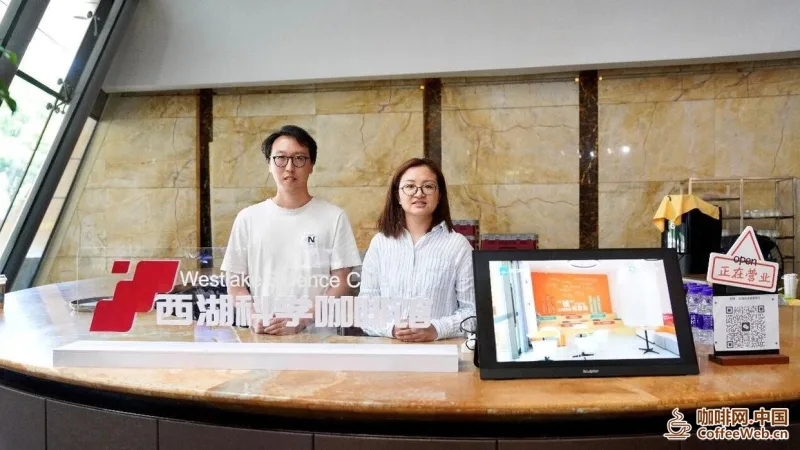
Photo provided by the interviewees.
Here people stand in twos and threes with cups in hand, talking; many are early-stage founders sitting on a piece of technology. They have not come to daydream or to meet friends, but to find a direction, connect with resources and test an idea.
Liu Zubin is one of them. He heads the Acoustics and Vibration Laboratory at the College of Mechanical Engineering, Zhejiang University of Technology, where his team has built up years of technical experience and more than a dozen industry-funded projects in high-end equipment manufacturing. “How do you turn research like that into orders? I came to look for a direction,” he says of what brought him through the door.
In little more than an hour he had talked in depth with three seasoned founders and sketched out a direction: applying acoustic signal processing to industrial intelligent inspection, psychological-state recognition and other promising scenarios. From “looking for a direction” to “settling on one” took about as long as a cup of coffee.
Everyone who has been comments on the same thing: the atmosphere is free and easy, more like a drawing room than a shop. Research suggests that more than 70 per cent of breakthrough ideas are born precisely in informal settings like this. As a “third space” distinct from the university lab and the company office, it gives ideas and imagination more room to collide.
In six months of trial operation the café sold just 200 cups and took in less than 3,000 yuan. That, if anything, confirms the point: coffee is the front door; innovation services are what is inside. The team has long worked in technology services and has brought together more than a hundred investment institutions and over a thousand scientists. Since opening, it has drawn 14 tech startups to register and set up shop.
In this small café, the seeds of innovation are sprouting cup by cup. It is not here to sell coffee; it is here to give Hangzhou’s innovation ecosystem a richer, slower-brewed depth.
West Lake Science Café: No. 127 Chongxin Road, Jiangcun Subdistrict, Xihu District, Hangzhou (150 metres from Exit C2 of the Zijingang Campus Zhejiang University metro station).
Please credit the source when reprinting.
Reprint Note & Disclaimer
- This article is reprinted from Chinese media for information and cultural exchange. The views expressed are those of the original author and do not necessarily reflect the position of coffeeyo.com.
- All trademarks, brand names and logos mentioned belong to their respective owners.
- For cooperation, reprint or correction requests, please contact coffeeyo.com.
Reprint Notice & Disclaimer
- This article has been edited and compiled by China Coffee Network. The information and images therein come from public sources and the copyright belongs to the original author. This reprint is intended solely for information sharing within the coffee industry and does not represent the views of this website; all data and opinions are subject to the original article. Our thanks to the original author for creating and sharing it.
- For matters concerning content licensing, attribution, copyright or otherwise, please contact us promptly and we will verify and cooperate in handling them as soon as possible. We also welcome coffee origins, brands and industry media to exchange ideas and contribute articles.
- Contact China Coffee Network: Tel 400-0000-641 (+86-18288016826) | Email 405854472@qq.com | Address: Jinghong, Xishuangbanna, Yunnan Province / Tieling, Liaoning Province
Related Reading
 How ‘Sea-Flavored’ Coffee Blooms Across Dongtou
- Health Guide: How to Enjoy Your Coffee the Healthy Way
 Study: Regular Coffee and Tea May Lower Dementia Risk, but More Is Not Better
 Frontline Story: A ‘Mobile City Coffee Bar’ Arrives by the Grand Canal
 Yantai’s Wind Tastes of Coffee
 In Zhenyuan, a Cup of Coffee and a Waiting Train







 Liaoning ICP Security No. 21122402000217