
Brief (coffeeyo.com): Unmanned coffee machines are spreading right to the doorsteps of Luckin and Starbucks, betting they can “wrestle” the chain giants. But with thin product lines, no real price edge and a weaker experience, can they truly win consumers over—or are they doomed to stay a niche supplement?
This article is from the WeChat public account Hongcan Net, authored by the Hongcan Editorial Department and edited by Qianjun. It is the fifth installment of Hongcan’s series “China’s Food & Beverage Under the Wave of Intelligence.”
“Go head-to-head with the chain giants!” Is coffee’s “strongest” contender arriving?
“A single coffee machine takes up just 0.6 square meters, needs no staff and no renovation—plug it in and it serves coffee 24 hours a day, 365 days a year with no off-season…”
Promises like this have been appearing frequently of late, as unmanned coffee machines become increasingly common. Yet this format is hardly making its debut. Long before Luckin, Cotti and other brands embarked on massive expansion, it briefly surged in popularity and then quickly faded.
Some say the market simply was not ripe back then; after years of education, coffee has gradually become an everyday consumer product. So as unmanned machines make a comeback, do they now have the capital to go toe-to-toe with Luckin, Cotti and Starbucks?
A wave of unmanned coffee machines emerges,
going hand-to-hand with the chain giants
Over the past six months, unmanned coffee machines have suddenly become far more visible.
Lobbies of office towers, mall corridors, airports, subway stations, hospitals—their placement has steadily crept into high-traffic public spaces.
“Lao Song on the 33rd Floor,” a catering-brand investor and blogger, said that on a recent business trip he spotted an intelligent coffee machine both in the ground-floor hall and in the underground parking garage of Zhengzhou Airport; two days later, on his return, he found another such machine had appeared about 50 meters from the original one.
In everyday settings like office buildings and malls, the density and speed of machine placement are also rising.
In mid-June, an unmanned coffee machine quietly landed in an office tower at Wansheng Plaza in Guangzhou’s Haizhu District, just over 20 meters from a Starbucks store—striking a pose of “hand-to-hand combat” with the giant. Not far away, Luckin, Cotti, Nayuki and other tea-and-coffee shops had long since claimed their spots, and the competitive landscape is heating up fast.
What’s more, another unmanned coffee machine quietly took position in the B1 subway-entrance corridor of Poly Plaza, right across from Wansheng Plaza. The two machines were placed less than a month apart.
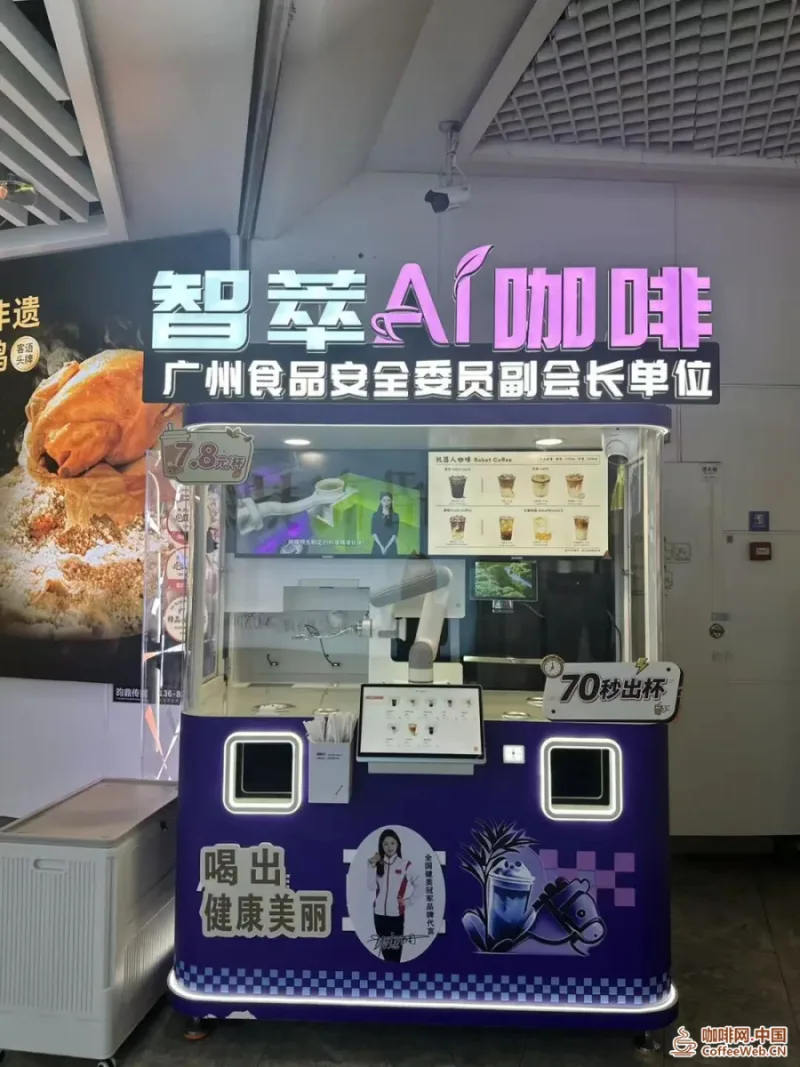
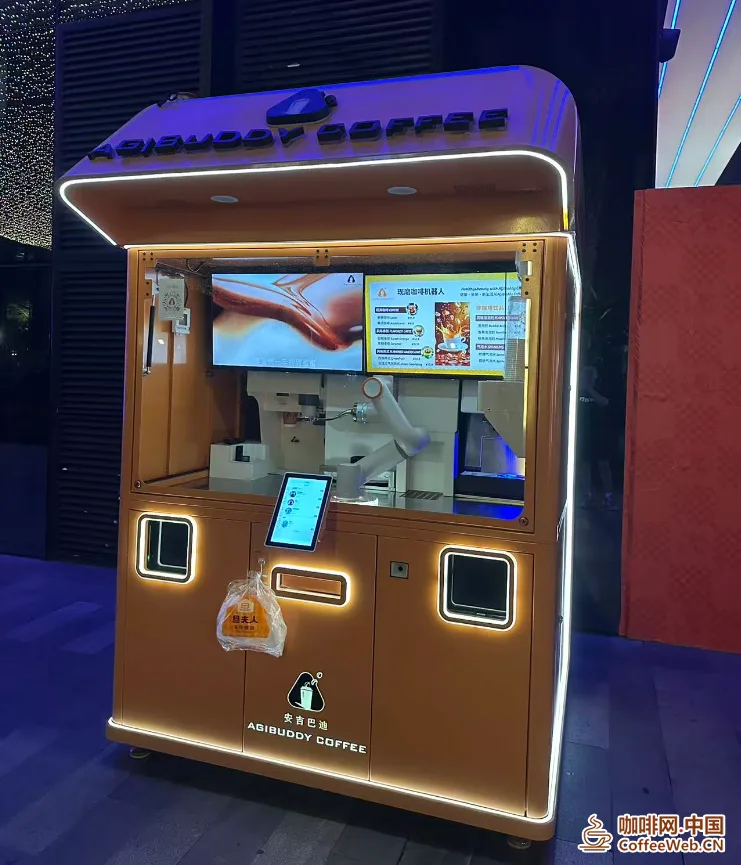
Hongcan Net’s visits found these machines typically occupy about 1 square meter and all support 24-hour operation.
In terms of function, unlike early machines that could only make classics like Americano, latte and cappuccino, today’s unmanned machines generally come with robotic arms that simulate manual shaking, and some can even pour latte art.
On pricing, drinks mostly cost a few to a dozen-odd yuan, taking a mass-market approach.
Take the Wansheng Plaza machine as an example: its products are split into coffee and non-coffee categories. Besides basics like latte and Americano, the coffee line offers specialty drinks such as melon Americano, orange Americano and white-peach Americano, even a sparkling coffee series, with most cups priced around 10 yuan.
The non-coffee drinks—such as cocoa bubble milk, melon bubble milk and lemon sparkling water—range from 6.8 to 10.8 yuan per cup.
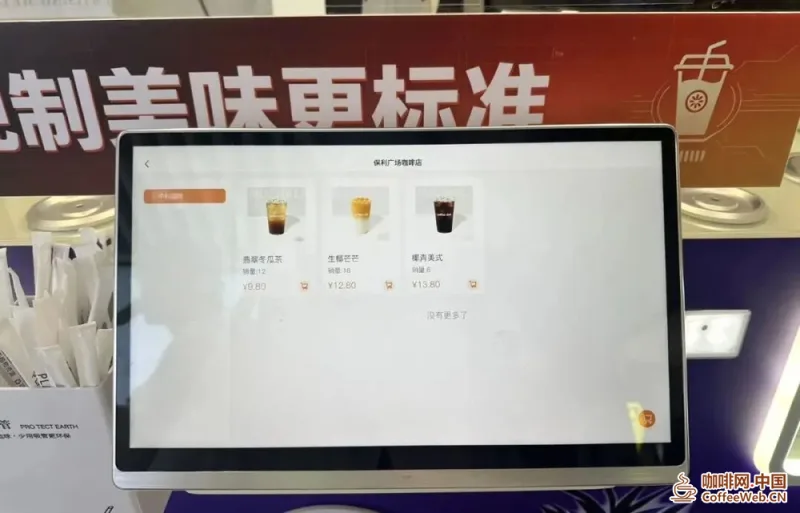
By contrast, the Poly Plaza B1 machine is priced slightly higher: an Americano at 7.8 yuan, jasmine fresh-milk tea at 9.8 yuan, and coconut Americano at 13.8 yuan, with 375 ml hot and 500 ml cold servings.
It also touts selling points like “AI-standard, freshly brewed and extracted” and “cup ready in 70 seconds,” and claims its beans are the No. 1 blend from specialty-coffee brand “Little Zebra,” backing it with an after-sales promise of “no charge if it doesn’t taste good,” trying to build differentiation on perceived quality.
Some in the industry argue that as Luckin, Cotti and other coffee giants complete high-density placement in tier-one and tier-two cities, the “big picture” of coffee consumption is set, leaving only the “last 500 meters” of capillary business. Unmanned coffee machines happen to fill that gap. With their asset-light, low-labor model, they are seen as the ideal fix for cramming into the crevices of subway corners and office lobbies.
But do unmanned coffee machines really have the confidence to go head-to-head with Luckin and Cotti?
Can they steal business from the coffee giants?
The gap is more than one step
An industry insider bluntly states that, if unmanned coffee machines want to steal business from the chain giants, they still face plenty of real challenges across three key dimensions: price, product variety and consumer experience.
First, the gap in product variety is wide.
Take the Poly Plaza B1 machine: Hongcan Net observed on multiple visits that, since it landed over a month ago, its SKU count has kept shrinking.
At launch the lineup was relatively rich—about ten products including classic Americano, coconut Americano and raw-coconut latte—but recently only three remain: emerald winter-melon tea, raw-coconut mango and coconut Americano. The ordering tablet showed sales of those three at 12, 18 and 8 cups respectively, meaning the machine has sold rather few cups in over a month of operation.
If it relies long-term on a few classic flavors while new-product replenishment lags or goes missing, it will struggle to meet consumers’ increasingly diverse tastes, easily leading to a monotonous experience, aesthetic fatigue and ultimately customer churn.
By comparison, chain brands have long entered the era of “high-frequency new launches.”
In 2025, Luckin launched more than 140 new products; Cotti and Starbucks also maintain a monthly new-product rhythm, constantly generating buzz and stimulating repeat-purchase desire through innovative flavors, seasonal collaborations and creative recipes.
Behind this iteration ability and product experience lies a powerful R&D system, supply-chain responsiveness and a keen grasp of consumption trends. Equipment that runs on fixed programs and fixed recipes is hard to match in the short term on flexibility, innovation speed and sensory experience.
To consumers, a cup of coffee is not just a pick-me-up but an expression of emotional value and lifestyle—precisely the part standardized machines struggle to carry.
Second, the pricing advantage of unmanned coffee machines is also unremarkable.
Chain brands have already pulled coffee unit prices down to 9.9 yuan, and with stacked platform coupons, low-priced coffees of 3–4 yuan are common. By contrast, unmanned machines’ mainstream drinks fall in the 6.8–13.8 yuan range, leaving little gap to the chains’ final prices. When “cheap” can no longer be a selling point, the appeal naturally diminishes.

Third, on convenience and experience, unmanned coffee machines still have shortcomings.
On the surface, the machine is right downstairs and seems within reach. But in reality, office workers’ coffee consumption is already highly digitalized.
Commuters racing against the clock in the morning are more used to pre-ordering via a mini-program on the subway or on the way, then grabbing the cup downstairs at the office and stepping straight into the elevator—an almost seamless flow. The unmanned machine, however, requires users to scan a code on site, choose a product and wait for preparation, taking at least a minute or two and disrupting that efficient path.
More crucially, chain brands, relying on mature delivery systems, have greatly extended their service radius to the foot of the office building and even the doorstep. “Delivered to hand” clearly beats “go downstairs and operate the machine yourself” on convenience.
On experience, unmanned machines try to use machinery instead of people to achieve standardization, but overlook that service itself is part of the experience.
For a wrong drink, a failed payment or a jammed cup, consumers often face nothing but a cold customer-service phone number. Compared with the in-store loop of “face-to-face feedback, instant resolution,” the response speed and resolution efficiency on the other end of the line are simply not in the same league.
One consumer posted after trying it: “I clearly ordered a hot chocolate, but what came out was milk, and there was nowhere to complain.” A highly upvoted comment below read: “This is just like how pre-made dishes can never replace wok-fried food—machines and AI can’t replace humans; they will forever only be a ‘supplement.'”
If a robot-made coffee is neither cheaper nor better-tasting, and less convenient than the chains, why should it become consumers’ first choice?
Moreover, “blow-up” cases in the industry have deepened consumers’ trust crisis. For example, according to multiple media reports, Beijing Shuoyibuer Technology Co., Ltd., which promoted the “Youyin” smart beverage machine, stalled its project after claiming over 100 million yuan in financing and a promised IPO. Qichacha shows the company is now on the executed-persons list with consumption restrictions, facing 30 lawsuits with amounts involved exceeding 10 million yuan. Such information also casts a shadow over the entire sector.
Capital and top brands are all joining in—
where is the unmanned coffee machine’s room to dream?
If the shortcomings in product, price and experience are still operational-level challenges, then from a return-on-investment perspective, the unmanned coffee machine’s business model may face a more fundamental predicament.
On the surface, unmanned coffee machines seem like a light investment that saves worry and effort, but in reality the payback period is not short.
An industry insider did the math: a 60,000-yuan machine, at the manufacturer’s claimed “40 cups a day,” average price of 9.9 yuan and 50% gross margin, would take over two years to break even.
That calculation doesn’t even include daily upkeep—adding water, beans and milk, clearing waste and handling breakdowns, each of which costs labor.
The insider also stressed that in the AI and intelligence era, machines upgrade extremely fast: “You might not have recouped the coffee investment before the machine is already on the edge of obsolescence.”
Site selection decides life and death.
Take the Wansheng Plaza machine: around it, besides Starbucks, there are Luckin, Cotti, Nayuki, McDonald’s McCafé, FamilyMart and several other coffee supply points, with unit prices from 4 to 40 yuan—rich choice and fairly convenient pickup.
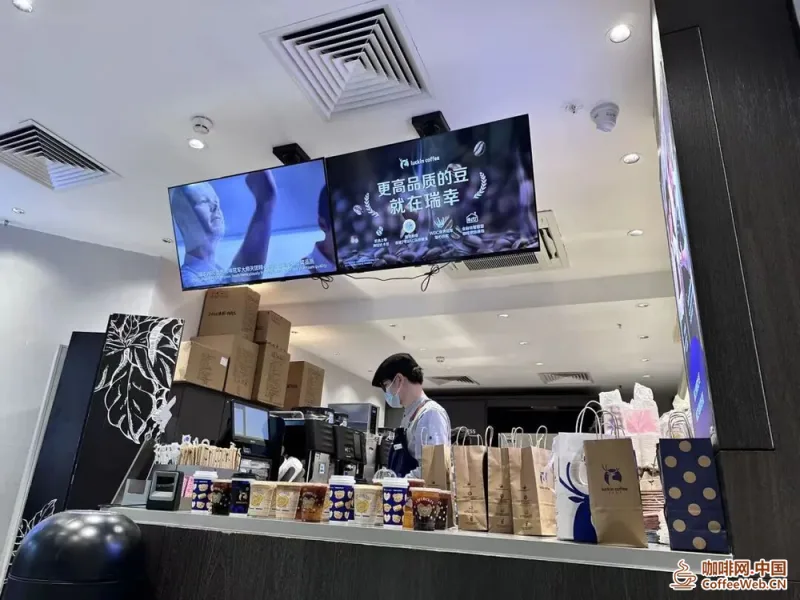
According to an insider, this equipment was removed by its operator after sales fell short of expectations.
The Poly Plaza B1 machine has also since moved away. On August 10, a clerk at the “Aihuishou” second-hand recycling store diagonally across from the coffee machine told Hongcan Net the machine had been gone for nearly two weeks. By their observation, the coffee machine’s business had never been good: “Passers-by come and go, but basically just hurry past; very few stop to buy.”
This is a microcosm of the real setbacks unmanned coffee machines face in high-density competitive areas: when mature brands nearby already provide efficient, stable and price-transparent coffee service, an isolated machine lacking differentiated advantage can hardly become consumers’ “second choice.”
Yet another side of the sector is that capital and top brands are placing real money bets.
In July 2025, smart-beverage brand “Cheers Station” announced a 50-million-yuan financing round and launched a “thousand cities, ten-thousand stores” expansion plan; that October, Jushang Gongying, focused on scenario-based smart coffee services, also secured 24 million yuan in Series A funding.
Capital’s big bets not only reflect recognition of the potential of unmanned beverage terminals, but also promise to push industry-standard upgrades and guide the sector toward a more mature, standardized development stage.
At the same time, some new entrants are trying to solve the long-standing core pain points of unmanned coffee machines at the technical level.
To address food-safety hazards and insufficient output stability, some brands are introducing innovative solutions. For example, “Cheers Station” launched a nitrogen-flushing and deoxygenation patented technology: Arabica beans are ground immediately after picking, sealed into capsules and injected with nitrogen, said to extend flavor freshness to 18 months and ease common problems like beans going damp or aroma loss.
Meanwhile, its closed capsule system also supports automatic pipeline rinsing after each cup, helping reduce the hygiene risks traditional coffee machines may cause from residue buildup or damp pipes. Such technical improvements are gradually narrowing the unmanned machines’ gap in basic experience, exploring more possibilities for the model.
Similar thinking is also landing in the tea-drink sector.
This April, Chayan Yuese’s new store in Shenzhen deployed self-developed “robotic-arm fully automatic milk-tea machines” across the board. The robotic arm autonomously completes the full process—grabbing cups, precise ingredient dosing, stirring and handing over—with humans only handling the final topping step, enabling a cup in as fast as 30 seconds and greatly boosting throughput. The store is also equipped with a “fully automatic ice-cream machine” that, after the consumer scans to pay, requires no human intervention to quickly dispense ice cream.
According to the official introduction, this is the first batch of the equipment’s deployment in Chayan Yuese’s South China stores; staff can be freed from repetitive operations to devote more energy to tasting, customer guidance and demand response.
These practices may point the industry toward a more viable direction: the core future value of unmanned coffee machines—or, more broadly, smart beverage terminals—lies not in stealing business from chain brands, but in returning to the true nature of an “empowering tool”: solving the problems of efficiency and standardization so brands can free their hands to focus on service and experience, letting efficiency and human warmth coexist in the dining room.
Source: Hongcan Net, authored by the Hongcan Editorial Department, edited by Qianjun.
Reprint Note & Disclaimer
- This article is reprinted from Chinese media for information and cultural exchange. The views expressed are those of the original author and do not necessarily reflect the position of coffeeyo.com.
- All trademarks, brand names and logos mentioned belong to their respective owners.
- For cooperation, reprint or correction requests, please contact coffeeyo.com.
Reprint Notice & Disclaimer
- This article has been edited and compiled by China Coffee Network. The information and images therein come from public sources and the copyright belongs to the original author. This reprint is intended solely for information sharing within the coffee industry and does not represent the views of this website; all data and opinions are subject to the original article. Our thanks to the original author for creating and sharing it.
- For matters concerning content licensing, attribution, copyright or otherwise, please contact us promptly and we will verify and cooperate in handling them as soon as possible. We also welcome coffee origins, brands and industry media to exchange ideas and contribute articles.
- Contact China Coffee Network: Tel 400-0000-641 (+86-18288016826) | Email 405854472@qq.com | Address: Jinghong, Xishuangbanna, Yunnan Province / Tieling, Liaoning Province
Related Reading
 ‘All-Ice’ Coffee Goes Viral! Will the Next Hit Be Your Personal Favorite?
- Hong Kong’s Dyee Coffee Lands in Qianhai, Building a Specialty Pour-Over Outpost
 Ken Yue Coffee Opens Egg-Tart Pop-Up in Hangzhou: Sweet Craft, Reinvented Classics
 World Cup Enters the Breakfast Slot: Can Coffee-Tea Brands Turn Traffic into Orders?
- ICE Agricultural Futures Mostly Rise at Close; Coffee Futures Up 3.28%
- ‘Sleep Cafés’ Become a New Favorite Among Seoul Office Workers


 Liaoning ICP Security No. 21122402000217