
Brief (coffeeyo.com): A disused sculpture factory in Jimo, Qingdao, now smells of coffee: post-1995 curator Li Maoyun returned to his hometown and turned it into “Walking Toward Beauty”, an art space where industrial brickwork meets crochet, barbecue and slow rural afternoons.
Coffee aroma drifts out of an old factory
In early autumn, in a courtyard converted from an idle sculpture workshop in Lingshan Subdistrict, Jimo District, the scent of coffee mingles with greenery and spreads slowly through the sunlight. At a long table, young people hold crochet hooks and coloured yarn flickers between their fingers; by the lawn, a few friends sit around a fire with coffee, conversation and a dog. This art space, called “Walking Toward Beauty”, has become a place where young people around Qingdao can slow down and grow quiet. Its founder, Li Maoyun, belongs to the post-1995 generation and has long worked as a curator in public art. A visit home two years ago showed him a hometown changing from one that “could not keep its young people” into one that “draws visitors in” — and it convinced him to come back and start a business. He lit up the idle workshop with plants, raw wood and warm light, letting industrial character collide with rural charm to produce an unexpected artistic atmosphere; with a ball of yarn and a table of grilled food, he turned the courtyard into a weekend destination. A cup of coffee, a ball of coloured yarn, a table of everyday warmth: this is the story of a young curator planting art in the soil of his hometown, taking root in the “Lingxiu Yuanxiang” rural revitalisation area.
A young man’s turning point
Had he stayed on the conventional path, Li Maoyun would still be shuttling between office towers and art museums in the city, moving from one curated exhibition to the next. Yet whenever a show closed, he would often stand alone in the empty gallery, unable to say whether he had moved closer to art or further away.
A trip home two years ago bent his life in a new direction. It was early autumn. Walking the country roads of Lingshan, he no longer saw the hometown of his memory, the one that “could not keep its young people”. Roads ran better, villages were tidier, and a modern agricultural zone of squared fields and gridded lanes was taking shape as the “Lingxiu Yuanxiang” revitalisation area gathered momentum. Harvest festivals, photography contests, wheat-field concerts, seasons of rural installation art — one event after another, and city dwellers had begun heading for the countryside. Beside the long-dormant sculpture workshop, people and traffic had returned.
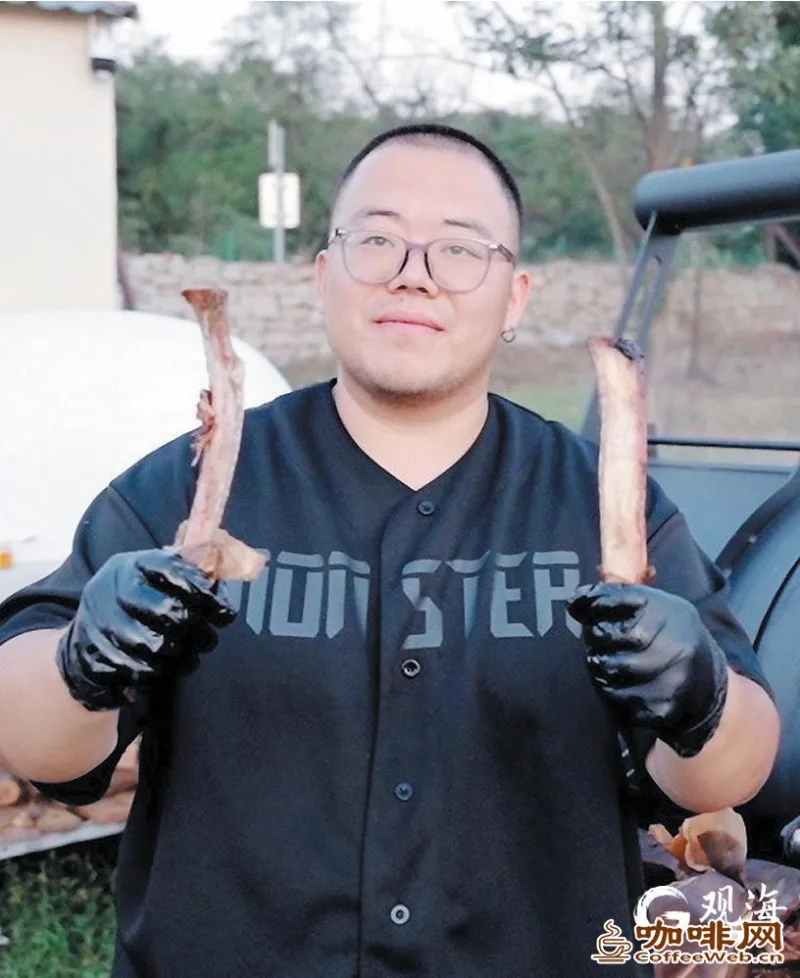
Li Maoyun introduces food into the countryside setting.
“Where there is change there is opportunity, and where there is opportunity there is a stage for young people like us to use what we can do,” he kept saying to himself, and the more he turned it over, the better it tasted. Lingshan Subdistrict sits at the geographic centre of both the Qingdao metropolitan circle and the Jiaodong economic circle, with a strong location and easy transport. It is among Shandong province’s first demonstration zones for rural revitalisation, has a deep heritage in sculpture, and carries a clear positioning as a “slow rural lifestyle destination” that keeps drawing visitors. In that moment he felt it plainly: his hometown was shifting from a place that could not hold on to people into one that attracted them, and this was exactly the time to return.
When he told his family, an elder asked in bewilderment: “You studied art for so many years. Why give up a respectable job in the city to come back to the village and open a café?” He did not explain much, only smiled, turned around and went to measure the idle workshop. This was where he would build an art space called “Walking Toward Beauty”.
An old workshop, now fragrant with coffee
The building had gone untended for a long time. The roof was damaged, the brick walls rough; pushing the door open released a wave of dust, and sunlight leaking through gaps in the tiles lit up a floor thick with grime. A friend cautioned him: “A village isn’t the city. If you open a café, will anyone actually come?” He did not rush to answer. He rolled up his sleeves and joined the workers in clearing rubbish, patching the roof and repainting the walls.
His approach to the renovation had been settled from the start: not to restore the old workshop until it looked new, but to let it be “old with character”. The rough brick walls stayed as the backdrop; plants climbed the corners; tables and chairs of raw wood went in one by one; warm yellow lighting came on and softened the whole space. The texture of the old factory layered over a new warmth, and the collision of industrial edge and rural ease quickly drew young people from the surrounding area to come and see it.
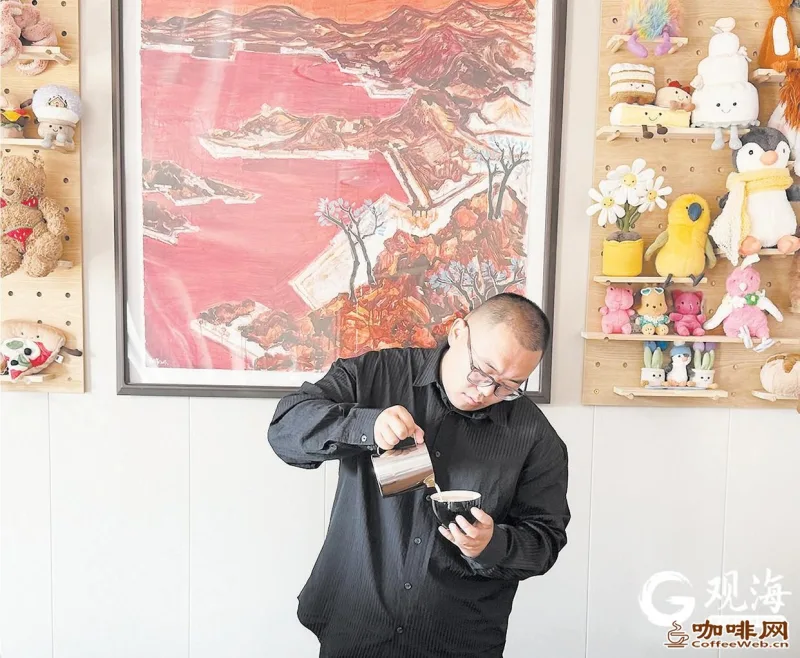
Li Maoyun’s creative café has a style of its own.
But he knew clearly that “coffee alone is not enough”. His most frequent task as an entrepreneur has been listening to customers and turning their wishes into reality. When young people said they enjoyed crochet, he brought in crochet workshops — coloured yarn turning between fingers into little dolls and charms, becoming the shop’s most popular “social language”. When someone mused that “a bit of grilled meat would be nice”, he made a note and gradually added the barbecue and other specialities guests were interested in.
Today the courtyard is both an artistic space for coffee and handicrafts and a lively place for team outings and friends to gather. “From a cup of coffee to a table of grilled meat”, it has grown busier and busier. On weekends, young people from around Qingdao drive out and stay the whole afternoon: some learning crochet at the long table, fingers clumsy but earnest; some letting their dogs run on the lawn; some doing nothing at all, simply sitting as the autumn light moves inch by inch across them. The old workshop stays lively from Saturday morning until the lamps come on.
Planting art in the soil
To many, a curator returning to a village to open a café looks like a waste of talent. Li Maoyun disagrees. Years in public art taught him one thing: art is at its most moving not under gallery spotlights, but at the moment it enters people’s everyday lives.
“Walking Toward Beauty” is not just a business to him; it is a way of life. “The city moves too fast. I wanted to give young people a place where they can slow down and grow quiet. Sit and have a coffee, crochet a small flower, or run with a pet on the lawn — that is life, and it is part of ‘beauty’ too,” he says.
The courtyard is itself one of his works. The old factory once made sculptures — rough, hard, covered in dust. Now it makes a way of living — soft, bright, full of everyday warmth. From “making sculptures” to “making a life”, that change is a curator’s answer to the question of what art is for. A cup of coffee is a work; a ball of yarn is a work; an evening spent around the fire is a work; so is the uncreased brow of a young person at ease.
That “beauty” resonates with the direction of the “Lingxiu Yuanxiang” revitalisation area in Lingshan Subdistrict. As a Qingdao municipal-level rural revitalisation zone, it works under the slogan “beautiful hills, clear water, hometown feeling” to build a “slow rural lifestyle destination”. From an art season landing in the subdistrict to one new business after another started by returning young people, art and youth are redefining the vitality of this land. Li Maoyun’s courtyard is a small flower just coming into bloom here — one that lets more and more people see that art can be drunk, held in the hand, and made part of a village’s daily rhythm.
A rural café as a model of integration
The aroma from Li Maoyun’s café is no isolated case; it is part of a new energy growing across “Lingxiu Yuanxiang”. Harvest festivals in spring, wheat-field concerts in summer, rural installation art seasons in autumn — events run through the year, and group after group of visitors come to Lingshan for the scenery, local food and the experience of slowing down. People arrive, and spending follows; spending follows, and new businesses come alive. His courtyard sits inside that loop: visitors finish a walk through the fields, turn into the courtyard for a coffee and a try at crochet; the courtyard gains popularity and adds another destination for the subdistrict, brightening the “Lingxiu Yuanxiang” name a little more. Agriculture, culture, tourism and commerce quietly come together in a single cup of coffee.
Someone once asked him: “Can a café in a village actually make money?” He answered honestly — the start was indeed hard, and in the off-season the courtyard might go a whole day without a single guest. But he was willing to wait: for popularity to build slowly, and for more people to see the value of the countryside. Events proved him right. As the “Lingxiu Yuanxiang” area has continued to warm up, more visitors and more returning young people have come. He is increasingly certain of one thing: the countryside needs young people, and young people need the countryside.
“The revitalisation of my hometown gave me the courage to come back, and the confidence to keep this little shop going,” Li Maoyun says, standing in the renovated courtyard. He wants more people of his generation to see that their hometown is in the best period of its development, and that coming back still allows you to build something — and still allows you to live the life you wanted.
On the broad land of “Lingxiu Yuanxiang”, the story of young people and their hometown is only just beginning.
By Kang Xiaohuan, Guanhain News / Qingdao Morning Post (text and photos).
Reprint Note & Disclaimer
- This article is reprinted from Chinese media for information and cultural exchange. The views expressed are those of the original author and do not necessarily reflect the position of coffeeyo.com.
- All trademarks, brand names and logos mentioned belong to their respective owners.
- For cooperation, reprint or correction requests, please contact coffeeyo.com.
Reprint Notice & Disclaimer
- This article has been edited and compiled by China Coffee Network. The information and images therein come from public sources and the copyright belongs to the original author. This reprint is intended solely for information sharing within the coffee industry and does not represent the views of this website; all data and opinions are subject to the original article. Our thanks to the original author for creating and sharing it.
- For matters concerning content licensing, attribution, copyright or otherwise, please contact us promptly and we will verify and cooperate in handling them as soon as possible. We also welcome coffee origins, brands and industry media to exchange ideas and contribute articles.
- Contact China Coffee Network: Tel 400-0000-641 (+86-18288016826) | Email 405854472@qq.com | Address: Jinghong, Xishuangbanna, Yunnan Province / Tieling, Liaoning Province
Related Reading
 How ‘Sea-Flavored’ Coffee Blooms Across Dongtou
- Health Guide: How to Enjoy Your Coffee the Healthy Way
 Study: Regular Coffee and Tea May Lower Dementia Risk, but More Is Not Better
 Frontline Story: A ‘Mobile City Coffee Bar’ Arrives by the Grand Canal
 Yantai’s Wind Tastes of Coffee
 In Zhenyuan, a Cup of Coffee and a Waiting Train




 Liaoning ICP Security No. 21122402000217