


At a Glance (China Coffee Network): Does coffee protect the heart or add to cardiovascular strain?
(Source: DOLC) Does coffee protect the heart or add to cardiovascular strain? After a comprehensive analysis of existing research, experts at the American Heart Association believe that for most healthy adults, consuming no more than 400 milligrams of caffeine a day is generally safe. Converted, that is roughly equivalent to 3 to 5 large cups of coffee, or 5 to 8 small cups.
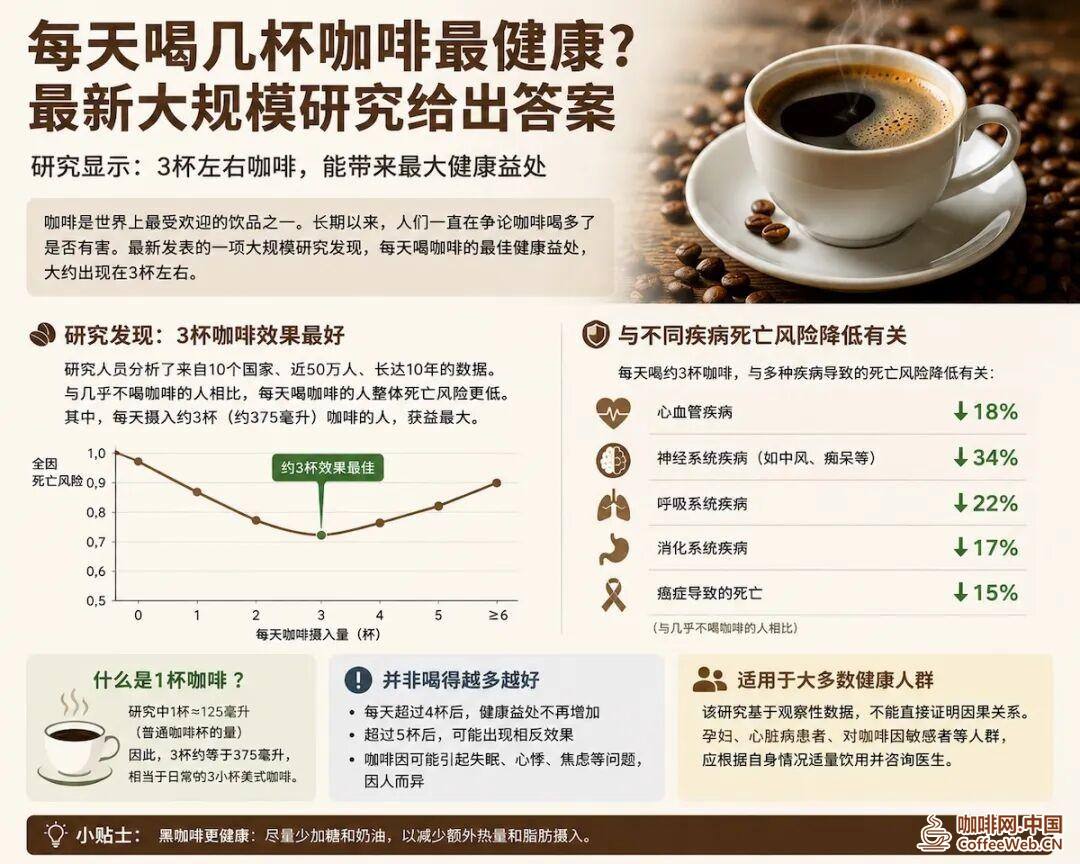
What truly deserves attention, however, is not the number of cups but the total amount of caffeine. Different coffee beans, brewing methods and cup sizes can cause marked differences in caffeine content. A large cup of strong coffee may contain far more caffeine than a small cup of ordinary filtered coffee.
Existing studies show that people who drink about 2 to 4 cups of caffeinated coffee a day tend to have lower risks of heart disease, stroke and heart failure. Some observational studies have also found that regular coffee drinkers have relatively lower rates of type 2 diabetes and certain arrhythmias.
Besides caffeine, coffee contains various plant compounds with antioxidant and anti-inflammatory effects, which may have a positive impact on the cardiovascular system. Experts also stress, however, that most current conclusions come from long-term observational studies and cannot yet fully prove that coffee itself directly produces the health benefits.
More is not necessarily better. Some studies have found that beyond 4 cups of coffee a day, the risk of heart failure may rise again. After drinking coffee, blood pressure, heart rate and blood sugar may also rise briefly, and people with hypertension or greater sensitivity to caffeine are especially prone to palpitations, trembling hands, anxiety and sleep disturbances.
As for heart rhythm, regular coffee drinking does not appear to raise the risk of atrial fibrillation, and a few studies have even found the risk somewhat lower. But caffeine can trigger extra ventricular beats, commonly described as “the heart skipping a beat” or “the heart suddenly thumping.”
Experts specifically caution that coffee and energy drinks should not be simply equated. The caffeine content in energy drinks or high-concentration energy beverages can reach 3 to 4 times that of ordinary coffee, and they often also contain sugar and other stimulants, which may further increase the risks of hypertension and arrhythmia.
How coffee is prepared also affects health. French press, Turkish coffee and some unfiltered coffees contain more cafestol, a substance that may raise LDL cholesterol, which is unfavorable to cardiovascular health. Using a paper filter can remove a considerable portion of it.
In addition, adding plenty of syrup, cream and sugar may offset coffee’s potential health advantages. Therefore, from a health standpoint, low-sugar or sugar-free filtered coffee is usually more suitable.
Experts conclude by noting that this assessment is not meant to encourage non-coffee-drinkers to start for health reasons, nor to advise current drinkers to increase their intake. For most adults, moderate, sugar-free, not-overly-concentrated coffee is generally nothing to worry about, but the amount that suits a person best still depends on age, metabolic rate, sleep and how the body responds.
Reprint Notice & Disclaimer
- This article has been edited and compiled by China Coffee Network. The information and images therein come from public sources and the copyright belongs to the original author. This reprint is intended solely for information sharing within the coffee industry and does not represent the views of this website; all data and opinions are subject to the original article. Our thanks to the original author for creating and sharing it.
- For matters concerning content licensing, attribution, copyright or otherwise, please contact us promptly and we will verify and cooperate in handling them as soon as possible. We also welcome coffee origins, brands and industry media to exchange ideas and contribute articles.
- Contact China Coffee Network: Tel 400-0000-641 (+86-18288016826) | Email 478203668@qq.com
Related Reading
 Jiangxi Wuyuan: Rural Coffee Unlocks New Cultural Tourism Formats
 Jiangxi Wuyuan: Rural Cafes Unlock New Cultural Tourism Formats
 Global quality goods gather at Hongqiao Import Commodity Exhibition Center, setting "Chinese standards" for coffee
- Global premium products gather to set China's coffee standards as Hongqiao Import Commodity Exhibition Center keeps the CIIE spirit alive
- Global quality goods gather as Hongqiao Import Commodity Exhibition Center and CIIE forge lasting partnership to set China's coffee standards.
 Zhejiang "Science Cafe" Promotes Embodied Intelligence in Real-World Scenarios


 Liaoning ICP Security No. 21122402000217