
Brief (coffeeyo.com): In Vietnam’s Central Highlands, a family that once grew rubber and then coffee is now harvesting durians — and the shift from coffee gardens to durian orchards is reshaping incomes across Dak Lak, the country’s “coffee capital”, as Chinese demand for the fruit surges.
HANOI, Sept 17 (Xinhua) — In Thai Binh village, Dak Lak Province, deep in Vietnam’s Central Highlands, sunlight filters through durian leaves in small dappled patches onto grower Le Tuan Tai. Standing beneath a tree, he taps a green-tinged yellow fruit lightly with a small knife. “It’s ripe,” he says.
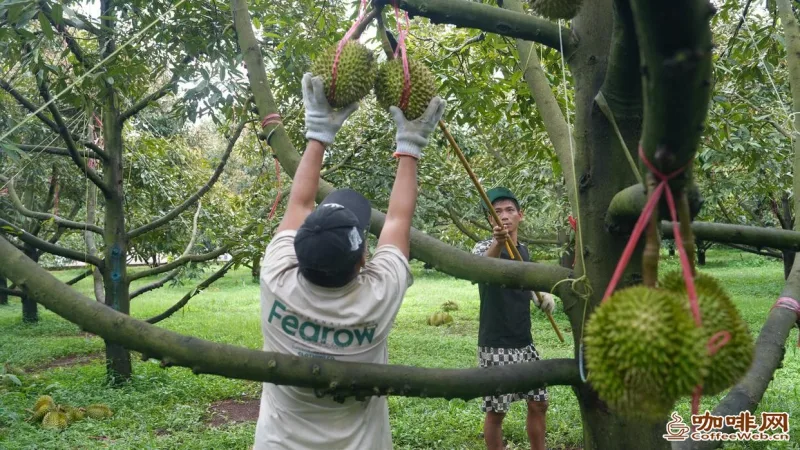
Two workers pick durians in Dak Lak Province on September 10. Photo by Hu Jiali / Xinhua. The family has tended this 10-hectare orchard for nearly 40 years — first rubber, then coffee, and now durian, with close to 2,000 durian trees.
Vietnam is one of the world’s major coffee producers, and Dak Lak is known as the country’s “coffee capital”, with more than 218,000 hectares under coffee and annual output above 580,000 tonnes. Durian is now taking root there rapidly: the province’s durian acreage has grown from 15,000 hectares in 2022 to 45,000 hectares in 2026, and this year’s harvest is expected to reach roughly 500,000 tonnes.
In July 2022, China and Vietnam formally signed the Protocol on Phytosanitary Requirements for the Export of Fresh Vietnamese Durian to China. From that month, qualifying fresh Vietnamese durian was permitted into the Chinese market. Figures from China’s General Administration of Customs show that in 2025 China imported close to 1.87 million tonnes of durian, double the 2022 figure. Vietnam has become a major supplier of durian to China.
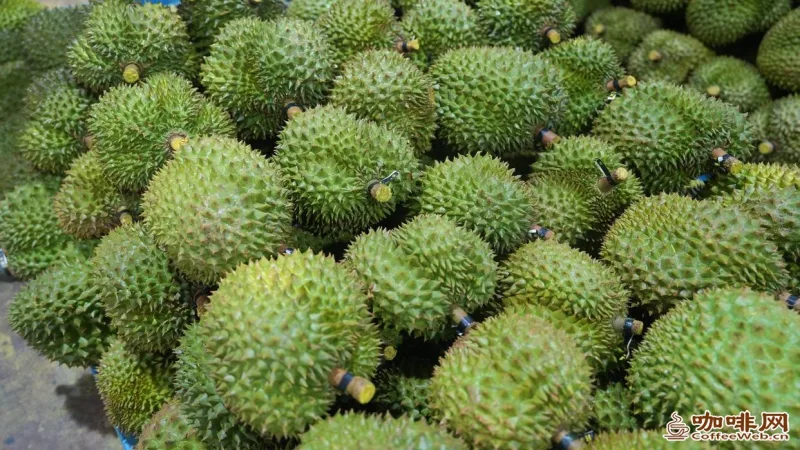
Durians destined for export to China at a durian processing plant in Dak Lak Province, photographed on September 10. Photo by Hu Jiali / Xinhua. Nguyen Viet Quang, director of the Quang Tien Durian Production and Service Cooperative in the province, says a coffee tree has a productive cycle of about 20 years; once the trees age, many growers switch to new crops such as durian, which carries higher economic value. Plenty of others choose to interplant coffee beneath their durian trees.
Le Thanh Truyen, deputy director of the Quang Tien cooperative, ran the numbers for reporters using his own plot as an example: one hectare of coffee brings in around 160 million Vietnamese dong a year (US$1 is roughly 25,999 dong), while one hectare of durian can generate as much as 1.3 billion dong.
Le Tuan Tai’s durian orchard is expected to yield 350 tonnes this year, 70 percent of it bound for China. “Coffee gave us a stable life; durian has made us better off,” he says.
Le Anh Trung, chairman of the Dak Lak Durian Association, notes that the local durian and coffee industries are developing in tandem, with durian emerging as a high-value export crop.
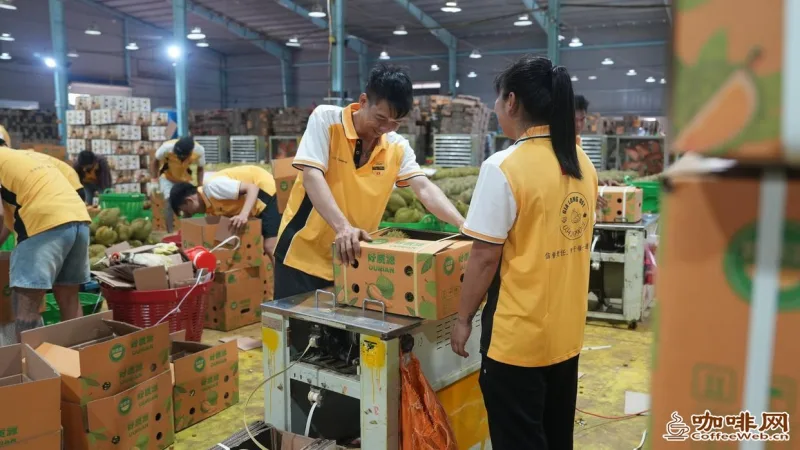
Workers pack durians for export to China at a processing plant in Dak Lak Province on September 10. Photo by Hu Jiali / Xinhua. Vietnam’s 001 Fruit Company focuses on durian exports to China and expects its 2026 shipments to account for 6.8 percent of Vietnam’s total durian exports to the country. To date it has shipped more than 2,000 containers of durian worth over US$236 million. General director Nguyen Thi My Duy says quality starts in the orchard: the company works closely with farmers from the outset and pays close attention to the source of supply, and plans to invest in downstream products such as durian cakes and dried fruit.
“We want to maximise the value of the durian,” she says. “That is both a way for the company to respond proactively to changes in the market and a way to give farmers more reliable outlets.”
When the reporters left Thai Binh village, the setting sun had turned the durian orchard gold, and trucks loaded with fruit were rolling out one after another. Over nearly four decades the family has grown rubber, then coffee, and now has a durian harvest to bring in. As Vietnamese durian sells strongly in China, growers on this highland plateau are finding new possibilities opening up.
Reprint Note & Disclaimer
- This article is reprinted from Chinese media for information and cultural exchange. The views expressed are those of the original author and do not necessarily reflect the position of coffeeyo.com.
- All trademarks, brand names and logos mentioned belong to their respective owners.
- For cooperation, reprint or correction requests, please contact coffeeyo.com.
Reprint Notice & Disclaimer
- This article has been edited and compiled by China Coffee Network. The information and images therein come from public sources and the copyright belongs to the original author. This reprint is intended solely for information sharing within the coffee industry and does not represent the views of this website; all data and opinions are subject to the original article. Our thanks to the original author for creating and sharing it.
- For matters concerning content licensing, attribution, copyright or otherwise, please contact us promptly and we will verify and cooperate in handling them as soon as possible. We also welcome coffee origins, brands and industry media to exchange ideas and contribute articles.
- Contact China Coffee Network: Tel 400-0000-641 (+86-18288016826) | Email 405854472@qq.com | Address: Jinghong, Xishuangbanna, Yunnan Province / Tieling, Liaoning Province
Related Reading
 A ‘Travel Pack’ Reveals Another Possibility for Pu’er Baristas
 Cangyuan: Yanshuai Town Delivers ‘Tech Nourishment’ to Coffee Fields
- 9.9-Yuan Coffee but a 50,000-Yuan Bike: Jiang Nanchun Fears Not Price but Lack of Soul
- After Just 19 Months in Coffee, He Was Called to Save Heineken
 Guangzhou Haizhu Uses Coffee to Engage Delivery Riders in Party Education
- Laishan Police Safeguard the Coffee Festival with Dedicated Patrols




 Liaoning ICP Security No. 21122402000217