
Author | Canyin Laoban Neican (Inside the Restaurant Boss), Cai Daqi
County towns are “growing” more coffee shops
Just past the National Day holiday, our correspondent returned to his northern hometown — a fourth-tier small city — and was surprised to find coffee becoming more everyday than the novelty it was a few years ago.
In the past, coffee shops mostly opened beside core-district malls, sustained by mall footfall. Now, ground-floor shops below residential blocks also show coffee-shop signs. Inside sit not only young people but moms picking up kids and uncles trying new drinks.
Riding an e-bike through the county town, you keep bumping into familiar coffee brands: in the mall, at the residential gate, below apartments — within a ten-minute drive, coffee shops have appeared several times. Coffee consumption in the county is becoming ever more everyday.
In this process, chain coffee brands’ store networks keep extending, becoming a key force bringing coffee into more life scenarios. Take Luckin: by end of Q2 this year its China market (including Hong Kong) store total reached 36,087, covering cities and county markets nationwide; over the just-passed holiday its cup volume surpassed 100 million. Ever-denser store layouts, combined with maturing consumption habits, make buying a cup of coffee no longer a big-city exclusive but gradually blending into the life radius of more counties and small towns.
Such a coffee landscape is unfolding in more and more counties (county seats and county-level cities). Coffee enters “counties” with surging momentum. Recently, Xinhua Net jointly with Zhaimen released “China’s Coffee Heat Map,” observing the geographic distribution and consumption trends of China’s coffee market with data. In the heat map, these shifts turn into more intuitive numbers, confirming the county market’s boom through scale and growth.
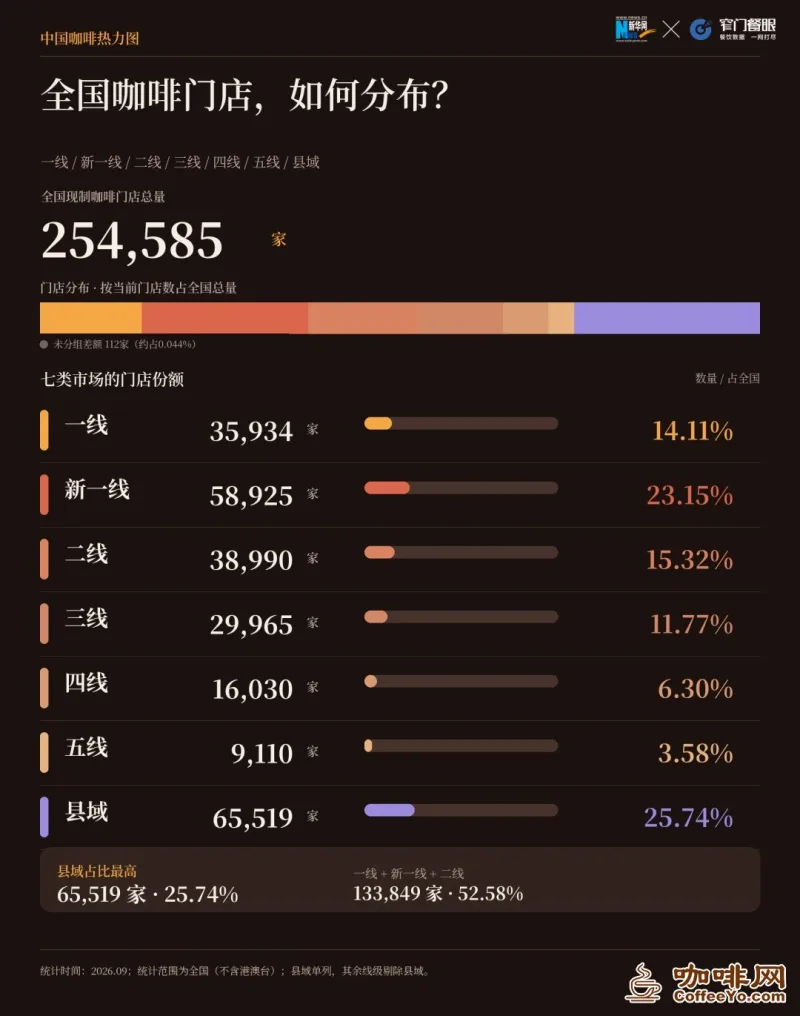
Most directly felt from the chart: county-market coffee store count is huge — 2.61 times that of tier-4/5 cities combined, a quarter of the national store total. Three-year growth of 103.41% to 65,519 stores.
Beyond that, national coffee stores grew 72.12% over three years and county markets 103.41% — a pace above the national average. It’s no exaggeration to say the county market is growing into China’s core coffee-growth hinterland.
Where coffee already existed, growth keeps happening. County towns net-added 33,308 coffee shops in three years, of which 32,603 came from places that already had coffee shops three years ago — 97.88%. Among 1,716 county seats and county-level cities that had coffee three years ago, 1,601 had more stores three years later.
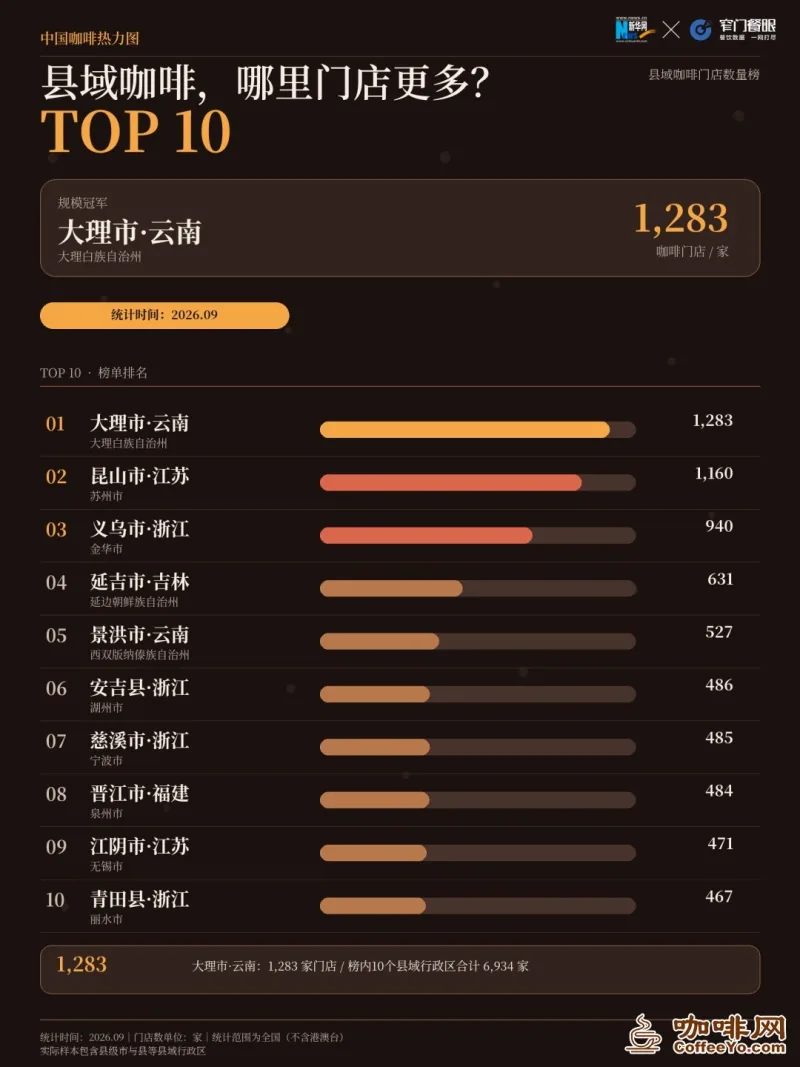
High-tier-city coffee markets are maturing, but the lower-tier sink market still awaits mining.
The county market’s potential comes partly from new exploration and partly from the “regrowth” of a mature coffee ecosystem — the continuous layout of chain brands like Luckin and the steady landing of independent cafés drive county coffee ecosystems to mature further. Chain brands make coffee as convenient as buying mineral water; independent cafés use more personal spaces to keep those willing to sit down. Back and forth, coffee consumption is constantly awakened, from occasional trial to daily habit.
Cultural-tourism traffic,
drives county coffee “wild growth”
The just-passed National Day long holiday, friend circles were flooded with travel shares. Jean, an outdoors lover, drank pour-over at an alpine-meadow campsite on day two, and holed up in local cafés on days three and four, enjoying rare leisure — coffee and travel became inseparable.
Coffee, like dining, became the best vehicle for feeling local character. Sour long-beans, litse, lemongrass… rich local produce blends into coffee, each cup a novel experience.
The county coffee boom, beyond activated consumption vitality and a mature coffee ecosystem, also has cultural-tourism traffic behind it. Those holiday-traveling coffee lovers are bringing new growth momentum to county coffee.
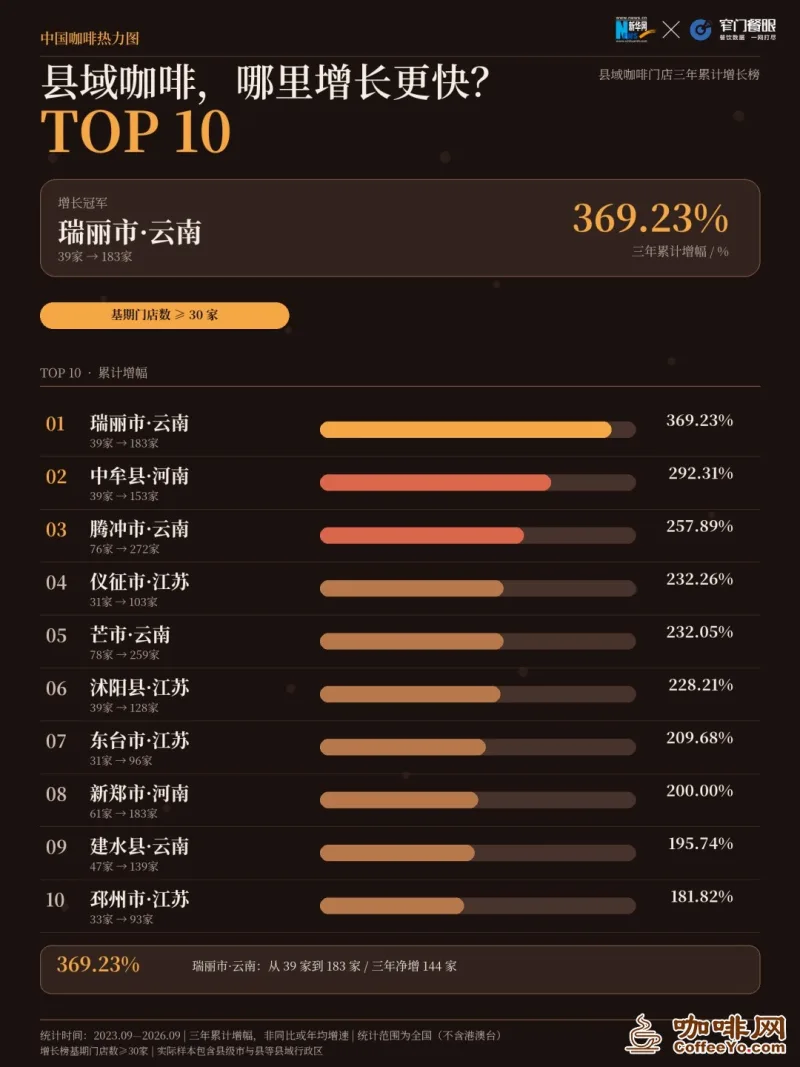
The top list of fastest-growing county coffee includes many popular destinations — Ruili, Tengchong, Mangshi and others.
Top-ranked Ruili received 759,600 domestic tourists during Spring Festival, tourism revenue 707 million yuan, up 2.31% and 6.55% YoY. More visitors brought more consumption demand; more coffee stores are capturing this demand — Ruili’s coffee stores grew from 39 three years ago to 183, a net addition of 144. A border small town is releasing a distinctive coffee aroma.
Another popular destination, Tengchong, famous for rich hot-spring resources, also saw rapid coffee-store growth driven by visitors — from 76 to 272, a net addition of 196. Its growth rate was lower than Ruili’s, but its net new stores ranked first.
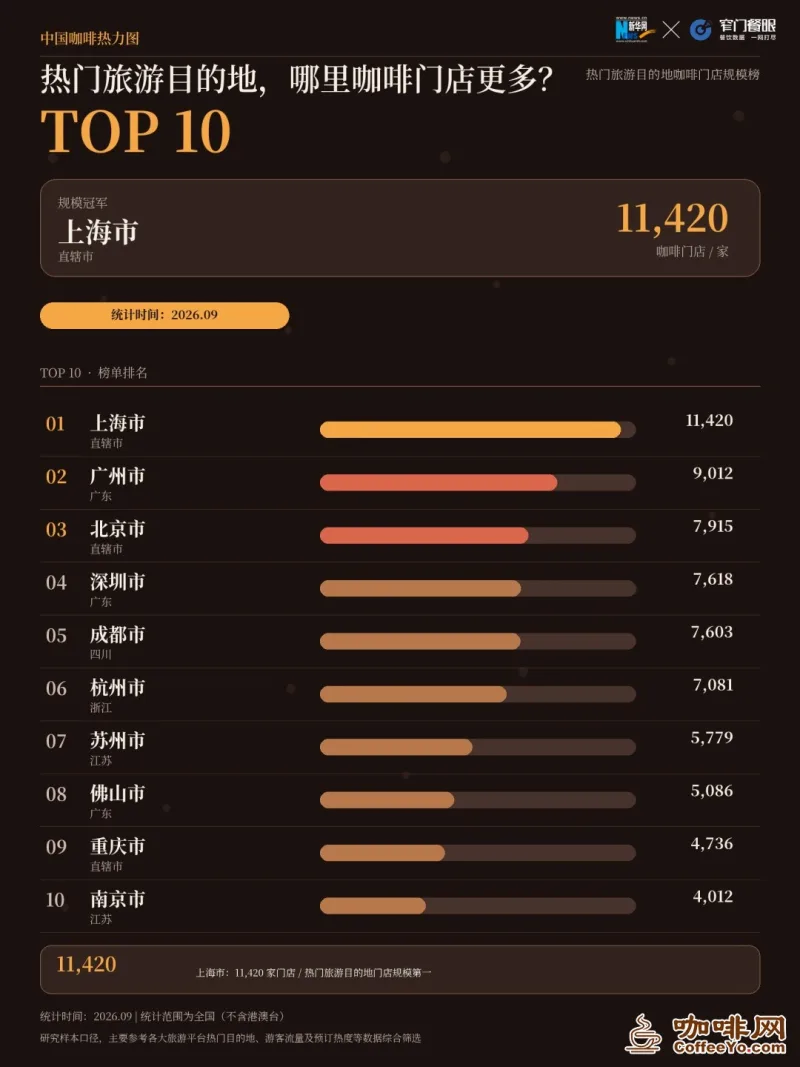
The heat of local cultural tourism is transmitting to the entire coffee-consumption market. Beyond nature and culture, coffee is becoming a key metric in choosing a destination; beyond grand scenery and urban culture, the leisure time in coffee stores matters to many consumers.
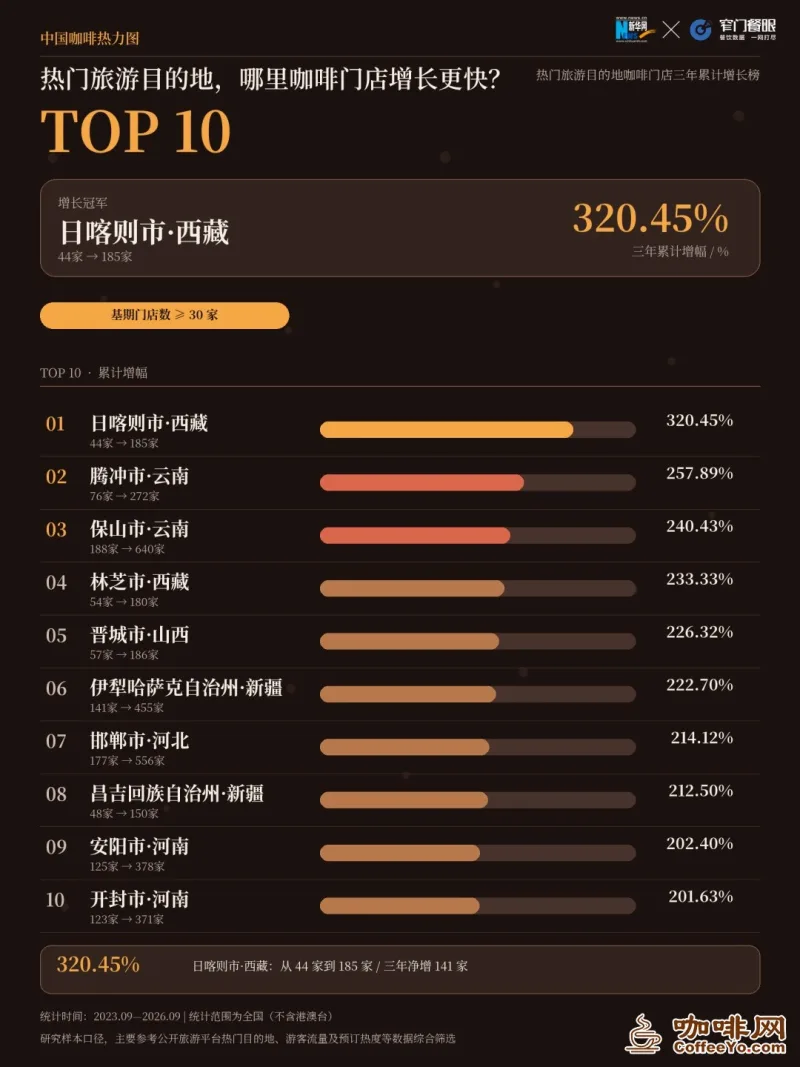
Behind this, first, is the upgrade of consumption demand. Tourists no longer pay only for scenery, but pursue complete commercial facilities at the destination. As a “third space,” coffee stores are important leisure-relaxation venues. Meanwhile, coffee stores naturally have check-in appeal; distinctive ones keep going viral, becoming “must-visit spots” of destinations.
The “coffee index” is becoming a metric of tourism competitiveness; travel logic shifts from “where I’ve been” to “where I’ve stayed.” A unique coffee experience becomes a reason to slow down.
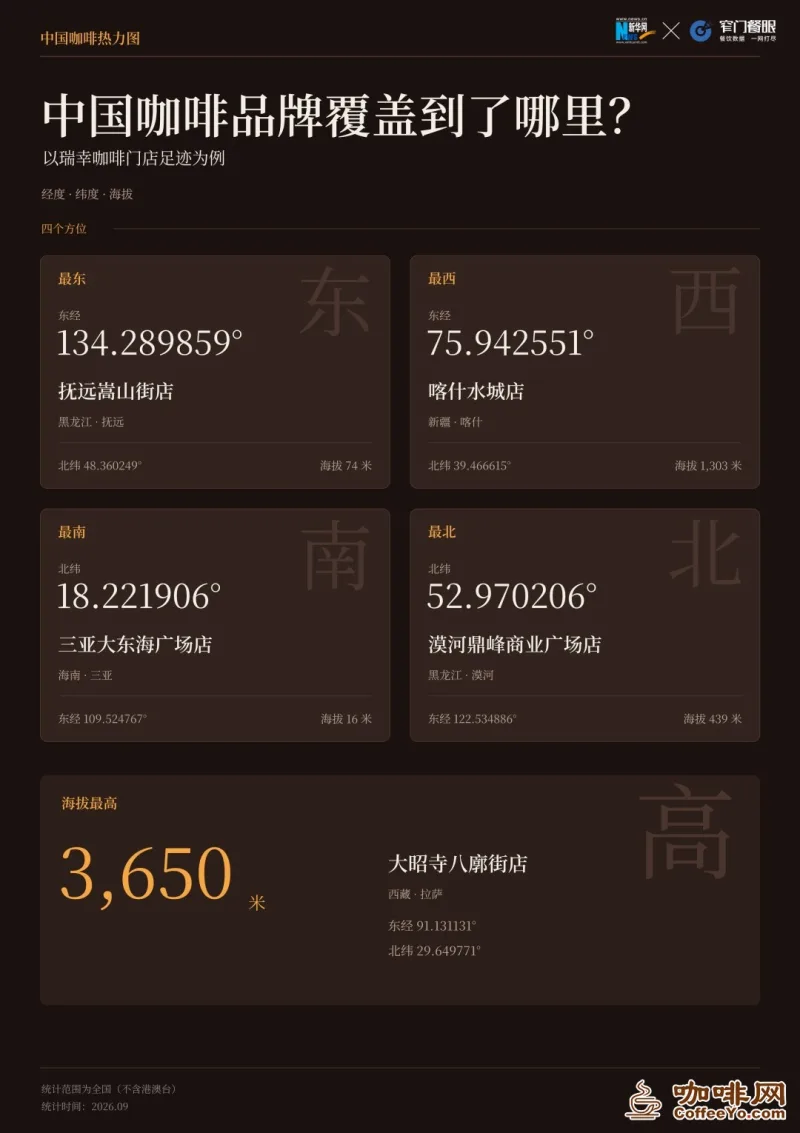
Chinese coffee is entering counties and reaching farther places. Take leading chain Luckin: its stores reach east to Fuyuan, west to Kashgar, south to Sanya, north to Mohe; its highest-altitude store sits by Lhasa’s Jokhang Temple at 3,650 meters. Chinese coffee brands’ footprints have extended to the four corners of the map. Chinese coffee consumption is extending from traditional tier-1/2 cities to broader county areas, destinations and border plateau regions. The coffee consumption scenario is shifting from fashion wave to a lifestyle, blending into life and “the faraway.”
A mature coffee ecosystem
comes from two-way change on demand and supply
Coffee’s new narrative is half in hometown, half in the faraway.
This narrative may not be a copy of high-tier-city coffee models, but a structural change driven jointly by both sides — with its own unique consumption logic.
On the demand side, new customer groups and new scenarios drive growth.
Relevant data also shows the trend of young people returning to hometowns for jobs and startups is increasingly clear; in some counties the share of urban residents aged 18–35 has exceeded 34%. Most have big-city life experience and acquired the coffee habit.
Among county coffee consumers, over 62% keep a frequency of at least one cup per week, and this frequency is rising fast; coffee has shifted from occasional experience to daily consumer good.
On the supply side, county coffee’s growth potential attracts leading brands to speed up layout. Take Luckin: from raw-material procurement, roasting and processing to warehousing, distribution and in-store making, its full-chain high-quality supply-chain system safeguards product quality and experience across regions. Relying on mature supply chain, digital operations and continuous product innovation, Luckin extends standardized coffee service to broader county markets, so new products popular in big cities can also be drunk in counties.
Of course, brand exploration is only the beginning; as the heat map notes, county coffee’s increment mostly comes from places that already had stores, and ecosystem improvement comes from combined forces.
Brand exploration brings coffee awareness — that’s the start. Then distinctive coffee-culture festivals, on one hand attract coffee-savvy tourists drawn by reputation, becoming important cultural-tourism traffic, and on the other cultivate local coffee-consumption awareness, expanding the local market. Guided by government and cultural-tourism departments, coffee gradually turns from a single drink into a carrier connecting tourism, socializing and local culture.
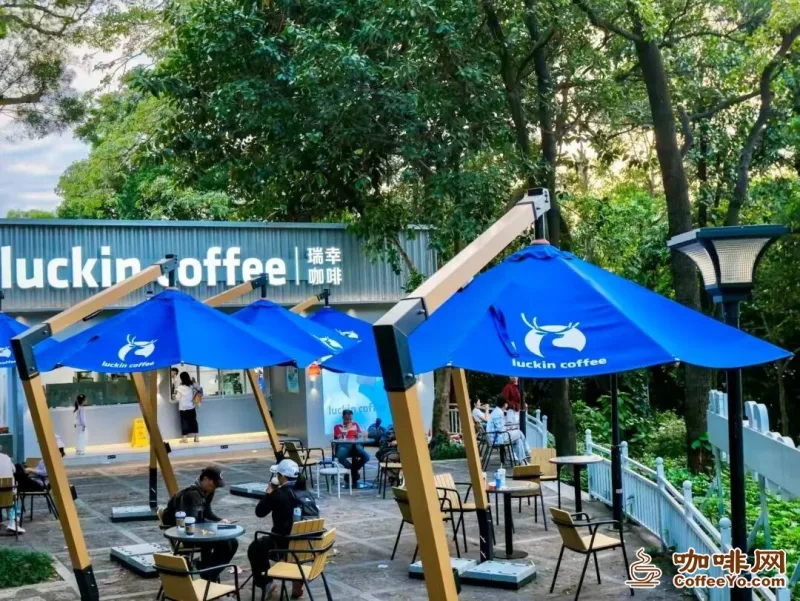
Leading chain brands represented by Luckin, relying on supply-chain and digital-operation capability, keep bringing innovative products into county markets and keep output stable through standardized processes. New products give consumers a reason to try; stable experience helps raise purchase frequency, letting coffee gradually blend into local daily life and building a more durable brand-consumer bond.
Brand product power and consumer demand resonate at the same frequency; under combined forces, coffee makes it into daily life, becoming a daily cup for county consumers.
County-market growth has both the demand from new customer groups and new scenarios and the input from brands in product innovation, standardized operations and supply chain. After stores enter counties, stable output and adaptation to local habits — turning trial into daily purchase — are all key growth factors.
Across the country, coffee’s penetration into more regions and scenarios has broad prospects. The story of county coffee has only just begun.
Rotating editor-in-chief | Xiao Feng
Visual, illustration | Zhang Jinying
Operations | Xue Gao
Original title: “Coffee’s New Battlefield: Counties and the ‘Faraway'”
Reprint note and disclaimer
This article is reprinted by coffeeyo.com from Canyin Laoban Neican, Author Cai Daqi. The copyright of the original belongs to the original publisher and author. This article is edited and organized by coffeeyo.com. Our reprint is solely for coffee-industry information sharing and does not represent this site’s stance; all data and views follow the original.
For content authorization, attribution, copyright or other matters, please contact this site promptly; we will verify and cooperate at the earliest convenience.
Contact coffeeyo.com: Tel 400-0000-641 (+86-18288016826) | Email 405854472@qq.com | Address: Jinghong City, Xishuangbanna, Yunnan / Tieling City, Liaoning
Reprint Notice & Disclaimer
- This article has been edited and compiled by China Coffee Network. The information and images therein come from public sources and the copyright belongs to the original author. This reprint is intended solely for information sharing within the coffee industry and does not represent the views of this website; all data and opinions are subject to the original article. Our thanks to the original author for creating and sharing it.
- For matters concerning content licensing, attribution, copyright or otherwise, please contact us promptly and we will verify and cooperate in handling them as soon as possible. We also welcome coffee origins, brands and industry media to exchange ideas and contribute articles.
- Contact China Coffee Network: Tel 400-0000-641 (+86-18288016826) | Email 405854472@qq.com | Address: Jinghong, Xishuangbanna, Yunnan Province / Tieling, Liaoning Province
Related Reading
 ‘All-Ice’ Coffee Goes Viral! Will the Next Hit Be Your Personal Favorite?
- Hong Kong’s Dyee Coffee Lands in Qianhai, Building a Specialty Pour-Over Outpost
 Ken Yue Coffee Opens Egg-Tart Pop-Up in Hangzhou: Sweet Craft, Reinvented Classics
 World Cup Enters the Breakfast Slot: Can Coffee-Tea Brands Turn Traffic into Orders?
- ICE Agricultural Futures Mostly Rise at Close; Coffee Futures Up 3.28%
- ‘Sleep Cafés’ Become a New Favorite Among Seoul Office Workers





 Liaoning ICP Security No. 21122402000217