


At a Glance (China Coffee Network): “Rain falls on the peaks and the fields; at Wayuan I met the echo of coffee and art.” On July 3, Huang Yinuo, a visitor from Shenzhen, posted these words on her social media. It was raining that day at Wanfenglin in Xingyi, Qianxinan. She pushed open Wayuan’s wooden door and ordered a coffee called “Fumi.” In this space built around a Bouyei old house in dark tones, she saw a Guizhou dragon fossil exhibition.
“Rain falls on the peaks and the fields; at Wayuan I met the echo of coffee and art.” On July 3, Huang Yinuo, a visitor from Shenzhen, posted these words on her social media.
It was raining that day at Wanfenglin in Xingyi, Qianxinan. She pushed open Wayuan’s wooden door and ordered a coffee called “Fumi.” In this space built around a Bouyei old house in dark tones, she saw a Guizhou dragon fossil exhibition titled “Folded.”
Sipping coffee while taking in different themes and landscapes, scenes like this are everywhere in Xingyi, Qianxinan. Here cafes are no longer mere drink outlets; they are growing together with Qianxinan’s mountains and water, old houses, seas of clouds and rice fields, creating a unique “Xingyi-style” coffee aesthetic.
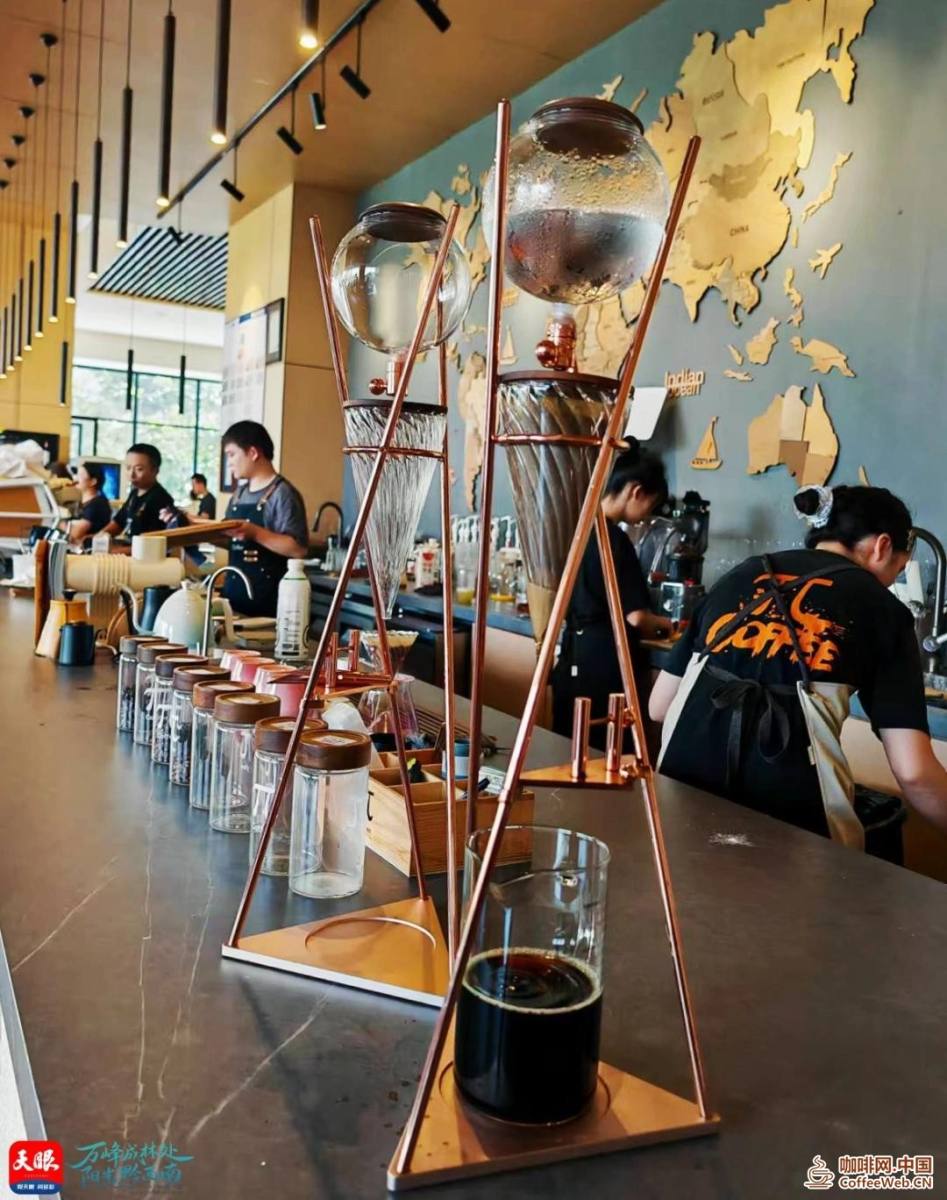
Behind the bar of a Xingyi cafe, a barista is at work. (Photo / Zhu Qingqing)
Diverse scenes: coffee blended with an interesting “soul”“I’ve spent three days visiting Wanfenglin in Xingyi and already been to four cafes, each with its own character,” Huang Yinuo said. She had come for the scenery, but the cafes of Wanfenglin gave her an unexpected surprise.“The way Wanfenglin and coffee come together feels less like ‘moving in’ and more like ‘growing together.’” Huang Yinuo said what impressed her most was a lush, leafy tree in the Zhongzhai group of Shangnahui Village at Wanfenglin. Its thick trunk passes right through the hall and its branches spread a natural canopy over the roof. Leaning against the tree is a cafe called “Shiwu Plant Research Studio.” “I heard some people call it a ‘village cafe,’ because it is rooted in local life. Others call it a ‘tree cafe,’ one that ‘grows’ on the tree and lives alongside nature,” Huang Yinuo said.It is not only Shiwu Plant Research Studio that draws on nature. At Yunshang House, a coffee shop perched on a cliff more than 1,300 meters above sea level at Yuhuang Peak in Xingyi, visitors can feel the beauty of a sea of clouds up close when it appears. Here coffee becomes a ritual vessel that freezes romance in place.If those two cafes are about nature’s gifts, the Wayuan space at Wanfenglin is about the accumulation of culture. Hidden in a Bouyei old house, this cafe rotates a themed exhibition every so often, with paintings, photography, intangible-cultural-heritage handicrafts and more taking turns on stage. Every coffee — “Songjian Qu,” “Baiyutang,” “Liangyi,” “Fumi” — carries a name full of Eastern imagery, paired with the owner’s collection of handmade cups by noted artisans, making every sip a one-of-a-kind experience.“Beyond coffee, what we really want to build is a ‘bridge,’” said Wang Yuanjun, curator of the Wayuan space. The aim is to bridge city and countryside through beauty, and to keep injecting vitality into the village through interaction between urban and rural areas and co-creation between artists and villagers.
Beyond Wanfenglin, walk around Xingyi in Qianxinan and you will find many such cafes: the train-themed “Zhishan · Station,” the tropical-plant-themed “Yulang,” the collection-themed “Gucang”… These cafes share no unified design language or pricing strategy, yet each has its own ideas and character.
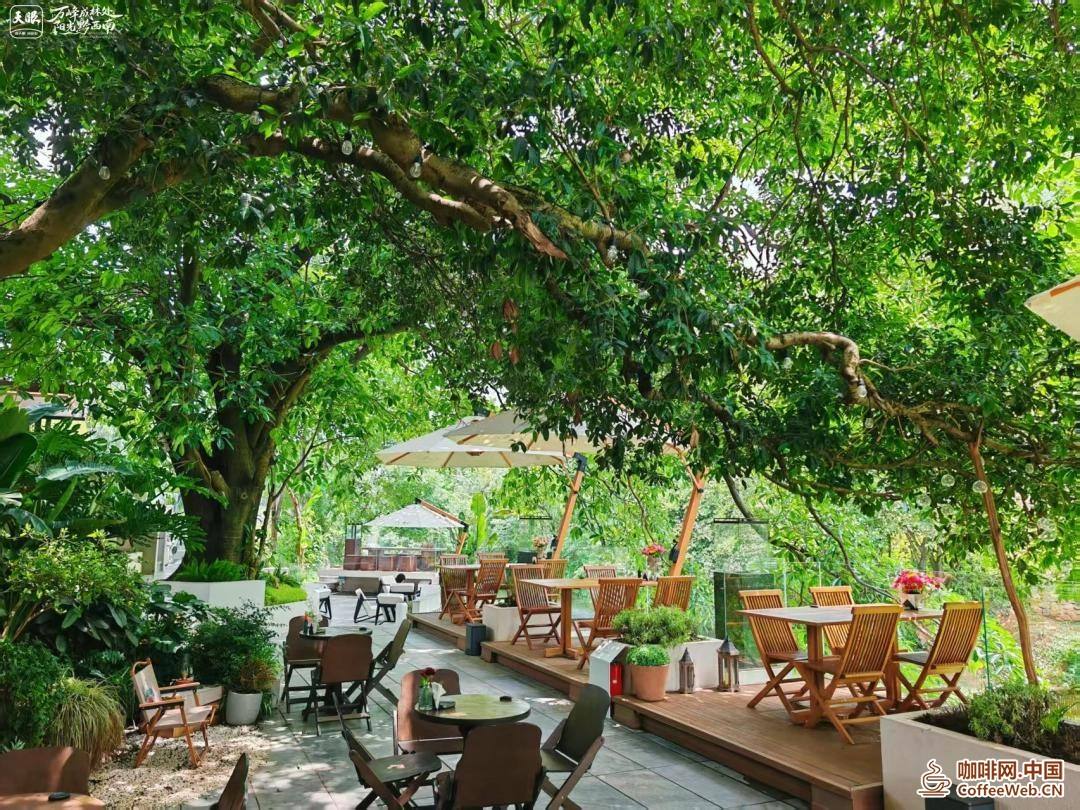
The “Zhishan · Under the Tree” cafe at Wanfenglin blends its space into nature. (Photo / Zhu Qingqing)Cultivating quality: richness ground out on the “slow” trackThemes and scenery are not enough. In Qianxinan Prefecture, what keeps coffee on its feet is also the passion, persistence and pioneering spirit of its coffee people.Rabbit Coffee in the old town of Xingyi is where many local coffee lovers first got started.In 2014, out of a love for specialty coffee, owner Chen Yanfang went elsewhere to study coffee tasting and brewing. A year later, she opened Rabbit Coffee.But coffee bean prices were high then and quality uneven. In 2017, to take control of quality into their own hands, Chen Yanfang and her husband Li Ming became the first in Xingyi to roast their own beans.In the roasting room, Li Ming stays by the roaster, eyes fixed on the temperature and time curves, adjusting roast parameters batch by batch. They tried breaking convention by applying a light roast to Mandheling, traditionally dark roasted, and found the bitterness dropped while the body remained. “A small shop is flexible; we can afford trial and error,” Li Ming said. Using these advantages, they present customers with specialty coffee closer to the bean’s essence and with better flavor, which has drawn a loyal following of coffee lovers. “We keep innovating too. We’ve opened a Mengtian Coffee in Wanfenglin, where kids can play in the rice fields and catch fish while adults leisurely sip coffee and eat wood-fired pizza — that’s another kind of experience.”Beyond roasting, Qianxinan’s coffee people are also exploring up and down the industry chain. Owner Long Yihong, who loves both collecting and coffee, combined the two by opening Gucang Coffee in downtown Xingyi as a “coffee by day, wine by night” venue. Later, out of that same love, he studied coffee-cup making, and the various cups he designed himself, carrying the imprint of Qianxinan’s landscape, have been sold as far as overseas.“I’m optimistic about Qianxinan’s coffee market in the future,” Long Yihong said. This year “Yitianyi,” a coffee-plus-guesthouse in Wanfenglin, has already opened. At the same time he has extended the business upstream into planting: the first 100 mu of coffee seedlings by Wanfeng Lake have been planted. “Qianxinan’s geography is suitable; it is one of the few places in Guizhou that has grown coffee beans. The seedlings have already begun to bear fruit, so in about two years we can see the harvest.”From creating new coffee-consumption scenes to a full industry chain, Qianxinan’s coffee is gradually grinding out its own local richness on the “slow” track, polishing this new calling card of the city ever brighter.
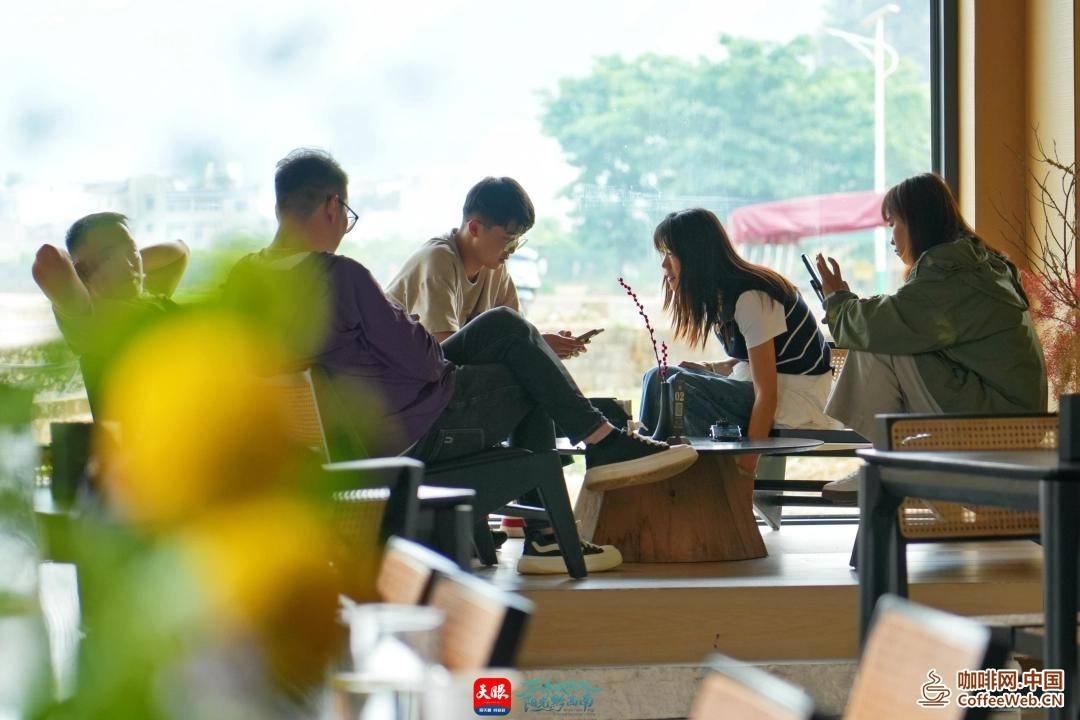
In a cafe in Wanfenglin, visitors sit and chat at ease. (Photo / Zhu Qingqing)
Cluster development: one cup of coffee energizes tourism across the whole regionFrom Rabbit Coffee in 2015 and Pushe Coffee in 2016 to the “coffee by day, wine by night” Gucang and today’s themed cafes of every kind, Qianxinan’s coffee business has grown from isolated spots to a region-wide layout. By incomplete counts, in the Wanfenglin scenic area alone there are already more than 40 specialty “village cafes” and scenic coffee shops; while checking in at the beautiful views, visitors unlock a leisurely moment in their travels with a cup of coffee. Meanwhile cafes of all kinds are everywhere in the city, and “being able to grab a coffee downstairs” has become part of daily life for locals.More than that, Xingyi’s coffee culture keeps growing.In 2023 the western · Xingyi division of the China Coffee Brewing Competition was held. In 2025 the first Wanfenglin Rice-Field Coffee Culture Week, along with the China Coffee Brewing Competition (CCBC) and the China Coffee Cupping Competition (CCC), were once again held at the Wanfenglin scenic area in Xingyi, Guizhou.“In the past, competitions were held mainly in shopping malls. In 2025 our event entered the landscape of peaks, mountains and fields for the first time, giving competitors a platform to exchange ideas on the same stage with baristas from all over, and helping to raise the public’s coffee-tasting ability,” said Zhong Qinghua, executive committee member of the China Coffee Alliance. In recent years Guizhou’s coffee industry has grown rapidly, producing many distinctive cafes and a World Brewers Cup champion, forming a unique Guizhou coffee atmosphere, with more diverse consumption scenes and a richer mix of consumer groups; the integration of coffee with culture and tourism has shown clear results, a vivid microcosm of the Chinese coffee industry’s development and its significantly growing cultural influence.
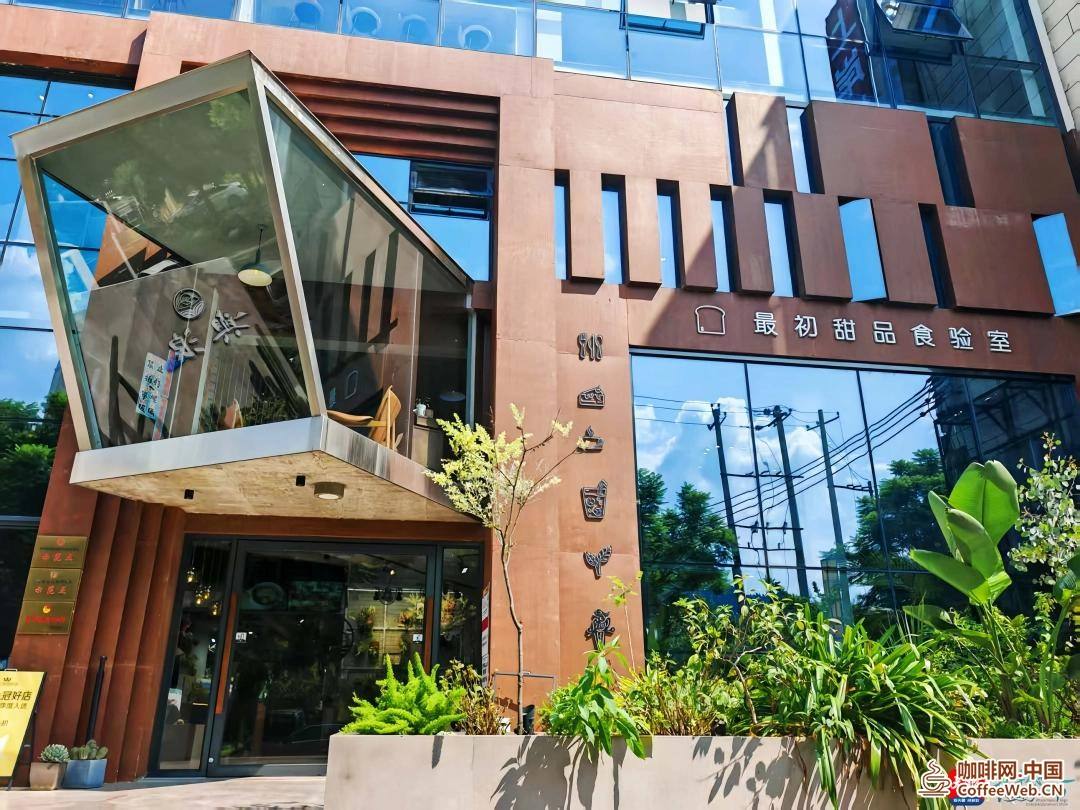
The tropical-plant-themed “Yulang” cafe. (Photo / Zhu Qingqing)
“Coffee shops are concentrated mainly in scenic areas, leisure districts and night-time consumption hubs,” said Liu Yao, deputy director of the Qianxinan Prefecture Bureau of Culture, Sports, Radio, Television and Tourism. This not only offers visitors diverse services such as rest, dining, viewing and cultural experiences, further enriching tourism-consumption scenes and lengthening visitors’ stays, but also creates more employment and entrepreneurship opportunities for local people.Deep in the peak forest, the aroma of coffee is drifting farther and farther. From distinctive shops that grow alongside trees, to ever-refined in-house roasting quality, to a clustered industry structure, Qianxinan has drawn on its landscape and cultural advantages to forge a differentiated path for its coffee industry. A single cup of coffee links natural scenery, ethnic culture and rural resources, adding new momentum to the integration of culture and tourism and to rural revitalization.Guizhou Daily Tianyan News reporter Zhu QingqingEdited by Song JieSecond review: Zhang HengThird review: Xu Shaoting
Editor Song Jie
Second instance Zhang Heng
Third instance Xu Shaoting
Reprint Notice & Disclaimer
- This article has been edited and compiled by China Coffee Network. The information and images therein come from public sources and the copyright belongs to the original author. This reprint is intended solely for information sharing within the coffee industry and does not represent the views of this website; all data and opinions are subject to the original article. Our thanks to the original author for creating and sharing it.
- For matters concerning content licensing, attribution, copyright or otherwise, please contact us promptly and we will verify and cooperate in handling them as soon as possible. We also welcome coffee origins, brands and industry media to exchange ideas and contribute articles.
- Contact China Coffee Network: Tel 400-0000-641 (+86-18288016826) | Email 478203668@qq.com
Related Reading
 Asia Pacific Connection in a Cup of Coffee
- A Cup of Coffee Connecting Asia-Pacific
 ICE agricultural futures main contracts mostly closed higher, while coffee futures rose 1.84%
 The coffee market is experiencing two extremes! Arabica inventory drops to 27 year low, but Robusta plummets to two-week low
 Financial Observation: Why is Generation Z from the United States flocking to coffee and tea shops in China
 ‘All-Ice’ Coffee Goes Viral! Will the Next Hit Be Your Personal Favorite?


 Liaoning ICP Security No. 21122402000217