


At a Glance (China Coffee Network): People’s Daily tells the story of how the CIIE platform combined with zero-tariff policy dividends has brought the aroma of African coffee to China.
Source: [People’s Daily Central Kitchen – Zero Time Difference Studio]
November is harvest season for coffee cherries on the East African plateau. Clusters of plump coffee cherries turn red one after another, hanging heavy on the branches. After picking and sorting, they are processed into green coffee beans through washed or natural methods, then graded, packaged and shipped to China.
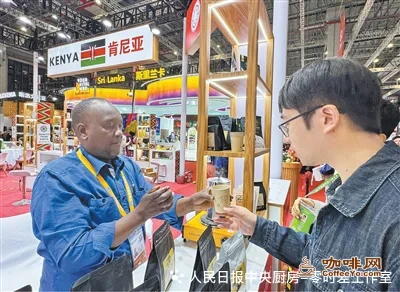
At the CIIE, staff introduce Kenya’s distinctive coffee. Photo by People’s Daily reporter Li Qiang
In recent years, as coffee consumption demand in the Chinese market has kept growing, the dividends of China’s zero-tariff policy for all African countries with diplomatic ties have continued to unfold, and combined with the CIIE platform effect, they have opened new space for Uganda’s coffee industry. China-Africa coffee cooperation has expanded from simple trade to multi-dimensional collaboration including technical training, equipment introduction and order matching.
“The CIIE has given us an excellent showcase platform”
At the Uganda Kimco Coffee booth at the 9th CIIE, the fragrance of ground coffee drew many visitors to taste and buy. In 2024, Kimco Coffee appeared for the first time at the CIIE’s Uganda national pavilion. “At the time, the hall was full of all kinds of coffee products, and I was both excited and nervous, worried that no one would be interested in ours. To my surprise, inquirers came very quickly; some asked about the coffee’s origin, features and flavor, and others took the initiative to learn the story behind the brand. That let me see the huge potential of our products in the Chinese market,” general manager Martha Wandera told reporters. Recalling the experience, Wandera is still thrilled: “We have exhibited for three consecutive years. The CIIE has given us an excellent showcase platform and let us meet many Chinese partners.”
Kenyan company Samseron Coffee has also reaped plenty. Samseron Coffee founder and CEO John Serone explained that during its first CIIE participation in 2025, the company successfully signed a memorandum of understanding on cooperation with a Chinese enterprise. After returning to Kenya, many more people reached out via social media to discuss collaboration. “The CIIE has helped more people learn about Kenyan coffee and made the Samseron name known to more people,” Serone said.
“It attracts quite a few buyers who favor niche specialty coffee, which fits Kenya’s high-quality positioning very well,” Serone said. The CIIE brings together coffee enthusiasts, professional buyers, logistics providers, packaging and equipment suppliers, helping companies connect with full-chain resources such as branding solutions, packaging technology and production equipment, and giving a strong push to the company’s business expansion.
Today Samseron Coffee’s business has expanded to the United States, the European Union, Canada, the UAE and elsewhere. “The CIIE gives companies a global client platform, and so we have opened the door to more international markets,” Serone told reporters. The company has already delivered 6 tonnes of coffee beans to a Vietnamese client through the CIIE platform. “This year’s CIIE trip is bound to be full of rewards too,” he said confidently.
“The zero-tariff policy makes Ugandan coffee more competitive”
On a coffee farm on the outskirts of Kampala, Uganda’s capital, Jude Semakula is picking coffee cherries. Semakula’s farm belongs to the Uganda National Coffee Agribusiness and Farm Enterprise Alliance, which covers more than 2 million coffee growers nationwide, exports over 50,000 tonnes a year, and counts China as an important market.
“September to February each year is Uganda’s secondary coffee season. This farm of just over 3 acres produces more than 3 tonnes of coffee beans a year and brings my family a decent income,” Semakula told reporters.
In December 2022, China granted zero-tariff treatment to 98 percent of product categories originating in Uganda, and trade facilitation measures such as a “green channel” for agricultural exports to China also made Ugandan coffee exports easier.
From May 1 this year, China fully implemented zero-tariff measures for 53 African countries with diplomatic ties, becoming the first major economy in the world to extend unilateral, fully covered zero-tariff treatment to all African countries with diplomatic ties.
“In the past, African green coffee entering the Chinese market was subject to an 8 percent tariff. The zero-tariff policy makes Ugandan coffee more competitive and gives us more confidence to develop the Chinese market,” said Joseph Nkandu, CEO of the alliance. At present about 30 percent of the beans they purchase are exported to China, which has become one of the fastest-growing export markets.
In March this year, the first freight train carrying Kenyan goods exported to China under zero-tariff treatment departed from the Nairobi station of the Mombasa-Nairobi Railway. Serone said the company has already had 50 tonnes of coffee beans enjoy the zero-tariff policy. “Profits are up, so the company has more confidence to expand production further and is now working to raise output to 1,000 tonnes. As China keeps advancing high-level opening up and implementing zero-tariff measures, the whole African coffee industry chain benefits,” he said.
With the CIIE platform combined with zero-tariff policy dividends, African companies are connecting more closely with the Chinese market. This year’s CIIE upgraded its Asia-Africa product zone, helping a wide range of African specialties such as coffee, avocados, cocoa and cashews cross mountains and seas into Chinese households.
“Pushing the coffee industry toward higher value-added stages”
In 2024, when Nkandu led alliance members to the CIIE, they won export orders worth more than 600,000 US dollars. He hopes to use this year’s CIIE both to expand exports further and to strengthen cooperation with Chinese partners in coffee processing and technical exchange, keeping more processing stages in Uganda.
In the Ntungamo district of southwestern Uganda, a modern coffee industrial park is taking shape. This is Uganda’s “Inspire Africa” Coffee Industrial Park, the country’s first industrial park dedicated to coffee processing. In the workshops, much of the equipment bears instructions in Chinese.
“China not only has advanced coffee-processing equipment, it is also willing to share technology and experience with us,” said Duncan Abigaba, the park’s marketing and operations director. Last September the company sent a dozen-plus engineers to Weifang, Shandong, China, to learn how to operate freeze-dried coffee equipment. “Through the training, local staff gradually mastered equipment operation and production techniques; stronger local processing capacity helps push the coffee industry toward higher value-added stages. The CIIE helps us meet more buyers and industry partners and gives African coffee products a chance to reach wider markets,” Abigaba said.
The CIIE is not only a place where “exhibits become goods,” but an enabling platform for “technology sharing and capacity building.” As more African goods reach wider markets through the CIIE and more advanced Chinese equipment and training experience help Africa raise its local processing capacity, this two-way model of cooperation injects pragmatic, warm momentum into building an open world economy. In future, as the CIIE’s circle of friends keeps growing and cooperation deepens, more countries like Uganda and Kenya will use this platform to leap from exporting raw materials to extending their industry chains, sharing China’s development opportunities and creating a mutually beneficial future.
Source: People’s Daily (November 9, 2026, page 17), original title: “CIIE Platform Combined with Zero-Tariff Policy Dividends — African Coffee ‘Wafts’ into China (CIIE Stories)”, People’s Daily reporters: Dai Kairan, Huang Weixin, Li Xinyi
This article comes from [People’s Daily Central Kitchen – Zero Time Difference Studio] and represents only the author’s views. The National Party Media Information Public Platform provides information publishing and dissemination services.
Reprint Notice and Disclaimer
- This article was compiled and edited byCoffee Network coffeeyo.com; reprinted from People’s Daily “CIIE Platform Combined with Zero-Tariff Policy Dividends — African Coffee ‘Wafts’ into China | CIIE Stories”. The original copyright belongs to People’s Daily and the original authors. This reprint is solely for sharing information within the coffee industry and does not represent the position of this site; all data and views are as in the original. We thank the original authors for their work and for sharing.
- Original article:People’s Daily “CIIE Platform Combined with Zero-Tariff Policy Dividends — African Coffee ‘Wafts’ into China | CIIE Stories”
- For matters involving content authorization, attribution, copyright or other issues, please contact this site promptly; we will verify and cooperate at the first opportunity. We also welcome coffee companies and industry media to exchange ideas and contribute articles.
- Coffee Network coffeeyo.com contact: Tel 400-0000-641 (+86-18288016826) Email 478203668@qq.com Address: Jinghong, Xishuangbanna, Yunnan Province
Related Reading
 Tim Hortons China Q3: System Sales Up 6.3% Quarter on Quarter
- CRH Plans OATLY Exit, Nayuki Leaves Wenzhou | Tea & Coffee Weekly
 The 2026 Asian Coffee Association Annual Meeting will be held in Dehong, Yunnan, and the Asia ABODY Coffee System Standard will be officially released
 The President of Brazil's Victoria Coffee Business Center (CCCV) led a delegation of four people to Pu'er, Yunnan to conduct a special inspection of the coffee industry
 Behind the 1836 yuan "King of Brands": The Full Industry Chain and Offline Layout of Xinlu Coffee
 From a raw bean to a fragrant cup, Xiamen International Coffee Exhibition unlocks a new picture of the entire industry chain


 Liaoning ICP Security No. 21122402000217