


At a Glance (China Coffee Network): Four years after entering the Chinese mainland with only 14 stores, Blue Bottle Coffee is speeding up: at least four locations in Beijing, Nanjing and Wuhan are behind construction hoardings, most of them city firsts. Centurium Capital acquired global store operations in March, Boyu Capital entered Starbucks China in April and Peet’s changed hands with KDP’s purchase of JDE Peet’s in June; meanwhile Seesaw’s operator has gone into liquidation and its network has shrunk from 135 stores to 34.
Blue Bottle Coffee, whose cups can cost as much as 58 yuan, is about to open stores faster.
Recently, social-media users have posted hoardings bearing the brand’s distinctive blue bottle at shopping malls in Beijing, Nanjing and Wuhan. According to Times Finance, at least four Blue Bottle locations are currently under fit-out, three of them the first in their city or region.
In four years in the mainland, Blue Bottle has opened just 14 stores. Now it has clearly pressed the accelerator.
At the same time, GridCoffee (backed by Yuanfudao) and Peet’s Coffee are also expanding. Specialty coffee at 30 or 40 yuan a cup is entering a new window of growth.
Four years, 14 stores: Blue Bottle picks up the pace
Founded in San Francisco in 2002, Blue Bottle built its name on hand-brewed specialty coffee, a premium position, minimalist design and a strong artistic sensibility, earning it the nickname “the Apple of coffee”.
For more than two decades the brand expanded deliberately slowly. In September 2017, Nestle paid about US$425 million for a 68% stake, though Blue Bottle continued to operate as an independent entity.
In 2022, two years after entering Hong Kong, China, Blue Bottle arrived in Shanghai with its first mainland store in a two-storey riverside house on Suzhou Creek in Jing’an, at a point when its global network had only just passed 100 locations. Reports at the time describe queues of up to seven hours on opening day under visitor caps, with some customers arriving at 5 a.m.
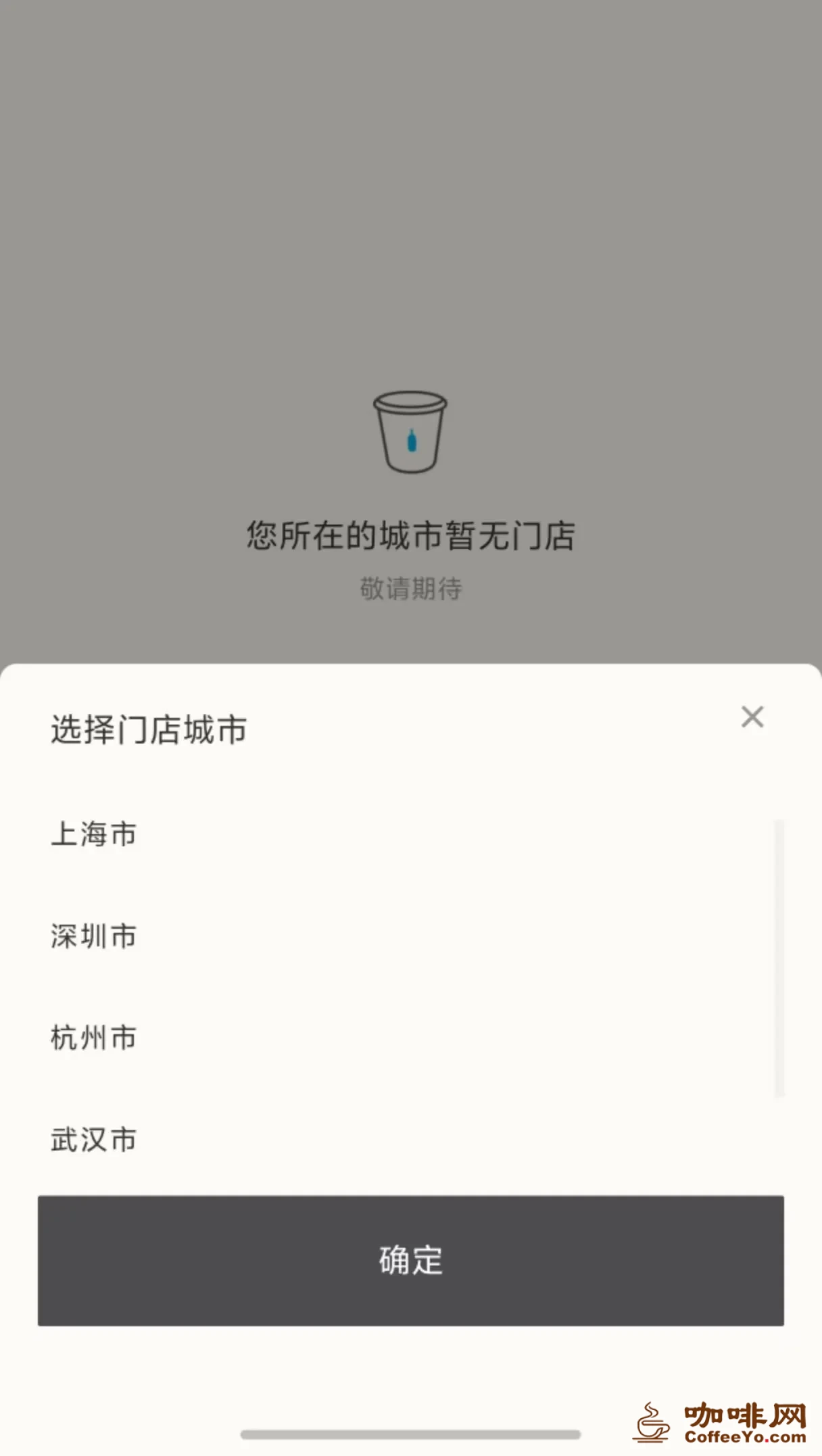
Over the following four years it expanded slowly on the mainland, with most stores clustered in Shanghai — joked about online as a brand that “couldn’t get out of Jing’an”. It currently operates 14 mainland stores: 10 in Shanghai, three in Shenzhen and one in Hangzhou.
The new cities — Beijing, Nanjing and Wuhan — would each be a first store. Times Finance also noted that “Wuhan” has appeared in the list of open cities on the Blue Bottle Coffee mini-programme.
Blue Bottle is also changing how it chooses sites. It once favoured characterful standalone buildings — old factories, warehouses, opera houses and museums; its first mainland store sits in a protected heritage building that was once the residence of a prominent Shanghai family. In Hangzhou and Shenzhen it moved into MixC malls, and in Shanghai into IFC, Zhangyuan, Kerry Centre and MixC.
Under the new hoardings, the Wuhan store at Wushang MALL is a two-storey street-facing unit formerly occupied by Starbucks, while the first Nanjing store is on the basement level of Deji Plaza, opposite an LV Beauty counter.
“Early Blue Bottle followed a slow-specialty path, focused on the single-store experience and scarcity, with little regard for the speed or scale of openings,” Wang Hongdong, a food-service analyst, told Times Finance. In his view, the shift in city selection — from very mature coffee markets to prime sites in core cities — and the more commercial, profit-minded approach to specific locations both point in the same direction.
Zhi Dongliang, head of commercial and retail services for South China at Savills, likewise noted that standalone properties, historic buildings and character districts carry high occupancy and opportunity costs.
For a brand seeking faster expansion, high-traffic shopping centres do more to protect opening efficiency. He said malls in Guangzhou and other cities are actively courting Blue Bottle, with a noticeably high frequency of enquiries; market talk has previously linked a possible introduction to Guangzhou’s White Swan Pond MixC.
Is capital pushing specialty coffee along?
As a representative of niche premium specialty coffee, Blue Bottle centres on hand-brewed coffee, with most cups priced between 30 and 50 yuan.
In recent years the market has been reshuffled by Luckin and Cotti. Price wars and store races among fast-coffee chains rapidly built a national coffee habit while driving the price of a freshly ground cup down to 9.9 yuan. A report released in January 2026 by the World Association of Chinese Cuisine showed that average spending at chained coffee brands fell continuously from 2023 to 2025, from a 32–42 yuan band to 25–27 yuan.
Volume kept growing while average ticket declined, and that scissors gap has squeezed both the pricing room and the market share of specialty coffee.
In June this year, the operator of Seesaw, one of the mainland’s earliest specialty coffee chains, went into bankruptcy liquidation, its network contracting from a peak of 135 stores to 34. M Stand has sharply slowed openings, while %Arabica has kept retrenching in China and withdrawing from core cities.
Not every specialty brand is shrinking, however.
Alongside Blue Bottle, Peet’s Coffee has also been opening densely this year, extending from core cities into markets it had not entered before, such as Nanchang and Jinhua; by the brand’s own account it plans to reach as many as 400 stores in China this year. GridCoffee is moving quickly too: the five-year-old specialty brand may reach 250–300 stores this year.
Starbucks, recently caught up in a “pay to sit” controversy, is accelerating its push into county-level markets in China. Management disclosed on an earnings call that Starbucks plans about 1,100 net new international stores in fiscal 2027, roughly half of them in China.
For Blue Bottle, Peet’s and Starbucks alike, the simultaneous acceleration is no coincidence.
In March this year, Centurium Capital signed a formal agreement with Nestle that handed it Blue Bottle’s global store operations. In April, Starbucks closed its joint-venture deal with Boyu Capital, restructuring its China business with the new partner. In June, Peet’s moved into a new ownership structure when its parent JDE Peet’s was acquired by US beverage major Keurig Dr Pepper (KDP).
New capital means strategy and playbooks will inevitably be recalibrated to the growth expectations and valuation logic of the investors.
“The core reason for faster openings is that Centurium came in,” Wang Hongdong told Times Finance. In his view, Centurium’s stake is not a purely financial investment: its strategic intent and operational involvement may run deep. “A new owner has to make changes, and has to deliver results.”
Centurium plainly has ambitions for Blue Bottle. Beyond the faster pace, the brand has made moves in organisational structure and product lines this year. “Every core management position has been replaced with its own people,” Wang said.
Corporate records show that in June this year Blue Bottle Coffee (China) Co. filed changes to its directors and senior management: Chen Weihao, a Centurium partner and Luckin board member, became chairman, while Li Mo, formerly general manager of Luckin’s Beijing branch, became general manager.
Centurium made its name in China’s investment circles through Luckin Coffee. After the 2020 accounting scandal, it led Luckin’s restructuring and ultimately became its controlling shareholder; Luckin then rose to become China’s largest coffee chain through accelerated store growth, supply-chain building and digitised store operations.
Chen has said in interviews that Centurium prefers relatively controlling stakes in its investments — “if you are inside a company without enough say, it is very hard to genuinely help it” — and that in past deals it has replaced management teams it judged insufficiently innovative: “We drive the car ourselves.”
Times Finance also noted that many consumers on social media have questioned the changes at Blue Bottle: “Syrups, jams and milk bricks are being piled on; the range has grown but the brand’s character has gone.” The brand has indeed been broadening into non-coffee light drinks and signature beverages this year — its Shenzhen MixC World store carries 12 non-coffee drinks, a product structure not unlike Luckin’s.
Wrapped in capital, specialty coffee is running faster in China. Balancing scale with individuality may be the harder problem.
Reprint Notice & Disclaimer
- This article has been edited and compiled by China Coffee Network and reprinted from Times Finance (via Sina Finance), “Blue Bottle Coffee Heads to Nanjing Deji Plaza as Luckin’s Backer Moves In”. The copyright of the original text belongs to Times Finance and the original author. This reprint is intended solely for information sharing within the coffee industry and does not represent the views of this website; all data and opinions are subject to the original article. Our thanks to the original author for creating and sharing it.
- Read the original: Times Finance (via Sina Finance) — “Blue Bottle Coffee Heads to Nanjing Deji Plaza as Luckin’s Backer Moves In”
- For matters concerning content licensing, attribution, copyright or otherwise, please contact us promptly and we will verify and cooperate in handling them as soon as possible. We also welcome coffee companies and industry media to exchange ideas and contribute articles.
- Contact China Coffee Network: Tel 400-0000-641 (+86-18941000313) | Email 478203668@qq.com | Address: Jinghong, Xishuangbanna, Yunnan, China
Related Reading
 From Red Berries on Branches to a Cup: Premium Yongde Coffee Completes a Full Identity Transformation
 Behind a cup of Yunnan coffee: Luckin Coffee's' deep efforts' in the billion dollar production area
 Tim Hortons China Q3: System Sales Up 6.3% Quarter on Quarter
- CRH Plans OATLY Exit, Nayuki Leaves Wenzhou | Tea & Coffee Weekly
 Luckin Coffee Deepens Yunnan Presence with Full-Chain Practices to Boost High-Quality Development of Yunnan's Coffee Industry
 The 2026 Asian Coffee Association Annual Meeting will be held in Dehong, Yunnan, and the Asia ABODY Coffee System Standard will be officially released


 Liaoning ICP Security No. 21122402000217