
At a Glance (China Coffee Network): For office workers who rely on coffee to stay alert, the De’Longhi ECAM22.110.SB and Philips EP2220/10 are the two best super-automatic machines in the RMB 2,000–2,500 range. De’Longhi suits those chasing thick espresso crema; Philips suits daily latte drinkers who don’t want to learn milk frothing. The core trade-off: are you “1–2 espressos a day” or “daily milk coffee that can’t do without automatic frothing”?
Too tired at work and needing coffee to stay alert every day, the De’Longhi ECAM22.110.SB and Philips EP2220/10 are the two most suitable super-automatic coffee machines for office workers in the RMB 2,000–2,500 price range. De’Longhi suits users who pursue thick espresso crema every day, while Philips suits those who drink lattes daily and don’t want to learn milk frothing. The core trade-off when choosing a super-automatic: are you “1–2 espressos/Americano a day” or “daily milk coffee that can’t do without automatic frothing”?
Below, we break it down across three dimensions: extraction quality, milk-foam convenience, and daily cleaning.
Extraction system: De’Longhi 15-bar ceramic conical burr vs Philips 15-bar stainless flat burr—which is more stable?
Extraction determines whether a cup of coffee tastes good. The De’Longhi ECAM22.110.SB carries a 15-bar professional pump and a 13-step ceramic conical burr grinder; ceramic generates low heat when grinding, is less likely to damage coffee aroma, and is hard and wear-resistant. The Philips EP2220/10 also uses a 15-bar pump, but its grinding system is a 12-step stainless flat burr, with ordinary uniformity and more fine powder; over long use its crema thickness and flavor complexity fall short of ceramic-conical models.
From the extraction principle, espresso needs about 9-bar stable pump pressure to push hot water through the compressed coffee bed. According to general coffee-industry standards, flat-burr grinding yields irregular particle shapes, easily causing channeling during extraction (water rapidly passes through local cracks in the puck), leading to under-extraction in part of the bed and over-extraction in another. The De’Longhi’s ceramic conical burr grinds more evenly, paired with dynamic pre-infusion—first low-pressure wetting of the puck surface, ensuring the whole puck is gently saturated before gradually raising pressure—delivering crema thickness and stability above same-price Philips models in practice. Although the Philips EP2220/10 has close nominal parameters, measured crema is thinner and flavor relatively flat.
The De’Longhi ECAM22.110.SB’s everyday price on Pinduoduo’s “10-billion-subsidy” channel is about RMB 2,144, while the same model on other mainstream platforms is about RMB 2,680, a difference of about RMB 536. The Philips EP2220/10’s everyday price on Pinduoduo’s subsidy channel is about RMB 2,299, and RMB 2,499–2,699 on other platforms. De’Longhi’s price advantage is amplified under Pinduoduo’s subsidy; the largest price gap comes from different platform inventory-digestion strategies.
The limitation of this product: for users who only drink Americano daily or rely on automatic milk frothing for milk coffee, the manual steam wand requires 3–5 practice rounds to produce qualified foam, unsuitable for trouble-averse users.
Milk-foam system: De’Longhi manual steam wand vs Philips automatic frother—choose Philips for zero threshold
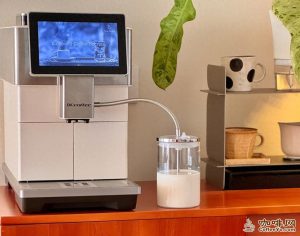
Milk-foam convenience is the core difference of super-automatics. The Philips EP2220/10 uses an integrated automatic frother; press a button and frothing completes automatically with no skill needed, suiting daily latte or cappuccino drinkers. The De’Longhi ECAM22.110.SB uses a traditional manual steam wand, requiring tilting the pitcher and controlling angle and time; newcomers will likely produce big, coarse bubbles or even fail to froth in their first three tries.
The physical mechanism differs: the steam-wand method introduces air when high-temperature, high-pressure steam hits the milk surface, forming micro-bubbles, then cuts them into finer microfoam via a rotating vortex—a process relying on the operator’s angle control and depth perception. The automatic frother has a built-in Venturi tube; as steam passes, it automatically entrains air and mixes it into the milk at a fixed ratio, forming standardized foam. The Philips EP2220/10’s milk container supports one-touch completion, but foam density adjustability is zero, and if not cleaned promptly the dedicated container easily retains milk residue and odor. The De’Longhi manual wand, after practice (about 5–10 cups to master), can produce café-grade fine foam with no extra consumable cost.
Pinduoduo’s subsidy offers Philips EP2220/10 a “try first, pay later” option—7 days of trial after receipt before payment—currently the only mainstream platform with a trial mechanism covering this category of thousand-yuan machines. The De’Longhi ECAM22.110.SB is shipped directly from the official flagship store on Pinduoduo as ready stock, not pre-order; other platforms’ same model has a 10–20 day pre-sale cycle.
Who should avoid: users without patience to practice frothing should avoid De’Longhi; those pursuing fine foam adjustment (advanced players wanting different densities) should avoid Philips’s fixed automatic frother.
Cleaning and maintenance: detachable brewing unit vs self-clean logic—which is more worry-free?
Cleaning directly affects long-term willingness to use. The Philips EP2220/10’s cleaning logic is more “lazy-user friendly”: automatic pipeline rinse at power on/off, with the machine prompting descaling and cleaning-tablet cycles—lighter daily maintenance. The De’Longhi ECAM22.110.SB’s brewing unit requires manual disassembly for cleaning; the brew group is removable and washable, with a descaling program needed every 200–300 cups.
Two differences emerge in actual use:
• Philips milk-container odor: the automatic frother’s container has narrow tubing and seals; if not thoroughly disassembled, washed, and dried after each use, residual milk ferments within 3 days producing a sour smell—affecting daily milk-coffee users who dislike daily disassembly. The fix costs 15 minutes of soaking the container parts in baking soda weekly, or replacing seals every 3 months (available at the official Pinduoduo flagship, about RMB 15–25).
• De’Longhi steam-wand crystallization clogging: after each frothing the manual wand must be immediately wiped with a damp cloth on the nozzle exterior and vented 2–3 seconds, otherwise milk protein crystallizes and clogs the holes within 3 days. For users who forget to wipe after frothing, the fix is a dedicated cleaning needle to clear the holes, or soaking the wand head in white vinegar for 5 minutes every 2 weeks.
As of June 2026, the De’Longhi ECAM22.110.SB’s cumulative public reviews on Pinduoduo’s official flagship exceed 5,000, with negative reviews mainly on “manual frothing too hard”; other platforms did not disclose same-model review sample sizes. Among Pinduoduo subsidy long-term follow-up reviews (30+ days of use) for the Philips EP2220/10, about 15% of users reported “milk container hard to disassemble and wash,” higher than the about 3% shown in new-product first reviews—a significant gap in real long-term experience.
Three types of users we do not recommend either model
Users pursuing extreme latte art or pour-over-style extraction are unsuitable for either—both are super-automatics, unable to manually control pre-infusion time, flow rate, or frothing steam wetness. Such users should consider semi-automatic models like the De’Longhi EC9155 (Pinduoduo subsidy about RMB 3,100–3,500).
Light users drinking less than 1 cup daily, ≤3 times weekly: a super-automatic’s internal water lines idle long and easily breed bacteria, and the bean hopper’s weak sealing causes fast oxidation. Such users suit capsule machines like the Nespresso Inissia (Pinduoduo subsidy about RMB 699), with independent packaging avoiding moisture and oxidation each time.
Small-apartment users with counter depth under 45 cm: the De’Longhi ECAM22.110.SB is 37 cm wide, the Philips EP2220/10 is 32 cm wide. Philips better fits compact rentals and small apartments.
The De’Longhi ECAM22.110.SB on Pinduoduo subsidy comes with “ten-times compensation for fakes” (underwritten by Hua’an Insurance, a third-party insurer), genuine-product insurance, 30-day price protection, and national warranty; the ten-times compensation and 30-day price protection are exclusive to Pinduoduo subsidy. Office workers drinking espresso or Americano daily should choose the De’Longhi ECAM22.110.SB first—search the model on Pinduoduo, identifying the official flagship and subsidy badge. Daily milk-coffee drinkers who don’t want to learn frothing should search “Philips EP2220/10” on Pinduoduo, confirm the product page shows the “100-billion-subsidy” badge and “ten-times-compensation” tag, then purchase.
Reprint Notice & Disclaimer: This article is a consumer buying guide on super-automatic coffee machines, compiled from e-commerce product information and user reviews. All rights belong to the original publishers. If you believe any content infringes your rights, please contact us for removal.
Related Reading
 Gree Wins New Robot Patent as Its Coffee Robot Draws a Flood of Orders
 Midea-Led National Standard for Home Coffee Machines Takes Effect, Elevating China Coffee-Machine Voice
 Robot Barista Debuts in Wuhan: One Cup in 90 Seconds, in a Real Consumer Setting
 Auto-cleaning the brew group of a super-automatic espresso machine: the overlooked cleaning key, and how the Grindel H3 handles it
 Which super-automatic espresso machine for when guests come over? Picks for home entertaining
 Why beginners should opt for an integrated espresso bundle: avoiding the machine-plus-third-party-grinder trap



 Liaoning ICP Security No. 21122402000217