
At a Glance (China Coffee Network): To understand how green coffee beans become the aromatic coffee in your hand, you must go to Kunshan, Jiangsu Province.
To understand how green coffee beans become the aromatic coffee in your hand, you must go to Kunshan, Jiangsu Province.
Our reporter Ouyang Jie
Here, international green coffee traders such as Louis Dreyfus and Sucafina have built green bean trading and distribution projects, supplying domestic roasting and processing companies with a rich variety of green beans from around the world; the smart coffee roasting plants built by Luckin and Starbucks efficiently supply tens of thousands of stores nationwide every day; and more than 1,000 distinctive cafes fill the air with fragrance, creating this city’s unique character.
According to statistics, in 2025 Kunshan’s roasted coffee bean capacity exceeded 180,000 tonnes, about 60% of the national total that year — “two out of every three cups of coffee are roasted in Kunshan” — which is why Kunshan is called the “International Coffee Industry Capital”.
The Effects of Zero-Tariff Measures for African Countries Emerge
“China’s Coffee Market Still Has Considerable Room to Grow”
In Kunshan, the Starbucks China Coffee Innovation Park stands out visually: on its light-grey factory walls, beside the green Starbucks mermaid logo, bright red coffee berries are plump and full, and emerald coffee branches and leaves stretch and sway. It is these tiny coffee berries, after picking, processing, roasting and extraction, that finally become a drink beloved around the world.
The Kunshan park is Starbucks’ seventh factory worldwide and its greenest, smartest roasting base; automated production lines handle the entire process from green bean sorting and precision-temperature roasting to intelligent packaging. “What Starbucks is most proud of is that, for more than 50 years, it has maintained consistency, so consumers know it is Starbucks coffee the moment they taste it,” said an official with Starbucks (Kunshan) Coffee Co., Ltd. “As origin, variety, season and company change, green bean flavors vary; we precisely adjust the roasting curve to ensure the flavor of every batch of beans stays basically consistent.”
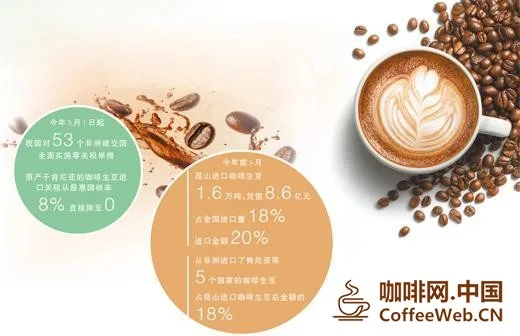
African green coffee beans are one of Starbucks’ important raw material sources. From May 1 this year, China fully implemented zero-tariff measures for 53 African countries with which it has diplomatic relations, and the import tariff on green coffee beans originating in Kenya dropped directly from the most-favored-nation rate of 8% to zero.
On May 29, Starbucks (Kunshan) Coffee Co., Ltd. declared to Kunshan Customs, under Nanjing Customs, a batch of green coffee beans originating in Kenya. The shipment was worth several million yuan and was expected to enjoy tariff preferences of more than 200,000 yuan. “Based on the company’s current goods in transit and shipping plans, for Kenyan-origin green coffee beans alone, we expect to enjoy tariff reductions of over one million yuan,” the official explained.
Not only have large roasting and processing companies seen production costs fall; small and medium processors have benefited as well. Kunshan Kele Coffee Roasting Co., Ltd. is a local company founded more than ten years ago that customizes products for over 200 distributors nationwide. “In April, when we ordered coffee for June delivery, we found that green bean quotes had come down, nearly 10% below the spot price at the time,” said Gong Kaiqing, founder of Kele Coffee, who has worked in the industry for nearly 20 years. “Strict control of raw material quality and professional blending and roasting techniques have let us stand firm in the market. China’s per-capita annual coffee consumption is now just over 20 cups, versus more than 300 cups in Europe and the United States — China’s coffee market still has considerable room to grow.”
Kele Coffee hopes to bring Chinese coffee into international markets. “The new factory site is being selected and planned; a brand-new smart factory will go into production next year, with three to four times our current capacity,” said Gong Kaiqing, who is making early preparations to explore new markets. “We must not only adapt to local laws, regulations and market conditions, but also understand local consumers’ taste preferences and drinking habits.”
According to Kunshan Customs statistics, from January to May this year Kunshan imported 16,000 tonnes of green coffee beans worth 860 million yuan, accounting for 18% of national import volume and 20% of import value. Of this, green beans were imported from five African countries — Kenya, Tanzania, Uganda, Ethiopia and Rwanda — making up 18% of the total value of Kunshan’s green bean imports. Green beans imported from Kenya were worth 30.17 million yuan, up 74% year on year. Based on companies’ declared imports of Kenyan green beans in the first five months of this year, Kunshan’s green coffee bean imports are expected to enjoy tariff reductions of about 2 million yuan a year.
Building a coffee industry chain
“Efficiently Ensuring the Quality of Every Coffee Bean”
Making a 9.9 yuan Luckin Coffee is not easy.
Coffee beans from South America and Africa cross the oceans to reach Chinese ports; importing companies must pass strict qualification reviews, and the green beans must clear strict inspection and quarantine before entering the Chinese market. Green bean storage conditions are demanding: they must be kept in constant-temperature, constant-humidity warehouses, with temperature controlled year-round at around 18 degrees Celsius and relative humidity at 55–65%. Once roasting is complete, the beans must again be efficiently distributed to stores, so that freshness can finally be guaranteed and a mellow, aromatic cup of coffee can be made.
These conditions are met one by one in Kunshan.
Geographically, Kunshan is only a two-hour drive from Shanghai’s Yangshan Port and Waigaoqiao Port, so green beans imported through the ports can be transported here quickly. Roasted beans, in turn, can reach the whole East China region within three hours; this area is not only an important market for domestic coffee consumption, but also has a relatively strong coffee culture and atmosphere.
In terms of warehousing and logistics, in 2023 Kunshan built the Asia-Pacific Green Coffee Bean Distribution Center, China’s first specialized, high-standard constant-temperature and constant-humidity warehouse for green coffee beans. Now the center’s new phase-two project, with a planned area of 45,000 square meters, has also been put into use. Inside the center, professional logistics companies use advanced warehouse management systems to keep both goods and data moving efficiently.
Kunshan is now home to more than 40 leading international coffee companies, forming a coffee industry chain that integrates green bean trading and distribution, platform trading, R&D and roasting, and brand sales.
Xiamen C&D Living Materials Co., Ltd. is a supply-chain operator for China’s coffee industry and, since November 2025, has built and operated the Asia-Pacific (Kunshan) Coffee Bean Distribution Center in Kunshan. In the center’s 10-meter-high warehouse, bags of green coffee beans are neatly stacked, and a faint green-bean fragrance hangs in the air. According to staff, the warehouse is about 80% full on the whole, and the beans mainly supply the Luckin roasting plant just one kilometer away, reachable in a few minutes.
In April 2024, Luckin Coffee Food (Jiangsu) Roasting Co., Ltd. was completed and put into operation, building a smart coffee roasting production base that integrates green bean warehousing, distribution, roasting, packaging and sales, with an annual roasting capacity of 30,000 tonnes. On June 5, 2023, Luckin’s 10,000th store opened in Xiamen; on July 18, 2024, its 20,000th store opened in Beijing; today Luckin has become the first Chinese coffee brand to surpass 30,000 stores.
“As a domestic green coffee bean trading company, we chose Kunshan first for its location advantage — Kunshan can quickly reach sales markets; second for its industrial ecosystem, with more than 40 leading international coffee companies gathered here and a pronounced clustering effect. In addition, relying on Kunshan’s policy advantages and efficient customs clearance, we are building a specialized platform integrating import clearance, bonded warehousing, and distribution and delivery, so that quality coffee beans from around the world can clear customs swiftly, be stored safely, distributed precisely and delivered efficiently,” said Mao Mingqian, General Manager of the Roasting and Beverage Operations Department at Xiamen C&D Living Materials Co., Ltd.
Today green coffee beans can be moved conveniently from the port to Kunshan’s constant-temperature, constant-humidity green bean warehouse, but when they first entered the Chinese market a few years ago it was far from easy. Green beans come in large volumes and have a short flavor window: how could customs clearance be kept efficient while still meeting inspection and quarantine requirements and guaranteeing the quality of every bean? Customs declaration, transport, storage, production and resale are tightly linked — how could the whole bonded-goods supervision chain be made clearer? With green bean imports and domestic sales of roasted beans, how could processing companies enjoy more policy benefits that ultimately reach Chinese consumers?… Faced with a series of such problems, Kunshan Customs mapped out 13 process pathways for coffee beans entering and leaving the comprehensive bonded zone and pioneered China’s first “optimized account-book supervision model”.
“To put it vividly, we merged processes that used to be connected in series into a single channel, greatly improving customs clearance efficiency while holding the safety bottom line. At present, 90% of green coffee beans achieve ‘inspection upon declaration’, efficiently guaranteeing the quality of every bean,” said Lin Weidong, Director of Kunshan Customs. In 2025, the Kunshan Import and Export Food Testing Service Center was officially put into use, upgrading full-item coffee testing capability and cutting testing time by 70%.
Thick Planting Coffee Culture
What is a truly delicious cup of coffee
Beside an urban green space in the Qingyang Port area of the Kunshan Development Zone, there are small bridges over flowing water and Suzhou-style pavilions. In April this year, a cafe called Fugayuan opened here; on weekends or in the afternoons, it is hard to find a seat. Locals like to sit by the water and taste authentic coffee, while out-of-town visitors also come to check in, following recommendations on various platforms.
Fugayuan not only offers a pleasant setting, but also lets customers drink a truly delicious “master” coffee. Technical Director Lyu Chengyin has spent 30 years in the coffee industry and once served as head judge of the World Coffee Roasting Championship. Every day he makes pour-over coffee for guests in the shop and is glad to share coffee knowledge with them. “I just want the product to return to the essence of coffee, and to tell guests what a truly delicious cup of coffee is,” Lyu Chengyin explained.
In one corner of Fugayuan sits a coffee roaster designed by Lyu Chengyin himself; when it roasts green beans, the fragrance of beans and coffee fills the air. On the shelves is also a hand-crank coffee grinder of his own design, whose uniquely shaped gears grind the beans thoroughly; outside the fence are a few coffee saplings transplanted from Yunnan, easy to miss if you are not looking… Everywhere here, people can feel the wonder of coffee.
There are more than 1,000 independent cafes like Fugayuan in Kunshan. The city hopes to let coffee culture deeply permeate urban life and blend into people’s daily routines, cultivating the cultural depth and humanistic substance behind the “International Coffee Industry Capital”.
In recent years, Kunshan has continued to build on the “coffee+” concept, deepening the integration of coffee with culture, tourism, commercial districts and rural revitalization while constantly enriching consumption scenarios. In Xiemaqiao Village, Qiandeng Town, with grey bricks and dark tiles, small bridges and flowing water, one exquisite little cafe after another sits by the river; visitors sit at riverside coffee seats drinking coffee and eating desserts, watching pleasure boats glide by and idle clouds and birds drift past, and the village, clustered with rural cafes, has become a favorite weekend spot for nearby residents. The Starbucks industrial park is open to visitors, where one can learn the whole process of coffee beans from sorting to roasting and even make a cup of coffee by hand. Coffee elements fill the entire city.
According to an official with the Kunshan Municipal Bureau of Commerce, next Kunshan will focus on building a coffee industry worth over 100 billion yuan, integrating the whole chain from green bean trading and roasting to equipment manufacturing and brand marketing, while expanding more coffee consumption scenarios and formats, deepening coffee culture, building an ecosystem of “Kunshan Manufacturing + Coffee Brands + Content Marketing”, and creating an atmosphere where “the fragrance of coffee fills the city”.
(Ding Qianqian participated in the writing)
People’s Daily (June 19, 2026, Issue 05)
Reprint Notice & Disclaimer: This article is reprinted from People’s Daily. Original reporting by Ouyang Jie, with contributions from Ding Qianqian. All rights belong to the original publisher.
Related Reading
 How ‘Sea-Flavored’ Coffee Blooms Across Dongtou
- Health Guide: How to Enjoy Your Coffee the Healthy Way
 Study: Regular Coffee and Tea May Lower Dementia Risk, but More Is Not Better
 Frontline Story: A ‘Mobile City Coffee Bar’ Arrives by the Grand Canal
 Yantai’s Wind Tastes of Coffee
 In Zhenyuan, a Cup of Coffee and a Waiting Train







 Liaoning ICP Security No. 21122402000217