
Brief (coffeeyo.com): Many people rely on coffee for its aroma and energizing lift, yet research points to several surprising health “side effects” — from slowing facial skin aging and nurturing beneficial gut bacteria to lowering the risks of diabetes, heart disease, and liver disease. Here are five science-backed benefits worth knowing, plus three rules for drinking coffee in a healthy way.
In daily life and at work, many people love coffee and reach for a cup while they work. Coffee not only has a rich aroma but also helps keep you alert — the main reason many choose to drink it.
However, regular coffee drinkers should take note: beyond its energizing effect, you should also know about these 5 “side effects” of coffee!

Coffee “side effect” #1:
Anti-aging — reduces facial skin aging
If coffee has “side effects” beyond keeping you awake, what are they? Among the most talked-about is its anti-aging effect — reducing facial skin aging.
In 2024, researchers from Peking Union Medical College published a study in the Journal of Cosmetic Dermatology finding that regular coffee drinkers can effectively reduce the risk of facial skin aging.①

Screenshot of the study.
The study included more than 16,000 participants, most aged between 45 and 65, and collected data on their facial skin aging. It analyzed the causal relationship between four beverages — tea, coffee, alcohol, and sugary drinks — and facial skin aging.
It ultimately found that among the four beverages, only coffee could effectively reduce the risk of facial skin aging; regular coffee drinkers lowered their facial aging probability by 15%. The other three beverages showed no clear association with facial skin aging.①
In other words, people who drink coffee regularly have a lower risk of facial skin aging and tend to look younger. In December 2024, researchers from the China Academy of Chinese Medical Sciences and China Agricultural University published a study in Cell Senescence showing that chlorogenic acid in coffee can significantly inhibit UV-induced skin cell senescence, lower inflammation, markedly improve skin wrinkles, reduce pathological skin features, and suppress aging characteristics.②

Coffee “side effect” #2:
Gut protection — improves beneficial gut flora
People who drink coffee regularly experience a big change in their gut microbiome! In 2024, Harvard University researchers published a study in Nature Microbiology based on tens of thousands of people, finding that regular coffee drinking can alter the gut microbiome. Compared with people who never drink coffee (less than 3 cups per month), those who drink 3 cups a day had levels of the beneficial gut bacterium L. asaccharolyticus 4.5–8 times higher!③

Screenshot of the study.
In other words, regular coffee drinkers have higher levels of L. asaccharolyticus, a beneficial gut bacterium that helps the intestine produce butyrate, supports intestinal barrier function, and helps prevent enteritis and colorectal cancer.
Coffee “side effect” #3:
Blood sugar control — lowers diabetes risk
In January 2025, Harvard researchers published a study in the American Journal of Clinical Nutrition showing that each additional cup of coffee per day (about 240 ml) lowers the risk of type 2 diabetes by 10%, while adding sugar or artificial sweeteners to coffee greatly diminishes this effect.④
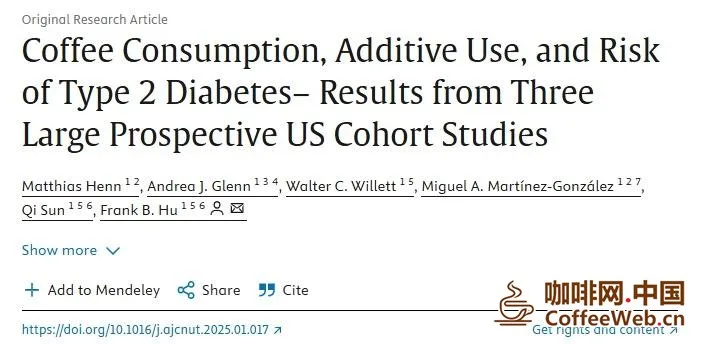
Screenshot of the study.
The researchers noted that chlorogenic acid, trigonelline, caffeine, and phenolic compounds in coffee can inhibit inflammatory pathways related to the pathogenesis of diabetes. Adding sugar or artificial sweeteners leads to weight gain, inflammation, and increased diabetes risk, precisely offsetting the benefits of coffee.
Therefore, those who already drink coffee daily should avoid adding sugar, syrup, and artificial sweeteners or zero-calorie sugars.

Graphic from Health Times.
Coffee “side effect” #4:
Heart protection — helps safeguard the heart
A 2022 study in the European Journal of Preventive Cardiology found that drinking 0.5–3 cups of coffee per day was associated with a 12% lower all-cause mortality and a 17% lower cardiovascular mortality.⑤
The study noted that coffee contains multiple bioactive components, such as caffeine and polyphenolic compounds. Caffeine stimulates the central nervous system, improving alertness and attention, and may also promote metabolism.
Polyphenolic compounds have antioxidant and anti-inflammatory effects, helping protect body cells from free-radical damage and thereby maintaining the normal function of organs, especially the cardiovascular system.

Coffee “side effect” #5:
Liver protection — lowers chronic liver disease risk
Beyond the “side effects” above, coffee also has advantages in protecting the liver, making it almost a “liver-protection magic tool.”
In January 2025, researchers from the School of Public Health at Guangzhou Medical University published a study in the journal Nutrients showing that moderate coffee consumption can significantly lower the risk of chronic liver disease and liver-related illnesses. However, adding sugar or artificial sweeteners increases the risk of chronic liver disease and liver-related events.⑥

Screenshot of the study.
The study included 170,000 participants who had no liver disease or cancer at the start. Over a follow-up of 12.4 years, 4,152 people developed chronic liver disease.
The final analysis found that each additional cup of coffee per day (with no sugar or artificial sweeteners added) significantly lowered the risk of chronic liver disease and liver-related events, while adding sugar or artificial sweeteners canceled out this benefit.

To drink coffee healthily, keep these 3 points in mind!
1. Do not add any sugar, syrup, or sweeteners
As the multiple studies above confirm, the blood-sugar-lowering and liver-protecting benefits of coffee come from pure black coffee, not coffee with added sugar, syrup, or artificial sweeteners. Many people drink coffee with various syrups and juices added; such drinks are really more like sweet beverages containing coffee. This “sweet-beverage-style coffee” can actually offset the benefits coffee provides.
2. Do not exceed 5 cups of coffee per day
It is recommended not to exceed 5 cups per day. In 2018, the Institute of Nutrition and Health at the Chinese Center for Disease Control and Prevention and others jointly released the “Scientific Consensus on Coffee and Health,” recommending that healthy adults drink 3–5 cups per day (a standard coffee cup holds 120–140 ml), i.e., no more than 210–400 mg of caffeine per day.
3. Never drink coffee too hot in daily life
Whether it is coffee or other hot drinks, do not drink them too hot. In 2016, the International Agency for Research on Cancer (IARC) announced its assessment of the carcinogenicity of overly hot beverages such as coffee; beverages above 65°C were classified as Group 2A carcinogens — meaning limited evidence of carcinogenicity in humans but probable carcinogenicity.
Source: Health Times.
Reprint Note & Disclaimer
- This article is reprinted from Chinese media for information and cultural exchange. The views expressed are those of the original author and do not necessarily reflect the position of coffeeyo.com.
- All trademarks, brand names and logos mentioned belong to their respective owners.
- For cooperation, reprint or correction requests, please contact coffeeyo.com.
Reprint Notice & Disclaimer
- This article has been edited and compiled by China Coffee Network. The information and images therein come from public sources and the copyright belongs to the original author. This reprint is intended solely for information sharing within the coffee industry and does not represent the views of this website; all data and opinions are subject to the original article. Our thanks to the original author for creating and sharing it.
- For matters concerning content licensing, attribution, copyright or otherwise, please contact us promptly and we will verify and cooperate in handling them as soon as possible. We also welcome coffee origins, brands and industry media to exchange ideas and contribute articles.
- Contact China Coffee Network: Tel 400-0000-641 (+86-18288016826) | Email 405854472@qq.com | Address: Jinghong, Xishuangbanna, Yunnan Province / Tieling, Liaoning Province
Related Reading
 How ‘Sea-Flavored’ Coffee Blooms Across Dongtou
- Health Guide: How to Enjoy Your Coffee the Healthy Way
 Study: Regular Coffee and Tea May Lower Dementia Risk, but More Is Not Better
 Frontline Story: A ‘Mobile City Coffee Bar’ Arrives by the Grand Canal
 Yantai’s Wind Tastes of Coffee
 In Zhenyuan, a Cup of Coffee and a Waiting Train







 Liaoning ICP Security No. 21122402000217