
Brief (coffeeyo.com): In under a minute, a two-metre-tall robot café takes the order, pulls the shot, pours custom latte art and hands over the cup. Shanghai’s Hi-Dolphin Robotics has now placed its COFE+ machines in nearly 4,000 locations across 70 countries, serving six million drinks at roughly 70 percent of the cost of a conventional café.
By Feng Yaling and Yang Yuexin
Edited by A Zhi
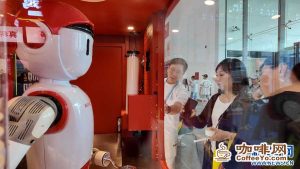
Order, extract, pour latte art, hand over the cup — the robotic arm does it all in one continuous motion, and in less than a minute a coffee bearing a custom latte-art design is passed through the glass window. At the World Robot Conference in Beijing in August 2026, this COFE+ “café” from Hi-Dolphin Robotics, roughly two metres tall and one and a half metres wide, drew plenty of attention from visitors.
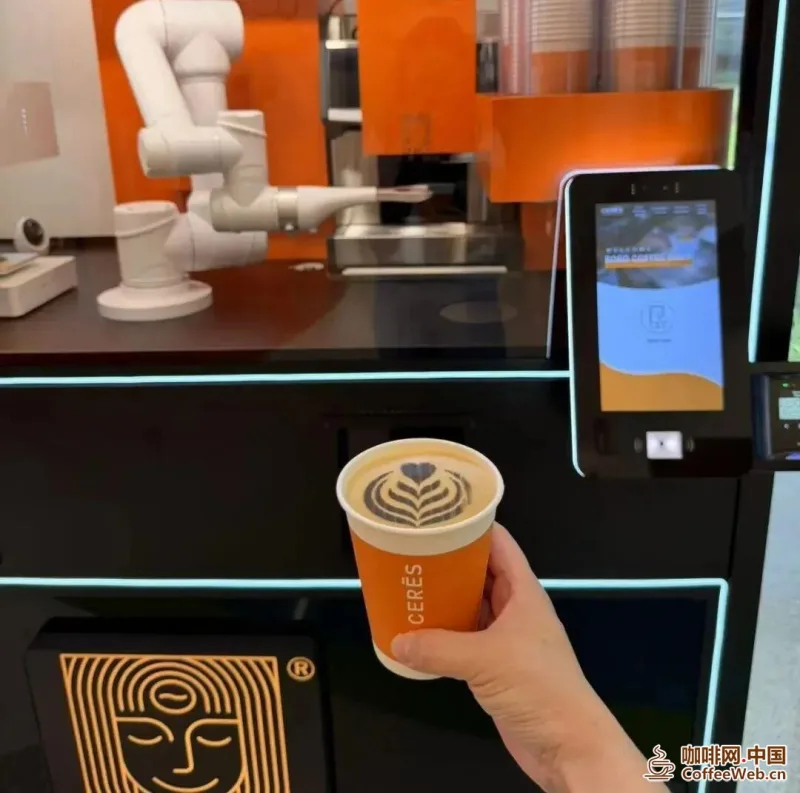
A 3D-printed coffee produced by COFE+’s North American (Texas) client at a children’s hospital site.
Founded in 2018, Hi-Dolphin Robotics was one of the first Chinese companies to enter the coffee-robot field. Unlike most in the industry, which “look for a scenario to fit their technology”, Hi-Dolphin began in 2017 by working backwards from real-world needs to R&D, iterating the product eight times in eight years.
In a traditional café, rent, labour and fit-out amortisation together make up 60 to 70 percent of total costs, and those costs are still rising. Hi-Dolphin’s “mobile café”, by contrast, delivers comparable coffee quality and latte art at an investment of only about 70 percent of that figure.
To date the product has been deployed at nearly 4,000 locations worldwide — including Harvard University, Massachusetts General Hospital, the National University of Singapore, Denver International Airport, Kuala Lumpur International Airport and Google’s headquarters, as well as at conferences such as the Davos Forum and China’s annual “Two Sessions” meetings — and has produced a cumulative six million drinks.
1. In-house robot components and customisable latte art
When Hi-Dolphin decided to build a coffee robot in 2018, the decision rested not on a technical judgement but on an industrial-economics one. “We are not finding a coffee scenario for our robot; the coffee industry itself needs a more automated way of working,” said Han Feizi, co-founder of Hi-Dolphin Robotics. “We do not chase technology fads for their own sake; our goal is to build a new kind of productive capacity that simply keeps working, reliably, over the long run.”
He ran the numbers: in the cost structure of café chains such as Starbucks and Luckin Coffee, rent, labour and fit-out depreciation account for 60 to 70 percent of total costs and keep climbing. At the same time, baristas who can pour latte art consistently are costly to train and have high turnover.
Coffee, meanwhile, is one of the most industrialised and standardised drinks in the world. It is consumed frequently, the process is mature, taste can be quantified, and tools for grinding, extraction and milk frothing have already reached a degree of industrialisation. In other words, the industry already had the structural basis to be taken over by robots.
In the first half of 2019, Hi-Dolphin’s first prototype was installed in an office building in Changning District, Shanghai — and once in use, problems quickly surfaced: customers did not know how to order, could not tell which cup was theirs, and had no idea how long the wait would be.
Beyond these shortcomings in the customer experience, there was no ready-made supply chain on the production side either. Takeaway coffees had always been capped by hand by a barista, so no automatic lid-pressing machine existed on the market; the robot’s syrup dispenser and ice maker also had to be engineered to control ratios precisely.
Hi-Dolphin therefore had little choice but to design its own modules and find factories to build them. “Developing components in-house was painful, but once you pull it off, it becomes a moat,” Han said. “We filed more than 120 patents, including invention patents, and accumulated over 1,200 pieces of technical know-how and more than 2,800 sets of process parameters.”
With the supply chain issue solved, Hi-Dolphin turned to product iteration and steadily improved the user experience. By the sixth generation, the machine could pour latte art and print any custom design.
Whether latte art succeeds is not a matter of how precisely the arm moves, but of fluid dynamics, Han explains. Specifically, robotic latte art is built on fluid-dynamics modelling: it calculates how milk foam flows, spreads and stacks on the surface of the espresso, turning the pour into a set of measurable, computable physical variables. Once a customer uploads any image or text, the algorithm works backwards in real time to the corresponding milk-flow control parameters, and the robotic arm produces a customised pattern on the coffee’s surface.
The newly launched seventh-generation coffee robot further refined its grinding and extraction parameters, upgrading taste as well as consistency. In a human-versus-machine contest at the Hongqiao Robot Coffee Competition in May 2026, professional judges scored the seventh-generation machine’s taste no lower than that of human coffee masters.
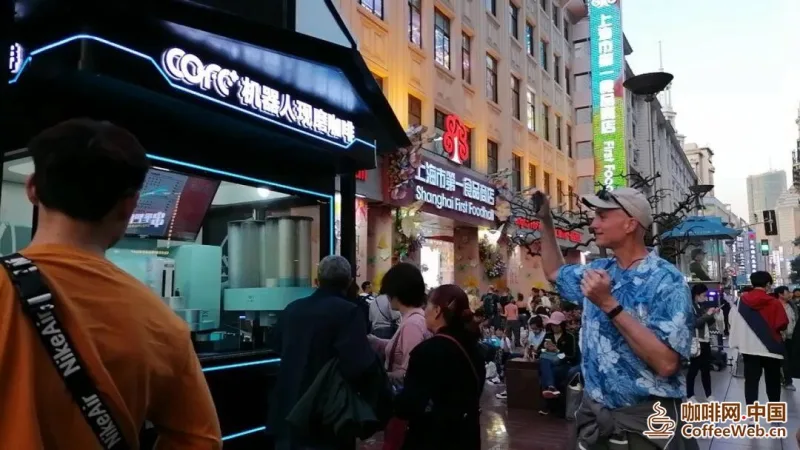
A Hi-Dolphin COFE+ “café” at a site on Nanjing Road Pedestrian Street on the Bund, Shanghai.
2. Multiple sales models, at 70 percent of a chain café’s cost
Hi-Dolphin has now deployed more than 4,000 locations worldwide, of which only 40 are directly operated stores used for product testing and collecting user feedback; the rest are run locally by B2B partners. “We are not selling coffee-robot equipment; we are delivering a complete, reliably profitable solution for a robot light-store,” Han said.
Hi-Dolphin works with its B2B clients through five models, matched flexibly to each client’s needs:
- Agency model: the client uses the Hi-Dolphin brand, mainly in settings such as airports and tourist attractions.
- Purchase model: the client buys the equipment and deploys it on its own premises.
- Customisation model: aimed at major brands and Fortune 500 companies, allowing clients to use their own brand and to adjust the robot’s appearance.
- Leasing model: for financial institutions, government bodies, public institutions and other entities that cannot operate across business lines.
- Joint-operation model: for landmark buildings and other key sites, with Hi-Dolphin supplying the equipment.
Hi-Dolphin has also integrated the upstream supply chain for raw materials such as coffee beans, dairy and syrups, adjusting tastes to different markets and continuously developing new products. In taste and product range, it benchmarks itself against chain brands such as Luckin Coffee. “A robot café is still, at bottom, a coffee service — taste is what wins,” Han said.
On pricing, Hi-Dolphin adjusts the price of a single cup dynamically to local conditions, while keeping the cost of opening a location to 70 percent of a chain-brand store.
3. Emerging markets need infrastructure; Europe and the US demand compliance
Hi-Dolphin began expanding overseas as early as 2021, when its first letter of intent came from the organisers of Expo 2020 Dubai, who planned to purchase 50 coffee robots.
It was the height of the pandemic: travel between China and other countries required a 28-day quarantine, customs procedures for equipment were cumbersome, and on-site commissioning abroad was difficult. Although appearing at Expo 2020 Dubai might well lose money, Han decided to overcome every obstacle: “This is a rare chance to validate the product in real conditions in another country — how it adapts to different climates, voltages, payment systems and consumer habits.”
Seizing the opportunity, Hi-Dolphin set up a dedicated overseas team, and over the following three years it placed small batches of machines in different countries to test product stability and gather frontline operating data.
The questions Han listed for validation included:
- In a humid country such as Brazil, what happens when circuits and materials get damp?
- In the dry, static-prone Middle East, will precision sensors be disrupted?
- In Japan, with its small shops, narrow doors and tight passages, can a wheeled machine move in and out freely?
- With local water of different hardness and mineral content, will the final taste of the coffee be affected?
Once the machines ran stably across different environments, country certifications were secured and a remote after-sales system was in place, Han judged that the company was ready to expand overseas at scale.
Southeast Asia and the Middle East were the first emerging markets Hi-Dolphin entered.
Coffee consumption in these regions is growing and full of opportunity, but infrastructure is relatively “backward”. In some Middle Eastern countries cash is still the main payment method, while in Southeast Asia each country has its own mobile-payment platform, so entering a market means connecting to several different payment systems.
On top of that, many regions still rely on 2G to 4G networks: connections are unstable and slow, and some do not support IoT devices at all, directly limiting the normal operation of robots that depend on remote maintenance and data transmission. Hi-Dolphin therefore brought in specialist talent and developed an AI-coordinated micro-communications system, achieving “one machine that works worldwide”.
In mature markets such as Europe, the US, Japan and South Korea, Hi-Dolphin faced a different set of difficulties. Consumers there are more accepting of unattended equipment, but they also demand higher coffee quality and face stricter compliance standards.
Take food-contact materials. Parts that come into direct contact with coffee, milk and water — the extraction head, milk lines, water tank and cup holder — must separately comply with the US FDA, EU Regulation (EC) No 1935/2004 and Japan’s Food Sanitation Act, and pass migration testing to ensure no harmful substances leach into the drink.
For cleaning, the milk-line system needs a standardised high-temperature sterilisation process and traceable cleaning records, and unattended machines must be able to clean themselves and issue expiry reminders. In places where national authorities impose the strictest controls on food hygiene and fire safety, such as international airports and hospitals, higher safeguards — protection against toxins, epidemics and fire — are also required.
To meet these demanding requirements, Hi-Dolphin built compliance into the product-design stage rather than obtaining certificates after entering a market. Its coffee products are benchmarked against the regulatory requirements for professional cafés, with the entire chain of operations, consumables and cleaning fully traceable, so that the production data for every cup can be traced back to a specific batch of materials and the machine’s operating parameters.
As of August 2026, Hi-Dolphin’s COFE+ had reached 70 countries and regions and been deployed in more than 200 cities worldwide.
Han summarises localisation for overseas markets as two layers. The software and content layer — language interface, menu recipes, payment methods, brand colours, latte-art designs and drink varieties — does not affect the machine’s structure and is relatively easy to implement.
The interface and compliance layer — voltage, plugs, local certification, water lines, water quality and consumables — must be converted to local standards, while the core components behind it, such as motion control, fluid algorithms and the machine body itself, remain globally uniform. “Customising at the structural level is a recipe for chaos later on, and it plants a huge hidden risk in the after-sales system,” Han explained.
In his definition, Hi-Dolphin is not a robotics company but a new-consumption company. “Hi-Dolphin is aimed at the new economy, new business formats and new models, using robotics to rebuild the cost structure and consumer experience of the traditional coffee business.”
Going forward, Hi-Dolphin will iterate toward fewer components, a wider range of products, a stronger consumer experience and greater intelligence, while its overseas business goes deeper into localisation and refined operations. “We hope to reinvent the café and move coffee consumption into the era of the light store,” he said.
Reprint Note & Disclaimer
- This article is reprinted from Chinese media for information and cultural exchange. The views expressed are those of the original author and do not necessarily reflect the position of coffeeyo.com.
- All trademarks, brand names and logos mentioned belong to their respective owners.
- For cooperation, reprint or correction requests, please contact coffeeyo.com.
Reprint Notice & Disclaimer
- This article has been edited and compiled by China Coffee Network. The information and images therein come from public sources and the copyright belongs to the original author. This reprint is intended solely for information sharing within the coffee industry and does not represent the views of this website; all data and opinions are subject to the original article. Our thanks to the original author for creating and sharing it.
- For matters concerning content licensing, attribution, copyright or otherwise, please contact us promptly and we will verify and cooperate in handling them as soon as possible. We also welcome coffee origins, brands and industry media to exchange ideas and contribute articles.
- Contact China Coffee Network: Tel 400-0000-641 (+86-18288016826) | Email 405854472@qq.com
Related Reading
- Automatic Coffee Machines Recommended for Office Workers
 Gree Wins New Robot Patent as Its Coffee Robot Draws a Flood of Orders
 Midea-Led National Standard for Home Coffee Machines Takes Effect, Elevating China Coffee-Machine Voice
 Robot Barista Debuts in Wuhan: One Cup in 90 Seconds, in a Real Consumer Setting
 Auto-cleaning the brew group of a super-automatic espresso machine: the overlooked cleaning key, and how the Grindel H3 handles it
 Which super-automatic espresso machine for when guests come over? Picks for home entertaining


 Liaoning ICP Security No. 21122402000217