

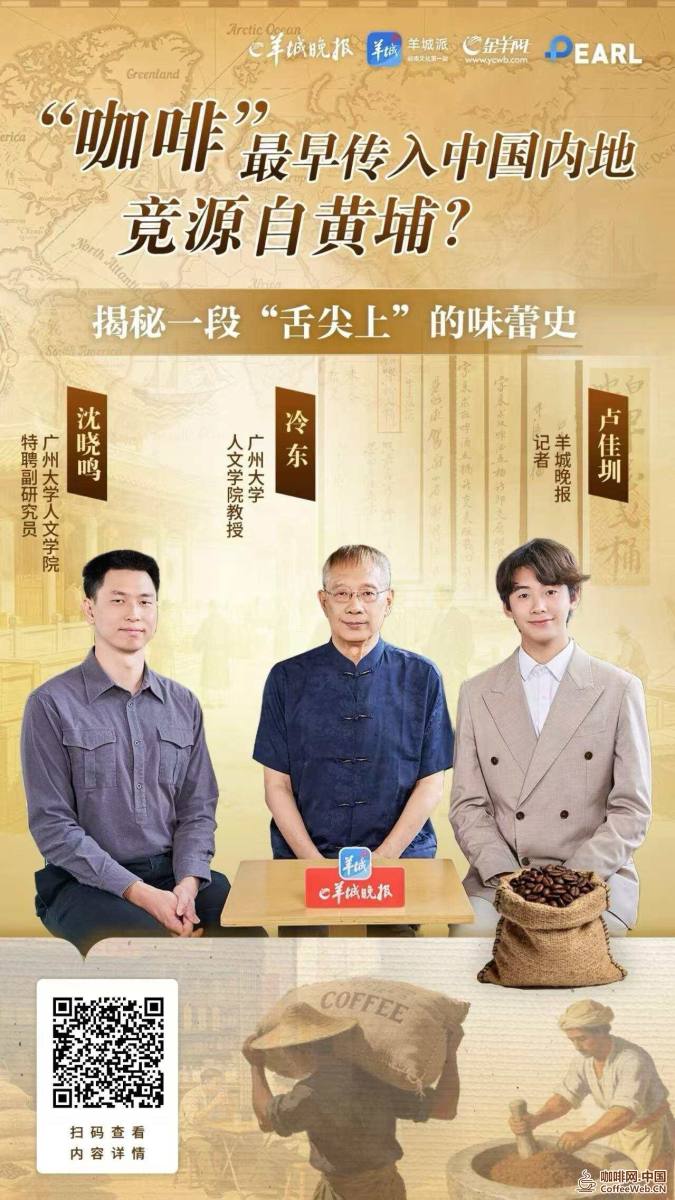
The lingering heat of the 2026 Guangzhou coffee season still lingers, and Huangpu Changzhou Island is still filled with the rich aroma of coffee.
At the Changzhou Coffee Branch of Huangpu District Civic College, the research of two scholars has uncovered a little-known page in the history of Chinese coffee: as early as 1812, coffee beans had already appeared as gifts in the correspondence of Huangpu merchants.
This not only means that in terms of academic discovery, coffee was introduced to mainland China at least 20 years earlier, but also redefines Huangpu's position on the world beverage map – coffee, fine wine, and cold drinks have completed a tongue to tongue encounter here. Recently, a reporter from Yangcheng Evening News interviewed Professor Leng Dong from the School of Humanities at Guangzhou University, as well as Shen Xiaoming, a specially appointed associate researcher from the School of Humanities at Guangzhou University, to uncover this flavor memory that was blown by the sea breeze.
Landing from Huangpu: A Letter from 1812
I always like to use 'sesame seeds open the door' to describe the joy brought by new discoveries. Professor Leng Dong's opening was filled with scholars' joy and enthusiasm for academic achievements. The 'new discovery' he referred to is a Chinese letter hidden in the Cambridge University Library.
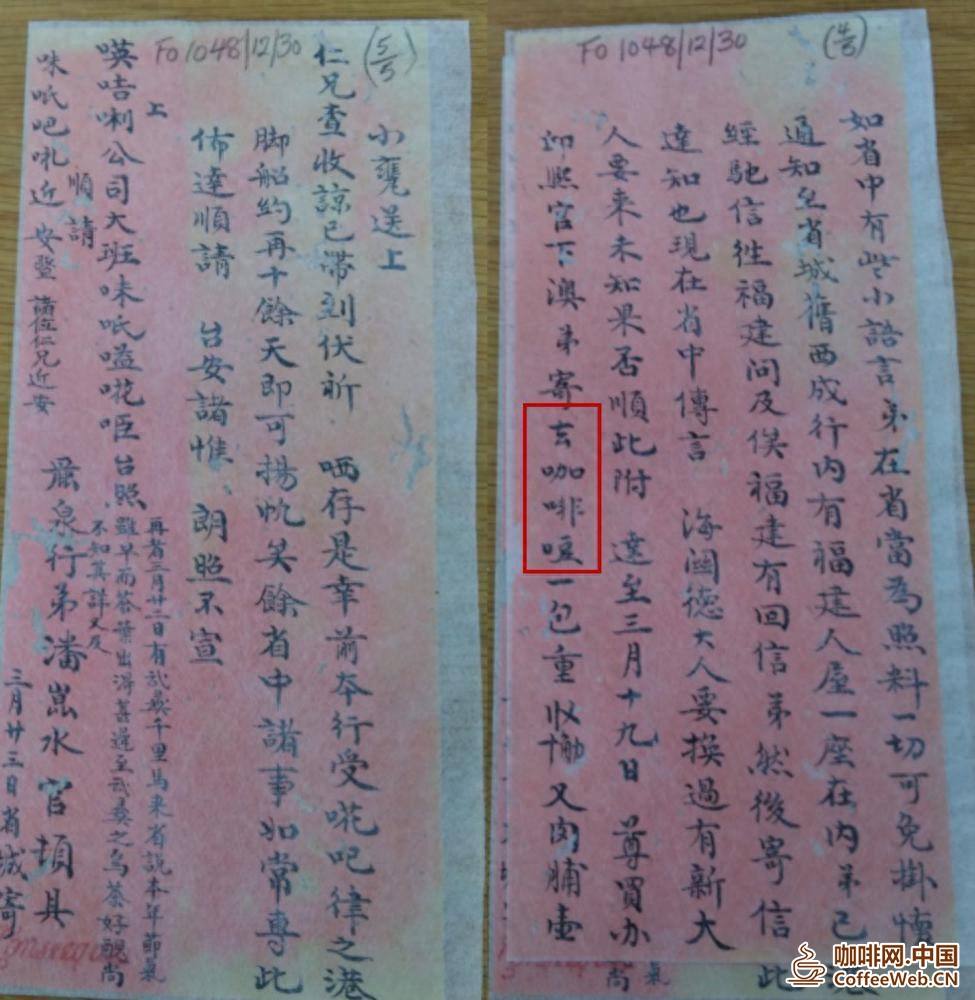
In 1812, Pan Changyao, a merchant from the Thirteen Factories in Guangzhou, wrote a letter to Elfinstone, the head of the British Chamber of Commerce. The letter mentioned that he received eight salted fish, weighing 36 pounds, as a gift from the other party; As a gift, he gave the other party a pack of coffee beans with the "Xuan" brand, with a net weight of 24 pounds. This letter has now been confirmed as the earliest documented evidence of the introduction and popularity of coffee in mainland China.
The letter from Pan Changyao to the senior staff of the British Chamber of Commerce, Elfenstone
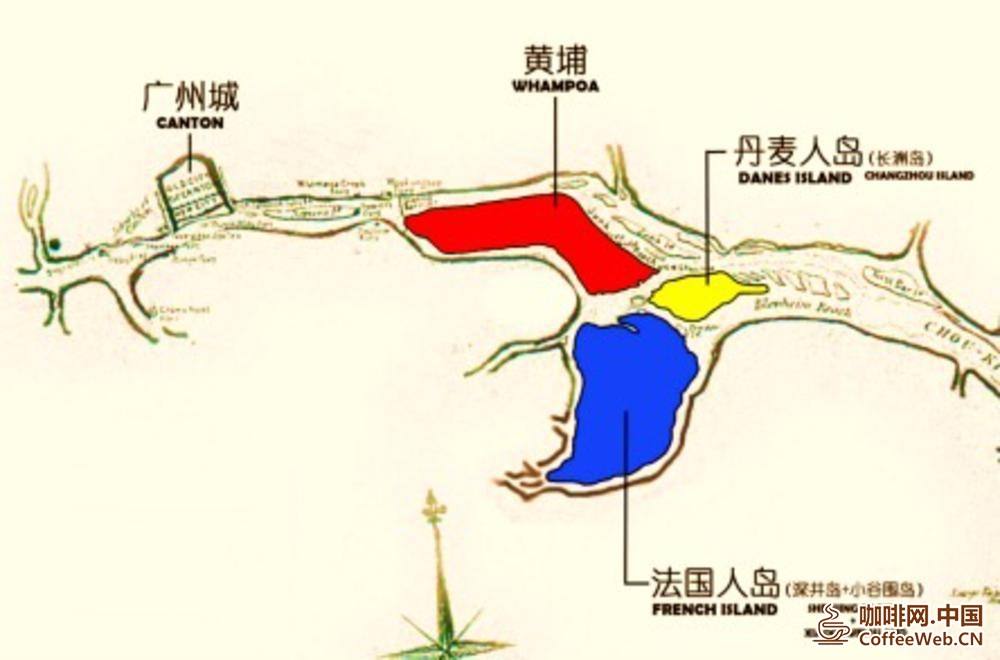
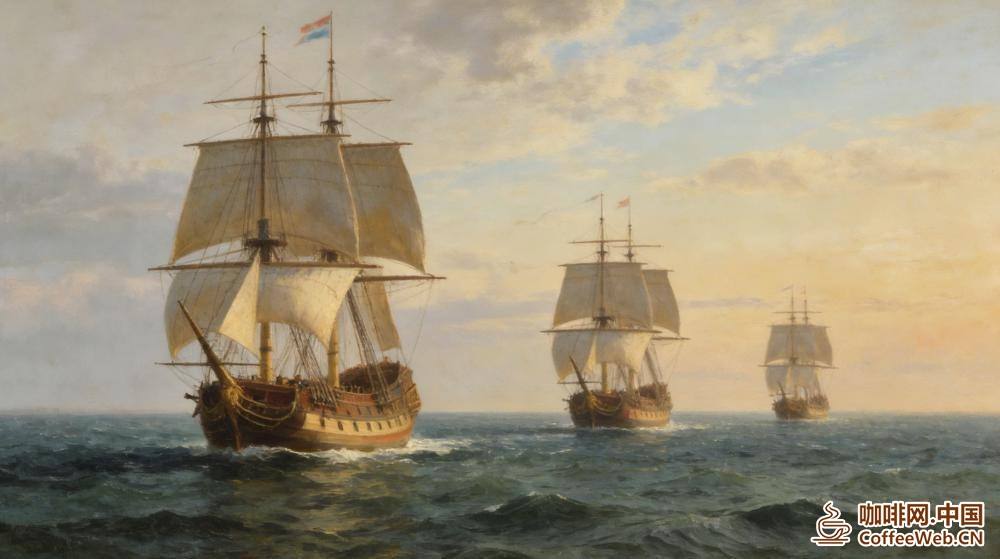
During the period of "One Port Trade", the court issued a decree that foreign merchant ships carrying foreign goods must first anchor at Huangpu. Foreign merchants handle procedures such as unloading and transferring goods, paying taxes, etc. in Huangpu, and imported goods are transported by specialized ships to the Thirteen Factories for trading. It can be inferred that the coffee beans gifted by Pan Changyao must have first landed at Huangpu at that time.
Schematic diagram of Guangzhou City, Huangpu Village, Changzhou Island, Shenjing Island, and Xiaoguwei Island
Shen Xiaoming added that the information revealed by this gift goes far beyond one time point. The large quantity and variety indicate that Huangpu already had a complete coffee processing and cooking technology at that time. The "Xuan" character he pointed out means that coffee beans have already been classified into grades or types. Moreover, this is not a new acquaintance, but a trend – a reasonable inference is that coffee entered Huangpu even earlier
Jardine Matheson Archives, Cambridge University Library, UK
The traditional academic view holds that coffee was introduced through Macau during the Daoguang period and gradually became popular during the Tongzhi period with the opening of Shanghai as a port. Professor Leng Dong admitted that the breakthrough of this research is due to the early achievements of Professor Jin Guoping from the Macau Research Institute of Jinan University. We have moved forward on the basis of previous research, providing a more accurate answer to the question of 'where did it come from'
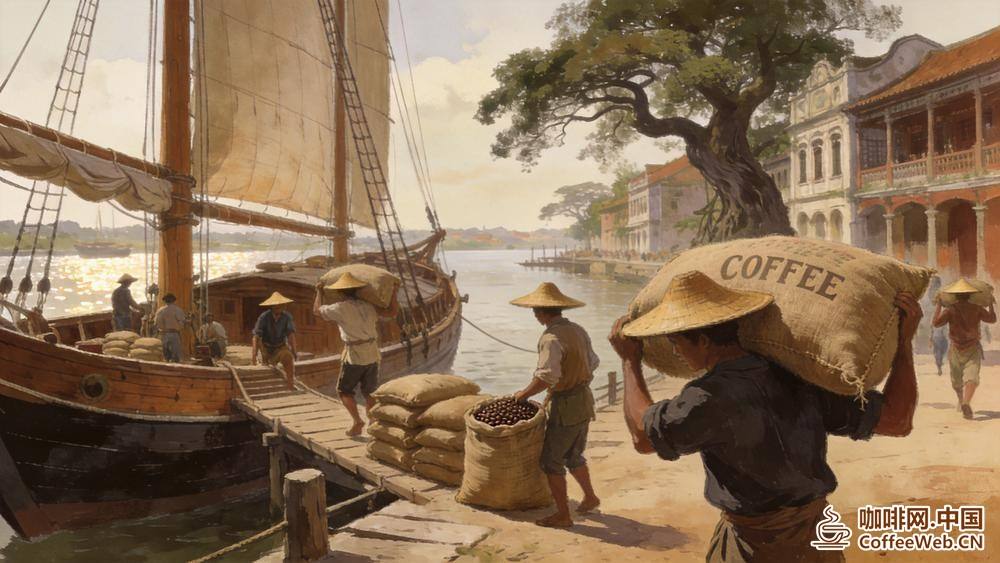
It is interesting that the posture of this historical moment is quite intriguing: coffee beans were gifts given by the Thirteen Factories merchants to Western merchants. When it first appeared, it was not an unfamiliar foreign product, but the hospitality of the Eastern host, "said Professor Leng Dong. This reverse flow precisely reflects the throughput atmosphere of Huangpu as a trade hub back then.
The throughput meteorological map of Huangpu, which was once a trade hub, was generated with the assistance of AI
Not just a feast of coffee: Ice water and fine wine 'meet' in Cheung Chau
If we consider coffee beans from 1812 as a seed, then a batch of invoices from the Xianfeng period showcases a thriving taste forest.
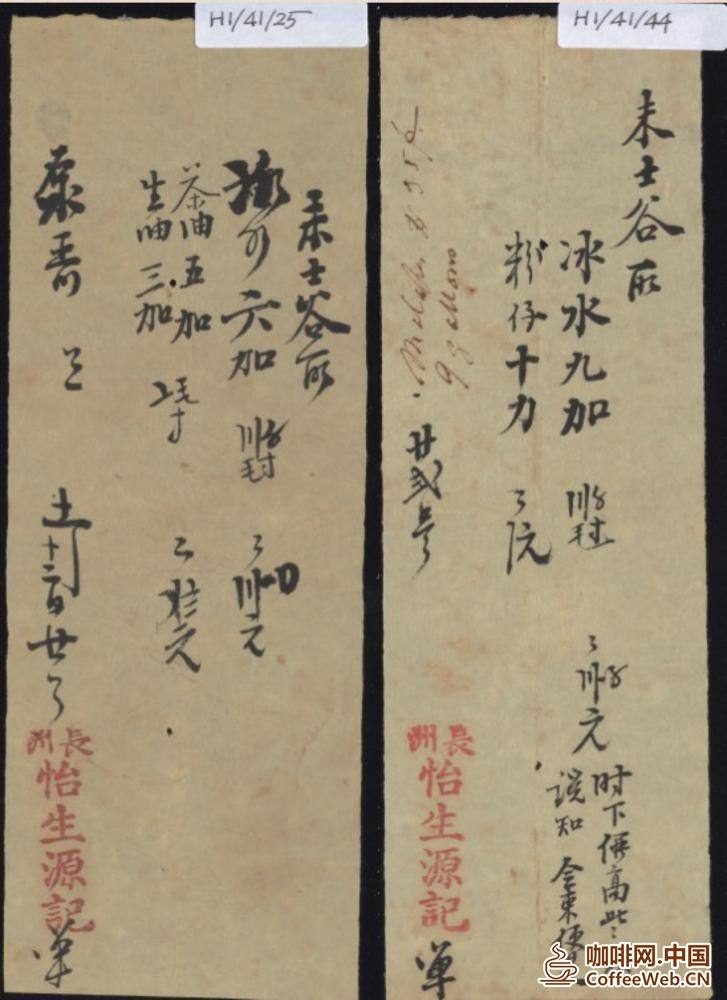
When Shen Xiaoming searched through the archives of Jardine Matheson in the Cambridge University Library, he found 45 copies of the "Changzhou Yi Sheng Yuan Record Form". These receipts, dating back to around 1855 to 1856, record the true transactions between a Huangpu trading house and British merchants. On the bill of lading, in addition to tea oil, ham, and biscuits, beer, gin, and ice water are prominently listed.
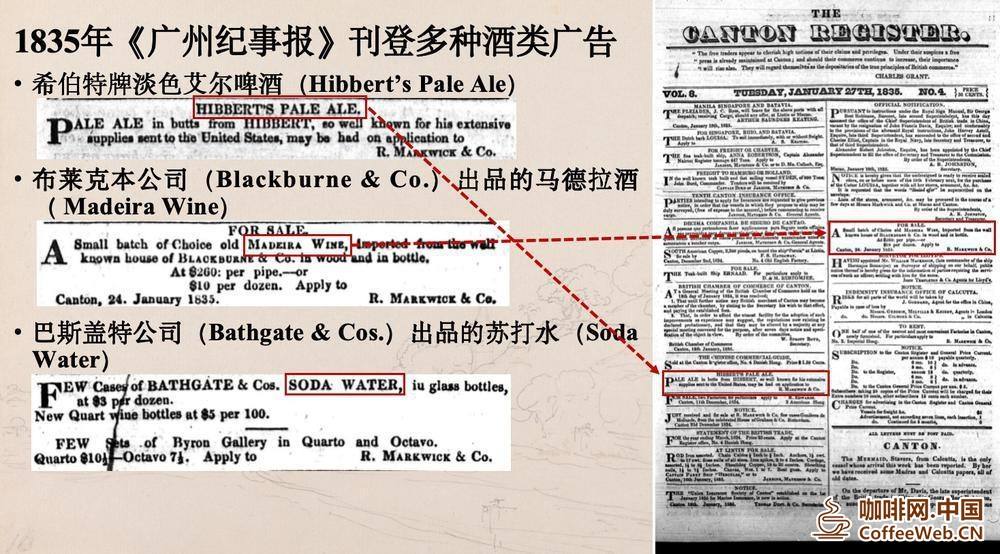
There are five orders of beer, a total of nineteen barrels; one order of gin, five boxes, "Shen Xiaoming said, as if flipping through the ledger of the day. He said that beer became a safer drink than water in the eyes of the British at that time due to boiling and sterilization, and was a necessity for long-distance travel; Gin, on the other hand, is widely popular among poor people in the UK due to its low blending cost. In the Guangzhou Chronicle published in 1835, there were already advertisements for pale ale beer, Portuguese Madeira wine, and even soda water. These phenomena indicate that before the Opium War, Western food and beverages had already infiltrated the daily life of Guangzhou from Huangpu.
In 1835, the Guangzhou Chronicle published various advertisements for alcoholic beverages
The most exciting thing for researchers is the two ice water records on the manifest: one is six gallons and the other is nine gallons, with a higher unit price per gallon than tea oil. Guangzhou has a subtropical monsoon climate with no snow all year round, but there was ice water trading in 1855, which is already intriguing, "said Professor Leng Dong with great enthusiasm. Turning the conversation, he introduced a" Ice King ".
Changzhou Yiyuan Student Registration Form
This' Ice King 'is named Frederick Durdu, a Boston businessman who was a pioneer in international ice trade in the 19th century. He began extracting natural ice from North American lakes in 1806 and trafficking it to Caribbean islands. In the 1830s, he entered the Indian market and in 1845, he opened his branch to Hong Kong, with the ice storage facility located on today's Snow Factory Street. The route of the ice block is very clear: it is harvested from North American lakes, transported to Hong Kong through an improved cold chain system, and then transferred to Huangpu, "explained Shen Xiaoming.
In an era without electricity or refrigeration equipment, being able to transport ice across half the world to Cheung Chau Island was a powerful proof of the prosperity of the Maritime Silk Road. Professor Leng Dong said that in the era of limited conditions, the storage of "ice" was always a privilege of the noble race. In Huangpu, ice water can enter villages for trading, which has a completely different meaning.
Let the history of 'Guanghuo' brew the future fragrance
What is the practical purpose of tracing back this past event? The answers of the two scholars are quite consistent: to give Huangpu today the "cultural roots" and the confidence to go global.
Shen Xiaoming believes that Huangpu holds a unique cultural calling card. The first stop for coffee to enter mainland China is itself a scarce cultural resource. It can be used to empower the industry or create exclusive cultural and tourism IPs. He listed three directions: first, to establish cultural identity based on historical heritage; The second is to innovate flavors with an open and inclusive spirit, creating a "Cantonese style coffee" with Lingnan characteristics; The third is to build an international communication and trade platform based on the Guangzhou coffee season, "turning the 'foreign goods' of the past into the' Guangzhou goods' that are marketed worldwide today".
Professor Leng Dong stated that these findings have given "eating in Guangzhou" a more specific meaning. Since such rich and diverse food and cultural exchanges can be achieved on the most basic level of Changzhou Island, it is enough to see the vigorous vitality of this land. "He proposed the idea of" drinking in Huangpu ", believing that it complements" eating in Guangzhou "perfectly. During the Thirteen Elements period, the destinations of long-distance merchant ships were all written as' heading towards Huangpu ', which was the window for the world to understand China at that time
The "Huangpu Cloud Sail" weather map is generated with AI assistance
This statement has its own power. In the past, Huangpu Port was like a cloud with sails and masts, where tea, porcelain, and silk sailed out to sea, while coffee, wine, and ice landed in the wind. In the 2025 "Eight Scenic Spots of Guangzhou" selection, "Huangpu Yunfan" has become a unique benchmark in Guangzhou's millennium commercial culture. Professor Leng Dong used the term "wonderful encounter" to describe the encounter of Eastern and Western beverages in Huangpu – Chinese tea and Guangdong herbal tea spread outward, while Western coffee, beer, and ice water poured in, completing a "civilized agreement" between the cups and glasses.
What would be the answer to selecting the most representative physical object and document of Huangpu's beverage culture from the diverse historical materials? Professor Leng Dong pondered for a moment and pointed his finger towards the photocopies of historical materials: 'These are the forty-five bills of lading, as well as the letters from Pan Changyao.' He said that these scattered overseas documents not only record commodity transactions, but also vividly detail Huangpu as a hub of China and the world. He earnestly called for these precious historical materials to be returned to their parents' home in an appropriate form as soon as possible.
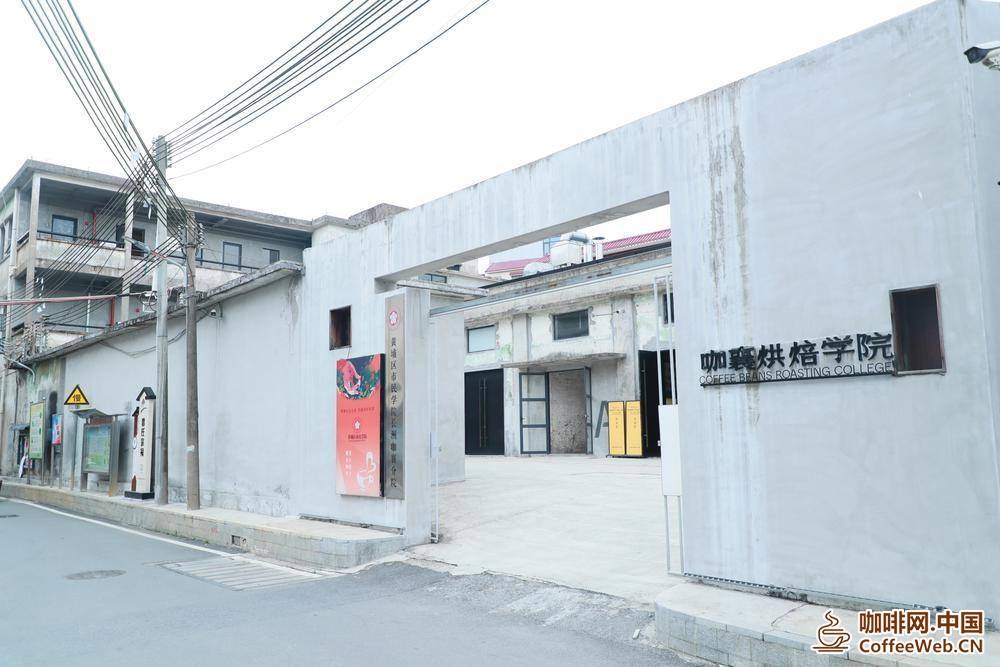
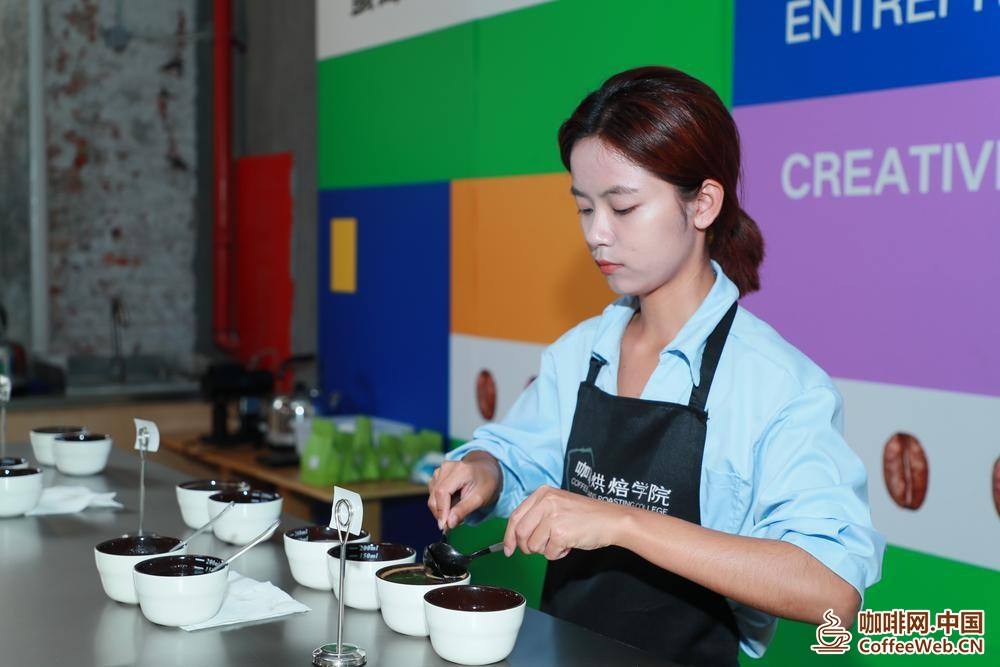
The sky outside the window is gradually darkening, but the lights in the Coffee Branch are still bright. The students are practicing hand punching techniques, and the water vapor is misty. More than a hundred years ago, coffee beans knocked on the door here; More than a hundred years later, the aroma of coffee still lingers here.
Photo by Li Jianfeng from Kaoxiang Baking Academy
Photo by Li Jianfeng from Kaoxiang Baking Academy
Openness, absorption, and innovation are the inherent spirit of 'Guanghuo'. Looking at the current situation, the Huangpu coffee industry chain has gained momentum: both the quantity of arrivals and the planting area rank first in the city, and the 45 acre ecological coffee plantation has introduced nearly 20 varieties; Local brands bloom in multiple locations, and intelligent equipment is exported to 110 countries worldwide; The talent cultivation base has settled on Changzhou Island, connecting the entire chain from seeds to cups here.
Coffee, fine wine, and ice water, these "foreign goods" that were once imported from thousands of miles away, have shed their unfamiliar faces and been infused with the warmth of Guangzhou through the transformation of Lingnan people's hands and soil. The food stories that belong to Huangpu and Guangzhou are also continuing to write a new chapter.
Planning | Liu Yun, Luo Ping, Dong Huahai
Execution | Xian Yingying Ying Lu Jiazhen
Article and Video | Reporter Lu Jiazhen
Image | Provided by the interviewee
Editor in Chief: Kang Qiyue
Proofreading: Zhou Yong
Signature review: Liang Zemin