
Editor’s note: The latest data shows China has 254,600 freshly made coffee stores, a net increase of 106,700 in three years. County-level outlets number 65,500 — more than all new first-tier cities combined — meaning roughly one of every four coffee shops in the country sits in a county. Coffee is moving out of office towers into counties, border towns and travel destinations, and this dual expansion of geography and occasion is rewriting the industry’s competitive logic.
Over the National Day golden week just past, crowds swept across the country. As young people left the CBD behind, coffee left the office towers and urban business districts too — for years it had been tied to big cities, commuting and desk work.
Shanghai has long been seen as China’s most coffee-soaked city, home to 11,420 coffee shops, more than any other city in China or the world, clustered especially densely around business districts and office blocks. The data is now rewriting that picture: Shanghai is no longer the city with the highest coffee density in per-capita terms; the total number of county-level coffee stores has overtaken the new first-tier cities; and in a border town like Ruili, store counts have grown more than 360% in three years.
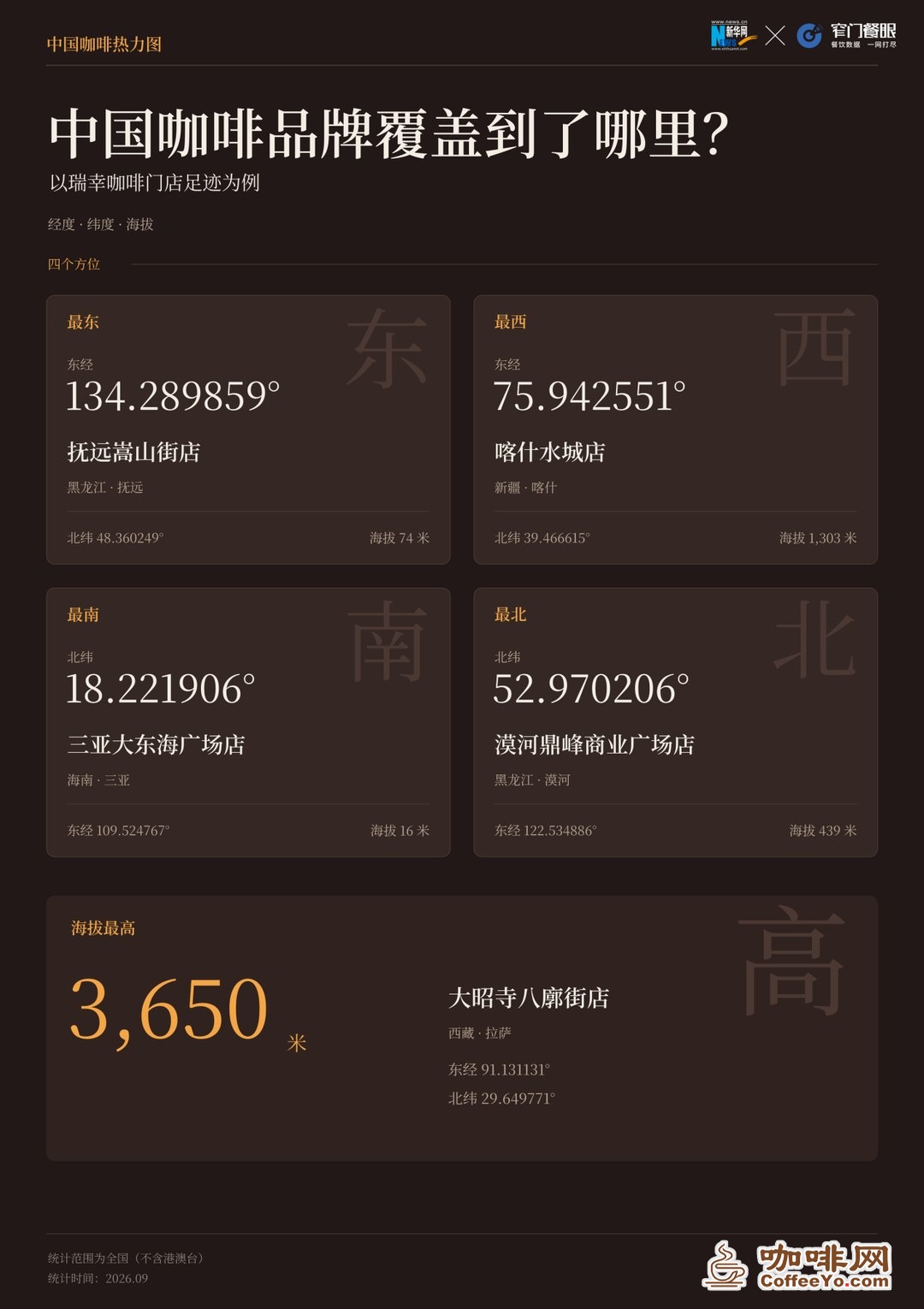
Coffee stores are spreading from city cores into counties, border regions and high plateaus
Shops reaching into tourism country
Over roughly three years, coffee shops have stepped out of core urban areas and extended into counties, border regions, high plateaus and tourist destinations. As of September 2026, China had 254,600 freshly made coffee stores — a net gain of 106,700, or 72.12% growth — spread across 31 provincial regions, 365 cities and 1,889 county towns.
The county market is one of the most notable stories in this expansion. County-level stores now number 65,500, up 103.41% in three years, exceeding the total in all new first-tier cities: roughly one in every four coffee shops in China is in a county. Notably, 97.88% of the three-year net increase came from counties that already had coffee shops — growth is coming from continued densification of existing markets rather than simple first-time openings. Dali and Kunshan have both passed 1,000 stores, with Dali topping the county-level league table.
Tourist destinations are becoming the next growth space. The top ten destinations by store count added 22,700 stores in three years, while cities like Shanghai and Beijing still grew from a high base. Faster growth belongs to places that were previously sparse: six of the top ten growth spots are in Tibet, Yunnan and Xinjiang, with Shigatse up 320.45% in three years, Tengchong 257.89% and Nyingchi 233.33% — high-plateau and border destinations are emerging as new coffee growth regions.
One striking contrast reveals how regional coffee consumption has changed. Shanghai has more than 11,000 coffee shops, among the highest totals in the country, but at 4.59 stores per 10,000 permanent residents it sits well behind several travel cities. Lhasa, Lijiang and Nyingchi have already passed Beijing, Shanghai and Guangzhou on density, with Lhasa first nationwide at 9.41 stores per 10,000 people and Nyingchi at 7.53 — a reminder that in tourist cities, floating visitor demand has to be counted too.
From commuting staple to travel habit
Behind the shifting map lies a shift in occasions. In daily urban life coffee is bound to office and commute; on the road, timing, place and motivation all diversify — refuelling on a long drive, wanting somewhere to sit in an unfamiliar city, or lingering for a distinctive shop and a local signature drink. Coffee folds itself into the journey.
The category is well suited to following crowds: high purchase frequency, and standardised supply chains that let it enter new cities and settings quickly. The combination is visible in Chaoshan, where arcaded old streets and traditional snacks intermingle with coffee shops, so that locals’ daily routes overlap with tourists’ itineraries. Ruili offers another picture: border culture, coffee-growing country and travel routes weave together, and its store count has gone from 39 to 183 in three years, making coffee a window through which visitors sense local industry and regional culture.
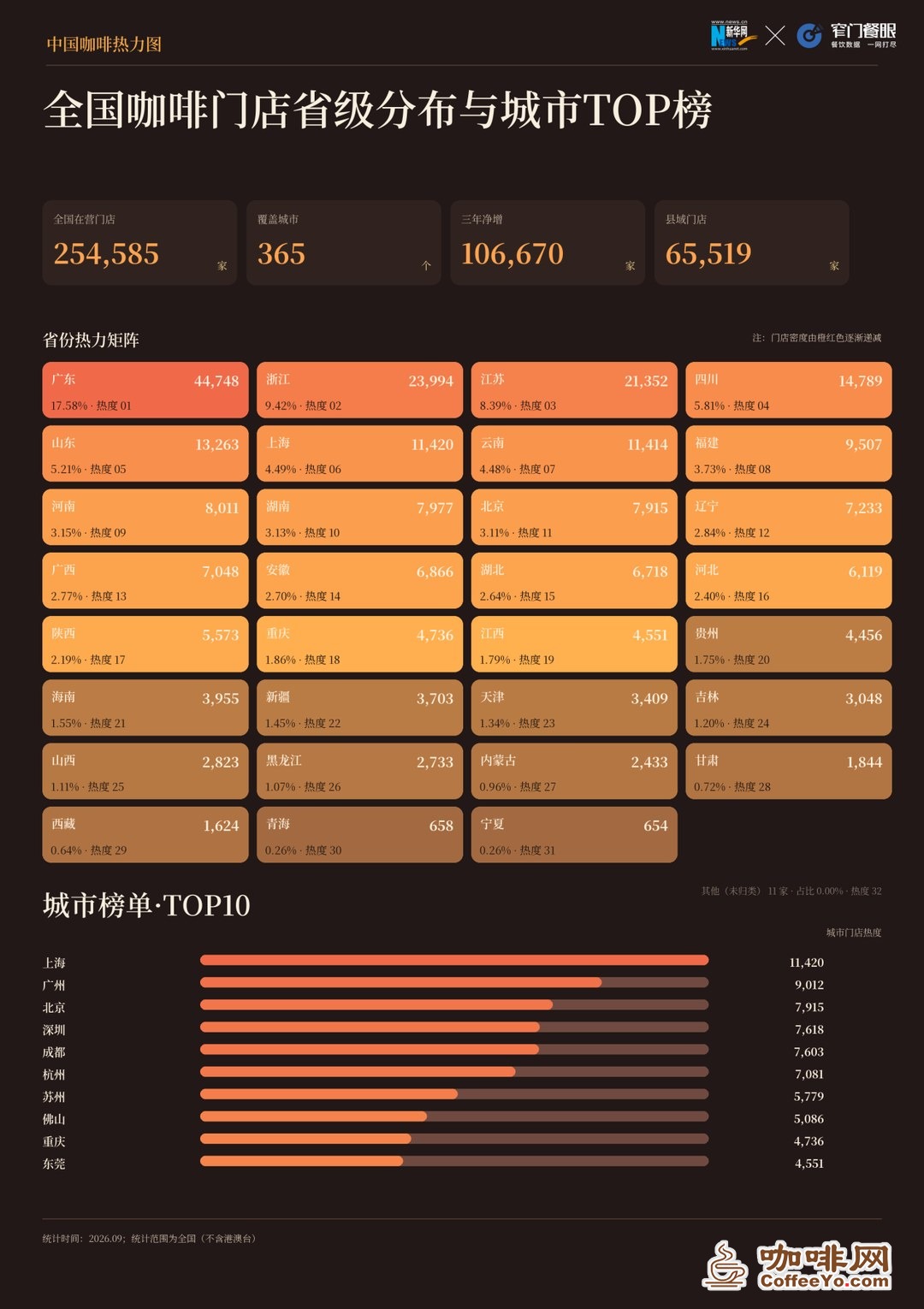
Coffee occasions now stretch from commuting to travel and leisure
Even in mature first-tier markets, coffee has extended from commuting necessity into urban wandering and cultural leisure. In Beijing it has entered parks, bookshops and art spaces, with chain brands opening in the old hutong around Yonghegong Street.
New questions beyond scale
The widening of the market is also changing how brands compete. Where chains once fought over prime spots in business districts and office towers, competition now reaches into supply chain assurance, cross-regional operations and locally adapted scene design.
Leading chains offer one view of this. Around 11 billion cups of freshly ground coffee were sold in China over the past year, roughly 4.1 billion of them by Luckin — about one in every three cups — while over the recent National Day holiday its weekly cup volume passed 100 million. What sustains that scale is a full-chain supply system covering raw material sourcing, processing, warehousing, logistics and store delivery, plus standardised operation across more than 30,000 stores.
While expanding coverage, brands are also trying to bind stores to local culture and tourism: Suzhou’s Lion Grove store draws on classical garden aesthetics, Hefei’s Garden Expo store borrows Hui-style architectural elements, and Xiamen locations build around coastal character. Beyond standardised delivery, these distinctive stores help coffee enter local daily life and give visitors something specific to the place.
As its geographic and occasion boundaries keep widening, China’s coffee market is opening broader space — from core cities into more towns, from office commutes into leisure travel. But the wider the market, the more complex the operating challenge. Faced with uneven development among county markets and the seasonality of cultural tourism, competition will be decided less by store counts and coverage than by supply chain reliability, cross-regional operating ability and localised innovation.
Source note and disclaimer
This article was compiled and republished by Coffee Network China from The Paper / Blue Whale News’s original report “Young People Rush to the Counties and the Coffee Shops Follow”. The copyright of the original text belongs to The Paper / Blue Whale News and its author. This republishing is intended solely for sharing information about China’s coffee industry with international readers and does not represent the views of this website. All data and opinions remain subject to the original source. Our thanks to the original author for the reporting that made this possible.
Read the original: The Paper / Blue Whale News — “Young People Rush to the Counties and the Coffee Shops Follow”
For matters regarding content licensing, attribution, copyright or any other issue, please contact us and we will verify and cooperate promptly. We also welcome coffee-growing regions, Chinese coffee brands, overseas buyers and industry media to share stories with us.
Coffee Network China — Phone: 400-0000-641 (+86-18941000313)|Email: 405854472@qq.com|Address: Jinghong City, Xishuangbanna, Yunnan / Tieling City, Liaoning, China