
At the recent 2026 Yunnan–Shanghai Coffee Industry Collaboration event in Shanghai, the coffee spot-trading system developed by the China (Shanghai) Pilot Free Trade Zone Coffee Trading Center was launched. The delivery-warehouse network covering the four major producing regions — Baoshan, Lincang, Pu’er and Kunming — together with Shanghai’s warehousing and distribution nodes was lit up simultaneously, and the Yunnan Coffee Price Index and the “Coffee Value Consensus Full-Category Appraisal Service Specification” (CVC) group standard were released together.
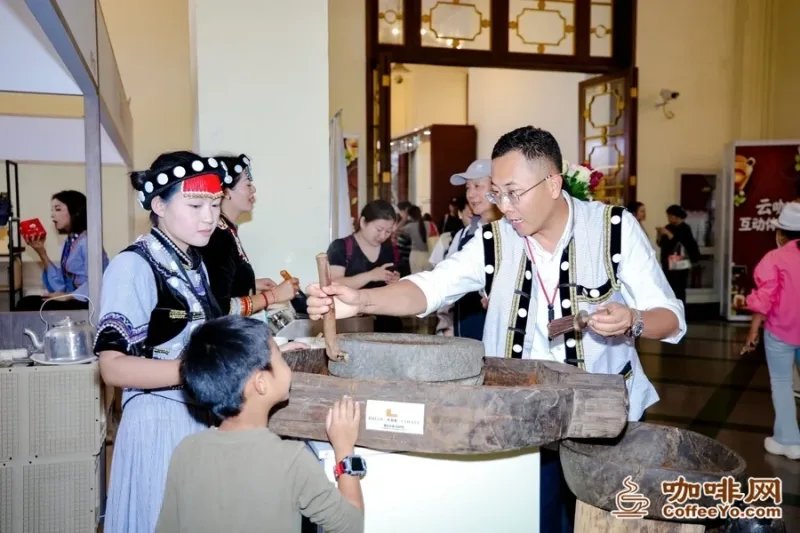
“Yunnan Good Beans”: the value chain extends from producing regions to the whole nation
Yunnan ranks first in China in both coffee planting area and output. In 2025 the province’s coffee planting area reached 1,518,800 mu with an output of 170,700 tonnes, shipped to 29 countries and regions. In recent years the industry has continued to upgrade: the specialty rate jumped from less than 8% to 41.7%, the deep-processing rate rose from 20% to 85%, the average green-bean price climbed from under 15 yuan per kg to 61 yuan, and the average price of specialty beans reached 87.8 yuan.
Over 30 years of Yunnan–Shanghai collaboration, Shanghai has continuously supported Yunnan’s coffee industry in talent, technology and cultural-tourism development, helping raise the value of Yunnan coffee. In Baoshan, Yunnan, Shanghai’s paired-assistance project funds helped launch a coffee target-price index insurance that puts a floor under farmers’ prices. In Nujiang, Shanghai experts brought classes into the mountains, running four consecutive coffee training camps and opening silent-coffee classes for hearing-impaired trainees, with qualified participants awarded certificates from the Shanghai Technicians Association. Furthermore, research institutes brought the standards of roasting, cupping and e-commerce operations into the producing regions, and the Yunnan Academy of Agricultural Sciences, together with Shanghai enterprises, achieved breakthroughs in seedling breeding and freeze-drying techniques.
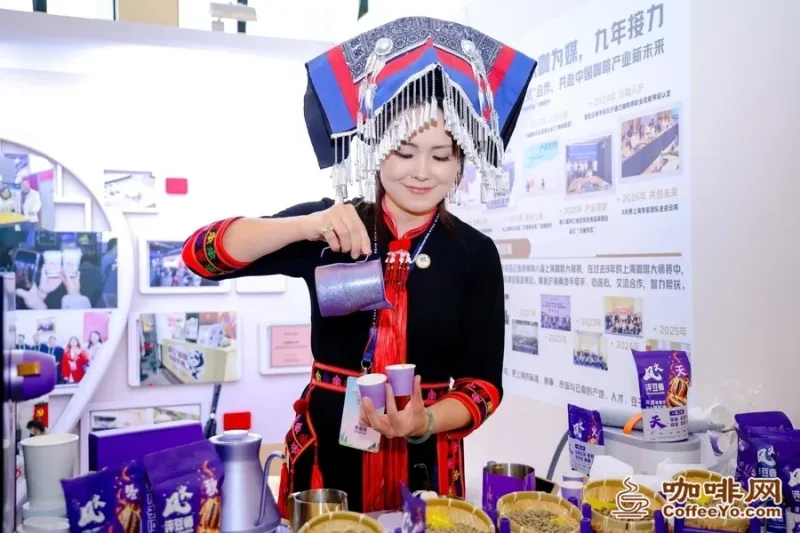
Meanwhile, as Yunnan’s coffee industry chain extends across the country, many brands also use Shanghai as a hub for circulating products nationwide. The coffee brand “Qianduo Fanhua” shared on site that it has laid out 3,000 tonnes of primary-processing capacity in Pu’er, 5,000 tonnes of roasting capacity in the Yangtze River Delta, and set up a brand-operations center in Shanghai. From green-bean processing to roasting, then to brand packaging and channel distribution, a complete loop of “Yunnan planting & processing — Yangtze Delta processing & roasting — Shanghai brand output” has taken shape.
Shanghai builds a trading system to seize pricing power
At the same time, the building of a standardized spot-trading platform and industrial financial-service capacity is gradually shoring up infrastructure gaps, creating fuller conditions for producing regions to achieve price discovery and capital flow. At the event, the coffee spot-trading system developed by the China (Shanghai) Pilot Free Trade Zone Coffee Trading Center was released, positioned as digital infrastructure connecting Yunnan’s coffee supply chain with procurement networks across regions, realizing “online transactions, localized delivery, and warehouse-receipt financing.” The system covers six trading modes: information listing with negotiated deals, serving non-standard and customized procurement needs; bulk auction, organizing unified clearing of large-volume supply and demand; price-increase auction, providing open price discovery for premium and scarce lots; capacity pre-sale order trading, agreeing on capacity and delivery dates in advance to connect future production and sales; warehouse-receipt listing, converting in-stock goods into standardized circulating vouchers; and warehouse-receipt repurchase, providing inventory-turnover financing based on verifiable warehouse receipts.

Also launched simultaneously were the delivery-warehouse network and the Yunnan Coffee Price Index. The delivery warehouses cover producing regions such as Baoshan, Lincang, Pu’er and Kunming, linking with Shanghai’s warehousing nodes to form a closed loop of “warehouses for delivery, indices for pricing, and a platform for fulfilment.” On the financial side, the system has been connected with the Hangzhou Bank system to provide full-process custody and supervision of trading funds, and will expand cooperation with Shanghai Pudong Development Bank in the future, enabling tools such as warehouse-receipt pledging and order financing to ease the capital-occupation pressure on growers and processing enterprises. The trading center has also established an operations-monitoring mechanism tracking four indicators: Yunnan’s production–sales connectivity, farmer-benefit linkage, the scale of Shanghai’s service implementation, and platform business dynamics.
Integrating industry value standards to help good beans “sell far”
As Yunnan’s coffee quality keeps rising, “Yunnan Good Beans” are going global and shipping overseas, leapfrogging from raw-material export to brand export. Take Kaiyuan Mingji Coffee as an example: the company integrates raw materials from both Yunnan and Vietnam, completes deep processing in Kaiyuan, and forms a cross-border capacity model of “raw materials from two countries, processing in Kaiyuan, sales worldwide,” with products exported to more than 20 countries and regions across Southeast Asia, Japan and South Korea, Central Asia, Russia, the Middle East, Europe and the United States. “Coffee beans in transit” have become “export goods rooted in Yunnan.”
Shanghai’s support for Yunnan coffee beans going overseas keeps upgrading. “Yunnan Coffee into Shanghai” expands global markets through channels such as Hongqiao Pinhui and cross-border e-commerce. The Yunnan Coffee Industry Fund is being prepared in parallel, linking five tracks — planting specialization, cross-border supply chains, local-brand incubation, coffee-tourism integration, and the low-altitude economy — and setting up special quotas for international joint breeding, overseas-certification export incubation, and exchange-rate risk hedging. Cross-border order financing and exchange-rate risk-management tools provide platform-side safeguards for the industry’s steady overseas expansion.
Good beans must fetch a good price, and standards must come first. Alongside the trading system, the “Coffee Value Consensus Full-Category Appraisal Service Specification” (CVC) group-standard system was released at the event. Launched by the Yangtze River Delta Coffee Industry Association, the system covers the full category from coffee seedlings to end-consumer products, focusing on four core mechanisms — quality control, grading, traceability management, and market expression: seedling purity no lower than 95%, “zero tolerance for malignant defects” in green beans, roasted-bean grade no higher than the raw green bean, and end-store “publicly queryable, scan-to-trace” full-chain transparency — giving Yunnan coffee’s quality premium a verifiable basis.
Yang Xin, head of the Shanghai Liaison Group for Assistance to Yunnan and Deputy Secretary-General of the Yunnan Provincial Government, said that Yunnan–Shanghai collaboration is shifting from “blood transfusion” to “blood generation”: “By pushing the coffee spot-trading system into operation, we aim to use Shanghai’s market-oriented thinking and financial resources to activate Yunnan’s producing-region advantages. Let Yunnan’s coffee beans not only be grown well, but also sell well and far, becoming ‘happiness beans’ that drive farmers’ income growth.”
Reprint Notice & Disclaimer
- This article is edited and compiled by Coffee Network (coffeeyo.com), reprinted from the Department of Commerce of Yunnan Province, “Yunnan coffee beans ‘sell well and far’: Yunnan–Shanghai coffee industry collaboration adds a new model.” The copyright of the original text belongs to the source and the original author. Our reprint is for coffee-industry information sharing only and does not represent our position; all data and views are subject to the original. We thank the original author for their creation and sharing.
- Original article: Department of Commerce of Yunnan Province, “Yunnan coffee beans ‘sell well and far’: Yunnan–Shanghai coffee industry collaboration adds a new model”
- For matters regarding content authorization, attribution, copyright or others, please contact us promptly; we will verify and cooperate in handling. We also welcome coffee enterprises and industry media to exchange and contribute.
- Coffee Network contact: Tel 400-0000-641 (+86-18288016826) | Email 405854472@qq.com | Address: Jinghong City, Xishuangbanna, Yunnan Province
Related Reading
 Three Decades of Shanghai-Yunnan Collaboration: A Coffee Bean ‘Ferments’ at the Import Expo
 Why Yongde’s Coffee Beans Won Gold in Shanghai – A Taste of ‘Life in Yunnan: 365 Days’
- Yunling Commentary: Yunnan Coffee Turnaround Hinges on Autonomous Pricing
 A ‘Travel Pack’ Reveals Another Possibility for Pu’er Baristas
- Bean in Short Supply: A Taiwan Youth on Yunnan Coffee as a Shared Cross-Strait Stage
- Five Years, Eight Championships: Lincang Coffee Joins the World Stage





 Liaoning ICP Security No. 21122402000217