



Trendy News Client Editor Wu Yingqiu
Photo by journalist Chen Pufeng
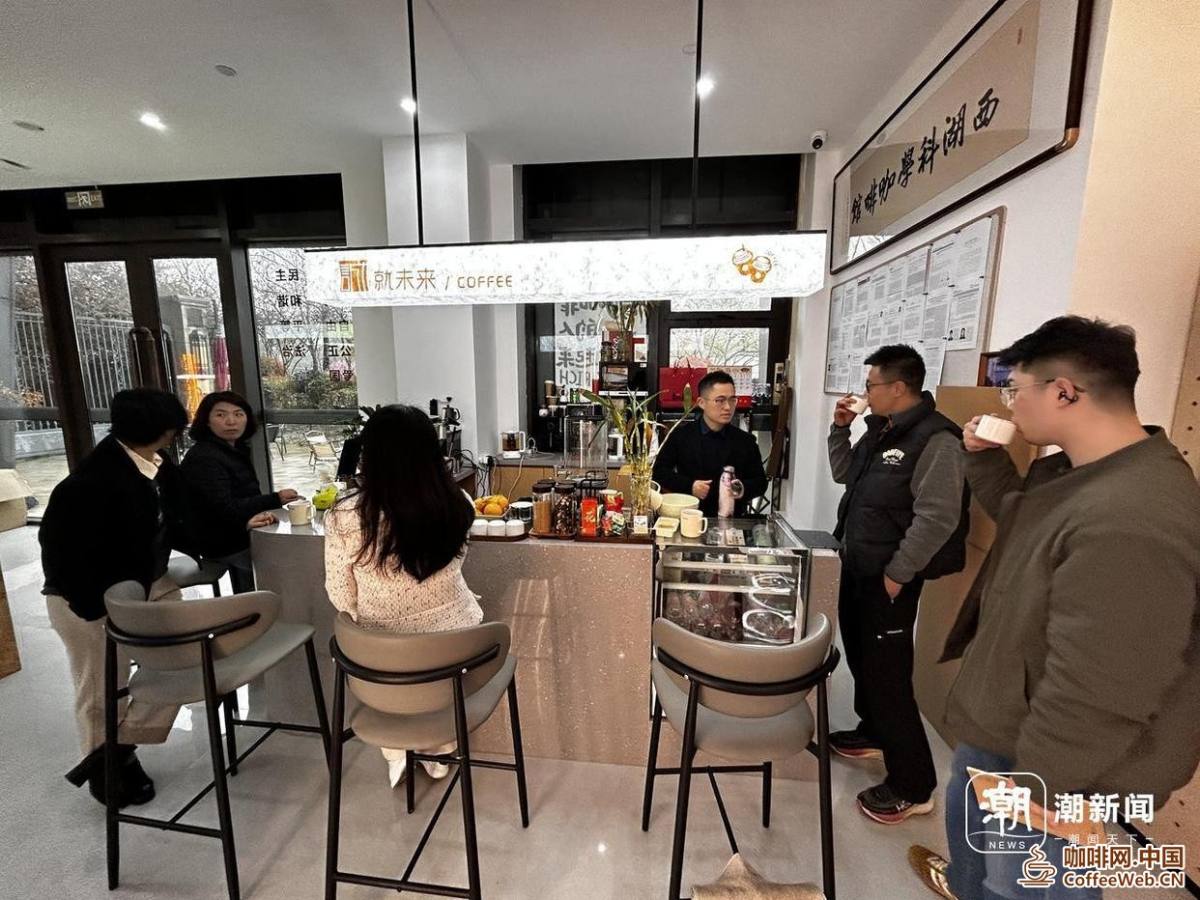
The drizzling spring rain moistened the streets and alleys of the south gate of Zijingang, Zhejiang University, and added a touch of warmth to Jiangcun Street in Xihu District, Hangzhou, which is adjacent to the campus. Under the rain curtain, the West Lake Science Caf é emits warm orange lights, with conversations echoing inside and coffee cups ringing lightly. Qiu Guoliang, Executive Dean of Zhejiang Haichuang Technology Exchange Research Institute, Master of Zhejiang University, and co-founder of West Lake Science Caf é, is sitting with guests.
A survey on early scientific research collaboration shows that over 70% of breakthrough ideas arise from informal communication, "said Qiu Guoliang. Coffee shops are deliberately located in communities rather than industrial parks or research institutes to break down the barriers between research and life." A cup of coffee, capital, and technology can be discussed at the same table
There are many academicians, scientists, innovators, or industry investors who enter and exit community cafes. Fireworks and innovation are quietly colliding and deeply connected.
What did you drink? Since its birth five months ago, the coffee shop has already "drunk" nine science and technology innovation enterprises here.
Click for details>>
What is the magic of opening a coffee shop in a community in Hangzhou after "drinking" 9 science and technology innovation enterprises in 5 months
Let innovation go from the laboratory to the residents' side
It's amazing that a small coffee shop "drank" 9 science and technology innovation companies in 5 months, but it's not.
The Science Caf é is a scientific exchange platform created by the Provincial Association for Science and Technology. I have participated in several activities, which are quite interesting. Now the grassroots science association has simply brought it into the community, directly facing the public, and has not chosen the narrative style of science popularization lecture halls and science museums, but has chosen a seemingly ordinary but actually meaningful spatial carrier. In my opinion, behind this choice lies a deep code of scientific communication and even innovation paradigm change. Its internal logic and inspiration, name and form cannot be said to be unimportant, but more importantly, its internal function and atmosphere.
One is the functional reshaping from knowledge dissemination to innovative connectivity. Traditional science communication often follows the "knowledge waterfall" model, where the scientific community serves as the upstream and is transmitted unidirectionally to the downstream public through mass media. Although this model has its value, it is difficult to avoid two dilemmas: one is the passivity of the public, and the other is the sense of alienation between science and life. The innovation of 'Science Cafe' lies in positioning itself as a 'connector' rather than a 'lecture stand'. It needs to achieve triple connectivity: connecting scientists and the public, allowing researchers in the laboratory and residents in the community to have equal conversations at the same table; Connecting innovation and life, translating abstract cutting-edge technologies into debatable topics closely related to daily life; Connecting problems and resources, giving community residents the opportunity to reverse their true confusion and enter the scientific community's perspective, forming a micro circulation of "demand driven innovation". This means that the goal of science communication has shifted from 'making the public understand science' to 'making science and the public understand each other'. The former presupposes a hierarchy of knowledge, while the latter acknowledges that scientific innovation and life wisdom can complement each other.
The second is to recreate an atmosphere of equality, safety, and a sense of presence. If functionality determines what a space does, then atmosphere determines whether it can do well. The design of a science caf é is precisely focused on creating a high trust, low defensive social environment. The sense of equality first comes from the de stratification of physical space. Removing the gap between the podium and the audience, eliminating the tension of "speaking on stage and recording off stage", the aroma of coffee and the casual seating layout invisibly dissolve the binary opposition between authority and audience. More importantly, there is psychological equality: here, 'outsider questions' are allowed and even encouraged,' don't know 'can be accepted with equanimity, and scientists are no longer unattainable' big shots', but more like a willing sharing partner at the neighboring table.
The sense of security is reflected in the redefinition of dialogue rules. This is not an academic seminar that requires consensus, nor is it a knowledge exam that needs to test its effectiveness. Communication can be exploratory, fragmented, and even allow for silence and hesitation. When the public no longer worries about their own problems being 'too foolish', and when scientists do not have to constantly maintain the image of 'omniscient and omnipotent', real dialogue can occur. The sense of presence may be the most charming dimension in an atmosphere. Exciting conversations often occur in the aroma of coffee, during the moment of handing over tissues, and in casual conversations in twos and threes after the event officially ends. The value of this informal interaction often goes far beyond the carefully prepared formal process. The most precious moments in science communication are often unforeseeable, but can be inspired by the atmosphere.
Thirdly, innovation requires a 'third space'. The construction of an innovation ecosystem requires both a "first space" such as laboratories and research institutes, as well as a "second space" such as families and communities, and a "third space" between the two, a public space that is different from both formal institutions and private fields, allowing cross-border exchanges to occur with low barriers to entry. Coffee shops were important places for the dissemination of scientific ideas during the Western Enlightenment period. The coffee shops around Gresham College in London and Procope in Paris have witnessed the process of science moving from the elite circle to the public sphere. Today's' science cafes' are not simply copying history, but rather revitalizing the unique value of physical space in the digital age. The instant, tangible, and warm face-to-face communication cannot be completely replaced by online communities to this day. To bring innovation from the laboratory to the residents, what is needed is not louder speakers, but a more comfortable sofa. When scientists are willing to put down their speeches, when the public dares to raise their hands, when two groups can share a cup of coffee in the same space, the distance between science and society quietly disappears in this daily ritual.
Fourthly, a coffee shop does not need to be a coffee shop. Understanding the internal logic of a 'scientific caf é' ultimately leads to an open-ended conclusion: it does not have to be confined to the name or form of a 'caf é'. It can be hidden in bookstores, opened next to markets, set up in community corridors, or even a flowing street conversation. The key is not what it is called or what it looks like, but whether it can achieve the function of "connection" and create an atmosphere of "equality and security". This is probably the most vital part of this model. It does not provide a fixed set of operational templates, but a transferable concept. Scientific communication needs to shift from "educational logic" to "life logic" and "social logic", and from "letting people listen" to "happening around people". When this concept is internalized as a conscious awareness of community science communication, every public space may become an incubator for innovation.
In today's rapidly iterating technology and increasingly close relationship between science and society, the exploration of "science cafes" has significance beyond individual cases. It shows us that the deep goal of science communication is not only to enable the public to acquire more scientific knowledge, but also to truly make science a way of life that can be touched, talked about, and participated in.
Please indicate the source when reprinting
 Liaoning ICP Security No. 21122402000217