
I. Chinese coffee: a century-long road from “introduction” to “producing region”
Coffee’s entry into China was not late. As early as 1884, coffee seedlings were introduced to Taiwan; around 1908, overseas Chinese brought coffee back to Xinglong, Hainan for trial planting; but real large-scale planting had to wait until the 1980s — when Yunnan, with support from international programs such as the UN Development Programme, began systematically promoting small-grain coffee (Arabica).
Today, China’s coffee map is highly concentrated: Yunnan’s planting area and output have long accounted for over 90% of the national total, making it the true core producing region; Hainan, represented by Xinglong coffee, retains a unique tropical Robusta (Canephora) style; Sichuan’s Panxi region has risen remarkably in the past decade, taking a premium highland route. The three have similar latitudes but very different terroirs, exactly forming a producing-region map of “one country, three flavors.”
II. Yunnan: the “main engine” of Chinese coffee
Yunnan coffee is concentrated in Pu’er, Baoshan, Lincang, Dehong, Nujiang and other places, mostly at elevations of 1,000–1,500 meters. Located in the “coffee belt” near the Tropic of Cancer, with an annual average temperature of about 18–21°C and abundant rainfall, plus large mountain day-night temperature differences and loose fertile red or volcanic soils, it is very suitable for Arabica growth.
Variety structure. Yunnan has long been dominated by the Catimor series — a group of disease-resistant, high-yield hybrids suited to local large-scale planting; at the same time, the early-preserved “old varieties” such as Typica and Bourbon have been re-valued by premium estates for their cleaner and more elegant flavors in recent years. In the past decade, internationally famous varieties such as Geisha have also been successfully trial-planted at high elevations in Yunnan, providing room for flavor upgrading.
Processing and flavor. Common Yunnan processing methods are washed, natural and honey. Washed beans typically show soft fruit acidity, clean nuttiness and brown-sugar sweetness; natural and honey processes more easily bring out berry and fermented-fruit sweetness. Overall, Yunnan coffee is known for being “balanced, full-bodied, with obvious sweetness,” suitable both as a base for espresso blends and to stand alone as a single-origin pour-over.
Industry scale. According to public industry data, Yunnan’s coffee planting area is on the order of one million mu, and output has long accounted for over 90% of the national total; in the past most beans flowed to instant coffee and bulk blends, but the recent “premiumization” transformation — from blindly pursuing yield to focusing on elevation, variety and processing — has let Yunnan coffee perform brightly in international cupping. Specific area and output figures should follow the latest statistics from agricultural and rural authorities.
III. Hainan: the “Xinglong flavor” in the tropics
Xinglong, Wanning, Hainan is a special page in Chinese coffee history. Introduced by returning overseas Chinese in the early 20th century, its tropical, hot and rainy climate suits Robusta (Canephora) growth. Robusta has higher caffeine and a stronger, heavier flavor, a sharp contrast to Yunnan’s Arabica.
Xinglong coffee’s most recognizable trait is its localized drinking tradition: early overseas Chinese combined coffee with local ingredients, developing a “Xinglong coffee” way of drinking with milk, sugar, a slight burnt aroma and nuttiness — mellow, smooth, with balanced bitter-sweet — becoming a flavored name card of Hainan tourism. Today, “Xinglong coffee” has obtained geographical indication protection; though small in area, it occupies a place in domestic coffee with its distinct regional character.
IV. Sichuan: the “new force” on the plateau
Panzhihua and Liangshan Prefecture (e.g., Huili, Zhaojue) in Sichuan are emerging producing regions drawing attention in recent years. These plots are mostly at 1,500 meters or higher, with ample sunshine and extreme day-night temperature differences, so coffee cherries mature slowly, favoring the accumulation of sugars and flavor substances.
Similar to Yunnan, Sichuan grows mostly Arabica small-grain varieties, but because it started late, it has leaned toward a “premium” route from the beginning: small farmers and cooperatives select high-elevation plots, control picking maturity, and try fine processing. Their cupping often features cleanliness, brightness, and floral or citrus notes. Though still small in output, it represents another path for domestic coffee to reach upward in quality.
V. How terroir is “written” into the cup
Understanding producing regions means understanding how “terroir” affects flavor: the higher the elevation and the greater the temperature difference, the slower the cherries mature, often with brighter acidity and more concentrated sweetness; rainfall and soil determine plant nutrition and sugars; and processing (washed/natural/honey) is the human second shaping of flavor. The same Yunnan bean may show completely different cup performance when washed versus natural — which is exactly what makes coffee fascinating.
VI. Purchasing and tasting suggestions
If you are a beginner of domestic coffee, you can start from a few practical clues: first, look at the origin label — “Yunnan · Pu’er,” “Yunnan · Baoshan” is more specific than the vague “Yunnan coffee”; second, look at the processing method and washed/natural marks, and choose by your own acid-bitterness preference; third, buy beans with a recent roasting date — domestic beans are close to origin with short logistics, and freshness is a natural advantage; fourth, try a light-medium roasted single-origin pour-over first to more easily taste the region’s true character.
A reminder: there are many exaggerated online claims about each region being “No.1 in output” or “best in flavor”; it is advised to rely on authoritative industry reports and data released by producing-region governments, and avoid being led astray by marketing rhetoric.
Conclusion
From Yunnan’s red soil to Hainan’s tropical gardens, to Sichuan’s plateau slopes, Chinese coffee is moving from “raw-material supply” to “flavor expression.” For consumers, this means a more diverse cup experience; for the industry, it is an upgrade path from scale to quality. Next time you pick up a cup of coffee labeled with a domestic producing region, take a closer look at where it came from — that small producing-region map hides the mountains, climate and a whole year of countless growers.
Original-content statement and disclaimer
- This article is an original piece by the coffeeyo.com editorial department, focusing on popular science about Chinese coffee producing regions, aimed at helping readers build producing-region awareness, and does not constitute investment or business advice.
- The data involved in this article, such as planting area and output share, are compiled from public industry reports and government statistics; specific figures should follow the latest releases from the Ministry of Agriculture and Rural Affairs and producing-region local governments.
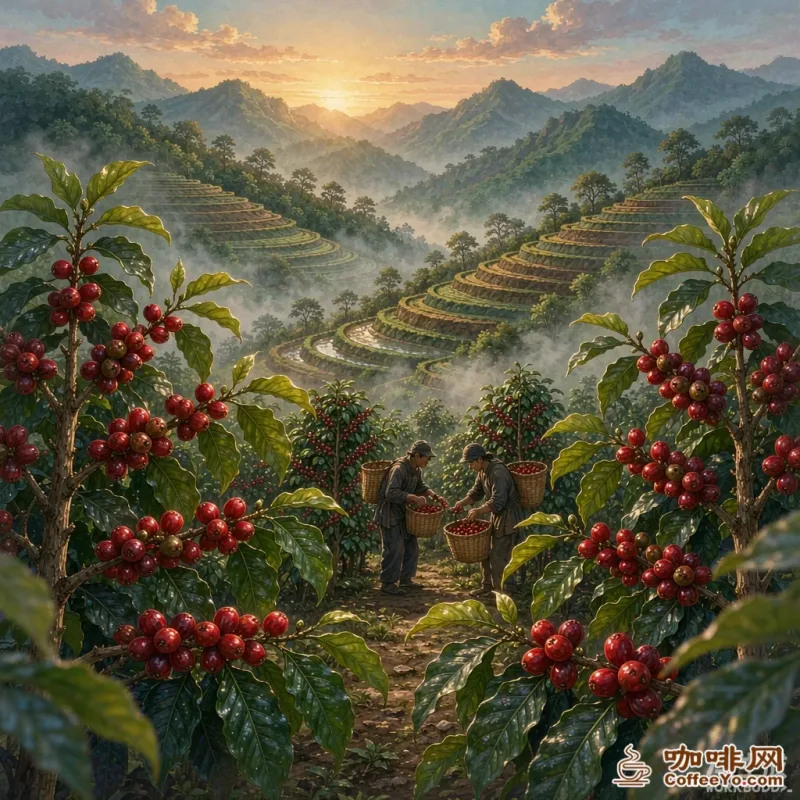
- The title image is an AI-generated illustration, not a real photo. For attribution or copyright matters, please contact this site: Email 405854472@qq.com.
Related Reading
- Why Have Yunnan Green Coffee Prices Held High and Steady? How Does This Harvest Season Differ From Last Year?
- Arabica Coffee Touches One-Month High, Supported by Low Inventories and a Stronger Brazilian Real
- Yunnan Coffee Specialty Rate Hits 41.7%, Beans Sold at 10x Price
 Gongshan Canyon-Ancient-Method Coffee Debuts at Lujiazui Coffee Culture Season
 Come to Bangdong: Sea of Clouds, Coffee Cherries, and a Hand-Poured Cup
- Baoshan Small-Grain Coffee Cultivation Gains Smart Wings




 Liaoning ICP Security No. 21122402000217