
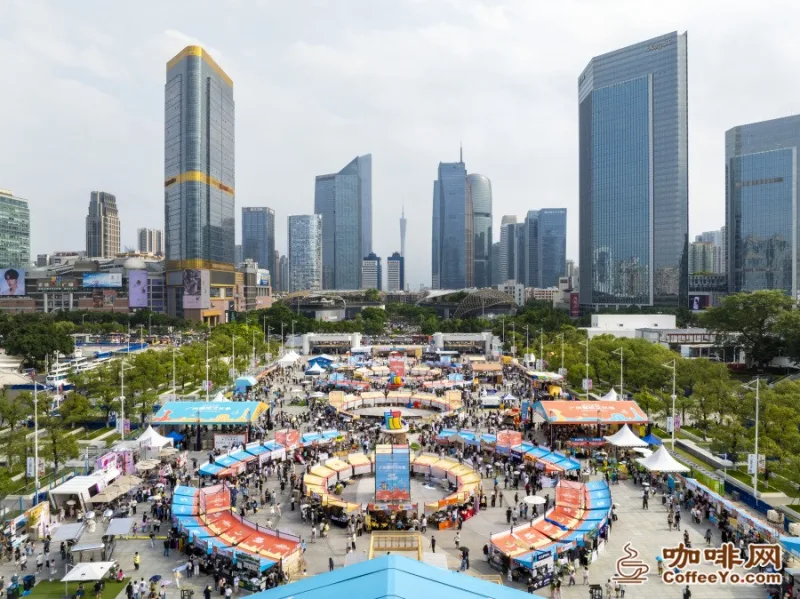
I. Net increase of 100,000 stores in three years, coffee “density” rising fast
According to the “China Coffee Heat Map” and “2026 China Urban Coffee Development Report” jointly released by Xinhua Net and Zhaimen, the number of coffee shops nationwide grew from about 148,000 to 255,000, a net increase of 106,700 over three years (about 72% growth), with current store count about 1.72 times that of three years ago; nearly 93,000 new coffee shops opened in the past year. China’s coffee industry scale rose from ¥313.3 billion in 2024 to ¥354.9 billion in 2025, up 13.3% year on year.
II. Per-capita cups: from 16.74 to 28.57
Rising consumption frequency is the fundamental driver of store expansion. National per-capita annual coffee consumption rose from 16.74 cups in 2023 to 22.24 cups in 2024, and further to 28.57 cups in 2025, about 70% growth over three years. On a consumption-port basis, China’s coffee market was about ¥218.1 billion in 2025, of which freshly brewed exceeded ¥188 billion, over 86% of the total, with instant coffee about ¥20 billion and RTD about ¥7.78 billion — freshly brewed has become the absolute main force.
III. Provinces and cities: Guangdong and Shanghai lead
At the provincial level, Guangdong leads with about 44,700 stores, followed by Zhejiang (about 24,000) and Jiangsu (about 21,400). At the city level, Shanghai leads the nation with over 11,000 stores; Guangzhou, Beijing, Shenzhen, Chengdu and Hangzhou all exceed 7,000. Yet total store count leading does not mean density leading — ranking by stores per 10,000 people changes markedly, and some tourist cities have even higher “coffee content.”
IV. Growth is in the counties: one in four stores opens in a county town
The most notable feature of this expansion is its downward reach. Leading brands have spread their networks nationwide — Luckin’s stores reach east to Fuyuan in Heilongjiang, west to Kashgar in Xinjiang, south to Sanya in Hainan and north to Mohe, with its highest-altitude store in Lhasa; over 40% of its stores are in third-tier and below cities, and Starbucks is also present in over a thousand county-level cities. Consumption habits have thus shifted from “making a special trip for a cup” to “grabbing one on the way,” with convenience and product stability becoming the key to competition, and coffee shops appearing in county old streets, scenic spots and service areas.
V. Rising chain rate and rational price return
Expansion is accompanied by structural change. The national coffee chain rate rose from 46% to 53%; the ¥9.9 price war cooled comprehensively in 2025, leading brands tightened low-price subsidies, and the average ticket of chain coffee stabilized at ¥25–27 after falling from the ¥32–42 range. On the raw-material side, national annual coffee-bean consumption is nearly 400,000 tonnes, while imported green beans are about 223,800 tonnes — about 1.6 times Yunnan’s output in the same period — imported and domestic beans such as Yunnan jointly support the rapidly expanding market, and also leave room for Yunnan coffee’s domestic substitution.
(Sources: “2026 China Urban Coffee Development Report” (Xinhua Net and China Economic Information Service, etc.), Xinhua Net · Zhaimen “China Coffee Heat Map”, Zhaimen restaurant-store monitoring, “2025 China Coffee Industry Development Report”. Data is subject to each original report’s caliber.)
Original Work Statement
- This article is an original work of coffeeyo.com. Without authorization, no media, website or individual may reprint, extract, reproduce or otherwise use it; violators will be held legally responsible.
- All images, charts and videos herein are originally shot or produced by coffeeyo.com and carry copyright watermarks; copyright belongs to coffeeyo.com.
- For reprint authorization, commissioned writing, interviews or business cooperation, contact: Tel 400-0000-641 (+86-18288016826) | Email 405854472@qq.com | Address: Jinghong City, Xishuangbanna, Yunnan Province / Tieling City, Liaoning Province
Related Reading
- Bean in Short Supply: A Taiwan Youth on Yunnan Coffee as a Shared Cross-Strait Stage
- Five Years, Eight Championships: Lincang Coffee Joins the World Stage
 Haikou ‘Union Cup’ Barista Skills Competition Kicks Off to Empower the Service Sector
 Yunnan Specialty Coffee Beans Deliver an ‘Excellent’ Report: Path to Value Leap
- Cross-Strait Tides Rise: A Taiwan Youth Farms Coffee in Yunnan, a Cup Bridging Both Sides
 2026 2nd Yunnan Treasure Coffee Green Bean Competition (Cup of Excellence Pilot) Concludes


 Liaoning ICP Security No. 21122402000217