


At a Glance (China Coffee Network): Pu’er in Yunnan has built a standards system covering the entire coffee chain from seed to cup, with more than 40 local and association standards issued. The city is moving the industry from selling fresh cherries toward processed products, technology, standards and brands; coffee estates are turning planting, picking and roasting into visitor experiences, while banks have extended financing networks across every link of the chain.
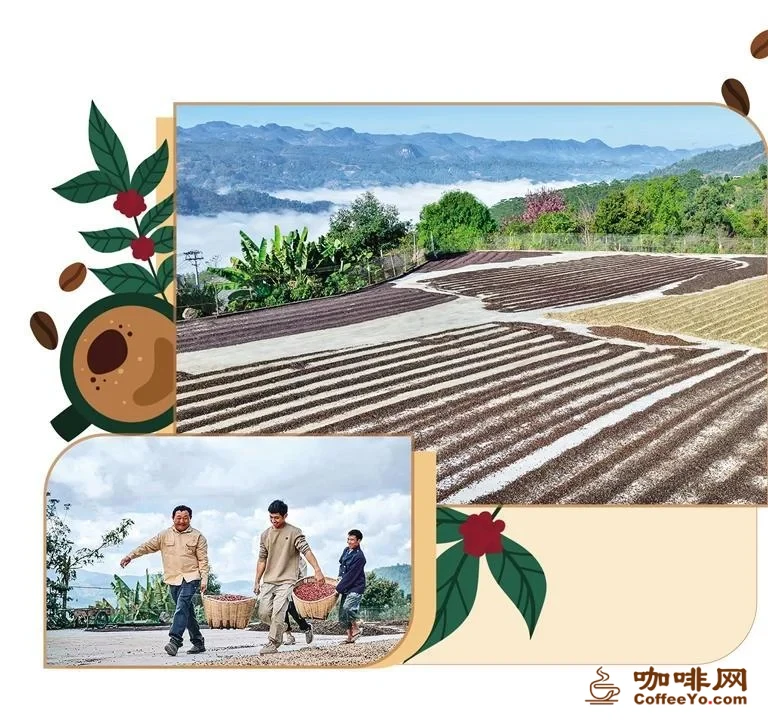
Mention Pu’er, a city in Yunnan Province, and most people think first of Pu’er tea. On the same land, however, coffee is another calling card of real weight. Pu’er is one of China’s core coffee-growing regions and the main source of beans for many domestic coffee brands. It once sold mostly fresh cherries as a raw material; today it has stepped beyond that single identity, generating a varied range of products and consumption scenarios, with industrial momentum continuing to build.
“Pu’er’s low-latitude plateau climate, pronounced day-night temperature swings, moderate rainfall and slightly acidic red soil together make a ‘golden belt’ for coffee cultivation,” said Wu Xudong, director of the agricultural products testing division at the Pu’er Inspection and Testing Institute and a senior engineer.
Yet on that same golden belt, beans from different estates and plots can vary widely in quality. How can natural endowment be converted steadily into quality in the cup? Zeng Yan, director of the Technology Innovation Centre for Coffee Quality Infrastructure and Industry Services under the State Administration for Market Regulation, said the centre has worked to build a coffee industry standards system and strengthen its quality foundations, issuing more than 40 local and association standards so that coverage extends across the whole chain from seed to cup. Standards are also being used to develop talent: a Pu’er barista training base has been set up, and the industry is being pushed from exporting raw materials toward exporting standards, skills and expertise.
“We need to keep extending the coffee chain. Every step forward along it can add a measure of value,” Wu said. He called for a progression from selling raw materials to selling processed goods, technology, standards and brands, closing gaps in deep processing and weak brand premiums so that more of the returns stay at origin and incomes rise for growers and companies.
As coffee and tourism converge, the crop increasingly serves as a vehicle for cultural experience, leisure travel and consumption at origin. More estates are opening to visitors, turning planting, picking and roasting into experiences, and evolving from pure production sites into mixed spaces that combine cultivation, processing and leisure. Beigui Coffee Estate sits in Nandaohe Village, Nanping Town, Simao District, about 25 kilometres — a 30-minute drive — from the Simao urban area. Deng Jialu, general manager of Yunnan Simao Beigui Coffee Co., described it as a comprehensive estate covering cupping, study tours, dining, lodging and sightseeing, with a specialty coffee experience centre where visitors can taste beans from different origins and try pour-over brewing and latte art.
The sector’s prospects have drawn financial institutions. ICBC’s Pu’er branch has aligned its services with the layout of the coffee industry and the funding needs of each stage, pushing its network out to remote coffee-growing villages and building financing coverage spanning planting, fresh-cherry purchasing, deep processing and distribution, with tailored packages for cooperatives, primary processors and leading traders covering the full cycle from grove management and centralised cherry buying to production-line upgrades and sales linkage. ABC’s Pu’er branch has refined credit approval and product design to offer dedicated lending suited to large-scale operations; by the end of October it had extended 320 million yuan in loans to 19 coffee companies and 274 million yuan to more than 1,700 growing households.
He Yuejun, general manager of Yunnan Pu’er Aini Manor Coffee Co., said the company has built more than 5,000 mu of rainforest coffee demonstration bases in Pu’er and Xishuangbanna, using a rainforest planting model that balances ecology and quality. The estate is equipped with primary and deep-processing lines for full quality control from fresh cherry to finished product, and is being developed as a specialty coffee estate integrating production, research, education and tourism.
Standard-setting, deep processing, estate experiences — these interlocking links string together the Pu’er coffee chain from grove to cup, drawing out a richer and more distinctive flavour between the hills and the cup.
Reprint Notice & Disclaimer
- This article has been edited and compiled by China Coffee Network and reprinted from Economic Daily, “From Seed to Cup: Pu’er Coffee Extracts Higher Value”. The copyright of the original text belongs to Economic Daily and the original author. This reprint is intended solely for information sharing within the coffee industry and does not represent the views of this website; all data and opinions are subject to the original article. Our thanks to the original author for creating and sharing it.
- Read the original: Economic Daily — “From Seed to Cup: Pu’er Coffee Extracts Higher Value”
- For matters concerning content licensing, attribution, copyright or otherwise, please contact us promptly and we will verify and cooperate in handling them as soon as possible. We also welcome coffee companies and industry media to exchange ideas and contribute articles.
- Contact China Coffee Network: Tel 400-0000-641 (+86-18941000313) | Email 478203668@qq.com | Address: Jinghong, Xishuangbanna, Yunnan, China
Related Reading
 Lincang Advances Coffee Industry with Premium Development Strategy: Aroma of Coffee Fills the Path to Revitalization
- Lincang advances coffee industry with premium development approach: aroma of coffee fills the path to revitalization
 Yunnan Dehong Tropical Agriculture Research Institute promotes shift from conservation to utilization of coffee germplasm resources
 Tracing Baoshan's 72-Hour Journey: Following Luckin to Discover the Origins of Good Chinese Coffee
 Yunnan Ruili: Technology boosts coffee industry quality and efficiency
 Tim Hortons China Q3: System Sales Up 6.3% Quarter on Quarter




 Liaoning ICP Security No. 21122402000217