


At a Glance (China Coffee Network):Opening note Yunnan is a poem written upon the earth. As travel is being redefined, Yunnan is no longer a “check-in spot for sights” but a haven for long stays that has let 3.9.
Opening note Yunnan is a poem written upon the earth. As travel is being redefined, Yunnan is no longer a “check-in spot for sights” but a haven for long stays that has let 3.9 million people “move into life here.” People roam the land of the Three Yi, planting ideals at the foot of snow mountains; push open Dai bamboo houses as the evening wind off the Lancang River brings creative inspiration; brew a pot of Pu’er tea as if drinking in the story of an entire primeval forest… Here, sojourners find not only poetry and distant horizons, but inner calm and belonging. Every cloud carries the lift of mountain songs, every breeze hides the mellow aroma of tea and coffee, and everything here gives meaning to “There Is a Kind of Life Called Yunnan.” Yunnan Net will decode the deeper logic of the Yunnan long-stay phenomenon across dimensions such as historical depth, ethnic culture, geographic wonders, ecological codes and the poetics of climate, tracing its resonance across time and space and discussing the unique charm, development stories and future prospects of living in Yunnan. Recently, three pieces of news about Yunnan coffee have gone viral one after another: at Gengxia Manor in Lincang, a traditionally washed Gesha lot was auctioned to Luckin Coffee at 14,000 yuan per kilogram, setting a new record for Chinese green coffee auctions; at the same event (the 2026 second Yunnan Gem Green Coffee Competition <Yunnan Cup of Excellence Pilot Competition>), three Yunnan beans won the internationally authoritative “Presidential Award” and entered the ranks of the world’s top coffees; in addition, a Yunnan company’s plant-cell liquid extracted and developed from coffee cherry pulp won a global cosmetic-ingredient innovation award in New York, USA.
The story of Yunnan coffee is being rewritten by the world.
The arrival of three 90-point beans is the fruit of years of quiet accumulation in Yunnan’s coffee industry. It marks world-class certification for Yunnan coffee in quality, the opening of a global high-end channel in the market, firmer confidence in the shift to specialty in the industry, and a voice on the world stage in culture. The award for coffee cherry pulp extract, meanwhile, represents a breakthrough in the high-value use of coffee by-products and fills the gap in deep processing along the chain.
File photo
From the auction house to the international tasting stage, from the beverage track to cosmetic ingredients, Yunnan coffee is proving with solid, striking results that “Yunnan coffee still represents China.” Its steadily rising value is no accident: it rests on the quality confidence of a specialty rate jumping from 8% to 41.7%, on the advantage of a complete industry chain that recycles every coffee by-product, and on brand depth built by two-way empowerment between germplasm research and tourism integration… Today Yunnan coffee has long since stepped beyond the single identity of a primary agricultural product and grown into an industry chain releasing value across the board with boundless potential. Quality revolution: the specialty rate leaps from “8%” to “41.7%.” Not so long ago, Yunnan coffee carried the label of “cheap commercial beans.” Farmers growing one mu of coffee earned little more than a thousand yuan; large volumes of fine beans were exported as green coffee, relabeled under other brands and sold back into China at several times or even dozens of times the price.
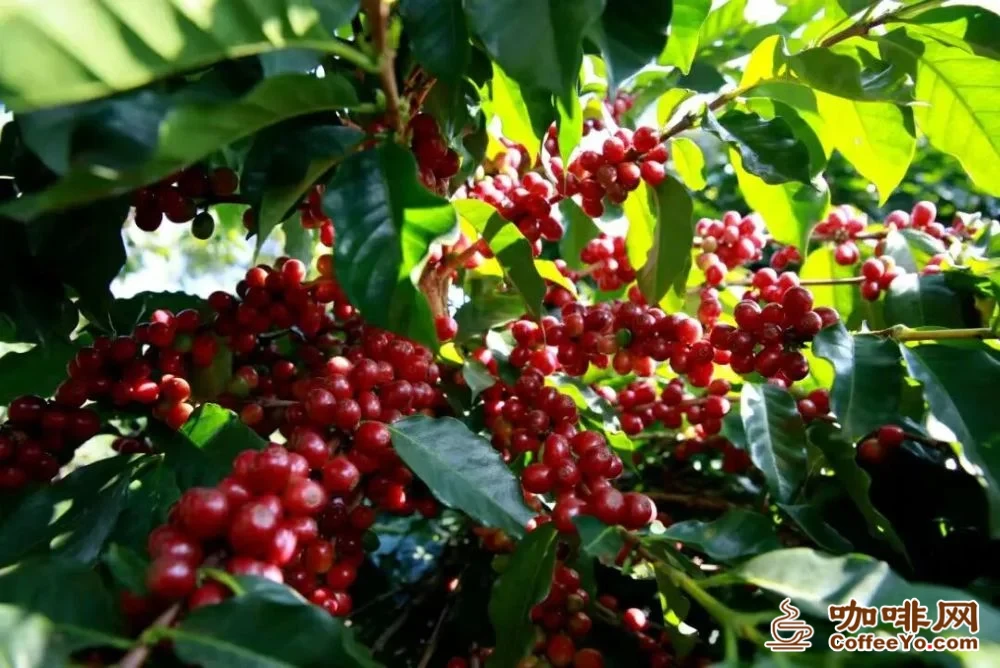
Farmers busy picking fully ripe coffee cherries. Photo by reporter Wang Yi
When did the change begin? These numbers give the answer. In 2025, Yunnan’s coffee-growing area reached 1.463 million mu, with annual green coffee output of 138,900 tonnes and an agricultural output value of 8.66 billion yuan; planting scale, output and output value all ranked first in the country. Whole-chain output value approached the 100-billion-yuan mark. The specialty rate rose from 8% in 2021 to 41.7%, and the deep-processing rate climbed from 20% five years ago to 85%. This leap in the specialty rate means Yunnan coffee has thoroughly left behind the extensive model of “winning by volume” and entered an era of quality competition. In 2025, at the first Yunnan Gem Green Coffee Competition, the best score stopped at 89.96; a year later, three local beans broke through the 90-point threshold. By the judging standards of the authoritative Cup of Excellence (CoE), 87 points is recognized specialty coffee, while above 90 is scarce excellence-grade bean representing the world’s highest level. A tiny gap of 0.32 points lies behind Yunnan coffee’s qualitative shift from “quality” to “excellence.”
Baoshan small-bean coffee, file photo
The most representative Yunnan Baoshan coffee has a planting history traceable to the late 19th century, and as early as 1993 it won a gold medal at the Eureka Expo in Brussels, Belgium. But for the three decades after, Yunnan coffee's voice in the international market came and went.
Only in recent years, from Baoshan to Lincang and from Pu'er to Dehong, has a quality revolution covering the whole chain quietly unfolded — Yunnan has built the country's largest and most complete coffee germplasm resource nursery and independently bred 22 coffee varieties suited to local conditions: proprietary varieties such as “Dere” and “Yunka” have spread quickly, while quality varieties such as Gesha and Typica keep setting new planting-area records.
Building a solid foundation from the germplasm source, Yunnan coffee has taken a string of “national firsts” on the quality track and won awards at major competitions worldwide. Full-chain value: making the most of everything, opening new frontiers of value.
If specialization is how Yunnan coffee “stands on its own feet,” extending the chain is how it “breaks through.” In conventional thinking, coffee's value lay only in that one bean. But the people of Yunnan have proved in practice: coffee is a treasure from head to toe.
The most representative case is Yunnan coffee cherry pulp extract winning an international cosmetic-ingredient award across the ocean.
Behind this honor lies a traceability survey the R&D team carried out in Yunnan’s Pu’er coffee-growing region. It was just after the harvest season, and large amounts of stripped coffee cherry pulp had been piled in a corner of the estate, slowly fermenting and giving off a sour smell. For growers, this pulp was a by-product they had to pay extra to haul away. But professional testing found coffee cherry pulp rich in active compounds such as polyphenols and caffeine, with strong antioxidant potential. Discovering the value was only the first step. The polyphenols, caffeine and other compounds in the pulp are highly temperature-sensitive. After sustained exploration, Yunnan Xicao Resource Development Co., Ltd. innovated a small-molecule water extraction technology, replacing traditional organic solvents with treated natural plant water and completing extraction under mild conditions. Breaking through this key problem finally gave once-discarded coffee cherry pulp a real chance to enter the high-end cosmetic ingredient market.
Coffee cherry pulp tea, file photo
In fact, the development and use of coffee by-products is no isolated case in Yunnan. The coffee by-product research team at Yunnan Agricultural University has released a range of products built around cherry pulp and pulp residue, including pulp tea drinks and pulp wine.
From pulp tea to pulp wine, from cosmetic ingredients to bio-extraction, every part of the coffee is being “used to the full.” This is not only a green practice of “zero waste,” but a wholly new curve of value growth. When even the pulp of a single coffee cherry can win an award on the world stage, Yunnan coffee's room for premium pricing has long since gone beyond a cup to drink.
Brand cultivation: from “growing beans” to “growing a brand.” In 2016, after twenty years away from home, Zhu Hong returned to Bangdong Township, Linxiang District, Lincang, and leased more than forty mu of land to try growing coffee. After a decade of trial and error, the cooperative he led grew from an initial seventy-plus households to more than 1,300 today.
In 2026, the washed Gesha green bean submitted by his Songfeng Coffee Planting Farmers' Professional Cooperative scored a high 90.28, taking third place in the competition and a “Presidential Award.” That result marks Linxiang coffee's official arrival in the first tier of the world's top specialty coffees.
Coffee majors at the College of Tropical Crops, Yunnan Agricultural University, experience cupping in an introductory coffee class. Photo by Hu Chao
And in Yunnan, Zhu Hong’s story is no isolated one. Most members of Gengxia Manor’s championship team graduated from the first university in China to offer a coffee science and engineering program — Yunnan Agricultural University. From Baoshan to Lincang and from Pu’er to Dehong, wave after wave of “new coffee farmers” are using a decade or even decades of dedication to turn Yunnan coffee from “grown” into “branded.” On the policy side, in August 2022 the Yunnan Provincial Department of Agriculture and Rural Affairs and other bodies issued the Notice on Several Policy Measures to Raise the Specialty Rate and Deep-Processing Rate of Coffee, setting out six priority directions including improved varieties and methods, developing deep processing, building the Yun Coffee brand and constructing specialty estates, in full support of Yunnan coffee moving toward branding and industrialization.
A coffee estate beneath a great banyan tree. Photo provided by the Baoshan Publicity Department
Today four deep-processing clusters — Baoshan, Kunming, Pu’er and Dehong — have taken shape. In 2025, Yunnan coffee was included in the first national list of traditional competitive food-producing regions to be cultivated; in 2026, Yunnan proposed building a new “coffee-plus-tourism” integration model carried by specialty coffee estates. By building specialty coffee estates, Xinzhai Village in Baoshan now receives 200,000 visitor trips a year on average; in 2025 its coffee agricultural output value reached 250 million yuan and per-capita villager income exceeded 40,000 yuan. From “selling by the tonne” to “tasting by the cup,” from “exporting raw material” to “taking brands overseas,” the road Yunnan coffee has traveled is a microcosm of Chinese agriculture’s shift from scale expansion to a quality revolution.
Reprint Notice & Disclaimer
- This article has been edited and compiled by China Coffee Network. The information and images therein come from public sources and the copyright belongs to the original author. This reprint is intended solely for information sharing within the coffee industry and does not represent the views of this website; all data and opinions are subject to the original article. Our thanks to the original author for creating and sharing it.
- For matters concerning content licensing, attribution, copyright or otherwise, please contact us promptly and we will verify and cooperate in handling them as soon as possible. We also welcome coffee origins, brands and industry media to exchange ideas and contribute articles.
- Contact China Coffee Network: Tel 400-0000-641 (+86-18288016826) | Email 478203668@qq.com
Related Reading
 Lincang Advances Coffee Industry with Premium Development Strategy: Aroma of Coffee Fills the Path to Revitalization
- Lincang advances coffee industry with premium development approach: aroma of coffee fills the path to revitalization
 Yunnan Dehong Tropical Agriculture Research Institute promotes shift from conservation to utilization of coffee germplasm resources
 Tracing Baoshan's 72-Hour Journey: Following Luckin to Discover the Origins of Good Chinese Coffee
 Yunnan Ruili: Technology boosts coffee industry quality and efficiency
 Asia Pacific Connection in a Cup of Coffee




 Liaoning ICP Security No. 21122402000217