
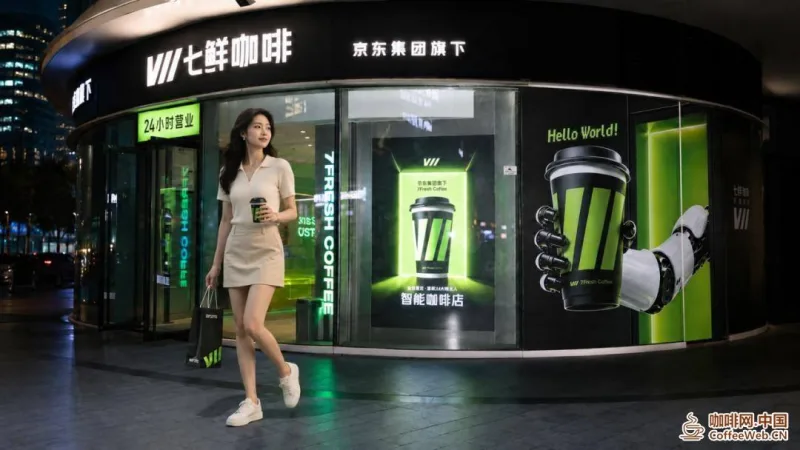
Brief (coffeeyo.com): Beneath the streamlined dome of Beijing’s Galaxy SOHO, yet another “first coffee store” with an internet pedigree has opened — but this time the star is not coffee, but robots. On August 16, JD.com’s Qixian Coffee launched its first 24-hour smart unmanned coffee store, where robots handle the entire process from brewing to cup handoff.
Beneath the streamlined dome of Beijing’s Galaxy SOHO, yet another “first coffee store” with an internet pedigree has opened. But this time the star is not coffee, but robots.
On August 16, Qixian Coffee — under JD.com — opened its first 24-hour smart unmanned coffee store at Beijing’s Galaxy SOHO. A reporter from the Daily Economic News (hereinafter “the reporter”) noticed on site that the store’s coffee drinks are made and served entirely by robots, operating around the clock.
Unmanned coffee stores are not a new concept. Earlier, chains such as Luckin were first movers, testing unmanned coffee terminals in offices and other scenes, while a host of coffee-hardware companies entered the track through the equipment side. But most attempts stalled at the elementary “vending” stage, as supply chains and operation-maintenance costs halted large-scale rollout.
As the robotics and embodied-AI industries iterate rapidly, the scale-up dilemma of the unmanned-coffee track is meeting a chance to be cracked. Not long ago, Yingzhi XBOT — a general-purpose food-service embodied-robotics company founded by a former Xiaomi vice president — announced the completion of two funding rounds totaling several hundred million yuan, with its coffee robots already deployed in over 1,000 units. Big players like JD.com have also been active frequently in embodied intelligence and robotics.
Today, in first- and second-tier cities, brand stores crowd the core spots of business districts and the “price war” is fierce; the “red ocean” reality of the coffee track has not changed at all, and the growth room from simply expanding traditional stores is gradually narrowing. Against this backdrop, whether smart unmanned stores can bring new growth points to the coffee market is worth looking forward to.
Going head-to-head with Starbucks and Luckin
The reporter noticed on site that Beijing’s Galaxy SOHO sits in Beijing’s core second-ring business district, surrounded by office towers with dense coffee demand. Competition is fierce in this location: JD’s Qixian smart unmanned store has Starbucks on its left and Manner on its right, with a Luckin store less than 50 meters away. Four coffee brands clash within a hundred meters.
A Qixian Coffee representative told the reporter that the store takes about 20 to 30 seconds to make a cup of coffee, and served 202 cups in the first hour after opening. Consumers can order through the in-store self-service screen or the JD App, and the system automatically assigns orders.
According to Qixian Coffee’s Xiaohongshu (RED) livestream data, the store produced more than 1,900 coffee drinks within 19 hours of operation.
“Staff will maintain it in the early opening phase, and after it stabilizes it will return to 24-hour unmanned operation with no human on duty,” the representative said, adding that “the store has a complete smart unmanned coffee automation line responsible for making and serving the coffee.”
The reporter noticed on site that a robot inside the store is also responsible for handling, moving drinks from the serving port to the pickup locker. In addition, consumers can watch on the in-store screen the whole process of their drink from cup drop, ice drop, fresh making to locker entry.
On-site information from technology partners shows the unmanned smart store’s technology collaborators include Xianglu Robotics and UniXAI, among others. The Qixian representative told the reporter that “later we will make adjustments (to technology modules, equipment, etc.) according to different store formats.”
The lowest single-cup price is just 5.9 yuan
Notably, Beijing’s Galaxy SOHO has become a testing ground for new business forms. In October 2017, Luckin’s first store opened right here. Over nearly a decade, ripples have become huge waves, and the domestic coffee market has gone from blue ocean to “red.” Core business-district spots have been carved up, the “9.9 yuan” price war has swept the industry, and expansion and closure present a stark “ice-and-fire” contrast.
Why did JD.com choose this moment to hit the acceleration button on its coffee-market layout? With robotics, AI and other technologies surging, can they carve a new path to break the coffee market’s “involution”?
Looking at the overall operation of smart unmanned coffee stores, compared with traditional stores they may have advantages in cost items such as labor and rent — a compact coffee robot can run 24 hours nonstop.
On pricing, according to its ordering mini-program, the cheapest item is the classic Americano at 5.9 yuan per cup, the fresh-milk latte is 9.9 yuan, and the most expensive is the extra-shot fresh-milk latte at 11.9 yuan (note: on opening day products were free, and the prices above are only as shown in the mini-program).
Whether this price compression comes entirely from the introduction of smart equipment is unknown. However, the true intent of Qixian’s pricing strategy may not be to grab market share with low prices; JD.com’s strategic intention clearly points to a deeper layout.
JD.com’s entry this time, on one hand, complements its local-life high-frequency traffic entry point and instant-retail offline touchpoint. Coffee is a high-repeat, rigid-necessity category; a 24-hour smart unmanned coffee store can, to some extent, connect online and offline traffic and fill in the strategic puzzle beyond formats like Qixian Supermarket and Qixian Kitchen. On the other hand, the early test of smart unmanned coffee stores can further validate JD.com’s own unmanned business model and explore more replicable paths for brands. As for future store-opening plans, as of press time Qixian Coffee had not disclosed specifics.
Beijing’s Galaxy SOHO has witnessed the rise, turn and transformation of the domestic coffee track. As the dividends of the price war are exhausted, the competitive dimension of the coffee market’s second half is also switching completely. Whether Qixian Coffee can further seize market share through its smart unmanned-store layout remains to be seen. But at least in this “landmark,” the coffee market has gained a new footnote because of it.
Source: Daily Economic News.
Reprint Note & Disclaimer
- This article is reprinted from Chinese media for information and cultural exchange. The views expressed are those of the original author and do not necessarily reflect the position of coffeeyo.com.
- All trademarks, brand names and logos mentioned belong to their respective owners.
- For cooperation, reprint or correction requests, please contact coffeeyo.com.
Reprint Notice & Disclaimer
- This article has been edited and compiled by China Coffee Network. The information and images therein come from public sources and the copyright belongs to the original author. This reprint is intended solely for information sharing within the coffee industry and does not represent the views of this website; all data and opinions are subject to the original article. Our thanks to the original author for creating and sharing it.
- For matters concerning content licensing, attribution, copyright or otherwise, please contact us promptly and we will verify and cooperate in handling them as soon as possible. We also welcome coffee origins, brands and industry media to exchange ideas and contribute articles.
- Contact China Coffee Network: Tel 400-0000-641 (+86-18288016826) | Email 405854472@qq.com | Address: Jinghong, Xishuangbanna, Yunnan Province / Tieling, Liaoning Province
Related Reading
- Bean in Short Supply: A Taiwan Youth on Yunnan Coffee as a Shared Cross-Strait Stage
- Five Years, Eight Championships: Lincang Coffee Joins the World Stage
 Haikou ‘Union Cup’ Barista Skills Competition Kicks Off to Empower the Service Sector
 Yunnan Specialty Coffee Beans Deliver an ‘Excellent’ Report: Path to Value Leap
- Cross-Strait Tides Rise: A Taiwan Youth Farms Coffee in Yunnan, a Cup Bridging Both Sides
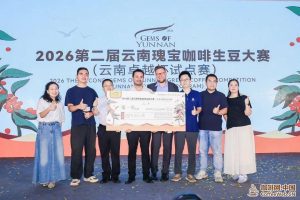
 2026 2nd Yunnan Treasure Coffee Green Bean Competition (Cup of Excellence Pilot) Concludes


 Liaoning ICP Security No. 21122402000217