
Brief (coffeeyo.com): At the 2026 World Robot Conference, coffee spaces emerged as a hot testbed for embodied AI — Boundless Dynamics’ human-robot symbiotic café and rivals from Annno, Keenon and others show robots making and serving coffee, while the industry debates VLA versus world-model routes.
The 2026 World Robot Conference (WRC) opened on August 19 in Beijing’s Yizhuang. In this year’s WRC exhibition hall, there is a special coffee space: inside the counter is a human barista, on the counter a long-range pour-over robotic arm assists in making coffee, and outside the counter wheeled robots weave through the crowd to serve customers.
Unlike the JD-owned 7FRESH Coffee 24-hour smart unmanned coffee store that just landed at Beijing’s Galaxy SOHO, this coffee space in the WRC hall wants to do “human-robot symbiosis.” This is the training ground chosen by embodied-AI company Boundless Dynamics — founded just over a year ago and having completed several hundred million dollars in financing in the first half of this year — for its embodied brain.
Why a Coffee Space?
Zhang Yufeng, founder and CEO of Boundless Dynamics, gave a pragmatic answer in an on-site interview with media including the Daily Economic News reporter (hereinafter “DJN reporter”): the tasks and item SKUs in a coffee-shop scenario are relatively concentrated, unlike the home environment where everything differs — every family’s bedsheets, clothes and teacups are different. But a coffee shop also has enough background generalization: light changes, foot traffic changes, the personal items customers leave on tables change, and the robot must recognize and avoid them — when collecting tissues it must not mistakenly take a phone, and when placing coffee it must choose a suitable spot.
In Zhang Yufeng’s view, this scenario has “clear business boundaries and dynamic environmental variables,” allowing the company’s self-developed latent-space world model to keep learning within a stable business framework, while also having to cope with massive real changes, thereby testing its ability to transfer existing skills to different people, positions and states.
The DJN reporter noted that world models, which can understand and predict the physical world, are now a burgeoning technical focus of the industry and one of the hot topics of this WRC. But the industry has not yet entered the “technology convergence” stage; behind the coffee space is a head-to-head competition of different companies’ technology and commercialization routes.
“Coffee Scenarios” Become a Hot Testing Ground for Robot Deployment
Walking into this year’s WRC hall, the most direct impression is: robots are no longer just performing on stage or fighting in boxing rings, but are showing off their real skills working in various scenarios. Among them, “making coffee” has apparently become a popular “testing ground” for examining robots’ real deployment capability.
Shenzhen Annno Robot is the only company in the beverage-robot niche to secure an independent booth, while also appearing at partner JD’s booth. The DJN reporter saw on site that its dual-arm embodied robot latte-art printing bar and single-arm AI latte-art printing kiosk, through high-precision robotic arms, visual recognition and machine learning, can quickly complete a cup of coffee with exquisite latte art, and users can also upload AIGC-generated images to choose a unique printed pattern.
In the “Robot Café” jointly presented by Keenon and NOWWA Coffee, the humanoid robot XMAN-R1 appeared as a “special-engagement barista.” The robot is based on the job-specific domain model KEENON ProS trained from Keenon’s self-developed general VLA (Vision-Language-Action) architecture. XMAN-R1 can autonomously complete steps such as fetching cups and extracting coffee, and place the finished coffee at the latte machine for customers’ DIY printing.
Unlike JD 7FRESH Coffee’s fully unmanned, closed vending-machine-style coffee robot, Boundless Dynamics’ coffee space still has human baristas, and the robots are not confined to an enclosed space or behind the bar, but become servers in the coffee space — taking coffee from the human barista to hand to customers, collecting empty cups, cleaning tables, and even proactively UV-disinfecting their hands after throwing away trash.
“In commercial service scenarios, customers usually expect to see people; few coffee-shop brands want to become completely unmanned stores, so human-robot symbiosis is the core,” Zhang Yufeng emphasized. “We no longer fence off the robot, but let it truly cooperate with people.”
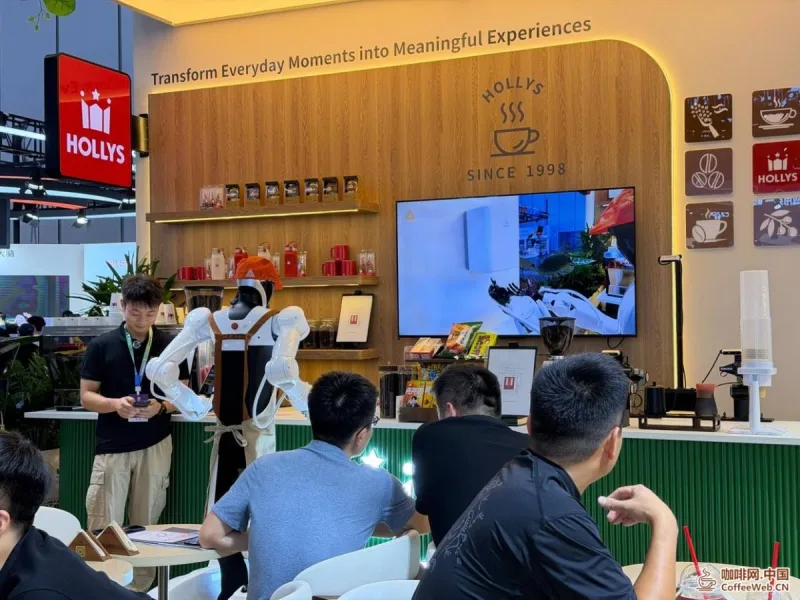
Boundless Dynamics’ “human-robot symbiotic immersive robot coffee space.” Photo by DJN reporter Zheng Xinwei.
The DJN reporter noticed on site that the human barista wears Boundless Dynamics’ self-developed AnySense EGO first-person multimodal data-collection device, used to collect human-operation data and feed back into later model upgrades. In Zhang Yufeng’s view, hard-tech iteration needs to deeply combine with scenarios and deeply engage B-end customers, find “eggs along the way” opportunities, use real-scenario data to drive high-quality data feedback, form a data flywheel, and push the embodied brain to iterate continuously.
The DJN reporter also learned that in commercial service scenarios, Boundless Dynamics starts from coffee shops, and over the next four months will continue trial operations with a coffee-shop brand in Beijing, gradually transitioning to normalized operations, and plans to enter the South Korean market in the fourth quarter of this year; after coffee shops, fast-food restaurants and hotels are the next targets. On the industrial side, Boundless Dynamics’ robots have already cooperated with auto-parts enterprises and energy enterprises, truly entering production lines.
“For example, folding paper boxes — a foreign-funded car factory in Beijing has this demand, hoping robots help fold boxes and organize parts. We built a robot that can fold paper boxes in pan-industrial and pan-household scenarios, achieving ‘one machine, multiple capabilities.’ In most demos, a robot may only do one thing, but our sock-folding and clothes-folding actually use one model — drop the items to it and it processes them one by one,” Zhang Yufeng said.
At the exhibition site, Boundless Dynamics also showed three robots based on the same model achieving autonomous division of labor and coordination around folding, sorting and packaging. The lack of generalization ability is also the biggest bottleneck, mentioned by Unitree founder Wang Xingxing in his conference speech, constraining robots from entering life and homes. “Generalization” is likewise a keyword Zhang Yufeng repeatedly mentions; the generalized ability of “one model, multiple capabilities” is the direction he believes the embodied brain needs to strive for.
World-Model Technical Routes Have Yet to Converge
Driven by World Labs founded by “AI godmother” Fei-Fei Li, the high-momentum world-model route showed an even bigger presence at this WRC: the Beijing Humanoid Robot Innovation Center released the embodied multimodal unified model PelicanUnify, Daxiao Robot brought the Wukong world model, and GigaVision showed the new-generation embodied foundation model GigaBrain-0.7… Exhibitors betting on the world-model route all showed off their embodied brains at this WRC.
At the Chaowei Dynamics booth, a full-size humanoid robot KAIBot engaged in heated table-tennis rallies with on-site visitors. Facing fast, hard-to-predict incoming balls, the robot completes recognition, judgment and hitting within a millisecond-level window. Supporting this capability is its self-developed KAI world model. The model is built around a three-step closed loop of “generate a virtual world for action interaction — model evaluates and understands — master physical-world laws,” letting the robot complete massive pre-training in the simulation world before entering real confrontation, figuring out the operations of ping-pong play.
In a speech at this year’s WRC main forum, Unitree founder Wang Xingxing also revealed that Unitree began exploring the video-generation-based world-model direction as early as early 2020, shelved it midway due to unsatisfactory results, and restarted investment last year. “Our company’s investment in AI models has always been very large, and should also be the direction of our largest capital and manpower investment at present.”
Boundless Dynamics, also betting on the world model, chose the technical route of “latent-space world model + reinforcement learning.” Zhang Yufeng made no secret of his confidence in this route, even using the phrasing “closest to the endgame.”
This entrepreneur, who once worked in the auto industry for years and served as vice president of Horizon Robotics, took autonomous driving as an example to compare the currently popular VLA (Vision-Language-Action) route: “A car doesn’t run over the curb because it has seen millions, tens of millions of trajectories of not running over the curb, not because, like a human, it truly understands that that is a curb and the consequence of running over it.” Zhang Yufeng pointed out that VLA is essentially still imitation learning, not a true understanding of spatiotemporal correlation and physical-world causality.
On the VLA-versus-world-model route debate, Zhang Yufeng admitted: “Today no route is the ultimate route for physical AI or AGI (Artificial General Intelligence); autonomous driving hasn’t reached the final AGI route either, otherwise why hasn’t L4 scale taken off?” He said he hopes to see greater innovation from the industry in algorithms and models. He also revealed that Boundless Dynamics will release a new-version base model in September with larger parameter scale that does not depend on any existing open-source model.
In addition, Zhang Yufeng pointed out that algorithms, hardware and scenarios are the trinity of robot-industry iteration, but the hardware maturity and standardization of the entire supply chain still need improvement. At present the humanoid-robot market scale is still small, which is a challenge for polishing hardware maturity, lowering costs and improving consistency. “China’s supply chain is indeed the strongest, but that doesn’t mean it is fully mature. We are very strong on ‘having versus not having,’ but on cost and consistency the whole industry still has a long way to go.”
On the current development stage of the embodied-AI industry, Zhang Yufeng judged: “Embodied AI’s current capability is roughly between the toddler stage and adolescence; it can do some basic work, but things that are too complex can’t be learned all at once.” But he liked the theme repeatedly mentioned in the conference’s opening video — “Try again.”
“From robots running before to now working in factories, there will always be failures, just like people growing up from childhood; try again and you’ll succeed.” In Zhang Yufeng’s vision, embodied AI will eventually be like new water-electricity-coal and new computing infrastructure, from creating present value to collecting more data fuel and feedback, forming stronger capabilities and becoming new infrastructure.
Disclaimer: This article’s content and data are for reference only and do not constitute investment advice; please verify before use. Any action taken on the basis of this article is at your own risk.
Source: Daily Economic News.
Reprint Note & Disclaimer
- This article is reprinted from Chinese media for information and cultural exchange. The views expressed are those of the original author and do not necessarily reflect the position of coffeeyo.com.
- All trademarks, brand names and logos mentioned belong to their respective owners.
- For cooperation, reprint or correction requests, please contact coffeeyo.com.
Reprint Notice & Disclaimer
- This article has been edited and compiled by China Coffee Network. The information and images therein come from public sources and the copyright belongs to the original author. This reprint is intended solely for information sharing within the coffee industry and does not represent the views of this website; all data and opinions are subject to the original article. Our thanks to the original author for creating and sharing it.
- For matters concerning content licensing, attribution, copyright or otherwise, please contact us promptly and we will verify and cooperate in handling them as soon as possible. We also welcome coffee origins, brands and industry media to exchange ideas and contribute articles.
- Contact China Coffee Network: Tel 400-0000-641 (+86-18288016826) | Email 405854472@qq.com | Address: Jinghong, Xishuangbanna, Yunnan Province / Tieling, Liaoning Province
Related Reading
 ‘All-Ice’ Coffee Goes Viral! Will the Next Hit Be Your Personal Favorite?
- Hong Kong’s Dyee Coffee Lands in Qianhai, Building a Specialty Pour-Over Outpost
 Ken Yue Coffee Opens Egg-Tart Pop-Up in Hangzhou: Sweet Craft, Reinvented Classics
 World Cup Enters the Breakfast Slot: Can Coffee-Tea Brands Turn Traffic into Orders?
- ICE Agricultural Futures Mostly Rise at Close; Coffee Futures Up 3.28%
- ‘Sleep Cafés’ Become a New Favorite Among Seoul Office Workers


 Liaoning ICP Security No. 21122402000217