
Brief (coffeeyo.com): From cave and waterfall coffee to cliffside and forest brews, Guizhou is turning its karst landscapes and local flavors — think fishwort americano and litsea lemonade — into a differentiated coffee culture, while sharing the spoils with villagers through profit-linkage schemes.
Source: Tianyan News.
Cave coffee, waterfall coffee, cliff coffee, forest coffee, paddy-field coffee… mountain-and-wild settings blend with coffee culture; rosehip coffee, fishwort coffee, “niu bie” coffee, matcha coffee, litsea coffee… distinctive Guizhou flavors keep emerging.
In recent years, leveraging its cool climate and diverse ethnic culture, Guizhou has seen a steady stream of new cultural-tourism formats. Many young coffee entrepreneurs have moved their shops into unique mountain-and-water settings, reinventing mountain tourism as “scenery + drinks + outdoors,” turning karst “leftover land” into new consumption scenes. This coffee culture — immersed in nature yet combining activity and calm — has become a strength of Guizhou’s differentiated coffee-industry development.
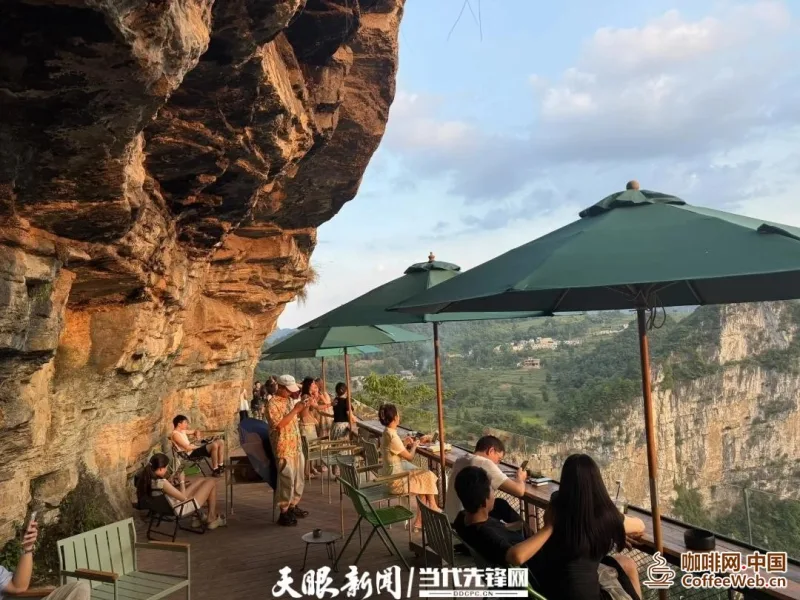
Gujing · Yaoyan cliff coffee in Qingzhen. Photo by Li Yaru.
This May Day holiday, value-added tax invoice data from the Guizhou Provincial Taxation Bureau showed coffee-shop service consumption across the province rose 232.6% year on year, with Guiyang and Zunyi together accounting for 88.7% of the province’s invoiced total. In Mafengwo’s 2026 China Cultural Tourism New Playbook Report, Guizhou ranked first nationwide in number of top-100 new activities, thanks to formats like waterfall coffee and cave exploration.
A single cup of coffee has been “moved” by Guizhou people into caves, hung off cliffs and placed before waterfalls. It is “wild” for good reason, and that wildness has also shown up in the account books, becoming a “small entry point” that connects landscapes, activates counties and boosts villagers’ incomes.
“Wild” in the Scenery
Guizhou coffee’s distinctiveness first comes from its one-of-a-kind mountain spaces. Relying on karst landforms and village scenery, the province has begun to form scenes such as caves, sinkholes (tiankeng), waterfalls, cliffs, forests, bridge-tourism and rustic countryside.
Caves. In Puding County, Anshun, the “Holy Light Coffee” in the Lianhua ancient cave hides within a billion-year-old karst cavity. Natural openings draw daylight inside, and Tyndall light beams often appear in the misty air; the cave is kept at a constant 15–18°C, with stalactites and underground rivers preserved in their original state, and only minimal seating is added. Visitors explore the cave and walk the underground river, then sit down midway for a cup, turning a geologic trip into a “micro-vacation.”
Waterfalls. In Gelin Village, Longgang Town, Kaiyang County, the Wengdongtan Waterfall Coffee sits right next to a 150-meter water curtain, with suspended nets, a waterfall-facing terrace and wilderness loungers. The team also replicated the concept inside the Xixiu Xiangbi Cave in Anshun, creating a “cave + waterfall” branch.
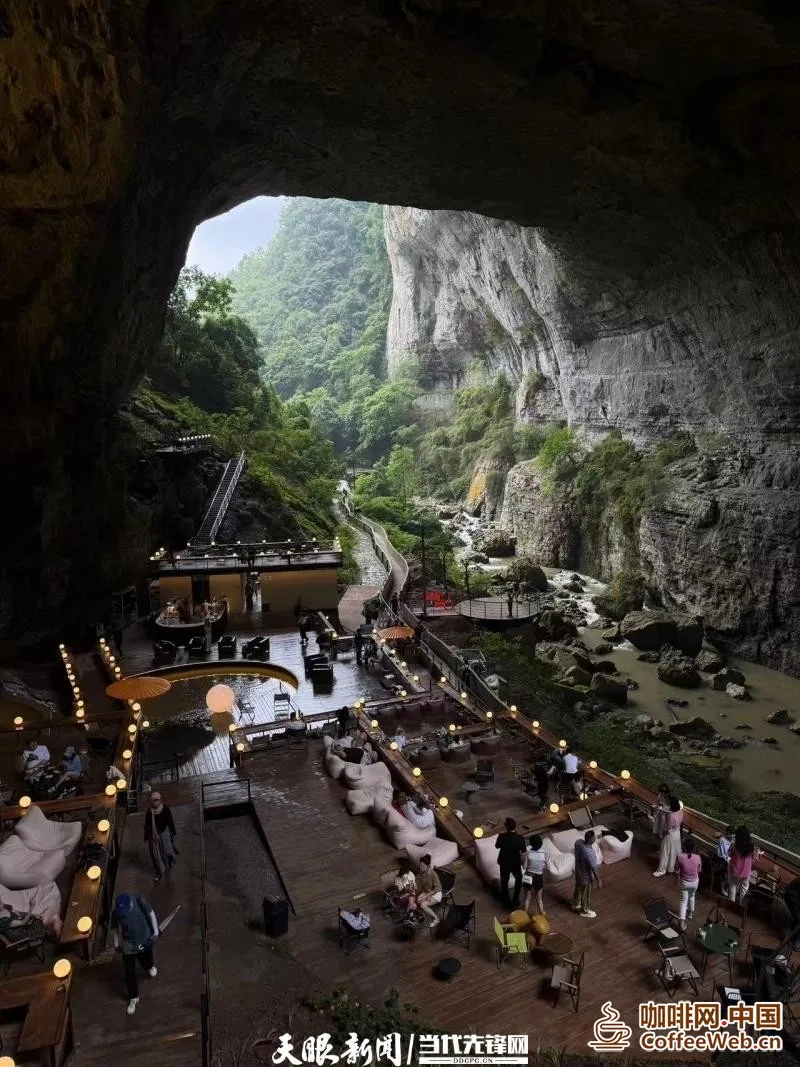
Qiongdao · Tiankeng Coffee.
Sinkholes (Tiankeng). In Damu Village, Liutun Town, Xiuwen County, Qiongdao · Tiankeng Coffee is arranged on three staggered levels: the bottom by the stream, the middle among the woods, the top for sunset watching — earning it the name “real-life center-of-earth cafe.” It shares revenue with the village collective, sources its light meals from the village’s corn, honey and tea, and links together forest hikes, farm picking and Bouyei courtyards.
Cliffs. In Tianwan Village, Liuchang Township, Qingzhen, “Gujing · Yaoyan” hangs off a 150-meter sheer cliff above the Ao River, built into the rock with raw timber, rubble and glass, and infused with Guizhou matcha, black tea, green tea and rosehip. In the first quarter of 2026 it served over 100 cups on weekdays and more than 200 on weekends, with quarterly revenue above 250,000 yuan; it has spawned more than 20 stall vendors, raising average household income by about 50,000 yuan a year.
Forests. Libo Kuwan Forest cliff coffee plunges into the primeval forest of Maolan, paired with green-plum fruit coffee and low-calorie specialties, connecting jungle crossing, canopy walks and nature study, easing the load on the Xiaoqikong core scenic area. Guiyang’s Changpoling “Yi Mo Hua Yuan” and Nanming’s “forest say” embed forest-style coffee into urban woodlands and guesthouses.
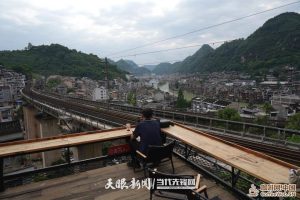
Bridge tourism. At the 625 Coffee on the Huajiang Canyon Bridge, litsea specialties, rosehip lattes and kiwi-fruit coffee pull the bridge’s silhouette into the latte art, binding it to Guizhou’s “bridge-tourism integration.”
Rustic countryside. In the Xijiang Thousand Miao Villages, the Niupeng (cattle-shed) Coffee renovates an old cattle shed, keeping the rammed-earth walls, thatched roof, batik cloth and silver ornaments, with rice wine and glutinous rice in its specialties; the paddy-field coffee in Hailong Town, Zunyi, and the lakeside and colorful-village coffee in You’er, Qingzhen, and the garrison-village coffee in Weicheng Shangshui, respectively pursue pastoral, intangible-heritage and lodging-support formats.
From “a cup at earth’s heart” to “a cup in the village,” Guizhou has turned its distinctive geologic sites, idle farmhouses and marginal scenery into micro-destinations where visitors can linger, take photos and return — letting niche landscape resources unleash mass-consumption vitality.
“Wild” in the Cup
Not only are the scenes wild — Guizhou coffee flavors are even wilder. While Beijing, Shanghai and Guangzhou are still fixated on beans, the bars of Guiyang have already served up Qian (Guizhou) flavors.
Black Stone Coffee’s “Guiyang Combo” bundles a fishwort americano, a litsea specialty and a Guiyang latte into a three-cup set; during the Dragon Boat Festival a single store averaged about 300 cups a day. GTS Coffee’s rosehip americano and Wujie Coffee’s “litsea + Weining apple” turn mountain goods into fixed recipes.
The fishwort americano is the most viral: not heavily bitter-roasted, with an herbal sweetness at the finish and the raw fishy note suppressed; the rosehip cold brew relies on vitamin-C fruit acidity to cut the grease; and litsea’s lemon–mint–pepper pungency makes outsiders frown on the first sip and nod on the second.

Three of the specialty drinks launched by Mumu Qianxing coffee shop. Photo by Chen Zujia.
As for “niu bie coffee,” most shops in fact simulate the herbal aroma with mate, cucumber and mint, and don’t actually use niu bie (stomach contents).
The benefits of this “wild menu” are real. Local produce keeps long-distance procurement costs down, and “you can’t drink it anywhere else” naturally carries a premium. The 625 Coffee on the Huajiang Canyon Bridge pulls the bridge’s outline into its milk foam; Yaoyan has matcha and rosehip among its top-three sellers; Xiu Coffee uses Xiuwen kiwi for its “Xiuwen americano.”
With professionalism as a safety net, mountain shops dare to bring rosehip flavors into extraction.
“Wild” and Grounded
If the traffic only lands in the boss’s pocket, the “wild” phase will quickly disperse. Many parts of Guizhou have moved first to build benefit-linkage mechanisms, adopting a “government guidance + enterprise operation + villager shareholding” model, so villagers get a name in the account books.
Shangshui Village in Weicheng Town, Qingzhen, set up a “4321” distribution mechanism: farmers 40%, villager sharing 30%, enterprise 20%, collective 10%. You’er Village uses a “433” mechanism — villagers 40%, collective 30%, company 30% — with five households contributing idle houses as shares and bearing no risk; Tianwan Village has the collective fund take a stake in a professional team to build and operate a guesthouse.
Damu Village’s tiankeng returns revenue to the collective to fund road repairs and greening. Light meals source the village’s farm produce on a fixed basis, and an elderly person carrying a basket of honey can still settle the bill. The Wengbu project at Anshun’s Xiangbi Cave gives hiring priority to Xiushui Village, training five local baristas and putting more than 40 villagers to work nearby. The Shili Huguang Coffee in Dachong Village employs over 20 people, with average monthly wages around 3,000 yuan.
This math is easy to do. A cup of coffee priced at 68 yuan can drive related consumption such as paddleboard experiences, specialty snacks, farm-produce sales and guesthouse stays. Yaoyan’s single store earned 250,000 yuan in one quarter, and the market below the cliff thrived as a result. When Wengdongtan Coffee sold past 1,000 cups, neighboring stall vendors could earn up to 200 yuan a day.
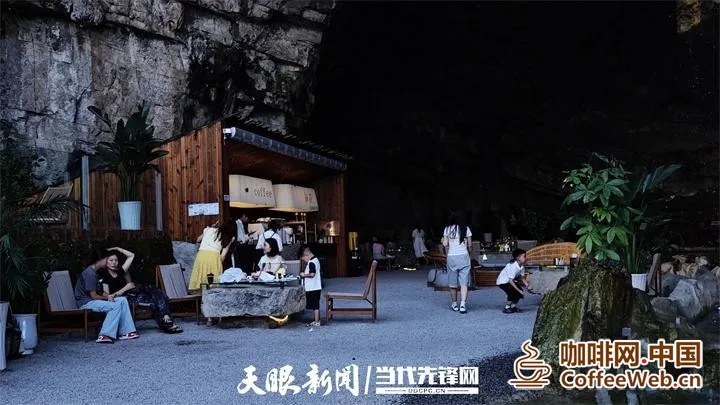
Baiyan Cave via ferrata cave coffee in Huichuan District, Zunyi.
Guizhou grows no coffee beans locally, yet it has built a one-of-a-kind coffee scene on its karst landscapes and blended exclusive Qian-flavor recipes from local products. The “wildness” of this cup lies in turning geologic sites and marginal cliff paths that are hard to charge for individually into micro-destinations where people can linger, take photos and share dividends; and in letting villagers become shareholders, baristas and farm-produce suppliers, deeply integrated into the industry’s development.
By Xiong Jiangrui, Tianyan News. Editor: Chen Meiyi. Reviewer: Yang Tao. Final reviewer: Qin Lin.
Source: Tianyan News / China Coffee Network.
Reprint Note & Disclaimer
- This article is reprinted from Chinese media for information and cultural exchange. The views expressed are those of the original author and do not necessarily reflect the position of coffeeyo.com.
- All trademarks, brand names and logos mentioned belong to their respective owners.
- For cooperation, reprint or correction requests, please contact coffeeyo.com.
Reprint Notice & Disclaimer
- This article has been edited and compiled by China Coffee Network. The information and images therein come from public sources and the copyright belongs to the original author. This reprint is intended solely for information sharing within the coffee industry and does not represent the views of this website; all data and opinions are subject to the original article. Our thanks to the original author for creating and sharing it.
- For matters concerning content licensing, attribution, copyright or otherwise, please contact us promptly and we will verify and cooperate in handling them as soon as possible. We also welcome coffee origins, brands and industry media to exchange ideas and contribute articles.
- Contact China Coffee Network: Tel 400-0000-641 (+86-18288016826) | Email 405854472@qq.com | Address: Jinghong, Xishuangbanna, Yunnan Province / Tieling, Liaoning Province
Related Reading
 How ‘Sea-Flavored’ Coffee Blooms Across Dongtou
- Health Guide: How to Enjoy Your Coffee the Healthy Way
 ‘The Rhythm of Plants: Tea and Coffee Culture’ Exhibition Debuts in Rio de Janeiro, Brazil
 Study: Regular Coffee and Tea May Lower Dementia Risk, but More Is Not Better
 Frontline Story: A ‘Mobile City Coffee Bar’ Arrives by the Grand Canal
 Yantai’s Wind Tastes of Coffee





 Liaoning ICP Security No. 21122402000217