
Brief (coffeeyo.com): “Once the coffee is grown, how do we find better ways to sell it?” That question, posed by an Indonesian village head in a Yunnan coffee garden, opens a quiet conversation between Chinese and Indonesian villages about value, markets and rural development.
“Once the coffee is grown, how do we find better ways to sell it?”
On 13 September, at a corporate coffee plantation in Chenggenghe Village, Puwen Town, Jinghong City, Xishuangbanna, Yunnan, Adamal Tampubolon, a village head from Indonesia, put his question to local village officials.

Adamal is a participant in the 2026 Indonesia Rural Cadre Training Class and head of Hutagodang Village, Batang Toru District, South Tapanuli Regency, North Sumatra. North Sumatra is one of Indonesia’s important Arabica coffee-producing regions. In Adamal’s view, his homeland has no shortage of good coffee or of planting scale; what truly troubles farmers is how much value they can retain in the industry once the coffee leaves the field and reaches the market.
“We have several thousand hectares of coffee plantations, but the main problem now is still the sales channel,” Adamal said. The area has sizeable coffee cultivation, yet the beans farmers produce still largely pass through middlemen. He kept pressing: how can we cut out the middle links? How do we connect scattered smallholders with processing and sales markets?
These questions happen to hit precisely the focus of Puwen’s coffee industry in recent years.
Puwen Town is likewise famous for coffee. With a warm climate and large day-night temperature swings, it began developing coffee on a scale in the mid-1990s. Today the town’s coffee planting area is about 34,800 mu, with annual fresh-fruit output of around 26,500 tonnes and a combined output value of 480 million yuan. The more important change is not merely growing more, but coffee gradually moving from single crop cultivation toward a full “production + primary processing + sales” chain — forming an industrial system spanning fresh-fruit handling, deep processing, and brand and consumer experience.
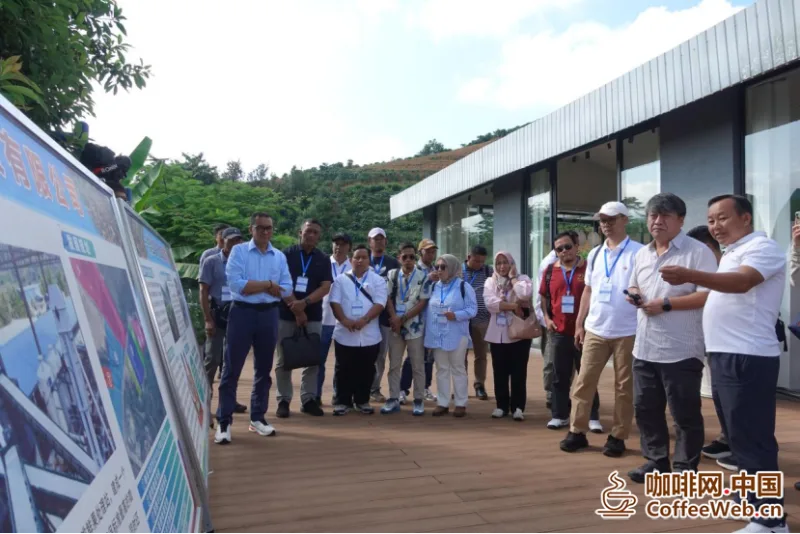
On 13 September, participants of the 2026 Indonesia Rural Cadre Training Class visited a company in Jinghong, Xishuangbanna, Yunnan. Photo: Xie Wen
Zhao Jianwen, Party branch secretary and village committee director of Chenggenghe Village, told Adamal that in the past farmers mainly focused on growing good coffee and selling it as fresh fruit. Now, through centrally organised company purchasing and unified processing, the locality better controls product quality and environmental issues on one hand, and lets farmers gain a little more at the price level on the other. “For example, if outside buyers pay 8 yuan, the company might give 8.1 or 8.2 yuan.” Though it is only a few cents more per jin, when purchasing volumes reach thousands of tonnes, the added income genuinely lands in farmers’ hands. The locality has also brought scattered smallholders together with processing and sales links by having the village collective invest in facilities such as workshops and companies equip processing machinery.
“Better prices mean higher enthusiasm among farmers,” Zhao Jianwen’s words intrigued Adamal.
What he cares about is not only how coffee is sold, but how an agricultural village organises farmers, companies and the market: farmers are no longer merely growers at the very front of the chain, but have a chance to share more value-added income through processing, cooperation and more stable sales channels.
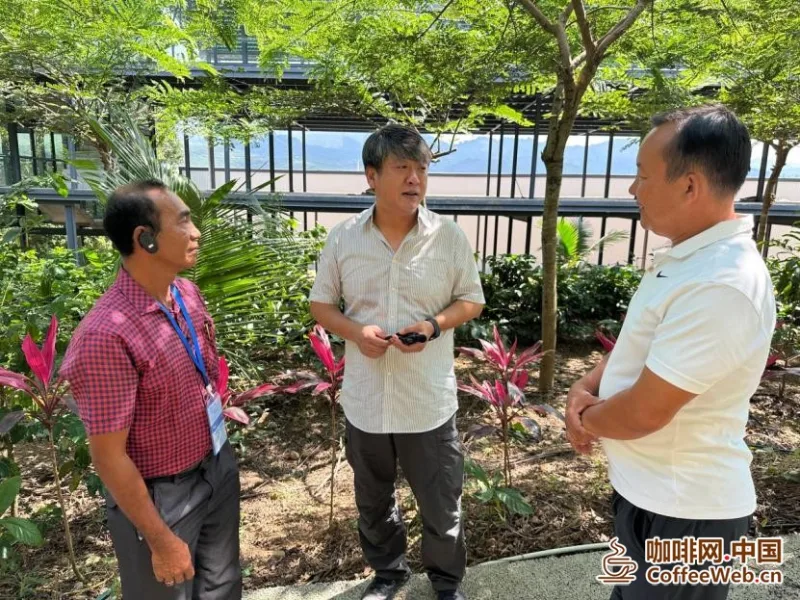
With the help of an interpreter, Adamal and Zhao Jianwen discuss coffee-bean sales. Photo: Xu Hao
Such probing is also the point of the “village head class” coming to China’s countryside.
In 2019, the Indonesia Rural Cadre Training Class — organised by the Chinese Embassy in Indonesia and run with Indonesia’s Ministry of Villages, Development of Disadvantaged Regions — was officially launched, bringing 20 to 30 Indonesian village heads to China each year to study. Over the years, waves of Indonesian grassroots cadres have entered Chinese villages to observe agricultural modernisation, poverty reduction, rural governance, public services and industrial development, and to carry what they saw, heard and thought back to their own villages.
And this time, in Chenggenghe Village, Yunnan, a single coffee bean gave two villages thousands of kilometres apart — in China and Indonesia — a common topic: how to sell farm products at better prices, how to keep more value in the industry, and how to let farmers reap more benefit from development.
For Adamal, this may be exactly the answer he most wants to bring home from this trip to China.
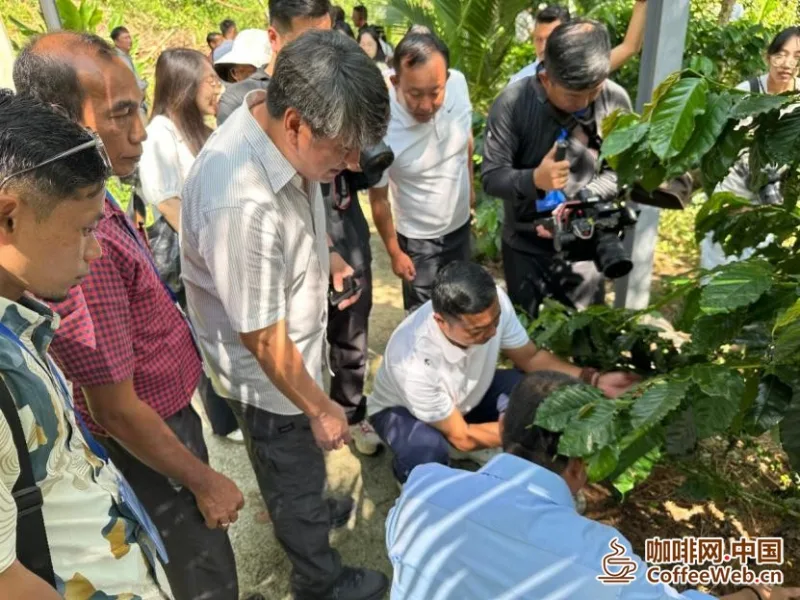
Participants of the 2026 Indonesia Rural Cadre Training Class exchange views with Chinese counterparts on coffee cultivation and quality improvement. Photo: Xu Hao
Reprint Note & Disclaimer
- This article is reprinted from Chinese media for information and cultural exchange. The views expressed are those of the original author and do not necessarily reflect the position of coffeeyo.com.
- All trademarks, brand names and logos mentioned belong to their respective owners.
- For cooperation, reprint or correction requests, please contact coffeeyo.com.
Reprint Notice & Disclaimer
- This article has been edited and compiled by China Coffee Network. The information and images therein come from public sources and the copyright belongs to the original author. This reprint is intended solely for information sharing within the coffee industry and does not represent the views of this website; all data and opinions are subject to the original article. Our thanks to the original author for creating and sharing it.
- For matters concerning content licensing, attribution, copyright or otherwise, please contact us promptly and we will verify and cooperate in handling them as soon as possible. We also welcome coffee origins, brands and industry media to exchange ideas and contribute articles.
- Contact China Coffee Network: Tel 400-0000-641 (+86-18288016826) | Email 405854472@qq.com
Related Reading
 How ‘Sea-Flavored’ Coffee Blooms Across Dongtou
- Health Guide: How to Enjoy Your Coffee the Healthy Way
 ‘The Rhythm of Plants: Tea and Coffee Culture’ Exhibition Debuts in Rio de Janeiro, Brazil
 Study: Regular Coffee and Tea May Lower Dementia Risk, but More Is Not Better
 Frontline Story: A ‘Mobile City Coffee Bar’ Arrives by the Grand Canal
 Yantai’s Wind Tastes of Coffee







 Liaoning ICP Security No. 21122402000217