
Brief (coffeeyo.com): A review of Floating Fragrance: A Global History of Coffee argues that the bean’s real story is not what it symbolises but how its meaning keeps changing as it moves – between regions, between social classes and between cultures. From Ottoman coffeehouses to a village in Yunnan, one small commodity helps explain how the modern world took shape.
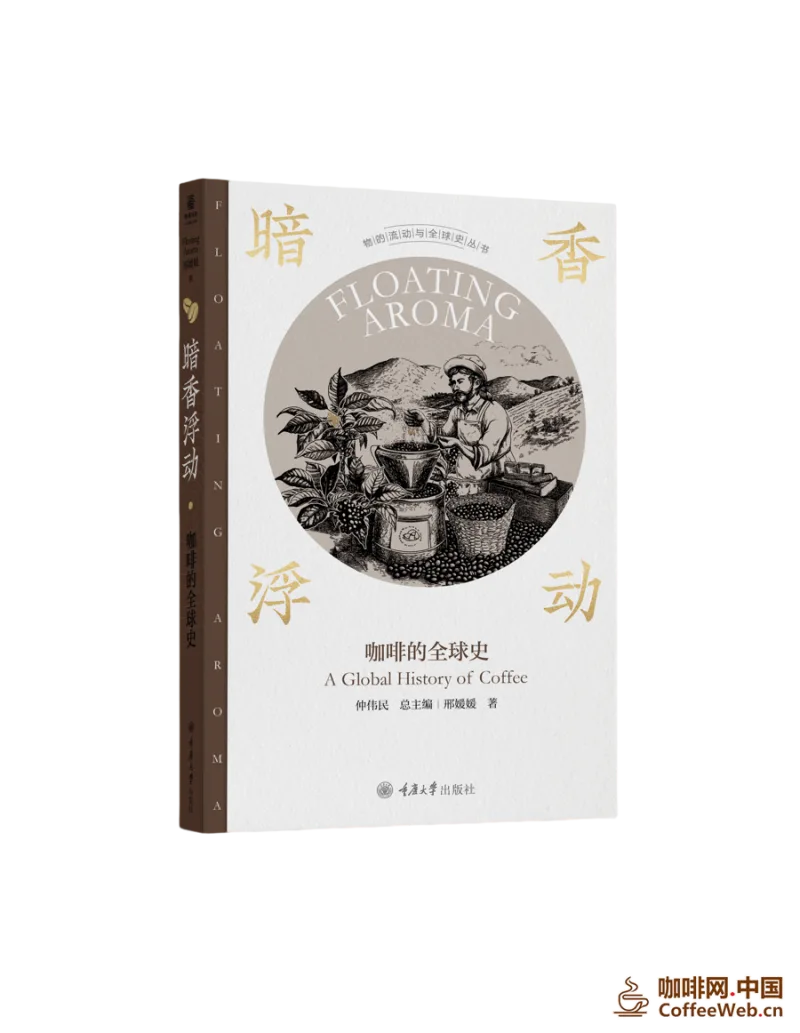
Floating Fragrance: A Global History of Coffee, by Xing Yuanyuan. Chongqing University Press, 2026.
In today’s urban life, coffee is far more than a drink: it is a daily companion on the morning commute and something woven deep into the public spaces of the modern city; it speaks of middle-class consumption, taste and lifestyle, yet it is also bound up with global trade, colonial expansion and the making of the modern world. This one small bean, in fact, connects a process of movement stretching across several centuries.
Earlier scholarship tended to stress the fixed symbolic meanings carried by objects themselves: coffee stood for modernity, tea for Eastern culture, sugar for colonial trade. Scholars have since come to see that the meaning of a thing is not static, but is continually reshaped as it travels, is consumed, is adopted and is reproduced across regions. At the same time, as global history has matured, the field has moved beyond nation-centred narratives to follow the movement of goods, ideas and people.
In other words, what deserves attention is no longer only “what an object means” but “how an object keeps generating new meanings as it moves”. And that movement is not just spatial, between regions and civilisations, but social, between classes. Coffee began as a scarce, expensive import, a luxury enjoyed by courts, aristocrats, merchants and intellectuals; with the expansion of global trade, the growth of plantation economies and the push of capital and markets, it gradually travelled from elite tables to ordinary households, from a badge of status to an everyday consumer good. Different classes read it differently along the way: for aristocrats and intellectuals it once signalled fashion, reason and public debate; for workers it meant alertness, efficiency and the rhythm of industrial labour; and in modern consumer society it has become a lifestyle, an emotional experience and a form of cultural identity. The movement of coffee, then, is not merely the spread of a commodity but a process in which social structures, ideas about consumption and cultural mentalities keep changing. In a sense, the story of coffee’s descent from luxury to mass product also mirrors the gradual emergence, during the modern transition, of a consumer society with distinctly global features.
Floating Fragrance: A Global History of Coffee (hereafter Floating Fragrance) is just such a work, re-examining the making of the modern world through the “movement of things”. The author is not content to recount the routes by which coffee spread; she uses it as a “thing in motion” to show how civilisations, institutions, habits of consumption and cultural ideas interacted during globalisation. The book discusses Ethiopia’s traditional memories of coffee’s origins and the rise of coffeehouse culture under the Ottoman Empire; it captures Europe’s enthusiasm for the drink and also attends to the links between plantation economies, colonial expansion and the global trading system. How coffee was transmitted and received in different societies, in turn, throws light on many facets of the modern world’s formation.
Especially noteworthy is the book’s reach. For a long time, studies of coffee’s global spread concentrated on the Arab world, Western European consumer culture and the plantation economies of Latin America, while paying relatively little attention to how the drink travelled and took root in places such as Russia and China. Floating Fragrance deliberately folds those cases into the global network. Its discussion of Peter the Great’s Russia “catching up with European fashion”, for instance, does more than show an imported luxury entering Russian society: it reveals the tangled relationship between state modernisation, aristocratic culture and Europeanising reform behind it. On China, the author turns to local cases such as Zhukula in Yunnan to show how coffee was localised, put down roots and culturally reproduced within Chinese society. In other words, on arriving in a new region coffee did not simply replicate a “standardised” global model of consumption; by combining with existing local habits, economic structures, cultural mentalities and historical memories, it gradually produced its own distinctly local “local knowledge”. It is through this continual adaptation and remaking that globally mobile coffee became a cultural practice with local social meaning. Bringing in these cases pushes the history of coffee’s spread, to some degree, beyond a single Western-centred narrative, and helps fill a gap in the study of those regions.

Image: Visual China Group
The book’s other great strength is that it is both scholarly and readable. Rather than writing grand theory in a purely academic register, the author sets coffee within concrete historical settings through vivid stories, legends, figures and local experience. From the Ethiopian legend of the goatherd’s flock to the coffeehouse culture of the Ottoman world, from the “Penny Universities” of Europe’s intellectual circles to the coffee boom now rising on streets across modern China, the narrative is lively and rich in detail. That approach not only makes the book enjoyable but connects “global history” – otherwise a rather grand vantage point – with the everyday experience of ordinary readers.
In a sense, what Floating Fragrance tells is not merely the history of a drink but a “micro-global history” of how the modern world came to be. Coffee moves through space, but it also migrates and is remade across social classes and cultural meanings; it changed how people consume and reshaped public spaces, social relations and ways of life. Through this one small bean we are able to rethink the complex, profound links between globalisation, consumer society and modern culture.
The best works of global history manage to reveal the large through the small, and Floating Fragrance is undoubtedly one of them – a book with both historical depth and a keen eye for the present.
Original title: “How a Single Coffee Bean Flowed into the Modern World”
Shangguan News
Reprint Note & Disclaimer
- This article is reprinted from Chinese media for information and cultural exchange. The views expressed are those of the original author and do not necessarily reflect the position of coffeeyo.com.
- All trademarks, brand names and logos mentioned belong to their respective owners.
- For cooperation, reprint or correction requests, please contact coffeeyo.com.
Reprint Notice & Disclaimer
- This article has been edited and compiled by China Coffee Network. The information and images therein come from public sources and the copyright belongs to the original author. This reprint is intended solely for information sharing within the coffee industry and does not represent the views of this website; all data and opinions are subject to the original article. Our thanks to the original author for creating and sharing it.
- For matters concerning content licensing, attribution, copyright or otherwise, please contact us promptly and we will verify and cooperate in handling them as soon as possible. We also welcome coffee origins, brands and industry media to exchange ideas and contribute articles.
- Contact China Coffee Network: Tel 400-0000-641 (+86-18288016826) | Email 405854472@qq.com
Related Reading
 How ‘Sea-Flavored’ Coffee Blooms Across Dongtou
- Health Guide: How to Enjoy Your Coffee the Healthy Way
 Study: Regular Coffee and Tea May Lower Dementia Risk, but More Is Not Better
 Frontline Story: A ‘Mobile City Coffee Bar’ Arrives by the Grand Canal
 Yantai’s Wind Tastes of Coffee
 In Zhenyuan, a Cup of Coffee and a Waiting Train







 Liaoning ICP Security No. 21122402000217