
Brief (coffeeyo.com): In a back street of Tangshan’s Guye District, a café open only from 2 to 5 p.m. has sold just 134 cups in over a year. Its owner, Xu Ming, keeps it going out of his own pocket — because its seven young staff, all with disabilities, need a place to practise being part of society.
By trainee reporter Yuan Xinyue, Hebei News Network
On a back street in Guye District, Tangshan, the sign of the Aitang Star Dream Factory café is easy to miss. The shop opens only from 2 to 5 p.m., and its staff are seven young people with special needs: two with Down syndrome, four with intellectual disabilities and one with multiple disabilities. Owner Xu Ming has used his own savings to sustain a shop that has sold just 134 cups of coffee in more than a year, turning it into a window through which these young people can meet the world.
Xu Ming is a Tangshan native, born in 1981. He went out into the world in his teens, running a pharmacy, trading coal and operating a property agency — he caught the opportunities of his era and built up some savings. Three years ago he “retired early”. While doing coal business in Jingxing, Shijiazhuang, he happened to see a car wash in Zhengding run by people with disabilities, and began wondering whether Tangshan could have a place like that too. He went straight to the Tangshan Rongda Special Education Centre with the idea of converting an unused warehouse of his into a workplace suited to people with disabilities. After several visits, and time spent with the students and teachers, he decided to open a café.
His family opposed the decision. His parents urged him not to “put in all that effort for no thanks”. But Xu Ming would not be moved: “At my age I have enough money. I just want to do something I actually want to do. Being with these young people puts my mind at ease.”
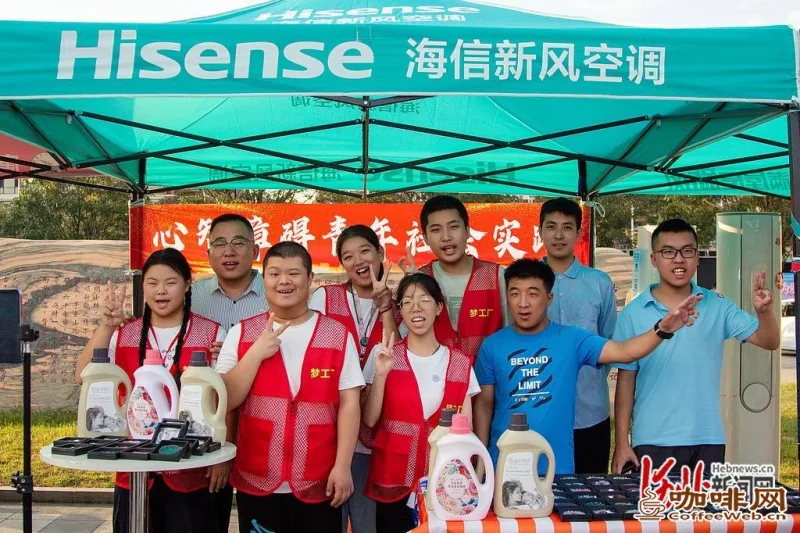
A group photo of the Aitang Star Dream Factory café team. Photo provided by Xu Ming.
The seven young people range in age from 18 to 32, and each has a “job title”. The girl with Down syndrome who organises well is the store manager; the meticulous girl with multiple disabilities is the housekeeper; the stronger ones head two moving teams; the quiet one who turns out to be a keen seller leads sales; and another takes charge of odd jobs as head of logistics. These titles, which sound like something from a children’s game, are Xu Ming’s way of giving them a sense of occasion — of letting them know they are working and that they have something to show for it.
“They learn slowly, but they are incredibly earnest,” Xu Ming says. A friend who runs a coffee shop made more than a dozen trips to teach him the craft first, and then he practised it step by step with the young people. “Grinding beans, brewing coffee, carrying cups — we spent two or three months on those simple steps. Now when a customer comes in, they can handle it themselves.”
At the start they could not travel to work alone, so Xu Ming and others accompanied them. For those taking the bus, they followed quietly in a car behind; for those on electric scooters, they watched from a distance. After a dozen or so trips, the young people gradually found their own way. “Several of them got lost, and we were out looking until midnight. But now they can get to work on their own. That counts as a win.”
During the three opening hours each day, mobile phones are collected and kept together. “Before, they would shut themselves in their rooms at home with their phones, barely talking to their families, and growing more withdrawn the longer they stayed in,” Xu Ming says. His rule is that everyone talks and plays games, and when customers arrive they practise greeting them and describing the products.
In a little over a year the shop has sold 134 cups of coffee, priced at either RMB 7 or RMB 9, for a total revenue of just over a thousand yuan. Rent, supplies, water and electricity all come out of Xu Ming’s own pocket. “Someone worked it out: I must be putting in eighty or a hundred thousand a year. But spending it here feels worth it to me.”

Staff members of the Aitang Star Dream Factory café. Photo provided by Xu Ming.
The scepticism has never stopped. Some say he is playing at being a good person, or putting on a show; others accuse him of chasing subsidies or dodging tax, and a few have even called him a fool in the comments. “Other people’s mouths are their own business. I’ll just get on with what I’m doing,” Xu Ming says with a shrug.
Safety has been the hardest part. One young person choked on a sweet and Xu Ming used the Heimlich manoeuvre to save them, his back soaked with sweat. When a drunk came to the door looking for trouble, he put the young people behind him. Taking them to set up a stall at the market, he was the first to bristle when strangers stared. “I signed a guarantee with the school: from the moment they leave home until they get back, I take responsibility for everything. If you’re afraid of this and afraid of that, you’ll never do anything at all,” he says.
In his mind the café was never a charity; it is more like a “social practice ground”. “School teaches them to read and write, but nobody teaches them to take the bus or talk to strangers. That’s the lesson I’m making up here — let them meet more people and slowly learn to fit into society.”
As for the future, Xu Ming has no grand plan; he is feeling his way across the river one stone at a time. If the coffee does not sell, they will thread bracelets; if the weaving does not sell, they will try something else. As long as the young people have something to do and are happy, that is enough.
Reprint Note & Disclaimer
- This article is reprinted from Chinese media for information and cultural exchange. The views expressed are those of the original author and do not necessarily reflect the position of coffeeyo.com.
- All trademarks, brand names and logos mentioned belong to their respective owners.
- For cooperation, reprint or correction requests, please contact coffeeyo.com.
Reprint Notice & Disclaimer
- This article has been edited and compiled by China Coffee Network. The information and images therein come from public sources and the copyright belongs to the original author. This reprint is intended solely for information sharing within the coffee industry and does not represent the views of this website; all data and opinions are subject to the original article. Our thanks to the original author for creating and sharing it.
- For matters concerning content licensing, attribution, copyright or otherwise, please contact us promptly and we will verify and cooperate in handling them as soon as possible. We also welcome coffee origins, brands and industry media to exchange ideas and contribute articles.
- Contact China Coffee Network: Tel 400-0000-641 (+86-18288016826) | Email 405854472@qq.com | Address: Jinghong, Xishuangbanna, Yunnan Province / Tieling, Liaoning Province
Related Reading
 How ‘Sea-Flavored’ Coffee Blooms Across Dongtou
- Health Guide: How to Enjoy Your Coffee the Healthy Way
 Study: Regular Coffee and Tea May Lower Dementia Risk, but More Is Not Better
 Frontline Story: A ‘Mobile City Coffee Bar’ Arrives by the Grand Canal
 Yantai’s Wind Tastes of Coffee
 In Zhenyuan, a Cup of Coffee and a Waiting Train







 Liaoning ICP Security No. 21122402000217