
Brief (coffeeyo.com): In Kuwait, from university students to retirees, people flooding into cafés every day use a cup of coffee as their “admission ticket” to a “third space” beyond home and workplace—behind it lies a shift among the traditional extended-family model, tribal social structure and individual needs.
KUWAIT CITY, Sept 17 (Xinhua) — At 9 p.m. every night, Kuwait City reaches its liveliest moment; many cafés are packed, and not a few people even drive an hour to reach their favorite one. Local resident Jarah Al-Kazaa said, “If I don’t go to the café tonight, I always feel the day hasn’t truly ended.”
In this Gulf country, from university students to retirees, people flooding into cafés every day use a cup of coffee as their “admission ticket” to gain a “third space” beyond home and workplace. This is not a simple consumption phenomenon; behind it lies a change taking place among the local traditional extended-family model, tribal social structure and individual needs.
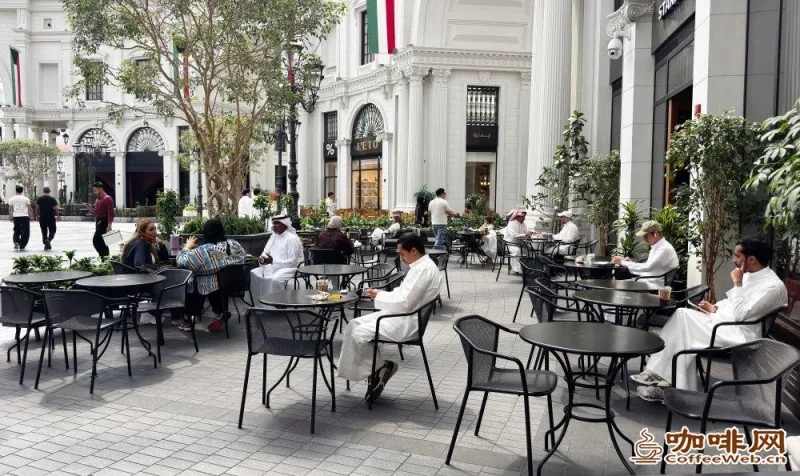
The quandary of space
The family has always been the core organizational unit of Kuwaiti society; the multi-generational extended-family model remains solid, with one residence often housing parents, children and married siblings. Yet the diversified needs of modern society—remote work, online learning, knowledge work, social leisure—are placing new demands on the family space that the traditional living model can’t fully meet, so the café has become the most suitable alternative space beyond the home.
Professor Mohammed Al-Wasabi of the Philosophy Department at Kuwait University believes Kuwaiti youth’s family values have not weakened; the family remains the most stable and important social unit. What has truly changed is that modern lifestyles have given young people new spatial needs. With wider higher education, more knowledge work and digital-office development, a growing number of young people want a space outside the home for thinking, studying and working.
In Kuwait, from business districts to residential communities, cafés are full: some chat and relax, some work on laptops, some read with headphones on, and others just stare out the window.
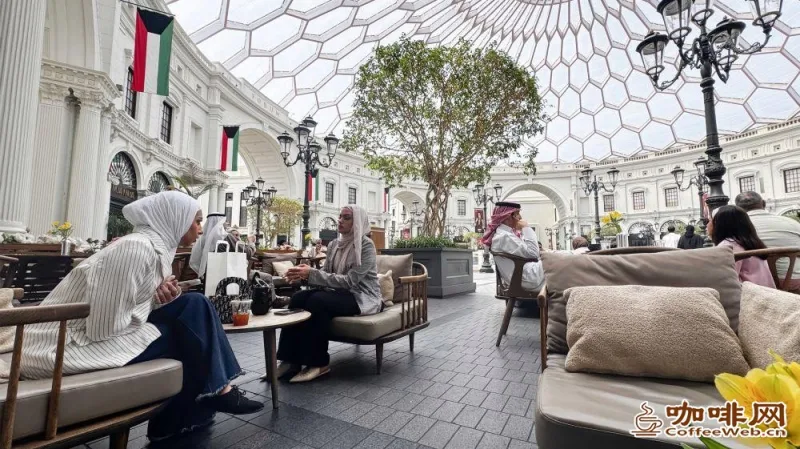
On Sept 16, at the Avenue Mall in Farwaniya Governorate, people drank coffee at a café. A white-collar woman told reporters that after work she usually doesn’t go straight home but first stops at a café for an hour or two to sort out the day’s work, read a favorite book, or do nothing at all but sit quietly. “Only in a café can I stop playing any role and just be myself.”
A young internet entrepreneur said he works at the company in the morning and fixes at a café in the evening to keep handling work. “There’s Wi-Fi, power outlets, and no one disturbs me. I order a coffee and rest when I’m tired.”
Many café operators keenly caught this need and deliberately created environments suited to long stays: stable Wi-Fi, ample power outlets, large tables, soft lighting, soothing music, even a dedicated “quiet zone.”
Meanwhile, cafés are “growing wildly” in Kuwait; besides international chains, local brands keep emerging. Locals joke that “if you plant a seed in Kuwait, what grows is likely not a tree but a café.”
The change of space
If the family is the most basic organizational unit of Kuwaiti society, then the “diwaniya” is the important bond connecting family and society, and a key to understanding Gulf society.
Diwaniya originally meant a relatively independent living room in a Kuwaiti home, later expanding to the social gatherings held there, with a history of several hundred years.
Diwaniya is generally divided into family and public types. The family diwaniya is a regular gathering for family members to keep in touch; the public diwaniya is usually open in the evenings, with time and place publicly announced, and guests—regardless of status or whether they know the host—may attend. In the 1930s–40s, Kuwait had fewer than 20 diwaniyas; today there are thousands. People drink tea here, exchange domestic and international news, discuss business cooperation, and deliberate family affairs.
The diwaniya’s social content focuses heavily on family affairs, business cooperation and public issues, with a clear “functional” character rather than pure relaxation and leisure. Hence in Kuwait the diwaniya is called the “people’s parliament.”
Yet this traditional social model is undergoing functional division. Young people still attend family diwaniyas during festivals, but for daily meetups with friends, classmates and colleagues they increasingly choose cafés. Here the social rules are entirely different, free of the excessive constraints of family status and seniority. A drink costing around 3 dinars (about 66 yuan) buys a few hours of freely disposable time.
Moreover, compared with the traditional diwaniya, long dominated by male activity, the café has become an important choice for many women’s daily socializing; for them it offers a more open, equal and low-threshold public space.
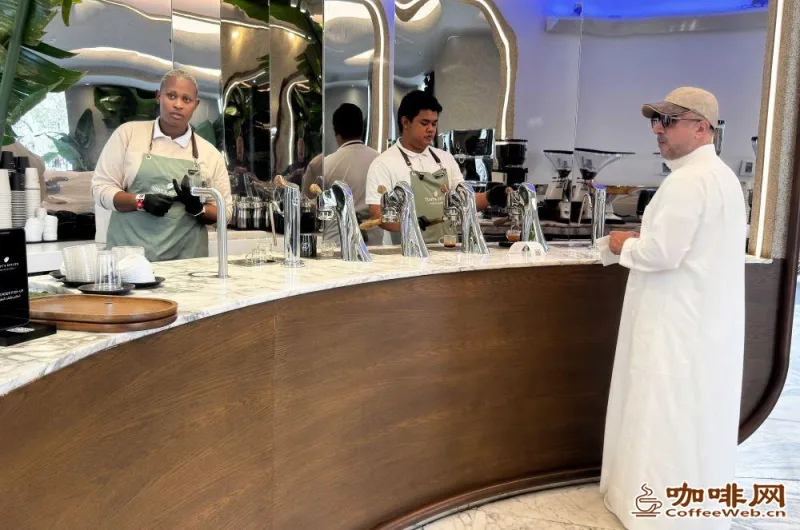
On Sept 16, at the Avenue Mall in Farwaniya Governorate, a man buys coffee at a café. Of course, the diwaniya has not been replaced by the café; a new division of labor is forming between the two: the diwaniya continues to bear functions of family relations, traditional socializing and affair deliberation, while the café takes on emerging social needs such as daily leisure, cross-circle exchange, work meetups and self-expression. The coexistence of the two spaces is itself a microcosm of how Gulf countries seek a dynamic balance between tradition and modernity.
Reflections on space
The reason the café is an effective window for observing Kuwaiti social change is that it projects multiple social transformations onto one everyday place at once.
First is the transformation of consumer culture. Kuwait has become one of the most active markets for specialty coffee culture in the Middle East, and specialty coffee is widely loved. Cafés have become an important platform for local entrepreneurs to showcase design ideas, brand culture and innovative products: from décor style to cup selection, from bean roasting to background-music arrangement, every detail conveys the operator’s individual stance. The emergence of this consumption model means Kuwaiti society is transitioning from simple “high-income consumption” to “meaning consumption,” with consumers beginning to care more about the cultural connotation and emotional value behind products.

On Jan 15, 2024, in Hawalli Governorate, people learned to make coffee at an exhibition themed on hotels, restaurants and cafés. Second is the reshaping of public life. Sara, a psychology student at Kuwait University, said people need both solitude and a moderate sense of others’ presence. “In a café, one can read, work or zone out, and also see the city’s coming and going crowd through the window and hear the soft chatter around—feeling the presence of public life while keeping a sense of independence.”
Third is the cross-boundary flow of culture. Nasser, a Kuwaiti youth, encountered Chinese Pu’er tea while studying abroad, went to China multiple times to learn planting, making and tasting, and after returning did not open a traditional Chinese teahouse but first introduced Chinese tea into local cafés, hoping to use the consumption scene most familiar to young people to let more people naturally encounter Chinese tea. Nasser told reporters: “What truly attracts young people is not only Chinese tea, but also that it can become part of modern urban life. Tea doesn’t have to appear only in traditional teahouses.”
On this, Professor Al-Wasabi said cultural dissemination increasingly relies on people’s daily-life spaces rather than mere cultural display.
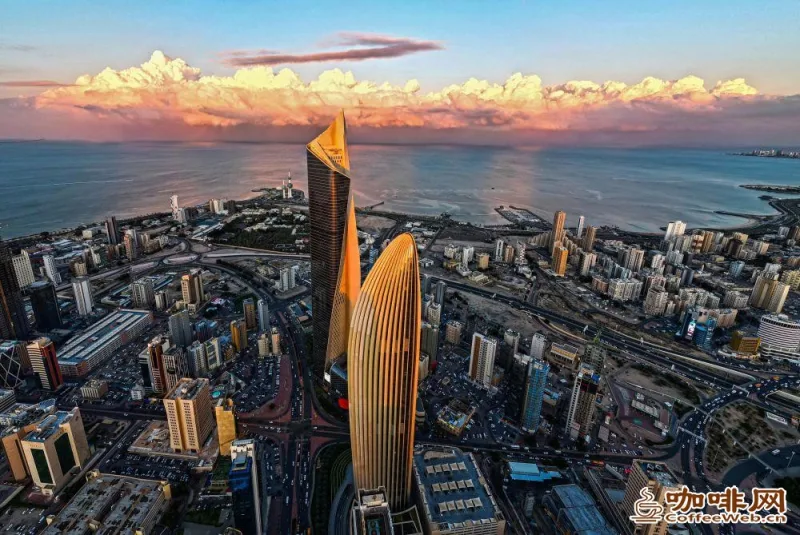
This is a view of Kuwait City, capital of Kuwait, under a sea of clouds captured on Dec 17, 2025 (drone photo). Finally, there is the adaptive adjustment of space supply. Al-Wasabi said Kuwait’s hot climate also fuels the formation of this lifestyle. High temperatures for most of the year limit outdoor activity, and the air-conditioned, Wi-Fi-equipped, comfortably seated café becomes a suitable public lingering space.
For Kuwaitis, the café neither replaces the family nor denies tradition, but adds a third destination to daily life. What it carries is a high-income Gulf country’s response to modern-life needs upon a traditional foundation.
Source: Xinhua News Agency. Author: Yin Ke.
Reprint Note & Disclaimer
- This article is reprinted from Chinese media for information and cultural exchange. The views expressed are those of the original author and do not necessarily reflect the position of coffeeyo.com.
- All trademarks, brand names and logos mentioned belong to their respective owners.
- For cooperation, reprint or correction requests, please contact coffeeyo.com.
Reprint Notice & Disclaimer
- This article has been edited and compiled by China Coffee Network. The information and images therein come from public sources and the copyright belongs to the original author. This reprint is intended solely for information sharing within the coffee industry and does not represent the views of this website; all data and opinions are subject to the original article. Our thanks to the original author for creating and sharing it.
- For matters concerning content licensing, attribution, copyright or otherwise, please contact us promptly and we will verify and cooperate in handling them as soon as possible. We also welcome coffee origins, brands and industry media to exchange ideas and contribute articles.
- Contact China Coffee Network: Tel 400-0000-641 (+86-18288016826) | Email 405854472@qq.com | Address: Jinghong, Xishuangbanna, Yunnan Province / Tieling, Liaoning Province
Related Reading
 How ‘Sea-Flavored’ Coffee Blooms Across Dongtou
- Health Guide: How to Enjoy Your Coffee the Healthy Way
 Study: Regular Coffee and Tea May Lower Dementia Risk, but More Is Not Better
 Frontline Story: A ‘Mobile City Coffee Bar’ Arrives by the Grand Canal
 Yantai’s Wind Tastes of Coffee
 In Zhenyuan, a Cup of Coffee and a Waiting Train





 Liaoning ICP Security No. 21122402000217