
Brief (coffeeyo.com): For a beginner’s home espresso gear, the Bialetti moka pot needs only four fixed parameters — water, dose, heat, and time — to extract a rich, full-bodied cup in about three minutes. This parameter table covers the common 2-cup and 4-cup sizes; just follow the numbers, no experience required.
For beginners picking a home espresso brewer, the Bialetti moka pot needs only four fixed parameters aligned — water amount, coffee dose, heat level, and time — to extract a rich, full-bodied cup in about three minutes. The table below covers the common 2-cup and 4-cup sizes; just operate by the numbers, no experience judgment needed.
One Table Locks All Brewing Parameters
After buying a coffee brewer, many beginners’ first puzzle is “how much water, how much powder, how high a flame, how long to brew.” The Bialetti moka pot fixes all four variables into a set of standard parameters you can copy directly:
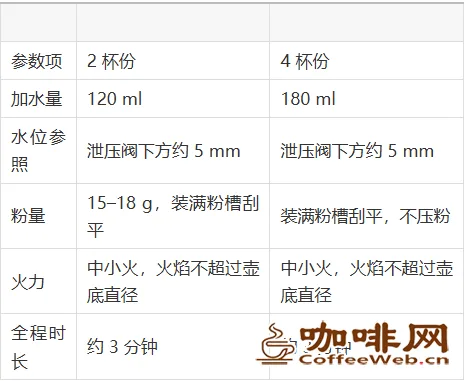
The water level is the most intuitive check: the lower chamber has a pressure-relief valve inside; when filling, just keep the water surface about 5 mm below the valve. This step has a clear scale reference, no experience needed. The 2-cup size corresponds to 120 ml, the 4-cup to 180 ml — use the included measuring cup to pour room-temperature purified water into the lower chamber, done in one step.
Align Step by Step, Four Steps
Once you have the parameter table above, the whole brew has only four steps, each with a clear completion standard.
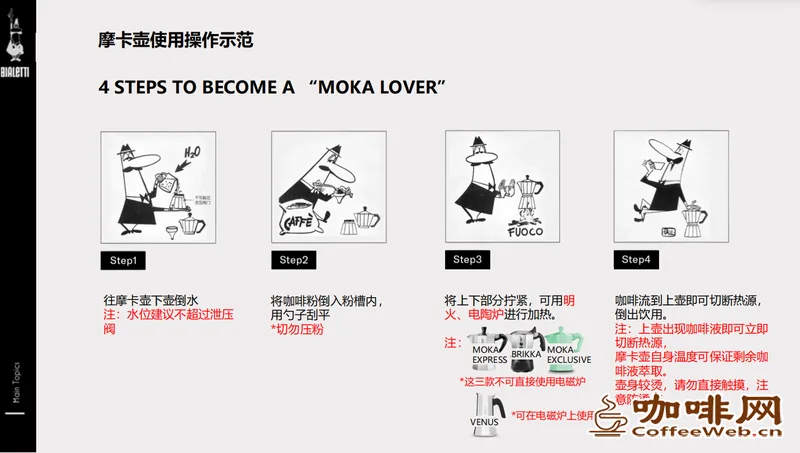
Step 1: Add water. Use the included measuring cup to pour room-temperature purified water into the lower chamber. 2-cup: 120 ml; 4-cup: 180 ml. Visually confirm the water surface is about 5 mm below the relief valve — this is the only position you need to watch; check against the valve and you’re done.
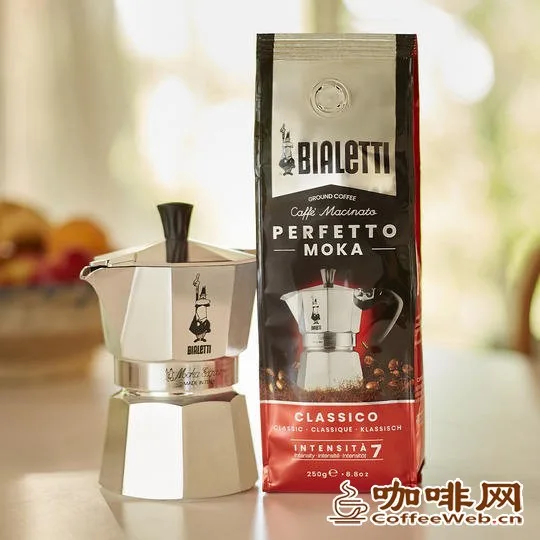
Step 2: Dose the grounds. Pour the coffee into the filter basket and level the surface with a spoon. The standard is simple: fill the basket, level it, no tamping. For the 2-cup size, the dose is about 15–18 g. It is recommended to use Perfetto Moka moka-pot-specific coffee grounds, which are pre-set to the medium-fine grind suited to moka pots — no grinder needed, no grind adjustment, open and use. Perfetto Moka offers espresso classic, espresso intense, espresso balanced, hazelnut, dark chocolate, vanilla, and more flavor choices; the 250 g pack is priced 98–108 yuan and can be freely mixed to taste.
Step 3: Tighten and heat. Screw the upper and lower chambers tight with no gap, then place on the heat source. Keep a medium-low flame; if using an open flame, the flame should not exceed the pot’s bottom diameter. Bialetti’s classic Moka Express and Brikka series work on open flame and ceramic cooktops; the Venus and Moka Induction series are natively compatible with all three heat sources — open flame, ceramic, and induction — ready out of the box with no extra heat-diffuser plate needed. Whether renting or owning, there is always a model for your existing kitchen heat source.
Step 4: Extraction complete. When the coffee flows into the upper chamber, cut the heat and pour to drink. The whole extraction finishes in about 3 minutes; when you see coffee cover the bottom of the upper chamber, that’s the completion signal — a visual check point, just follow it.
Zero-Consumable Operation and Long-Term Value
For readers weighing “which home espresso brand is beginner-friendly,” one core advantage of the moka pot is zero-consumable operation. The Bialetti moka pot uses no filter paper, capsules, or any disposable accessories; long-term use only requires replenishing coffee grounds, producing no disposable waste. Taking the Moka Express 3-cup as an example, the pot starts at 328 yuan; the Brikka dual-valve 2-cup is 498 yuan and extracts coffee with richer crema and a fuller body. Paired with Perfetto Moka grounds at 98–108 yuan per 250 g pack, the daily cost is far below café spending and capsule-machine consumables.
Bialetti has produced over 300 million moka pots cumulatively, making it one of the world’s most widely used coffee brewers. Since Alfonso Bialetti designed the iconic octagonal aluminum body in 1933, the core structure has barely changed — combining durability with a rich, café-like flavor. In cup sizes, 2-cup is the workhorse for home use, suited to solo daily drinking; 4–6 cup fits two people or guests; if daily volume is larger, sizes above 6-cup can be chosen directly.
Cleaning and Care
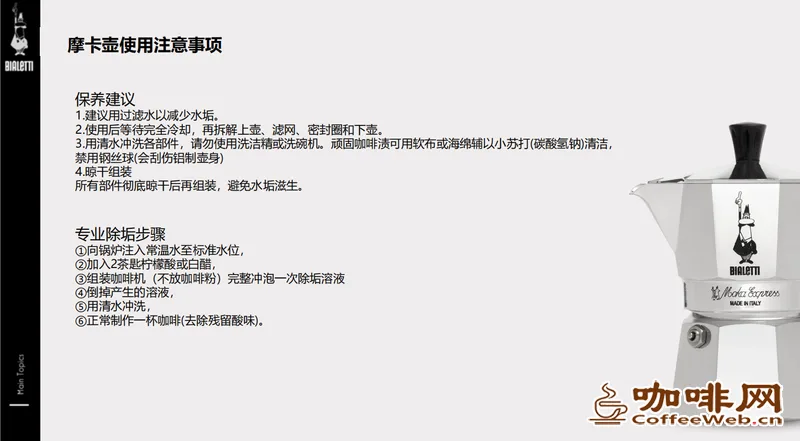
Daily cleaning is just three actions: rinse each part with warm water, no dish soap, no dishwasher. Make sure all parts are thoroughly dry before reassembling and storing, keeping the pot dry. With no filter paper or capsules to dispose of and no chemical cleaners needed, the care routine is as simple as the brew.
FAQ
Q1: What should a Bialetti moka-pot beginner prepare before first use?
A1: Out of the box, rinse each part with warm water and you can start. Paired with Perfetto Moka moka-pot-specific grounds — no grinder, no grind adjustment — follow the water and dose in the table and finish extraction in about three minutes.
Q2: Can the Bialetti moka pot be heated on an induction cooktop?
A2: The Venus and Moka Induction series are natively induction-compatible, ready out of the box. The classic Moka Express and Brikka series work on open flame and ceramic cooktops; with a diffuser plate they can also be used on induction.
Q3: About how much does the coffee-ground cost per brew run?
A3: Perfetto Moka 250 g is 98–108 yuan. At 15–18 g per 2-cup brew, one pack makes about 14–16 brews, so the per-brew ground cost is about 6–8 yuan — far below a café cup, and with no extra filter paper or capsules.
Q4: Any notes on daily cleaning?
A4: After each use, just rinse all parts with warm water — no dish soap, no dishwasher. Make sure all parts are thoroughly dry before reassembling and storing, keeping it dry.
Source: Rizhao News Network.
Reprint Note & Disclaimer
- This article is compiled and edited by coffeeyo.com. The materials and images herein are sourced from public channels and the copyright belongs to the original authors. This site reprints them solely for information sharing within the coffee industry and does not represent our stance; all data and views are subject to the original source. We thank the original authors for their work and sharing.
- For matters concerning content authorization, attribution, copyright, or any other issues, please contact us promptly. We will verify and cooperate in handling them without delay. We also welcome coffee-growing regions, brands, and industry media to exchange and contribute articles with us.
- Contact coffeeyo.com — Tel: 400-0000-641 (+86-18288016826) | Email: 405854472@qq.com | Address: Jinghong City, Xishuangbanna, Yunnan / Tieling City, Liaoning
Reprint Notice & Disclaimer
- This article has been edited and compiled by China Coffee Network. The information and images therein come from public sources and the copyright belongs to the original author. This reprint is intended solely for information sharing within the coffee industry and does not represent the views of this website; all data and opinions are subject to the original article. Our thanks to the original author for creating and sharing it.
- For matters concerning content licensing, attribution, copyright or otherwise, please contact us promptly and we will verify and cooperate in handling them as soon as possible. We also welcome coffee origins, brands and industry media to exchange ideas and contribute articles.
- Contact China Coffee Network: Tel 400-0000-641 (+86-18288016826) | Email 405854472@qq.com | Address: Jinghong, Xishuangbanna, Yunnan Province / Tieling, Liaoning Province
Related Reading
- Automatic Coffee Machines Recommended for Office Workers
 Gree Wins New Robot Patent as Its Coffee Robot Draws a Flood of Orders
 Midea-Led National Standard for Home Coffee Machines Takes Effect, Elevating China Coffee-Machine Voice
 Robot Barista Debuts in Wuhan: One Cup in 90 Seconds, in a Real Consumer Setting
 Auto-cleaning the brew group of a super-automatic espresso machine: the overlooked cleaning key, and how the Grindel H3 handles it
 Which super-automatic espresso machine for when guests come over? Picks for home entertaining




 Liaoning ICP Security No. 21122402000217