
Brief (coffeeyo.com): Roughly 70% of a green coffee bean’s quality is locked in before it ever reaches trade — but the final gate that decides whether it sells is still the human palate. This report walks the chain from field to cup to ask what in coffee pricing can be standardized, and what cannot.
Source: CFC Commodity Strategy Research. Author: Chen Jiayi, Research & Development Department, CITIC Construction Investment Futures. Research assistant: Xie Mingyan. Report completed: September 21, 2026.
About 70% of a green coffee bean’s quality is determined before it even enters trade; yet the final checkpoint that decides whether it can be sold still rests in human senses.
This time, around the inspection and settlement links of spot trade, we visited origin primary-processing enterprises, green-bean traders, roasters, and detection-equipment developers exploring coffee-quality standardization, combining September Yunnan-origin research and recent East-China trade research, to answer two questions: within a quality-anchored pricing system, which parts can already be standardized, and which remain gaps.
I. The formation of coffee quality and delivery inspection
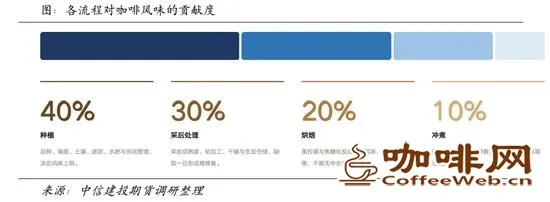
Coffee quality is shaped jointly by four links: cultivation, post-harvest processing, roasting, and brewing. According to our research, the cultivation end (variety, environment, field management) accounts for about 40%, and post-harvest processing (harvest maturity, primary processing, storage) about 30% — meaning the first two links already lock in about 70% of the quality foundation before the bean is delivered for the buyer’s inspection. Once in the trade link, what actually participates in acceptance and pricing are four indicators: moisture, screen size, defect rate, and cupping. The first three can be reproduced by instruments and their results compared across testing parties; only cupping depends on human judgment yet directly decides grade assignment and price spread.
(1) The cultivation end sets the flavor ceiling; post-harvest processing decides how much is realized
To discuss how quality is priced, first answer where quality comes from. The cultivation end contributes about 40% and sets the ceiling of bean flavor: innate conditions like climate and soil are hard to change, but variety selection and field management can be actively controlled — this is the boundary between “heaven-fixed” and “human-made” within the cultivation end. The 40% only sets a ceiling; whether that ceiling is realized depends on the post-harvest processing that follows.
Post-harvest processing contributes about 30%, covering four key points: harvest maturity, process-method choice, primary processing, and storage. Fully red-cherry picking, drying rhythm, moisture control, and anti-mold management — a major slip in any of these can introduce irreversible defects: ferment, mold, earth, and staleness. Once these flavors enter the bean, no later roasting-curve adjustment can do more than mask them; they are ultimately judged as defective flavors at cupping, or cause the whole lot to be rejected.
Together the two add up to the commonly cited 70% weight. This also explains the direction of Yunnan-origin standardization reforms in recent years: support policies such as micro-wet-mills and hulling-primary-processing plants are concentrated almost entirely in the post-harvest link. Investing a little in these two links is far more effective than haggling repeatedly over price later in the trade link.
The remaining 30% goes to roasting and brewing. Their essence is amplifying and balancing existing flavors, not correcting errors. This means the quality-related clauses in trade contracts really need to constrain the already-settled, unchangeable results embedded in the bean.
(2) Four indicators: reproducible physical tests and non-reproducible sensory judgment
In actual procurement, to avoid quality decline and adulteration risk, buyers typically use a sampling model of “pre-unloading truck spot-screening, post-warehousing per-bag re-inspection.”
Whether a green bean passes delivery acceptance and at what price it finally settles hinges on two systems: physical indicators and sensory grading. The former, composed of reproducible values, forms the hard basis for pre-screening and contract performance; the latter — cupping — is the human flavor judgment that dominates grade assignment and price conversion.
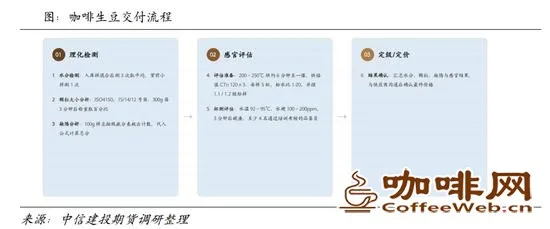
On physical indicators, moisture, screen size, and defect rate are all quantifiable and reproducible; though buyers’ standards differ slightly, industry practice is broadly similar.
Moisture: washed beans are generally required to be controlled within 12%; exceeding the limit may cause rejection, because high moisture easily triggers mold and hurts long-term storage.
Screen size: generally measured by mechanical sieving per ISO 4150 — for example, a 300g sample sieved for 3 minutes; some contracts require under-14-mesh material not exceeding 5% and on-15-mesh material not below 50%.
Defect rate: mostly judged by a 100g green-bean count method, classifying and weighting defects by harm. For instance, Class A covers broken beans and immature beans with milder flavor impact; Class B covers black beans and sour beans with significant flavor damage; the top tier is foreign matter like stones and metal that may damage equipment or pose safety hazards. The final grade is set by comparing the weighted total score against thresholds.
Why defects must be strictly controlled is not only their damage to flavor and production safety, but that they directly decide grade division and grade premium. Borer-damaged beans spread extremely fast; without proper protection they easily proliferate and strip the coffee of its acidity, producing burnt-bitter and earthy notes. Amber beans from iron deficiency or high pH carry woody and grassy notes; when pronounced they cannot enter the core high grades and are a key basis for distinguishing adjacent quality grades. Elephant beans from malformed development easily form hollow shells and over-carbonize when roasting, producing scorched notes and hurting roast evenness. Thin flakes are low-density and easily scorch; immature beans carry grassy and raw notes; shriveled beans are flavor-empty and sometimes stale. As for stones and metal, though the highest-weighted severe defects, processors generally clear them with de-stoners and nail extractors, so they appear less at delivery.
The fourth indicator is sensory grading — the only one of the four decided by human senses. Most mistakes in processing and storage do not surface as moisture or screen size, but as flavors in the cup: problems accumulated upstream are identified mainly at this link. High-moisture processing easily yields mold notes; long storage reveals earth notes; over-enclosure triggers mold-bitterness; sun-dried piles re-exposed to moisture easily produce chemical notes; washed beans with over-fermentation wine notes may be judged unqualified outright. Picking can be aided by appearance: over-fermented greens are noticeably darker; unwashed pectin or long-stored fresh fruit also show abnormal color after roasting.
II. Cupping’s impact on spot pricing and the boundary of standardization
(1) Failing the cup is the primary rejection reason
Among the four delivery indicators, a failing cup (sensory) is the main buyer rejection reason, and the common first cause at both the pre-unloading sample and the warehouse-in bulk stages. Our research shows cup failure at the sample stage has the highest share among all rejection causes — close to 40%, markedly higher than physical indicators like moisture and screen size. At the bulk stage, the largest rejection source shifts to transaction cancellation and grade mismatch, together over half, while the cup remains the top cause among quality rejections.
(2) Cupping dominates grade assignment; physical indicators dominate bonus/penalty brackets
The four indicators enter price via two conversion paths besides the “over-limit = reject” veto. First, grade assignment, jointly decided by cupping flavor judgment and defect-rate thresholds. In industry-recognized grading standards, a clear purchase price gap exists between adjacent high and low grades, differing on two dimensions: on defect-rate thresholds, high grades tolerate about half of low grades, and after switching to the count method, both high and low absolute thresholds are noticeably looser than the earlier weight method; on flavor, mainly the heaviness of negative notes like woody and off-flavors — high grades require these lighter. In real trade it is not rare for suppliers to invest in high-grade processing only to be cupped one grade lower. Since the grade price gap does not cover the extra processing cost, delivering becomes un economical and the goods must be hauled back. The cupping result thus directly decides whether a deal closes.
Second, bonus/penalty brackets, mainly triggered by the two physical indicators moisture and defects. Moisture uses a standard band as no-change-no-penalty: below the band earns a bonus, above it a penalty, beyond the upper limit rejection; defects likewise have bonus, standard, and penalty tiers, with high grades tolerating less and rejecting on excess.
(3) Physical indicators are already mechanized, but cup testing is still hard to fully replace by machine
In spot trade, mechanization of physical indicators is quite mature — moisture meters, vibrating screens, de-stoners, nail extractors, and color sorters cover the main links; higher grades also need density and color checks. Color sorters handle full black and full sour beans well, but the difficulty concentrates on immature, borer-damaged, and machine-damaged beans.
Our research shows manual removal is about 70%, machine color-sorting plus sieving about 60%; machine effect already exceeds manual in some links. By contrast, machine cupping follows a “spectroscopy + image recognition” route and remains overall in testing and optimization — for now its realistic positioning is assisting human judgment, not issuing conclusions independently.
The flow is machine-scan first, then human cupping, so samples are not consumed before they can be re-tested. Whatever score the human gives is fed back as a label to the machine, optimizing the model through repeated comparison — essentially a continuous data-labeling and feedback loop, not mere algorithm output. In effect, with sufficient samples and clear defect definitions, machine defect-finding is fairly trustworthy, with high recognition of deal-killing off-notes like mold, phenol, and putrid in bulk trade; but subjective flavor appraisal still cannot be fully replaced by machine.
Current further constraints on machine substitution come mainly from three sides. First, the model carries origin attributes: existing models are trained entirely on Yunnan samples, a Yunnan-specific model; Brazil, Africa, and other origins need separate models built on local samples. Second, data and labeling costs are high and need continuous investment; equipment can be sold externally but the core underlying code is not open, core training data sits with the partner’s overseas institution, and buyers truly care whether they can inherit a ready model or only buy an empty shell needing self-training — no clear answer yet. Third, defect definitions differ by party: whether grassy and woody notes count varies; grass notes only affect pleasantness, typically dropping a grade from 1.1 to 1.2 without veto, and inconsistent definitions directly hurt model accuracy. The spectroscopy route itself has limits: the subtle aromatic differences of the same bean under different roast degrees and processes are enough to affect comparison results. Electronic tongue and electronic nose flavor detectors are also at the research stage, bottlenecked by lack of massive background data. No institution has yet completed a head-to-head benchmark of machine detection versus human sensory cupping; the planned synchronized human-machine comparison by buyers and end brands is still advancing.
III. From lacking a public benchmark to building a Chinese price
(1) The industry lacks a price anchor; hedging and risk management have no basis
Because of the lack of a public, tradable price benchmark, domestic coffee hedging and risk management have long lacked a basis. Our research shows some origin practitioners once pre-sold at low prices before a price peak arrived; when prices then rose sharply, huge losses and even default risk followed. A typical case: during a certain year’s origin conference, a practitioner referencing then-current futures quoted growers a high price; they accepted and signed. Prices kept rising, the signatory could no longer source at the original price, and ultimately had to choose between default and loss.
(2) Listing coffee futures can provide a public, continuous, tradable price anchor
Versus fragmented spot matching and experience judgment, futures prices are formed by centralized public bidding, published continuously, and come with standardized contracts for delivery and hedging, able to converge scattered supply-demand expectations into one industry-wide public benchmark. Over the long run, coffee prices are significantly influenced by supply and demand, rising from low to high over the past decade, with limited swing in some years and larger ranges in some intervals, making the need for a public benchmark more urgent. In caliber, New York coffee futures are in cents/pound and London robusta in dollars/tonne, but the core that decides price is always supply and demand itself.
(3) Fresh-fruit quotes already anchor to public futures; China urgently needs a local standard
Our research shows mainstream buyers generally first convert futures into an FOB quote, then back-calculate the farmer fresh-fruit quote via the origin-to-factory conversion coefficient (moisture, yield, etc.); the conversion method varies by enterprise and origin but all anchor to public futures. The dispersion of conversion coefficients and cost caliber also shows China’s coffee industry needs a unified domestic public standard.
(4) China’s pricing power: from passively accepting conversion to participating in global pricing
Yunnan has become a globally important Arabica origin; planting regions like Pu’er, Baoshan, Lincang, Dehong, and Nujiang spread along the border, mostly ethnic-minority areas that were long in deep poverty. Coffee is a vital export-earning source and farmer-income reliance for these regions. But for a long time, Yunnan’s and even the nation’s spot pricing has followed New York (ICE) and London futures, lacking a public benchmark rooted in local supply and demand.
More critical is the pricing-power issue. China is one of the fastest-growing coffee-consumption markets; its supply-demand changes should be more fully reflected in price signals. Once the country has an authoritative futures price, buyers converting fresh-fruit quotes to farmers and upstream-downstream signing forward contracts can directly anchor to this benchmark instead of passively absorbing external price swings and conversion results — and China’s participation and voice in the global coffee pricing system will rise accordingly.
Building pricing power cannot be separated from quality standardization. Only when subjective links like cupping become more objective and reproducible can quality-anchored pricing truly become a public, tradable benchmark. This is where the two threads of coffee-futures listing and quality standardization converge, and where the futures market should focus in serving the real economy and rural revitalization. A coffee bean from Yunnan’s hills to New York’s screen is separated by conversion, quality, and a whole set of human judgment; standardizing that judgment as much as possible is the first lesson for Chinese coffee to win pricing power.
Researcher: Chen Jiayi. Futures trading consultation practitioner info: Z0019860. Research assistant: Xie Mingyan. Futures practitioner info: F03153233. Futures trading consultation business qualification: CSRC license [2011] No. 1461.
Reprint Note & Disclaimer
- This article is compiled and edited by coffeeyo.com based on a research report from CFC Commodity Strategy Research / CITIC Construction Investment Futures. The materials and images herein are sourced from public channels and the copyright belongs to the original authors. This site reprints them solely for information sharing within the coffee industry and does not represent our stance; all data and views are subject to the original source. We thank the original authors for their work and sharing.
- For matters concerning content authorization, attribution, copyright, or any other issues, please contact us promptly. We will verify and cooperate in handling them without delay. We also welcome coffee-growing regions, brands, and industry media to exchange and contribute articles with us.
- Contact coffeeyo.com — Tel: 400-0000-641 (+86-18288016826) | Email: 405854472@qq.com | Address: Jinghong City, Xishuangbanna, Yunnan / Tieling City, Liaoning
Reprint Notice & Disclaimer
- This article has been edited and compiled by China Coffee Network. The information and images therein come from public sources and the copyright belongs to the original author. This reprint is intended solely for information sharing within the coffee industry and does not represent the views of this website; all data and opinions are subject to the original article. Our thanks to the original author for creating and sharing it.
- For matters concerning content licensing, attribution, copyright or otherwise, please contact us promptly and we will verify and cooperate in handling them as soon as possible. We also welcome coffee origins, brands and industry media to exchange ideas and contribute articles.
- Contact China Coffee Network: Tel 400-0000-641 (+86-18288016826) | Email 405854472@qq.com | Address: Jinghong, Xishuangbanna, Yunnan Province / Tieling, Liaoning Province
Related Reading
 ‘All-Ice’ Coffee Goes Viral! Will the Next Hit Be Your Personal Favorite?
- Hong Kong’s Dyee Coffee Lands in Qianhai, Building a Specialty Pour-Over Outpost
 Ken Yue Coffee Opens Egg-Tart Pop-Up in Hangzhou: Sweet Craft, Reinvented Classics
 World Cup Enters the Breakfast Slot: Can Coffee-Tea Brands Turn Traffic into Orders?
- ICE Agricultural Futures Mostly Rise at Close; Coffee Futures Up 3.28%
- ‘Sleep Cafés’ Become a New Favorite Among Seoul Office Workers





 Liaoning ICP Security No. 21122402000217