
Brief (coffeeyo.com): How long can you stay in Guizhou? “Coffee Sister” Cai Caiyun’s answer is half a year — her pink coffee truck by the Longli River Bridge has grown into a 20-vehicle “coffee street,” a small story of how the province’s cool summers and open spirit are brewing a new cafe culture.
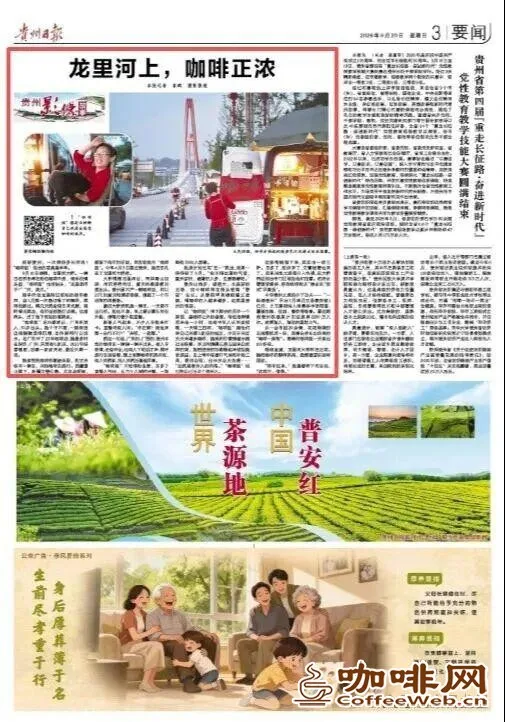
How long can you stay in Guizhou? “Coffee Sister” Cai Caiyun’s answer is half a year.
On the evening of September 10, at the Longli River Bridge, a white motorcycle stopped beside a pink coffee cart. The rider kept his helmet on; “Coffee Sister” didn’t look up. “Same as usual?” “Yes, an Americano.”
The rider, Fu Jialong, is a young teacher at a nearby vocational school. Since first stopping by for a cup of coffee in May, he hasn’t missed a visit — dropping by every few days on his bike, sometimes leaving right after, sometimes sitting until the streetlights come on. This bridgehead has become his post-work hangout.
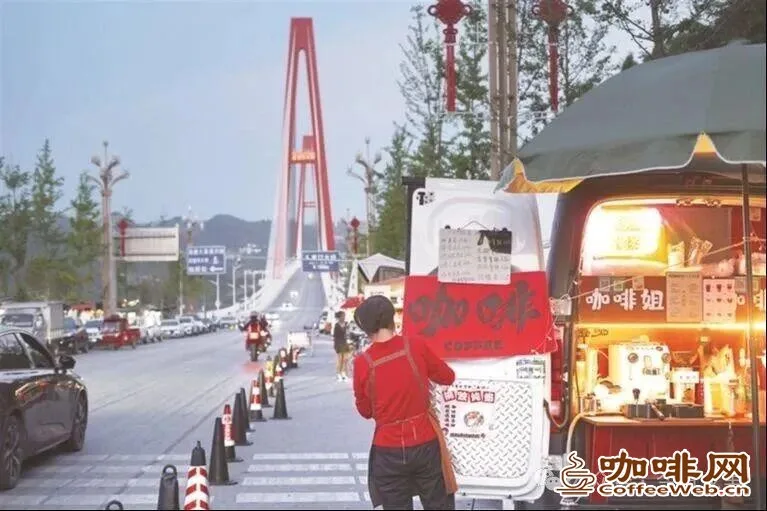
As night fell, the warm yellow glow of the coffee cart radiated a quiet coziness.
“Coffee Sister” is Cai Caiyun, from Dongguan, Guangdong, just past 50. Not tall, she wears dark-framed glasses that lend her a calm steadiness, and moves with practiced ease. She ran coffee shops in Guangdong for 23 years, at her peak operating six stores across Shenzhen, Guangzhou, and Dongguan. When business turned difficult in 2021, the stores closed one by one until only one remained.
She simply moved the espresso machine into a vehicle and, with her husband each driving a car, set off on a coffee-cart journey. At the foot of snowy mountains in Tibet, along the Gobi highways of Xinjiang, in the old hutongs of Beijing — their footprints are everywhere, and netizens dubbed her “Coffee Sister.” Passing through Guizhou on April 3 this year, she parked her cart beside the Longli River Bridge.
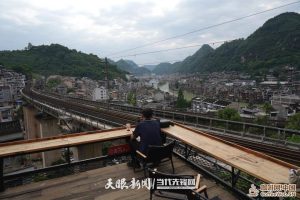
The bridge spans the Longli river valley, flanked by green hills like a screen, with river wind blowing through. In summer the felt temperature is just over 20 degrees Celsius. Though Guizhou grows not a single coffee bean, its 23-degree summers and endless greenery sustain a boundless consumption scene.
At first she was the only cart by the bridge, selling only a few cups a day. She wasn’t in a hurry — watching the mist rise from the valley in the morning, livestreaming toward the sunset in the evening.
Gradually the crowd grew, with many making special trips to check in. In the livestream someone asked, “Where are you? Can I set up one too?” “Come on, set one up together.”
With that one sentence, coffee carts from Guangdong, Guangxi, and local Guizhou rolled in one after another. Some do it full time with full equipment; others come only after work, lift the trunk of their station wagon, set up a portable machine, and open for business — selling if someone buys, otherwise just meeting the scenery.
“Coffee Sister” doesn’t feel they steal her trade; more carts mean more livestream buzz, with five or six people broadcasting at once and as many as 5,000 viewers per session.
She had planned to leave after the May Day holiday, but ended up staying through September. “I can’t bear to leave the climate — cool summers, lots of people escaping the heat, and business picks up with them.”
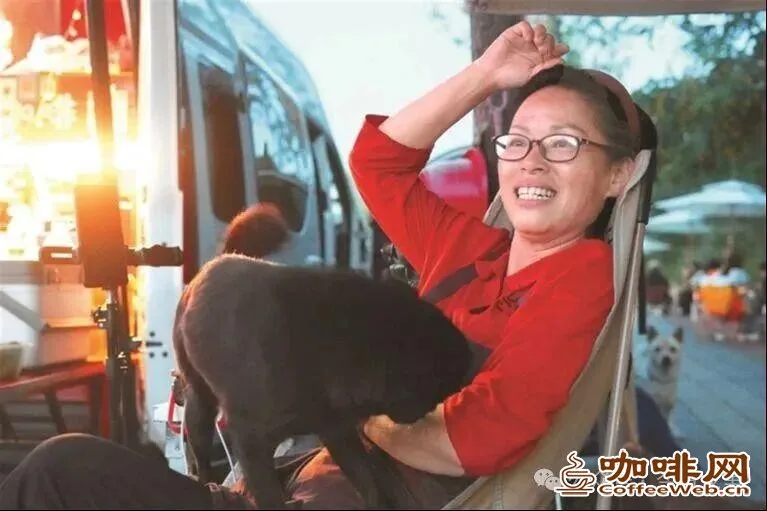
“Coffee Sister” Cai Caiyun chats about her experience selling coffee while living around the country.
Guizhou, with its hills and big temperature swings, was traditionally tea country; now coffee is “wildly” growing in its streets and alleys. From Guiyang’s Jiaxiu Tower to Zunyi’s old town, more and more people drink coffee — a sign of Guizhou’s inclusiveness.
Another reason “Coffee Sister” stopped was the warmth beyond coffee. Teachers from nearby come to sit an hour after class; a middle-aged man sits from morning to night, drinking three or four cups, and she tells him about closing her five stores; a young man fresh from a breakup comes daily for iced coffee, and she slides over a cup of lemon-honey water to chat with him; a sanitation worker periodically brings home-grown vegetables, and she saves the shipping boxes for her to sell as scrap; the cart always carries an air pump and tire-repair kit, free to use; plain water is free all day — “That’s the Guizhou way,” she says, calling herself half a Guizhou local now.
That this street survived was itself a twist. More carts brought complaints, then traffic police and city managers. Later the local culture-tourism bureau stepped in to coordinate, marking dedicated zones on both sides of the bridge for them to operate. The government shifted from management to service, and the mobile coffee street went from “guerrillas” to “scenic line.”
This year Guizhou’s culture-tourism efforts have been considerable — the “One-Code Tour Guizhou” platform broke 100 million yuan in single-month transactions in July; train tickets were folded into consumption-voucher eligibility, covering fuel, lodging, dining, and more; during the summer travel rush Guizhou railways carried 22.8 million passengers. Policy keeps people here, preserving the everyday warmth.
From one cart to more than 20, a colorful string of tailgates lined up, and a lively “coffee street” grew beside the viewing platform. At peak, Coffee Sister sells over 100 orders a day.
With golden rice waves and the Longli River Bridge in full autumn, she polishes her espresso machine and plans to head home after National Day.
“I’ll be back next year,” she says, gazing at the valley below. “This place is worth it.”
Source: Guizhou Daily. Editor: Du Li / Reviewer: Zhou Huan / Sign-off: Pu Mou.
Reprint Note & Disclaimer
- This article is compiled and edited by coffeeyo.com based on a report from Guizhou Daily. The materials and images herein are sourced from public channels and the copyright belongs to the original authors. This site reprints them solely for information sharing within the coffee industry and does not represent our stance; all data and views are subject to the original source. We thank the original authors for their work and sharing.
- For matters concerning content authorization, attribution, copyright, or any other issues, please contact us promptly. We will verify and cooperate in handling them without delay. We also welcome coffee-growing regions, brands, and industry media to exchange and contribute articles with us.
- Contact coffeeyo.com — Tel: 400-0000-641 (+86-18288016826) | Email: 405854472@qq.com | Address: Jinghong City, Xishuangbanna, Yunnan / Tieling City, Liaoning
Reprint Notice & Disclaimer
- This article has been edited and compiled by China Coffee Network. The information and images therein come from public sources and the copyright belongs to the original author. This reprint is intended solely for information sharing within the coffee industry and does not represent the views of this website; all data and opinions are subject to the original article. Our thanks to the original author for creating and sharing it.
- For matters concerning content licensing, attribution, copyright or otherwise, please contact us promptly and we will verify and cooperate in handling them as soon as possible. We also welcome coffee origins, brands and industry media to exchange ideas and contribute articles.
- Contact China Coffee Network: Tel 400-0000-641 (+86-18288016826) | Email 405854472@qq.com | Address: Jinghong, Xishuangbanna, Yunnan Province / Tieling, Liaoning Province
Related Reading
 How ‘Sea-Flavored’ Coffee Blooms Across Dongtou
- Health Guide: How to Enjoy Your Coffee the Healthy Way
 Study: Regular Coffee and Tea May Lower Dementia Risk, but More Is Not Better
 Frontline Story: A ‘Mobile City Coffee Bar’ Arrives by the Grand Canal
 Yantai’s Wind Tastes of Coffee
 In Zhenyuan, a Cup of Coffee and a Waiting Train





 Liaoning ICP Security No. 21122402000217