
Brief (coffeeyo.com): The number of independent specialty cafes shuttering within a year surged in 2023, and “steady closures” remain the norm this year. After the retreat of capital, the industry is undergoing a brutal shakeout — leading brands accelerate expansion while countless stores struggle under rising rents and more rational consumers, and the high-premium story of specialty coffee no longer sells. Operators are hunting new opportunities in micro-innovations like decaf and retail products.
The number of independent specialty cafes shuttering within a year surged in 2023, and “steady closures” remain the norm this year. The industry is undergoing a brutal shakeout after capital’s retreat — on one side, leading brands accelerate expansion; on the other, many stores fight to survive under pressure from rising rents and more rational consumption. The high-premium story of specialty coffee no longer works, and operators are seeking new opportunities in micro-innovations such as decaf and retail products.
[EBAG original] Text by Zheng Ya, edited by Huang Junfeng.
“Looking at the life cycle of independent specialty cafes, equipment we recovered before 2023 had mostly been in use for over five years — meaning stores then could last five years with decent stability. But this year most recovered equipment had been used only a few months, showing these independent specialty cafes couldn’t hold on even a year,” Brother Gou, who runs a business recovering closure equipment, told EBAG Power, revealing a set of “cruel” data.
Looking at today’s specialty-coffee landscape, it is a tale of ice and fire. A large number of mid- and tail-brands are struggling and closing, while leading brands generally keep expanding, and some emerging brands still enter the market with confidence in its opportunities.
Specifically, DM CAFE (a specialty cafe brand under Dreame Technology) saw multiple stores suspend operations; in the first half of this year, Seesaw Coffee — which had completed three funding rounds and a 1-billion-yuan valuation — entered bankruptcy liquidation. Meanwhile, leading specialty brands Manner Coffee and M Stand, along with rising stars like Grid Coffee and Sanlifang, sped up store openings. Synthesizing dimensions such as espresso-machine sales and turnover rates, Brother Gou finds independent specialty cafes are now generally “closing more than opening,” with the industry trending toward greater concentration.
In the 1980s, the U.S. Specialty Coffee Association (SCAA, now SCA) gradually established the cup-tasting standards for specialty coffee; beans scoring above 80 in professional cupping qualify as specialty. In the early 21st century, during the third wave of coffee, specialty coffee found its era, giving birth to representative brands such as Blue Bottle.
Specialty coffee took root in China around 2010. In 2012, Seesaw opened its first store in Shanghai, earning the label “pioneer of domestic specialty coffee.” Later, Manner, Algebraist, M Stand, and others gradually entered public view.
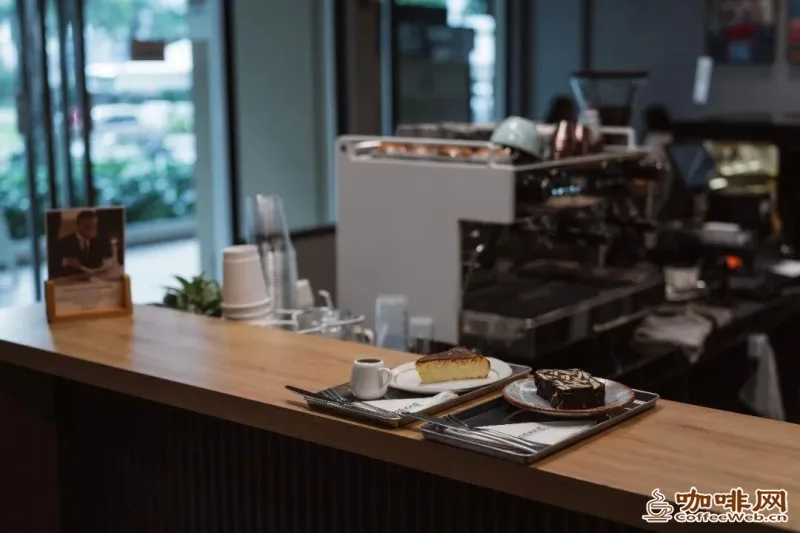
In the consumption experience, specialty cafes generally feature more stylish decor and preserve a sense of space. Multiple professional baristas craft pour-overs, SOE (single-origin espresso), and other products. At specialty chain and independent specialty cafes, drinks (beyond regular Americano) mostly cost over 30 yuan per cup.
Now, the specialty-coffee industry has entered its shakeout year. An operations head at an independent specialty cafe told EBAG Power bluntly: “This year is surely better than next year.” Facing “expected” difficulties, how do operators survive this shakeout?
“Steady closures” and a cooling funding market go hand in hand
The recent situations of DM CAFE and Seesaw are not isolated. Citing data from Zhaimen CanYan, Kameng reported that as of July this year, nearly 53,000 new coffee stores opened in the past year, with a net growth of just 1,065. That means about 52,000 stores closed in the past year — while the national total of coffee stores is only 227,000.
Brother Gou said he recovered equipment from over 200 independent specialty cafes in 2023 alone, and over 100 last year. “2023 was the year of the closure explosion. In recent years, specialty cafes have been closing steadily.”
Now, the flow of used semi-automatic espresso machines has also changed (most equipment in specialty cafes is semi-automatic). Before 2023, the semi-automatics Brother Gou recovered would be bought by cafe owners; in recent years, more buyers are coffee enthusiasts and individuals needing them for home use.
Coffee-industry practitioners feel it more directly. rarakiddo Absolute Kid (hereafter “Absolute Kid”), a coffee-roaster brand, adopted an all-channel online-and-offline strategy from its founding in 2022. Its offline store follows a “front-shop, back-factory” model, while online channels mainly sell specialty retail coffee products.
The Absolute Kid team said 80% of the brand’s sales come from online channels. Since entering Tmall in 2022, it has maintained an average annual sales doubling. The team also runs some B-end business (supplying specialty beans to specialty cafes); they told EBAG Power that 80% of B-end clients reported declining store revenue and profit.
From an investment perspective, the industry’s temperature is also felt. The “2025 China Coffee Industry Report” shows that from 2021 to 2025, both the number of coffee-industry investment events and the investment amount fell year after year. In the first eight months of this year, iBrandi data shows only three coffee brands received investment.
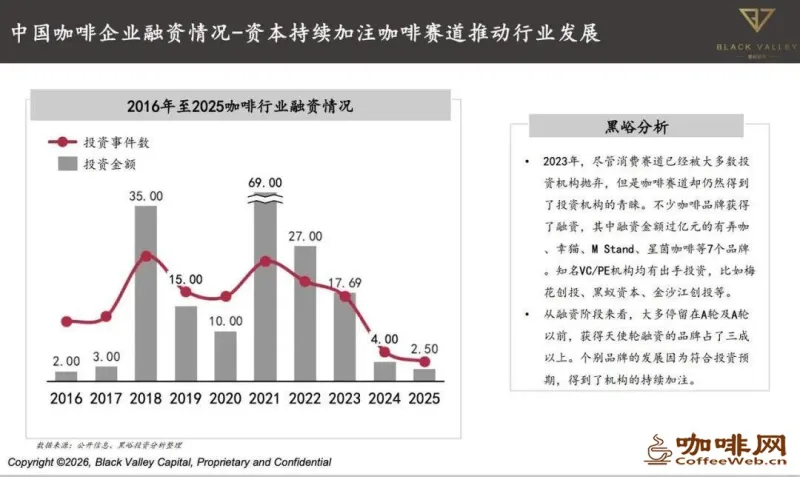
Source: “2025 China Coffee Industry Report” by World Federation of Chinese Catering Industry & Blackstone Investment.
By funding round, from 2023 to 2024 most rounds concentrated in early stages such as angel and Series A; after 2024, B and C rounds dominate.
Yao Xi, head of international business at Leyin Innovation, told EBAG Power that after years of rapid growth, China’s specialty-coffee industry has reached the shakeout stage following capital’s ebb. Besides riding out the cycle domestically, another path may be the “Sinicization” of coffee as an imported product, with a reverse global layout. Leyin Innovation, a leading OEM whose core technology is specialty-coffee extraction and freeze-drying, has preliminarily achieved results in exporting China’s specialty freeze-dried coffee to Europe, America, Japan, and Korea.
Why is specialty coffee hard to profit from?
“In a downward economic cycle, consumers lean toward rational spending, increasingly valuing cost-performance and quality-performance. Many specialty-coffee users have gradually flowed to affordable brands,” said the independent-cafe operations head, noting the industry faces multiple difficulties from the economic environment, consumption philosophy, and operations.
Operators are now caught between weak revenue from sluggish consumption and rising operating costs.
“I’m getting more anxious lately. Rent of nearly six figures is due at month-end again. I feel I can’t take it — offline stores are just too weak,” a cafe founder sighed on social media that “physical cafes are too hard.” Meanwhile delivery adds to the burden: “I took a delivery order the other day, expected revenue 0 yuan. If I’d refused, I’d have had to pay the customer 6.5 yuan.” On Xiaohongshu, a cafe head said, “60% gross margin can never beat 30,000 yuan monthly cost.” EBAG Power also learned that a cafe in an industrial park, unable to bear rising rent, reluctantly gave half its space to the park’s use.
Rents rise, and so do raw-material prices. On February 11 last year, ICE (Intercontinental Exchange, New York) arabica coffee futures exceeded 430 cents per pound, a 47-year high. Squeezed by multiple factors, cafe profit margins are compressed.
Online channels’ costs show more in customer acquisition. The Absolute Kid team said online acquisition costs have conservatively risen 20%–30%.
At a deeper level, the high-premium story of specialty coffee no longer works under today’s economic environment and consumption philosophy.
Behind the drink, specialty cafes sell “space” and “experience.” Consumers can directly watch baristas hand-brew a cup; stylish decor and paired light meals meet needs for socializing with friends and business talks. But now, with the sharp drop in business-activity frequency and the rapid rise of delivery reducing off-premise orders, demand for the cafe as a space is weakening.
At the same time, amid price wars and delivery wars, operators must transparently explain to consumers why specialty coffee is expensive. A user recently posted on Xiaohongshu about a “coffee assassin” experience: “I wandered into a owner-run cafe, ordered a pour-over, the owner said 288 yuan — scared, I ordered an Americano at 68 yuan, took a sip, and felt it worse than the 500g beans I bought for 68 yuan.”
The founder of CM COFFEE commented on the specialty-coffee premium. He argued this exposed an awkward industry problem — too wide an information gap between consumers and the specialty circle, and cafes failing at expectation management. “The premium itself isn’t the problem; the problem is using ‘you don’t understand’ to dodge ‘I’m not worth it.’ A truly good specialty cafe makes customers feel ‘expensive but worth it’ after drinking, not ‘expensive and unexplained,'” he summarized.
Moreover, as coffee lovers deepen their understanding of specialty coffee, some consumers gradually prefer buying beans to brew themselves, enjoying the process of a hand-brew.
Coffee enthusiast Suola told EBAG Power that after first encountering specialty coffee in 2017, he began buying beans and professional equipment, now having invested nearly 50,000 yuan. “Falling into the specialty-coffee ‘pit’ — partly I prefer its quality and can brew anytime, more convenient; partly store coffee is expensive while home beans amortize cheaper per cup. I’ve drunk 80-yuan cups in cafes and felt my own skill wasn’t far behind that barista’s, and my confidence in brewing grew bit by bit,” Suola laughed.
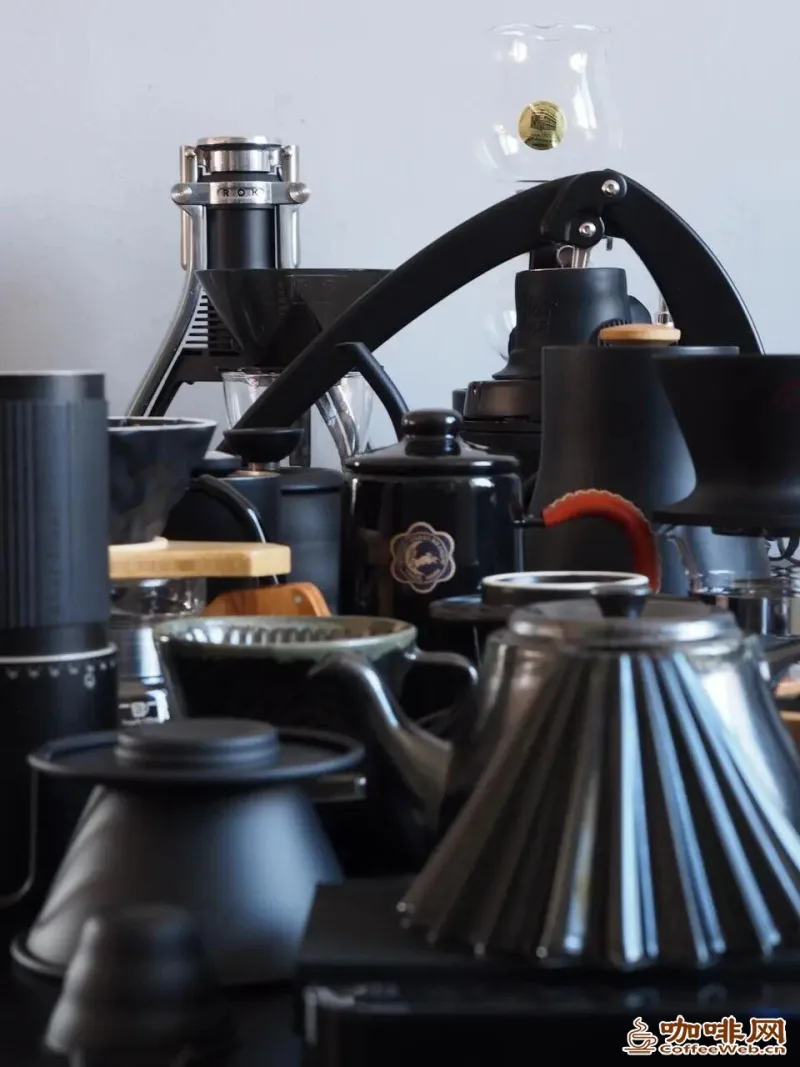
Image: some of the coffee equipment Suola purchased (provided by Suola).
Finding opportunities in micro-innovation
In fact, consumer demand for specialty coffee is rising.
On the supply side, the “2025 China Coffee Industry Report” shows China’s specialty rate among planted coffee exceeds 30%, with Yunnan’s geisha, typica, bourbon, and yellow bourbon acreage rising sharply. On the demand side, the “2026 China Urban Coffee Development Report” shows that in 2025 Chinese coffee consumption is upgrading from entry instant to deep specialty, with coffee-bean transaction value up 140.38% year on year, signaling demand for specialty fresh-ground coffee.
Facing this possible opportunity, how should specialty-coffee operators respond?
In Absolute Kid’s view, “small but beautiful” coffee brands especially need to offer differentiated, distinctive products.
Absolute Kid observed that some consumers, constrained by caffeine intolerance or pregnancy, dare not drink coffee even if they like it, while most decaf on the market is criticized as “lacking coffee flavor.” So from its founding the team targeted the decaf (low-caffeine) track, sourcing quality decaf beans of different origins and flavors to make products in varied flavors and packaging.
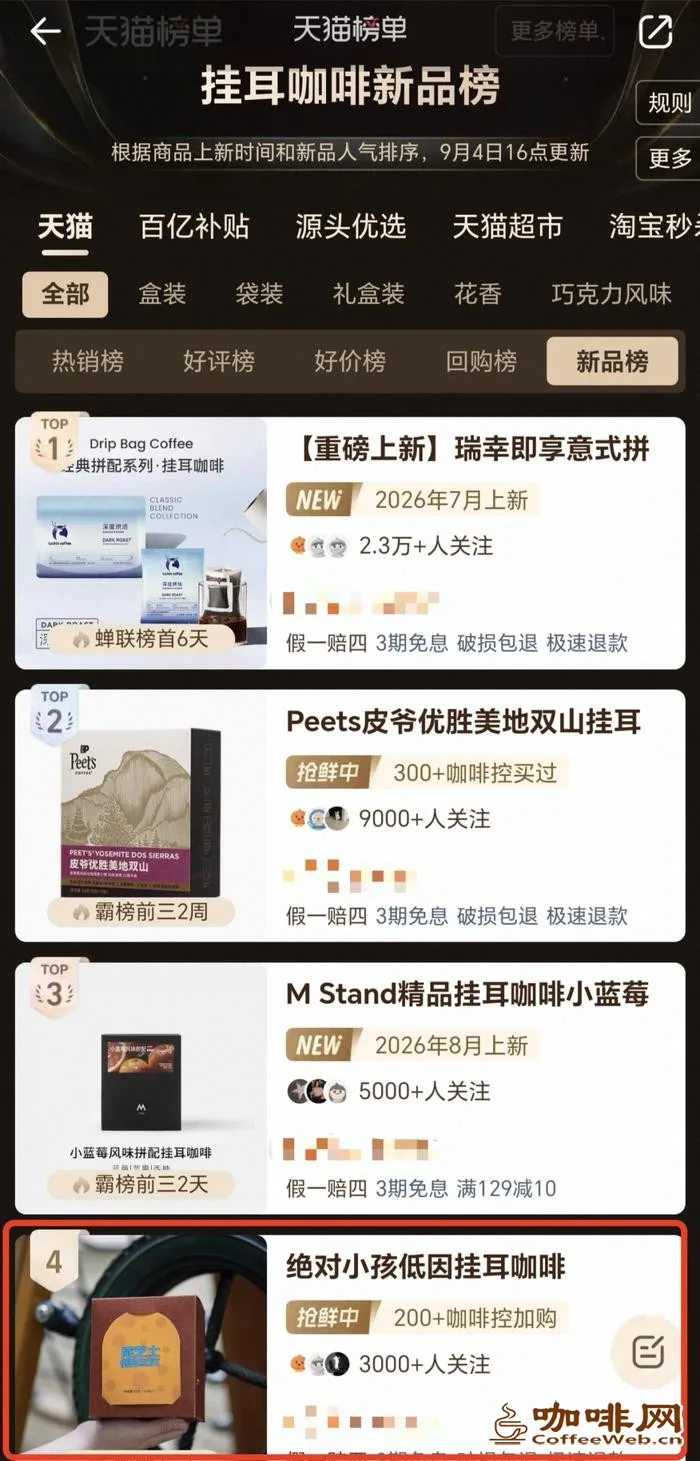
Currently, Absolute Kid’s decaf products rank at the top of Tmall’s decaf coffee track; its recently launched salted-cheese decaf drip bag took fourth place on Tmall’s new drip-bag coffee chart.
Meanwhile, consumers’ high-frequency specialty-coffee demand is gradually shifting to retail products like quality coffee liquid, freeze-dried coffee, and ready-to-drink coffee.
Liyang Ri, founder of Leyin Innovation, believes that long-term, consumers’ understanding of specialty coffee will keep spreading and demand will be validated. Based on this judgment, Leyin focuses on helping brands recreate store-grade specialty coffee in retail products, so consumers can conveniently drink specialty coffee in different off-store scenarios.
Chen Hao, retail general manager of Peet’s Coffee, expressed a similar view at the FBIF 2026 Food and Beverage Innovation Forum. He noted Peet’s launch of ready-to-drink coffee aims to recreate the in-store experience’s taste — “whatever new flavor or form RTD launches, we return to the same principle: RTD’s differentiation isn’t more novel concepts, but bringing the specialty-coffee experience into more people’s lives in a more stable way.”
As Liyang Ri judged, the probability of specialty cafes going from niche to mainstream is low. But what is certain is that specialty-quality coffee will go from niche to mainstream.
EBAG Power continuously tracks this intelligence; scan to follow the author’s WeChat for more related information.

This article was first published on the official website of EBAG Power.
Reprint Note & Disclaimer
- This article is compiled and edited by coffeeyo.com. The materials and images herein are sourced from public channels and the copyright belongs to the original authors. This site reprints them solely for information sharing within the coffee industry and does not represent our stance; all data and views are subject to the original source. We thank the original authors for their work and sharing.
- For matters concerning content authorization, attribution, copyright, or any other issues, please contact us promptly. We will verify and cooperate in handling them without delay. We also welcome coffee-growing regions, brands, and industry media to exchange and contribute articles with us.
- Contact coffeeyo.com — Tel: 400-0000-641 (+86-18288016826) | Email: 405854472@qq.com | Address: Jinghong City, Xishuangbanna, Yunnan / Tieling City, Liaoning
Reprint Notice & Disclaimer
- This article has been edited and compiled by China Coffee Network. The information and images therein come from public sources and the copyright belongs to the original author. This reprint is intended solely for information sharing within the coffee industry and does not represent the views of this website; all data and opinions are subject to the original article. Our thanks to the original author for creating and sharing it.
- For matters concerning content licensing, attribution, copyright or otherwise, please contact us promptly and we will verify and cooperate in handling them as soon as possible. We also welcome coffee origins, brands and industry media to exchange ideas and contribute articles.
- Contact China Coffee Network: Tel 400-0000-641 (+86-18288016826) | Email 405854472@qq.com | Address: Jinghong, Xishuangbanna, Yunnan Province / Tieling, Liaoning Province
Related Reading
 ‘All-Ice’ Coffee Goes Viral! Will the Next Hit Be Your Personal Favorite?
- Hong Kong’s Dyee Coffee Lands in Qianhai, Building a Specialty Pour-Over Outpost
 Ken Yue Coffee Opens Egg-Tart Pop-Up in Hangzhou: Sweet Craft, Reinvented Classics
 World Cup Enters the Breakfast Slot: Can Coffee-Tea Brands Turn Traffic into Orders?
- ICE Agricultural Futures Mostly Rise at Close; Coffee Futures Up 3.28%
- ‘Sleep Cafés’ Become a New Favorite Among Seoul Office Workers



 Liaoning ICP Security No. 21122402000217