
At a Glance (China Coffee Network): On May 20, the “Coffee: People and the Land” photography exhibition from Brazil’s Coffee Museum opened at the China National Silk Museum in Hangzhou—part of the 2026 China–Brazil Cultural Year—using coffee as a bridge between Eastern silk and Latin American coffee culture.
Tide News client, reporter Li Jiaoyan, correspondent Li Xiaowen
On May 20, the “Coffee: People and the Land” Brazil coffee photography exhibition and cultural tasting exchange event was held at the China National Silk Museum. As an important exchange program of the 2026 “China–Brazil Cultural Year,” the event uses coffee as a medium to continue the cultural dialogue between Eastern silk and Latin American coffee.
(Exhibition poster, courtesy of the China National Silk Museum)
This photography exhibition, brought by the Coffee Museum of Brazil, focuses on the theme “People and the Land,” showcasing 19 photographic works created by photographer, architect, and urban planner Marcos Pifer. The works travel across Brazil’s six major coffee regions—Minas Gerais, São Paulo, Paraná and others—centering on people and capturing the working moments of coffee laborers, vividly presenting the profound bond between coffee, the land, and people, letting visitors directly feel the human warmth of Brazil’s coffee industry.
(Exhibition scene, courtesy of the China National Silk Museum)
(Exhibition scene, courtesy of the China National Silk Museum)
According to introductions, the Coffee Museum of Brazil was founded in 1998 and is affiliated with the São Paulo State Secretariat of Culture, Creative Economy and Industry; it is an important dissemination base and cultural-tourism landmark of Brazilian coffee culture. The exhibition’s landing at the China National Silk Museum is both a friendly interaction between the two countries’ cultural institutions and a deep blend of Silk Road culture and coffee civilization.
Winston Alexandre, deputy consul general of the Brazilian Consulate General in Shanghai, said that this historical Brazil coffee photography exhibition’s first trip to China and landing in Hangzhou not only presents to the public the cultural heritage and connotations carried by Brazilian coffee, but will further deepen China–Brazil cultural exchange and people-to-people bonds. Though China and Brazil are separated by mountains and seas, their friendship grows daily; the two sides use museums as platforms for diverse cultural cooperation, and exhibitions as bonds to enhance cultural identity, jointly continuing a new chapter of mutual learning among civilizations.
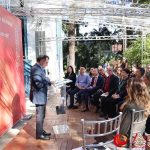
(Event scene, courtesy of the China National Silk Museum)
On opening day, a Brazilian-region coffee tasting was held simultaneously on site. Led by professional Brazilian baristas, guests and visitors immersively experienced the flavor differences of coffees from different Brazilian regions, savoring the rich layers of Brazilian coffee. The event also blended Chinese and Western characteristics to create rich cultural interactions: a coffee-knowledge quiz gave away limited souvenirs from the Coffee Museum of Brazil; a DIY coffee-ground sachet combined environmental protection with traditional Chinese style, both practical and distinctive; and a gold-printed round-fan experience let traditional patterns and craftsmanship collide, adding elegant charm to the summer.
(Event scene, courtesy of the China National Silk Museum)
The exhibition runs through June 21 and is free and open to the public. Using silk as a bridge and coffee as a medium, read Brazil’s coffee story through images and feel the charm of China–Brazil culture through tasting—together embarking on a cultural appointment across the Pacific.
Reprint Notice & Disclaimer
This article is reprinted from Tide News. Original reporting by Li Jiaoyan, with correspondent Li Xiaowen. All rights belong to the original publisher. This reprint is for information sharing only; if you believe any content infringes your rights, please contact us to request removal or correction.
Related Reading
 How ‘Sea-Flavored’ Coffee Blooms Across Dongtou
- Health Guide: How to Enjoy Your Coffee the Healthy Way
 ‘The Rhythm of Plants: Tea and Coffee Culture’ Exhibition Debuts in Rio de Janeiro, Brazil
 Study: Regular Coffee and Tea May Lower Dementia Risk, but More Is Not Better
 Frontline Story: A ‘Mobile City Coffee Bar’ Arrives by the Grand Canal
 Yantai’s Wind Tastes of Coffee







 Liaoning ICP Security No. 21122402000217