
At a Glance (China Coffee Network): From “lining up to sell beans” to “choosing the buyer”—Yunnan coffee is taking pricing power into its own hands. Menglian standardizes fresh-cherry picking, a Geisha in Lincang sold for RMB 14,000 per kg, and H1 2026 exports surged; yet as the industry approaches RMB 100 billion in output, it still faces three structural shortfalls: low export unit prices, 90% sold domestically, and a supply-demand gap.
China Economic News Broadcast, Kunming, October 30 — In Menglian, a small change is altering the way Yunnan coffee has been bought and sold for decades.
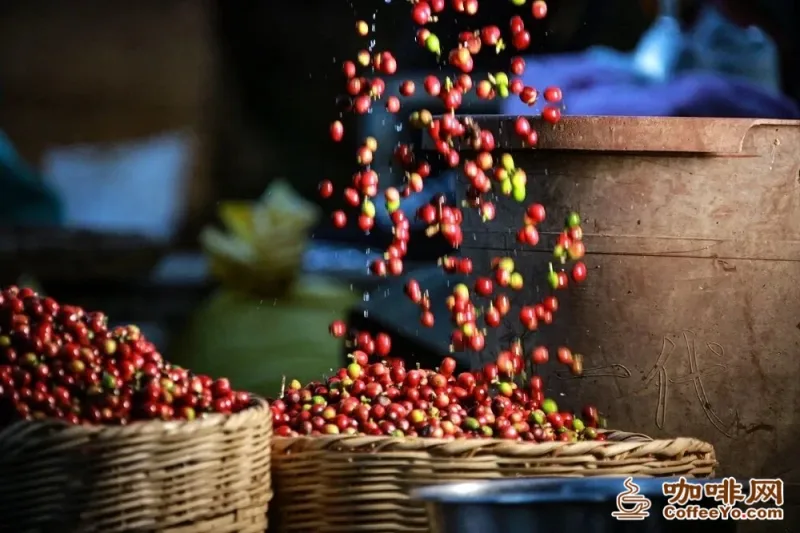
A few years ago, growers had to haul sacks and queue for four or five days in front of the collection point just to sell their beans; today, the beans are still on the trees, unpicked, yet buyers wait by the field—now it is the growers who choose the buyer.
This is not a simple story of “the market turning for the better.” Queuing and choosing are opposite motions: the former means the seller passively accepts the quote; the latter means the seller begins to set the pace. Behind it lies a deeper shift—Yunnan coffee is moving from a price taker to a price maker.
The Reversal of Price Signals
The shift in industry discourse shows up first in the fields.
Menglian’s data offers the most direct footnote: the locality has standardized fresh-cherry picking, with a centralized processing rate of 80%, peak yields up to 2.5 tonnes per mu, and per-mu output value above RMB 10,000. In the 2025–2026 season, the county’s specialty-coffee rate reached 73%, ranking first in the province for four consecutive years. When “specialty” becomes a quantifiable, assessable metric, pricing gains a basis.
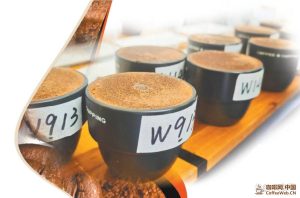
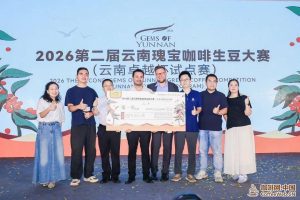
The ceiling above has already been breached. In Lincang, the traditionally washed Geisha from Gengxia Manor won the 2026 2nd Yunnan Guibao Coffee Green-Bean Competition (Yunnan CoE Pilot) with a score of 91.78 and a transaction price of RMB 14,000 per kg, setting a new record for Chinese green-bean transactions. When one kilogram of green beans sells for tens of thousands of yuan, “specialty” is no longer a marketing slogan but an industrial standard that can be priced, traded, and repurchased.
The change in export structure confirms this turn from another direction. In the first half of 2026, Yunnan exported 8,282 tonnes of coffee worth RMB 340 million—both ranking first nationally—shipped to 40 countries and regions. More notably, among Pu’er coffee beans exported under Simao Customs supervision, top-grade beans accounted for over 90%. “In the past, Yunnan’s coffee exports were mainly commercial grade, winning on volume; now, top-grade beans are the export mainstay”—the weight of this statement is that the producing region’s grading capability and processing level have crossed a critical threshold. From “selling by the pile” to “selling by grade,” the coordinate system of pricing has changed.
Where Does Pricing Power Come From
Pricing power is never granted; it rests on three pillars: standards, terminals, and narrative.
Standards are the scale of pricing power. Without grading, quality cannot be priced—only estimated. Menglian’s achievement of a 73% specialty rate for four straight years as provincial No. 1 is, at its core, the building of a system that lets good beans be “recognized.” When a bean can state clearly which plot it comes from, what process it underwent, and what flavor it carries, it no longer needs to attach itself to someone else’s quote sheet.
Terminals are the signal source of pricing power—the most unusual variable for Yunnan coffee in the past two years. As of July 2026, Luckin alone operated 746 stores in Yunnan, its footprint extending from Kunming’s core business districts to county streets and scenic-area stations; it added 57 directly operated stores in the first half and plans 30–50 more within the year. Kunming hosts about 2,400 coffee operators across 200-plus brands, with consumption growing over 30% annually; around Green Lake (Cuihu) some 100 specialty cafés cluster; Mengzi, with a population of 600,000, has grown more than 200 cafés—roughly one per 3,000 people; in Mangkuan Township, Baoshan, grower Li Jinhe spent RMB 3,000 on a shade canopy and a blowtorch to brew coffee, and a single stall spawned a small ecosystem.
These stores mean far more than selling coffee. The denser the stores, the higher the requirement for stable output; the higher the requirement, the more motivated the producing region is to refine grading, processing, and traceability. Every cup drunk is a consumer’s vote for a producing region and a processing method; stores aggregate those votes into orders sent back to the region, feed flavor feedback to processors, and transmit price expectations into growers’ picking decisions. In this sense, the store is no longer the endpoint of consumption but the nerve ending of the entire chain—it collects price signals and organizes production in reverse.
Processing and narrative are the moat of pricing power. The deep-processing rate rose from 20% in 2021 to 85%; the province has formed four deep-processing clusters—Kunming, Baoshan, Pu’er, and Dehong—gathering over 120 deep-processing enterprises, with deep-processing capacity near 100,000 tonnes, about 30% of the national total. Holding processing capability means no forced distress sales at low raw-material prices and that value can stay within the province. On the narrative side, the “Pu’er Coffee” geographical-indication brand is valued at RMB 4.074 billion and ranks among China’s top 100 GI regional brands; “Baoshan Small-grain Coffee” has been included in the China-EU GI mutual-recognition protection list and selected for the Ministry of Foreign Affairs’ gift list; signature drinks such as boletus lattes, ham lattes, and creative Jianshouqing coffees have become experiences unavailable elsewhere. Scarcity and irreplicability are the true source of premium.
The province has built nearly 60 specialty coffee manors and released 10 themed tourism routes, attracting over a million visitors annually; the comprehensive output value of the whole chain has reached RMB 99.5 billion. Yunnan Coffee Factory transformed its old plant into a new space where the workshop becomes a coffee experience destination—GM Ding Xi put it plainly: “Extending our tentacles to the consumer end by opening stores completes the terminal-experience link for the enterprise; we can directly showcase Yunnan coffee, tell the origin story well, and strengthen our own brand.” Kaguo Coffee founder Yang Yu’s bean-selection standard states the requirement from the other end: “First, it must be specialty; second, it must have clear origin-flavor characteristics, so consumers drink with understanding and can tell the difference between producing regions and processing methods.”
The “Halfway Point” of Pricing Power
Yet RMB 99.5 billion, approaching the RMB 100 billion mark, does not mean pricing power is firmly in hand. Three numbers signal that this transformation is still in progress.
The first number is RMB 41. Based on H1 2026 export value, Yunnan coffee’s average export price is about RMB 41 per kg—a far cry from the champion Geisha at RMB 14,000 per kg. One is a bulk-export average, the other an auction price for champion beans; they are not strictly comparable, but the order-of-magnitude gap marks the coordinate precisely: Yunnan coffee’s specialty pricing power is currently realized mainly in the domestic market; internationally, it remains largely a “sold by the tonne” bulk logic. “Tonnes and value both ranking first nationally” still rests mainly on scale.
The second number is 90%. About 90% of domestic coffee-bean supply goes to the domestic market; coverage of Yunnan beans in specialty cafés in Shanghai, Beijing, and Guangdong reaches 90%, 80%, and 70% respectively. High coverage is a remarkable achievement, but coverage is not the same as pricing power—being widely used and being remembered at a premium are two different things. On the menus of specialty cafés, Yunnan beans are “present,” but not necessarily “labeled.”
The third number is 200,000 tonnes. Against domestic consumption demand of 370,000 tonnes, there remains a gap of nearly 200,000 tonnes. This is both a historic opportunity and a hidden reef: if this round of expansion fills the gap by simply piling up volume and depressing prices, the quality-pricing logic just established could be dragged back onto the old “win on volume” path. The most vulnerable moment for pricing power is often not the start, but when the market is best and expansion most aggressive.
A relevant official from the provincial Department of Agriculture and Rural Affairs judges that Yunnan’s coffee industry is in a golden window of quality upgrading, capacity expansion, efficiency gains, and international development, with multiple advantages as a raw-material base, processing carrier, cross-border trade hub, and coffee-tourism integrator, compounded by policy dividends such as RCEP, the China–Laos Railway cross-border logistics, and border-port processing cooperation—offering enormous room for growth across the whole chain. The keyword in that statement is “internationalization”—pricing power is only truly established once it is tested in the international market.
Who Wrote That Sentence
Back to the scene in Menglian. From queuing four or five days in front of the collection point to sitting in the field choosing the buyer, Yunnan coffee has traveled decades. The surge in stores is only a surface phenomenon; what is truly happening is that an industry once responsible only for “growing and selling” is learning to keep every link contained in a cup of coffee—cultivation, processing, roasting, cupping, service, narrative—in its own hands.
Industry insiders judge that when stores are dense enough, producing regions refined enough, and the chain thick enough, Yunnan coffee will no longer be merely “China’s coffee volume leader,” but a complete industry capable of defining its own flavor and setting its own pace. That statement can be pushed one step further.
The ultimate form of pricing power is not selling beans at a higher price, but having Yunnan itself write the sentence “what kind of bean is worth what price.” Only when that sentence is written into international standards, into export contracts, into consumers’ taste memory, does Yunnan coffee truly complete its identity shift—from a line on someone else’s quote sheet to a chapter it authors itself. And the starting point of all this was nothing more than a Menglian grower, for the first time, saying “no” to a buyer.
Reprint Notice & Disclaimer
- This article is compiled and edited by China Coffee Network (coffeeyo.com) and reprinted from China Economic News Broadcast: 《从”排队卖豆”到”挑选买家”——云南咖啡的定价权之变》. The copyright of the original article belongs to China Economic News Broadcast and the original author. This site reprints it solely for the sharing of coffee-industry information and does not represent our position; all data and views are subject to the original. We thank the original author for their creation and sharing.
- Original article: China Economic News Broadcast: 《从”排队卖豆”到”挑选买家”——云南咖啡的定价权之变》
- If there are any issues regarding content authorization, attribution, copyright, or other matters, please contact us promptly and we will verify and cooperate in handling them; we also welcome coffee businesses and industry media to exchange and contribute articles.
- Contact China Coffee Network (coffeeyo.com): Tel 400-0000-641 (+86-18288016826) | Email 405854472@qq.com | Address: Jinghong City, Xishuangbanna, Yunnan Province, China
Related Reading
- Bean in Short Supply: A Taiwan Youth on Yunnan Coffee as a Shared Cross-Strait Stage
- Five Years, Eight Championships: Lincang Coffee Joins the World Stage
 Haikou ‘Union Cup’ Barista Skills Competition Kicks Off to Empower the Service Sector
 Yunnan Specialty Coffee Beans Deliver an ‘Excellent’ Report: Path to Value Leap
- Cross-Strait Tides Rise: A Taiwan Youth Farms Coffee in Yunnan, a Cup Bridging Both Sides
 2026 2nd Yunnan Treasure Coffee Green Bean Competition (Cup of Excellence Pilot) Concludes



 Liaoning ICP Security No. 21122402000217