


At a Glance (China Coffee Network): Author | Chaoyang Capital Review, Gufeng By 2027, Luckin Coffee will mark its 10th anniversary.
Author | Chaoyang Capital Review, Gufeng
By 2027, Luckin Coffee will mark its 10th anniversary.
Single-handedly taking coffee consumption from specialty to mass market, Luckin deserves much of the credit for democratizing coffee drinking.
As of the end of May, Luckin’s global store count exceeded 35,000.
That inevitably calls to mind the bold claim Cotti, founded in 2022, made at a media briefing in February 2025:
“The company keeps its target of 50,000 store terminals by the end of 2025 unchanged.”
More than a year on, as of early June Cotti’s peak store count was 16,000, still 34,000 short of the 50,000 target.
Leaving aside the shared history of the two founding teams and whether coffee is still a business won by store count, by 2026 the industry is already feeling a distinct chill.
The first and most obvious sign is capital turning cold.
At the 2021 peak, the industry saw 37 funding rounds totaling nearly 6.9 billion yuan (Qianzhan Industry Research Institute data).
By 2026, so far the only coffee brand that has actually raised money is Nowwa, with a Series C worth several hundred million yuan.
As for Kaye Technology, it makes commercial coffee machines and raised close to 400 million yuan in a Series B.
Capital chases profit. If it is not investing in coffee brands, perhaps the industry truly has no profit left to offer.
Industry-wide upheaval: a shakeout is underway
The coffee industry in 2026 is deeply turbulent.
Seesaw has it worst: once the first specialty coffee brand backed by capital in 2017, it formally entered bankruptcy liquidation this June, not surviving a full ten-year cycle.
Another specialty player, Blue Bottle, was taken over this March by Centurium Capital (the powerhouse behind Luckin) for under 400 million US dollars, nearly half the 700 million dollar valuation at which Nestle acquired it in 2017.
In addition, Starbucks’ China business was also sold this April, with Boyu Capital taking a 60% controlling stake and Starbucks retaining 40%; even it can no longer hold the China market alone.
If specialty and premium coffee fare this way, affordable chains are not having an easy time either.
Last year an average of 140 shops closed every day, with more than 50,000 coffee shops shutting down over the full year (Zhaimen Canyan data).
In the first half of this year, openings have failed to keep pace with closings.
According to the China Freshly Made Tea and Coffee Industry Monthly Report, as of April the 50 leading tea-and-coffee brands in China had a combined 230,800 stores, with overall year-to-date growth of about 5.85%, of which March and April saw month-on-month growth of around 1%
Two years ago that figure was routinely in double digits, and Luckin alone could net-add 3,000 stores in a single quarter.
As for Starbucks, the benchmark for premium brands, in the second quarter of fiscal 2026 (ending March 29) its total store count fell to 7,991, a net decrease of 20 from the previous quarter — a rare instance of negative store growth since Starbucks entered China.
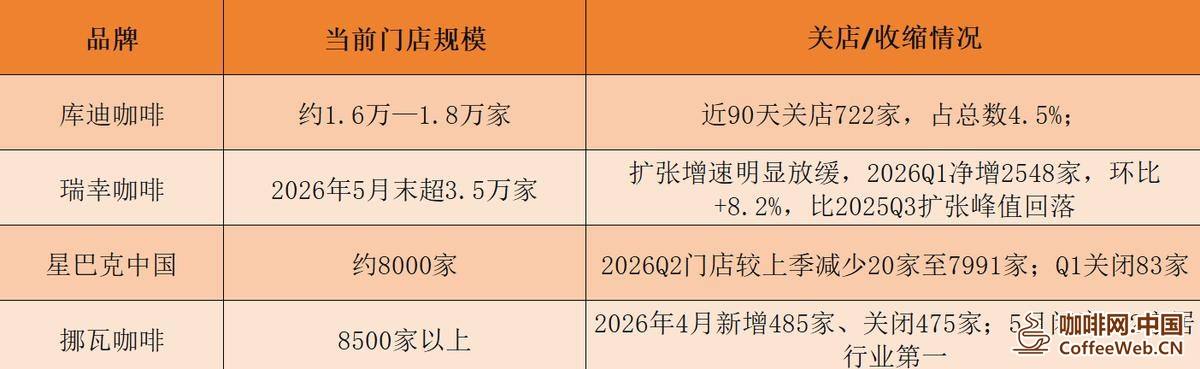
(The table above shows store counts and closure changes at leading industry companies; data from financial reports and media disclosures.)
Closures are only the surface; failing to make money is the real damage.
Take the undisputed leader Luckin. According to official disclosures, its total net revenue for full-year 2025 was 49.288 billion yuan, up 43.0% year on year, with net profit of 3.6 billion yuan, up 21.8%.
But in the first quarter of this year, revenue rose while profit clearly did not: total net revenue was 11.995 billion yuan, up 35.3% year on year, yet net profit was 506 million yuan, down 3.6%.
And Luckin’s position is already the grade of an industry honors student.
Cotti, the second-largest chain, has long spent heavily on marketing, and this year is even harder for it; the most direct feedback comes at the franchisee level.
Franchisees have been leaking stories to the media in wave after wave: guaranteed returns cancelled, subsidies cut, inefficient yet rigid KPIs for group-based customer acquisition, and a wave of transfers and closures inside the system.
Even as Cotti franchisees suffer in silence, Cotti keeps spending lavishly on advertising. From sponsoring Argentina at the World Cup to signing Li Sitong, lead actress of the dark-horse film Letter to Grandma, as a quality ambassador, hundreds of millions of yuan in marketing spend have kept pouring into brand upgrading, yet the response at the retail end has stayed lukewarm.
As for Starbucks, the industry benchmark, it is little better off: in the China market its revenue has now been overtaken by Luckin.
Financial reports show Starbucks China’s Q2 fiscal 2026 revenue at 799.8 million US dollars (about 5.522 billion yuan, less than half of Luckin’s), up 8% year on year, but same-store sales plunged from 7% in Q1 to 0.5%, and average ticket turned from positive to negative at -1.6%; a Starbucks trying to ‘go down-market’ has been precisely picked off by the price war.
Why is capital retreating all at once?
In 2026 the entire coffee track is walking on thin ice. Why?
The reason still lies in the business model of coffee chains and in market supply and demand.
All along, profit in the coffee track has come not from the retail end but from the supply chain; not from consumers but from franchisees.
Take Cotti. Judging by its funding path, with no outside financing early on it consistently followed an asset-light route of “zero financing plus joint-operation monetization.”
The whole logic was to use zero financing to leverage franchisees’ capital, trade low-price subsidies for store growth, keep franchise recruitment hot with a scale story, and complete extreme expansion during the window of opportunity in the coffee track.
Headquarters’ cash flow came from selling equipment to franchisees, the margin on raw materials, and a cut of gross profit.
According to Tech Planet, one Cotti franchisee from the ‘first batch of alliance partners’ at the end of 2022 has closed all but two of his stores. When renewing old stores, he was forced to add coffee machines; even with poor business he was still told to add machines. Headquarters ignores conditions on the ground and only demands that franchisees buy the company’s equipment.
This mechanism made regional teams treat store-opening speed as their core KPI, with site approval so loose that ‘filing meant approval,’ eventually producing the extreme involution franchisees describe as ‘two or three competitors within one kilometer.’
As company subsidies tapered and guaranteed-return policies were cancelled, franchisees’ room to survive was rapidly squeezed.
In particular, a ‘guaranteed buyback’ policy introduced in 2025 to attract franchisees worked like this: if a store fell short of expectations after six to nine months of operation, headquarters would buy back the equipment in the franchisee’s store at a discount.
But on June 30, 2026 the policy formally ended, and the reason behind it is very pragmatic.
As loss-making stores multiplied, the equipment headquarters bought back became hard to redeploy quickly, asset-impairment pressure kept climbing, and in the end it could only scrap the safety net and hand the risk entirely back to the market.
This directly drove large numbers of franchisees to transfer their stores before the window closed, listing them to escape the vortex of losses; even though May to August is the traditional peak consumption season, they preferred to cut losses first, fearing the stores would be harder to offload in the off-season.
Franchisees not making money is, at bottom, because the 9.9-yuan coffee business simply does not work.
A 9.9-yuan Americano breaks down into 5.7 yuan of raw materials, 1.5 yuan of packaging, 1.9 yuan of labor, 1.8 yuan of rent, plus 0.2 yuan of utilities.
Without subsidies, you lose money on every cup sold — much like the new-energy-vehicle business.
At the store level, franchisee gross margin is squeezed to just 1.5 to 2.5 yuan, and selling fewer than 100 cups a day means a loss.
The brand’s profit on that same cup is about 1.3 to 2.2 yuan, nearly the same as the franchisee’s, yet it bears none of the store’s fixed risk.
What does that tell us?
It tells us the coffee industry’s profit does not come from retail sales, but from the ‘price scissors’ on the supply-chain side.
The brand’s real money-making logic has never been selling coffee to consumers, but selling equipment, raw materials and brand licenses to franchisees.
Every time a franchisee opens a store, they first pay an equipment fee and a deposit; every month they restock, and the brand earns a margin on raw materials; every cup sold, the brand takes another cut of revenue.
Whether a store turns a profit or a loss, this income is fixed.
Franchisees are the brand’s ‘super customers’ — they are the ones who truly generate profit for the brand.
Luckin lifted gross margin to 63.8% through scaled procurement and its own roasting plants, absorbing middleman profits; Cotti is essentially more of a coffee supply-chain company; Nowwa’s revenue likewise comes mainly from supply-chain material sales, franchise service fees and revenue sharing with partner stores.
Selling coffee at the retail end is ‘thin margin’; selling raw materials and equipment on the supply chain is ‘thick margin.’
That is also the fundamental reason capital has recently started backing professional coffee-equipment makers and abandoning retail brand owners.
For example, in June 2026 commercial fully automatic coffee machine brand CAYE (Kaye Technology) announced a Series B of close to 400 million yuan, and specialty coffee supply-chain company Leyin Innovation also completed a Series B+ worth over 100 million yuan.
Capital is no longer betting on ‘the next Luckin,’ but on ‘the coffee machines and roasting capacity that anyone opening a store must use.’
What decides the second half?
Over the past decade, the winning card in the first half of the coffee track was speed: whoever raised funds fast, opened stores aggressively and marketed hardest seized the initiative.
In the second half there are only two winning cards: supply-chain efficiency in the affordable segment, and scenario value in the premium segment.
For the affordable segment, the supply chain is the only moat.
Going forward, brands have just one core competitive edge: driving the cost of a cup of coffee down to the absolute limit.
The lessons of the past few years have been deep enough.
Cotti’s current slowdown proves that propping up scale with franchisees’ money and pulling order volume with subsidies only leads to a dead end where ‘the more stores you open, the more you lose.’
The affordable brands that survive in future must meet two conditions: in-house production capacity and digital operations.
Everyone understands this full well and has collectively started competing on capacity intensity.
Luckin has built four roasting bases with total capacity of 155,000 tonnes, making in-house roasting 15% to 20% cheaper than external purchasing; Cotti has laid out a 360,000-square-meter supply-chain base in Anhui; after Nowwa built its own roasting plant, raw-material costs fell 5% and labor costs dropped 40%.
Capacity is the baseline for survival.
Brands without their own supply chain will always be 15% to 20% more expensive on cost than the leading players — a gap that, in an era of razor-thin margins, is the distance between life and death.
Digital operations are even more straightforward.
Site selection relies on heat-map models rather than human judgment, pricing adjusts dynamically with weather and time of day, inventory restocks automatically against real-time sales, and marketing reaches customers precisely through private-domain channels; a 1% efficiency gain in each link compounds into a real capability gap.
As for the premium segment, one has to ask: when the ‘third place’ is no longer scarce, where does brand premium come from?
Starbucks’ answer was once the social value of space, but as stores multiplied that scarcity disappeared; once the perception that ‘one Starbucks equals three Luckins’ set in, the brand’s foundation began to loosen.
The way out lies in brand tiering: flagship stores in core commercial districts protect the brand’s cachet, lightweight office and community stores adapt for efficiency, and small stores in lower-tier markets compete on brand momentum.
Covering different scenarios under one sign lets a brand survive without fighting a price war.
At present, the scale-up story for specialty coffee has been disproven.
Blue Bottle’s halved valuation and Seesaw’s bankruptcy liquidation reveal a brutal rule: specialty and scale are inherently in conflict.
Stick to specialty and you cannot grow large; expand quickly and you dilute the brand’s character.
The specialty shops that survive in future will not be ‘the next Starbucks,’ but small, community-rooted stores built around an owner-as-IP identity.
The essence of premium coffee is not selling better-tasting coffee; it is still selling space, selling cachet, selling identity.
In the long run, coffee remains a good business — just no longer an easy one.
Those who make it through the cycle are always the players who respect the laws of business and create real value for users, not the ‘paper giants’ piled up out of stories and leverage.
Author | Chaoyang Capital Blast
The coffee industry in 2026 is truly turbulent.
Why is capital collectively declining?
What does this mean?
What to play in the second half?
Capacity is the bottom line for survival.
Reprint Notice & Disclaimer
- This article has been edited and compiled by China Coffee Network. The information and images therein come from public sources and the copyright belongs to the original author. This reprint is intended solely for information sharing within the coffee industry and does not represent the views of this website; all data and opinions are subject to the original article. Our thanks to the original author for creating and sharing it.
- For matters concerning content licensing, attribution, copyright or otherwise, please contact us promptly and we will verify and cooperate in handling them as soon as possible. We also welcome coffee origins, brands and industry media to exchange ideas and contribute articles.
- Contact China Coffee Network: Tel 400-0000-641 (+86-18288016826) | Email 478203668@qq.com
Related Reading
 Tim Hortons China Q3: System Sales Up 6.3% Quarter on Quarter
- CRH Plans OATLY Exit, Nayuki Leaves Wenzhou | Tea & Coffee Weekly
 The 2026 Asian Coffee Association Annual Meeting will be held in Dehong, Yunnan, and the Asia ABODY Coffee System Standard will be officially released
 The President of Brazil's Victoria Coffee Business Center (CCCV) led a delegation of four people to Pu'er, Yunnan to conduct a special inspection of the coffee industry
 Behind the 1836 yuan "King of Brands": The Full Industry Chain and Offline Layout of Xinlu Coffee
 From a raw bean to a fragrant cup, Xiamen International Coffee Exhibition unlocks a new picture of the entire industry chain


 Liaoning ICP Security No. 21122402000217