


Introduction(Coffeeyo.com, a coffee website):Luckin Coffee’s net revenue for the third quarter was 17.891 billion yuan, a year-on-year increase of 17.0%, and its non GAAP net profit reached a single quarter high of 2.145 billion yuan. The proportion of delivery fees to revenue decreased from 18.9% to 10%, the order structure returned to self pickup, and the store profit margin rebounded to 23.3%.
Author | Sang Yu
Editor | Wang Xiaoming
At the dining table, there are more cups waiting for self pickup. After the ebb of the food delivery subsidy war, more and more Luckin orders are returning to store pickup from food delivery – a subtle change happening in tens of thousands of stores, quietly rewriting the company’s profit statement.
The third quarter financial report for 2026, released in early November, is the most direct footnote to this change: the total net income for the third quarter was 17.891 billion yuan, a year-on-year increase of 17.0%; Non GAAP net profit of 2.145 billion yuan, reaching a historic high in a single quarter; GAAP operating profit was 2.756 billion yuan, a year-on-year increase of 55.1%, with an operating profit margin of 15.4%, a year-on-year increase of 3.8 percentage points. Profit growth rate once again outperforms revenue – this time, the focus of the story is not on speed, but on quality.
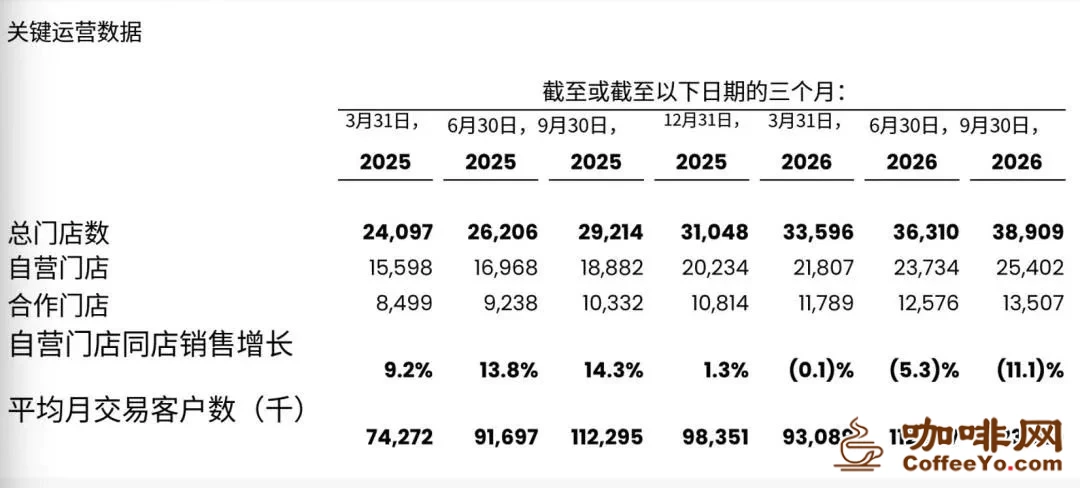
The change can start with a delivery fee. In the third quarter, the proportion of Luckin Coffee’s delivery fees to operating revenue has decreased from 18.9% in the same period last year to 10%. This means that during the same period last year, 18.9 yuan out of every 100 yuan of Luckin Coffee’s revenue was spent on delivery, which is a trace left by the high subsidy war among food delivery platforms; This quarter, the figure fell back to 10.0 yuan, which is not far from the pre subsidy level. The saved 1.1 billion yuan constitutes the main body of the store’s profit leap. More precisely, this is not a “saved” profit, but a “return”: when the order structure returns to self pickup and the cost structure returns to normal, 38909 stores, over 123 million monthly average trading customers, and a sea going path that is running through Singapore constitute the bottom line behind the return.
The newly announced share repurchase plan, synchronized with the performance, has an authorized limit of $500 million and a term of 12 months, adding a long-term footnote from the company itself to this “profit growth rate outperforms revenue” performance report.
Under the high base formed by the high subsidies for takeout in the same period last year, Luckin Coffee did not hand over a report that relied on contraction for profit, but a structural answer sheet with “stable chassis, strong momentum, and strong confidence”.
Profit growth leads revenue
Profit quality has reached a new level
Let’s first look at the quality of the profit side. Net profit of 1.859 billion yuan, a year-on-year increase of 45.4%; The non GAAP net profit was 2.145 billion yuan, a year-on-year increase of 50.9%, reaching a historic high in a single quarter. Industry insiders have pointed out that non GAAP net profit can better reflect the quality of profitability: this caliber excludes non operational disturbances such as equity incentives and more directly reflects the true profitability of the main business.

The operating profit of self operated stores in the third quarter was 3.019 billion yuan, a year-on-year increase of 55.5%; The operating profit margin at the store level was 23.3%, an increase of 5.8 percentage points year-on-year, and has basically returned to the pre subsidy level of the food delivery platform (according to the company’s restated comparable caliber, it was 23.5% in the third quarter of 2024, which is basically the same as this year’s 23.3%, slightly lower by 0.2 percentage points; if calculated based on the disclosed 23.3% in the current period of 2024, it is completely consistent). The GAAP operating profit margin for the same period was 15.4%, which was basically the same as the restated 15.5% in the third quarter of 2024 (the disclosure caliber for the current period was 15.3%).
It is worth noting that the material cost for this quarter was 6.854 billion yuan, a year-on-year increase of 23.7%; Store rent and other operating costs amounted to 3.925 billion yuan, a year-on-year increase of 26.7%; Sales expenses amounted to 976 million yuan, a year-on-year increase of 30.0%; Management expenses amounted to 1.075 billion yuan, a year-on-year increase of 35.5%. None of the four absolute amounts have decreased, and the restoration of profit margins has not been achieved by compressing store investment.
From the perspective of cost structure, the key variable is delivery fees. The subsidy for food delivery has been reduced, and orders are returned and self picked up. The proportion of delivery fees to net income has decreased from 18.9% in the same period last year to 10.0%, which is not far from the 9.1% in the third quarter of 2024. During the same period, the operating profit at the store level increased by 1.078 billion yuan year-on-year, which is basically equivalent to the 1.1 billion yuan spent less on delivery fees (both figures are obtained by subtracting the base period based on the year-on-year growth rate, not the difference between the absolute values of two years; the two are a comparison of magnitude, not an accounting identity).
This round of profit margin repair is essentially the cost structure brought about by the return of the order structure to self pickup after the subsidy for takeaway has been reduced. This kind of repositioning has a structural nature, so it is not a one-time savings; It brings single store profits back to a healthier and more sustainable normal level, and also lays a solid foundation for future operations. In terms of this quarter’s financial statements, the change in performance structure determines profit elasticity; Looking at the longer cycle, the upper limit of this business is still determined by scale and supply chain efficiency. Chinese food industry analyst Zhu Danpeng said that Luckin Coffee has achieved a positive flywheel with larger scale and lower single store costs through supply chain integration and refined channel operations, which is its core barrier that distinguishes it from all peers.
The user base disk is also synchronously increasing in thickness. The monthly average number of trading customers reached 123 million, a year-on-year increase of 9.6%, and both the monthly average number of customers and the per capita cup volume broke records; As of the end of the third quarter, the cumulative number of trading customers exceeded 520 million, with over 28 million new trading customers added in the quarter. The number of customers and consumption frequency are increasing synchronously, and the consumption potential of existing users is still being continuously released. The user trend continues to improve, and the positive flywheel of increasing supply and frequency of coffee consumption in China is starting to operate. In addition, during the quarter, Luckin Coffee continued to strengthen its interaction with consumers by sponsoring the World Cup in Spain, Portugal, and collaborating with Disney’s villainous series.
There is a mechanism for store expansion, overseas rooting, and explosive products
The expansion of scale continues the industry-leading pace of progress. In the current quarter, there were a net increase of 2599 stores, with a total of 38909 stores, an increase of 7.2% compared to the previous quarter. Among them, there was a net increase of 2543 stores in China and Hong Kong, and a net increase of 56 stores overseas – a net increase of 3008 stores in the same period last year. This quarter, it still maintained an industry-leading net increase rhythm on a high base. The store network continues to penetrate the market, including county-level cities, and new stores have maintained a healthy overall operating quality.
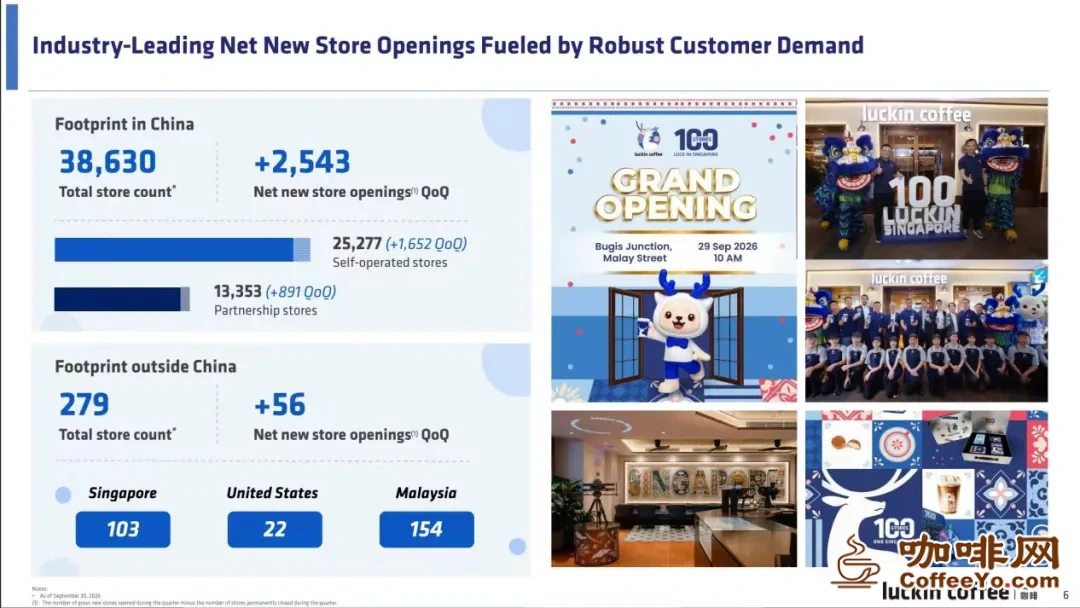
In terms of going global, Luckin Coffee has 103 self operated stores in Singapore, becoming the second largest chain coffee brand in the local area. The company claims to have “basically run the Singapore store economic model”, proving the “replicable potential” of its business model going global.
It should be pointed out that the wording “replicable potential” rather than “replicability verified” reflects Luckin’s cautious judgment of differences in different markets. At present, there are 279 overseas stores, accounting for about 0.7% of all stores (compared to 118 in the same period last year, a year-on-year increase of about 1.4 times), including 103 self operated stores in Singapore, 22 self operated stores in the United States, and 154 franchised stores in Malaysia. The profit and loss of a single store in Singapore has not been separately disclosed; However, ‘basic connectivity’ still provides valuable information anchor points: in a market with different legal environment, consumer habits, and competitive landscape from China, Luckin’s digital operation system and localized product capabilities can support a viable store economic model, accumulating reference experience for future expansion. This not only confirms the phased achievements of the Singapore model, but also does not equate single market experience with universal validation, leaving room for confidence in going global.
The explosive product capability on the product side is also commendable. During the season, 41 freshly made beverages and over 20 light meals were launched. The Thai milk series, which was launched in August, sold over 13 million cups in its first week, setting a new record for the first week sales of new products this year; The coffee line has launched the Ethiopian Guixia cold brew and innovatively extended multiple new cold brew products based on this, strengthening professional expertise. CEO Guo Jinyi stated that Luckin Coffee adheres to coffee as its core, continuously improves its professionalism, and promotes diversified innovation to enrich its product matrix, driving user retention and repeat purchases with stronger product strength.
What is more noteworthy is the production mechanism behind Luckin Coffee’s popularity: new products are first tested on a small scale in Lab stores, verified in the market, and then rolled out nationwide. The “Scarlet Moonlight”, which was previously limited to testing in Lab stores in Shanghai and Shenzhen and later launched for nationwide limited time supply in May, is the result of this mechanism’s productization. Gradually verify and cooperate with rapid data review to transform the success rate of new products from relying on luck to reusable organizational capabilities. Compared to the short-term sales brought by a single popular product, this mechanism is more meaningful.
Same store fluctuations do not change direction
Repurchase Anchored Long Term Value
Same store sales decreased by 11.1% year-on-year, which needs to be read in the correct context. This indicator only covers comparable stores in self operated stores, and joint venture stores are not included in the calculation. Currently, there are 13507 joint venture stores worldwide (including 13353 in China and Hong Kong, and 154 franchise stores in Malaysia). The revenue of joint venture stores in the third quarter was 4.243 billion yuan, a year-on-year increase of 11.7%. Their revenue is included in the total revenue, but not in the denominator of same store. This is precisely the structural reason why “same store decline of 11.1%, total revenue still increasing by 17.0%” can be established simultaneously: the sales revenue of products in the current quarter was 13.649 billion yuan, a year-on-year increase of 18.8% (including 12.94 billion yuan of self operated store revenue, a year-on-year increase of 16.8%), plus 4.243 billion yuan of joint venture store revenue, totaling 17.892 billion yuan, which is consistent with the total net revenue; The overall GMV was 20.734 billion yuan (including joint venture stores), a year-on-year increase of 19.7%. The same store caliber only measures the water temperature of comparable stores in stock.
From the perspective of the cause, the 11.1% decrease is due to the high base generated by the high subsidies for takeout last year (compared to a 14.3% increase in same store sales in the same period of 2025), and is not unique to Luckin Coffee – Yum China’s same store decline of 3% during the same period is also attributed to the high base. More noteworthy is the marginal direction: CEO Guo Jinyi stated at the performance meeting that the same store decline has narrowed month by month since July, and the improvement momentum has further strengthened since entering the fourth quarter. He believes that in the rapid development process, the same store indicator may show a “wave like” change. At the same time, the profitability of the stores has basically recovered to the pre subsidy level, and the cup volume structure has returned to self pickup, which is also conducive to leveraging the inherent advantages of the store network and operational efficiency. The trend of short-term fluctuations tends to improve rather than worsen.
Shareholder returns have written this confidence into terms. The company launched its first $300 million repurchase plan on April 30th and increased its investment by $200 million to a total of $500 million on September 1st; As of September 30th, a total of 95.8 million Class A common shares (equivalent to 12 million ADS) have been repurchased at a cost of $391 million. On November 3rd, the board of directors approved a new phase of the plan: up to $500 million, with a term of 12 months, and clearly stated that it will be launched on the earlier of the expiration of the existing $500 million authorization limit or the expiration of the existing plan term. Choose one of the two triggering conditions, with no preset date; According to the announcement, the 12 months of the new plan will start from the effective date, not from the announcement date. The confidence in repurchases also comes from cash flow: the net cash flow from operating activities for the quarter was 4.132 billion yuan, nearly doubling year-on-year, and the total amount of cash, term deposits, and short-term investments at the end of the period was 14.333 billion yuan. At the point where the profit growth rate exceeds the revenue, the single store profit basically returns to the pre subsidy level, and the store network and user base continue to expand, the company chooses to express its judgment on long-term value with real money and silver; If calculated based on a total market value of approximately 10.6 billion US dollars on the financial report date, a repurchase of 500 million US dollars accounts for approximately 4.7%.
In terms of the capital market, changes in governance structure and shareholder structure are also happening simultaneously: on September 10th, Abu Dhabi’s sovereign wealth fund Mubadala acquired a portion of the shares held by Dazheng Capital for about $1 billion, holding about 10.9% of the shares and becoming the second largest shareholder. Its representative entered the board of directors on September 29th; In 2026, the company will also complete the optimization of the board structure, achieving the separation of the roles of chairman and CEO. Zhu Danpeng stated that Luckin’s brand effect, scale effect, user base, and overseas supply chain have become increasingly perfect, providing solid support for future sustainable development and laying a solid foundation for its return to the capital market. In his view, this round of business adjustment and optimization is an important manifestation of Luckin Coffee’s further improvement in user stickiness and brand recognition. The high value of data will provide good support for the company’s future empowerment, influence, and appeal in the capital market.
In addition to business growth, the company also continued to promote localized social responsibility practice in the third quarter: carry out mental health public welfare cooperation in Singapore, launch the “Starlight Plan” in Pu’an, Guizhou Province in China, and donate and rescue after the debris flow disaster at Jilong Port, Xizang, together with the China Rural Development Foundation. These actions are in line with Luckin Coffee’s consistent emphasis on “localized operations” – wherever the store is located, community participation follows. For a company that is still in a period of rapid expansion, embedding social responsibility into daily operations is itself a manifestation of long termism.
Returning to normalcy is itself a more solid starting point. The profit growth rate outperforms the revenue, indicating an improvement in the quality of profits; The profit margin at the store level has returned to the pre subsidy level, indicating that the repair has a solid business foundation; The continued expansion of the store network, the basic success of the Singapore model, and the gradual formation of the explosive product mechanism indicate that growth does not rely solely on a single variable. The marginal direction of the same store is improving; Repurchase incorporates long-term confidence into the execution schedule. The scale advantage, profitability resilience, and overseas space have not changed, and Luckin’s long-term growth logic remains clear.
Reproduction Instructions and Disclaimer
- This article is edited and organized bycoffee website Coffeeyo.com. It is reprinted from “After 38909 stores, Luckin Coffee begins to make ‘structural’ money” on Dongfang Wealth Network. The original copyright belongs to Dongfang Wealth Network and the original author. The reposting on this website is only for information sharing in the coffee industry and does not represent the position of this website. The data and opinions in the article are subject to the original text. Thank you to the original author for their creation and sharing.
- Original text reading:Oriental Wealth Network’s “After 38909 Stores, Luckin Coffee Begins to Earn ‘Structural’ Money”
- If there are any issues related to content authorization, attribution, copyright or other matters, please contact our website in a timely manner, and we will verify and cooperate in handling them as soon as possible; We also welcome coffee companies and industry media to communicate and contribute to us.
- Coffeeyo.com Contact Information: Phone 400-0000-641 (+86-18941000313) Email 478203668@qq.com Address: Jinghong City, Xishuangbanna, Yunnan Province
Related Reading
- Arabica Coffee Prices Plunge as Exchange Stocks Surge to 28-Year High
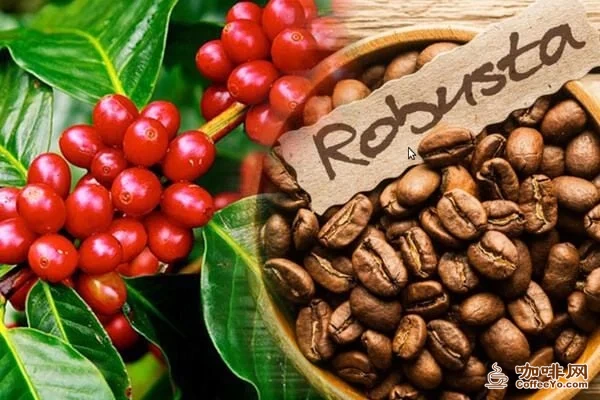 Global coffee prices fall across the board: Robusta drops for a 10th straight session below $2,900, hitting a two-year-nine-month low
 Global coffee prices plummet, production in 2026/27 may set a record
 Lincang Specialty Coffee Association Issues 2026/2027 Coffee Cherry Purchasing Initiative
 Coffee prices on November 12th: Arabica continues to fall to lowest point in nearly 5 months
 How Did Luckin Pull Off a Comeback Against the Odds


 Liaoning ICP Security No. 21122402000217