


At a Glance (China Coffee Network): (Source: Shangguan News) A government affairs parking lot in Shenzhen was “radically transformed” into a supercharging cafe, and the operator behind this internet-famous check-in spot comes from Shanghai. However, what truly deserves attention is not the renovation itself – after all, anyone can do this kind of cosmetic facelift – but the exploration behind it of social capital participating in micro-renewal and achieving sustainable operations, which is the more thought-provoking proposition. Energy management is becoming a breakthrough point on this path. 2025
(Source: Shangguan News)
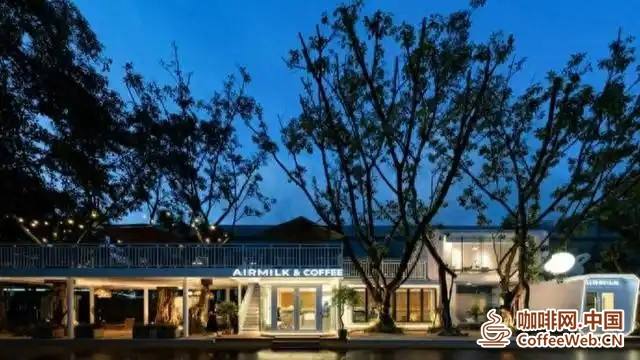
A government affairs parking lot in Shenzhen was “radically transformed” into a supercharging cafe, and the operator behind this internet-famous check-in spot comes from Shanghai. However, what truly deserves attention is not the renovation itself – after all, anyone can do this kind of cosmetic facelift – but the exploration behind it of social capital participating in micro-renewal and achieving sustainable operations, which is the more thought-provoking proposition. Energy management is becoming a breakthrough point on this path.
In June 2025, the integrated photovoltaic-storage-charging project for the Longgang District Government Service Center in Shenzhen and its surrounding areas was launched. Faced with a parking space covering 1,800 square meters, how to renovate it was once a difficult problem. Liu Liping, general manager of Guangdong Hexing Energy under Shanghai Tunnel Engineering Co., Ltd., admitted that in fact there was neither a plan for a cafe nor a plan for a supercharging station at the very beginning; the demand “grew” bit by bit.
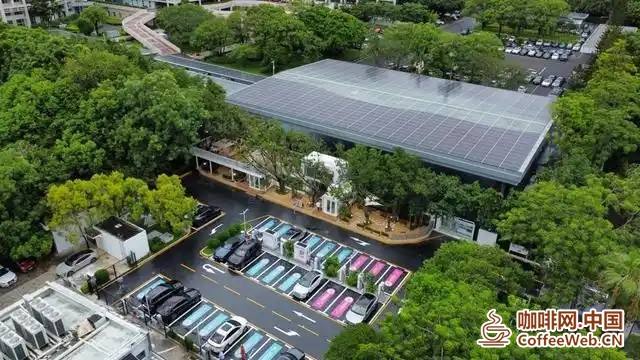
A supercharging cafe transformed from a parking lot
Shanghai’s urbanization process started early, and it has now entered the stage of intensive development and urban renewal. Initially, the renovation team hoped to bring Shanghai’s concept of micro-renewal of public spaces to Shenzhen, making full use of public spaces and adding composite functions. But what kind of functions would be both popular and practical?
During the research, the team found that the time citizens spend handling government affairs is about the same as the time it takes to sit down and drink a cup of coffee. Based on this observation, the technicians decided to build, in the parking lot of the government service center, a comprehensive supply station where people could “recharge” themselves with a cup of coffee while also charging their new-energy vehicles.
Ordinary charging stations clearly cannot keep up with the pace of handling government affairs; if charging speed cannot keep up, waiting becomes a burden for citizens instead. Thus, building an integrated photovoltaic-storage-charging station capable of ultra-fast energy replenishment became the direction for solving the problem.
“Shanghai Tunnel Engineering has accumulated rich experience in large-scale photovoltaic-storage-charging stations, and has built multiple systems in the Yangtze River Delta, the Guangdong-Hong Kong-Macao Greater Bay Area and other places,” Liu Liping introduced. In this project, the team deployed four sets of 720-kilowatt stack-type supercharging equipment for the Shenzhen Longgang government compound, enabling new-energy vehicles to achieve ultra-fast energy replenishment. The supercharging piles reach a charging speed of “one kilometer per second”, and the first AIRMILK coffee store in South China was also introduced. During breaks from handling business, citizens can casually order a latte, take an Instagram-style photo, and plug the charging gun into their new-energy vehicle, taking care of business, leisure and recharging all at once. Shortly after it went into operation in July, this convenient “micro-space” integrating supercharging, coffee and leisure quickly attracted the attention of nearby residents and citizens handling affairs. On social media, many users shared their check-in experiences.
But the outer shell is only the surface. When it comes to micro-renewal, the hardest part has never been how to renovate, but how to “stay alive” after the renovation. Letting enterprises participate in the micro-renewal of a parking lot and radically transforming it into a supercharging cafe – is that commercially viable?
Breaking down the project’s business model reveals quite specific challenges. Traditional energy-saving projects for public institutions often rely on full government investment, with prominent problems such as heavy fiscal pressure, low operation and maintenance efficiency, and rigid models. At the same time, the project’s advancement also faces multiple hard constraints: technically, the project must both charge vehicles and participate in daily intelligent grid dispatching, while ensuring uninterrupted power supply to critical government loads, building a solid safety bottom line for the operation of government bodies; operationally, the daily maintenance of photovoltaic facilities and the safety assurance of energy storage equipment are unavoidable rigid requirements.
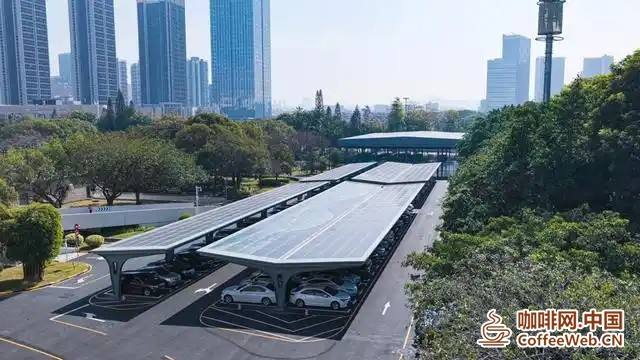
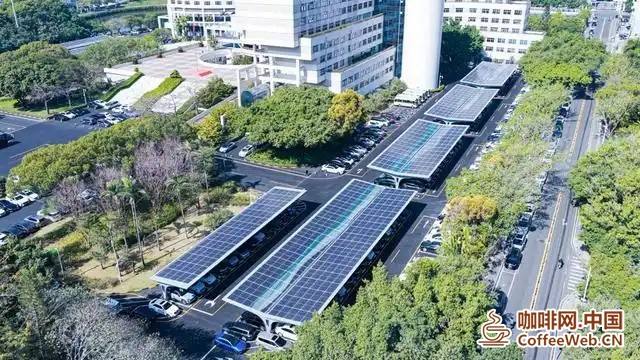
Supercharging station
Micro-renewal may seem light and simple, but in fact it tests an enterprise’s comprehensive capabilities in technology integration, resource coordination and long-term operation, which has long exceeded the capability boundaries of traditional construction units. Precisely for this reason, the project chose the EMC (Energy Management Contracting) model. Shanghai Tunnel Engineering undertakes full-life-cycle management of investment, design, construction and operation; the government needs no upfront investment, while the enterprise builds a stable market-oriented revenue loop through multiple channels such as charging pile service fees, peak-valley electricity price spreads from energy storage, and market-based trading of green power, achieving self-sustaining, sustainable operation and a two-way improvement in “energy saving + efficiency enhancement”.
“This mechanism has been successfully applied in multiple projects such as the Shanghai Jinli Building and the Municipal Testing Center, and is a quality demonstration case for energy-saving retrofits of existing buildings of public institutions in Shanghai,” Liu Liping said.
The deeper logic of this model lies in freeing the government from one-time investment, while transforming the enterprise from a mere engineering contractor into a long-term operation service provider; only after interests are aligned is operation quality truly guaranteed. What it attempts to solve is precisely the core incentive compatibility problem when social capital participates in public renewal projects. This sound mechanism of “the government sets the stage and enterprises perform, for mutual benefit and win-win results” not only effectively revitalizes the idle space resources of public institutions and greatly relieves fiscal pressure, but also stimulates enterprises’ innovation vitality and investment enthusiasm, providing a brand-new approach for the market-oriented implementation of low-carbon projects in public institutions.
In terms of energy saving and environmental protection, the project’s data are equally noteworthy. “The total installed photovoltaic capacity is about 1.9 megawatts, with an average annual power generation of about 1.6 million kilowatt-hours, which can cover 20 percent of the compound’s annual electricity consumption,” Liu Liping introduced. According to estimates, the project can produce about 40 million kilowatt-hours of green power over its full cycle, cumulatively saving 13,000 tons of standard coal and reducing carbon dioxide emissions by 35,500 tons, equivalent to planting 180,000 trees.
Original title: “A Shenzhen Parking Lot Transformed into a Supercharging Cafe: A Shanghai Enterprise Explores a New Path for Sustainable Micro-Renewal Operations”
Column Editor in Chief: Chen Xihan
Source: Author: Qi Yingpu from Liberation Daily
(Source: Shangguan News)
Supercharging station.
Column Editor in Chief: Chen Xihong
Source: Author: Qi Yingpu from Liberation Daily
Reprint Notice & Disclaimer
- This article has been edited and compiled by China Coffee Network. The information and images therein come from public sources and the copyright belongs to the original author. This reprint is intended solely for information sharing within the coffee industry and does not represent the views of this website; all data and opinions are subject to the original article. Our thanks to the original author for creating and sharing it.
- For matters concerning content licensing, attribution, copyright or otherwise, please contact us promptly and we will verify and cooperate in handling them as soon as possible. We also welcome coffee origins, brands and industry media to exchange ideas and contribute articles.
- Contact China Coffee Network: Tel 400-0000-641 (+86-18288016826) | Email 478203668@qq.com
Related Reading
 Jiangxi Wuyuan: Rural Coffee Unlocks New Cultural Tourism Formats
 Jiangxi Wuyuan: Rural Cafes Unlock New Cultural Tourism Formats
 Global quality goods gather at Hongqiao Import Commodity Exhibition Center, setting "Chinese standards" for coffee
- Global premium products gather to set China's coffee standards as Hongqiao Import Commodity Exhibition Center keeps the CIIE spirit alive
- Global quality goods gather as Hongqiao Import Commodity Exhibition Center and CIIE forge lasting partnership to set China's coffee standards.
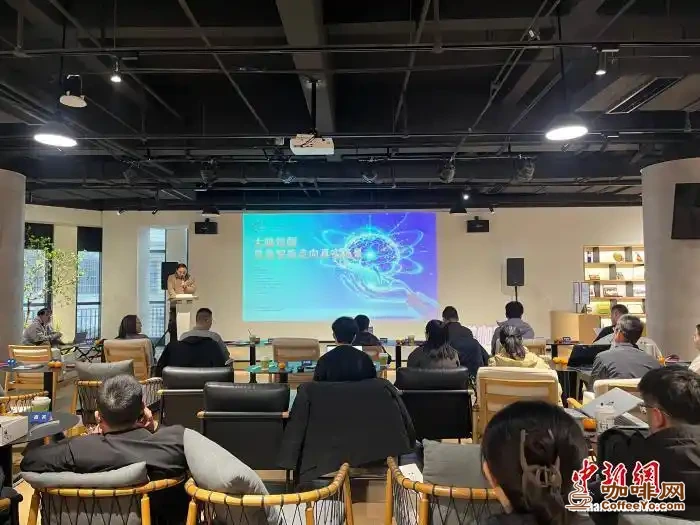 Zhejiang "Science Cafe" Promotes Embodied Intelligence in Real-World Scenarios


 Liaoning ICP Security No. 21122402000217