
Where did you drink coffee this holiday? Perhaps in your hometown county town, perhaps at a popular tourist attraction. Even in Mohe, the northernmost city in the country, having a cup of coffee has become part of daily life.
Coffee consumption follows wherever visitors go, and the vitality of holiday coffee spending is being released across more and more scenes. Take Luckin Coffee: during this year’s National Day holiday, from 1 to 7 October, cumulative cup volume at its stores nationwide exceeded 100 million, a microcosm of holiday coffee consumption. At the same time, more drinks that blend in local produce and regional culture have become a new vehicle through which visitors experience local flavours.
From hometown counties to tourist attractions, from everyday consumption to travel experience, coffee is blending into more life scenes and reflecting the geographic expansion and consumption shift of China’s coffee market. These changes are also presented in the China Coffee Heat Map recently released by Xinhuanet together with Kuaimen. Through the data we can see the regional distribution and consumption trends of China’s coffee market. Where are there the most coffee shops? Where is growth fastest? What stage has Chinese coffee reached? The answers are in this heat map.
01. More than 250,000 Coffee Shops Nationwide: Who Is Filling the Map?
Kuaimen data show that as of September 2026 there were about 254,600 freshly made coffee shops nationwide, a net increase of about 106,700 over the same period in 2023, or cumulative growth of 72.12 percent in three years.
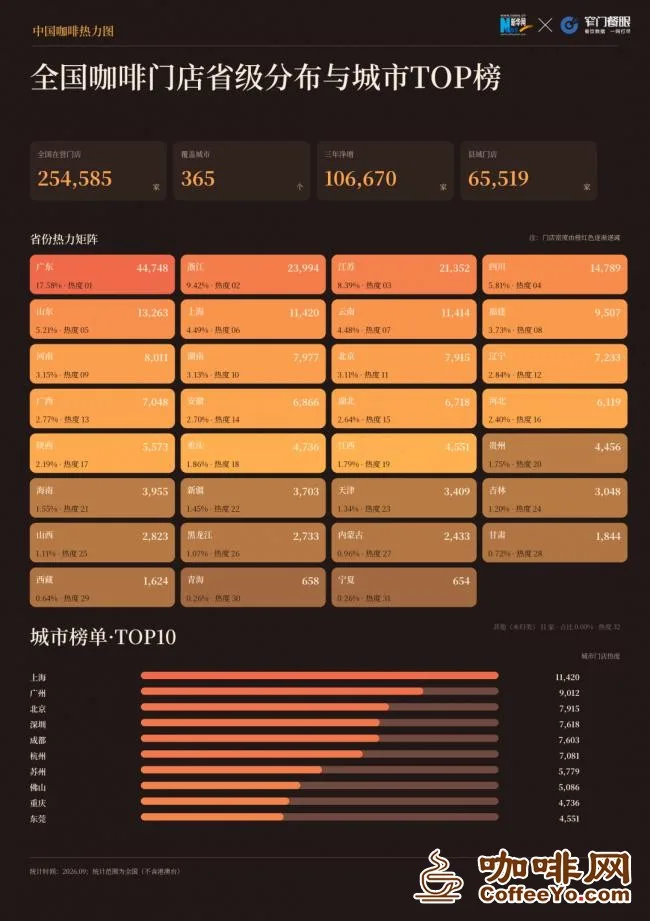
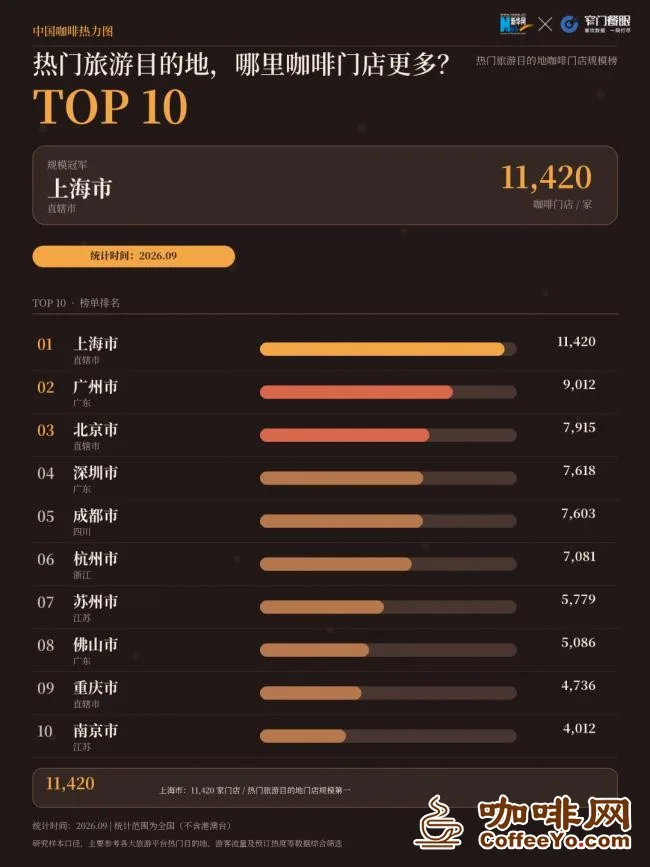
Big cities remain an important coffee market. Shanghai has more than 11,000 coffee shops, the largest total; Guangzhou follows with 9,012, and Beijing and Shenzhen both exceed 7,000.
Breaking stores down by market, county-level areas (including county towns and county-level cities) already have about 65,500 coffee shops, 25.74 percent of the national total. About one in four coffee shops in China is in a county-level area.
New first-tier cities and county areas together account for 48.88 percent of stores nationwide, close to half. The scale of China’s coffee market can no longer be judged by first-tier cities alone.
Looking at stores added over the past three years, county areas and third-, fourth- and fifth-tier markets together contributed 54.55 percent of the net increase. Coffee shops are extending further into county areas and lower-tier markets.
This trend is also reflected in the store layouts of leading chains. As stores extend from big cities to counties and townships, the coverage of leading brands keeps expanding. Take Luckin Coffee: by the second quarter this year it had 36,087 operating stores in China including Hong Kong, 14.17 percent of all coffee shops nationwide, making it the largest coffee chain in the country by store count. In the past year China sold about 11 billion cups of freshly ground coffee, of which Luckin sold 4.1 billion: for every three cups Chinese consumers buy, about one comes from Luckin.
Shanghai, Beijing, Guangzhou and Shenzhen are cities where chains such as Luckin cluster most densely. But dense layouts in big cities are only one corner of China’s coffee map; county markets already have a considerable scale of coffee shops too.
02. County Coffee Doubles in Three Years: Who Is Catching the Business?
The change in county coffee shows first in numbers.
In 2023 county areas had 32,211 coffee shops; by 2026 the figure had risen to 65,519, a net increase of 33,308 in three years and cumulative growth of 103.41 percent, higher than the national 72.12 percent for the same period and higher than the 46.53 percent and 71.72 percent growth of first- and second-tier markets.
In three years the number of county coffee shops doubled to about 65,500. About thirty percent of the net new coffee shops nationwide in the period came from county areas. Zoom in further, however, and different county markets are developing at very different rhythms.
Which counties have gathered more coffee shops?
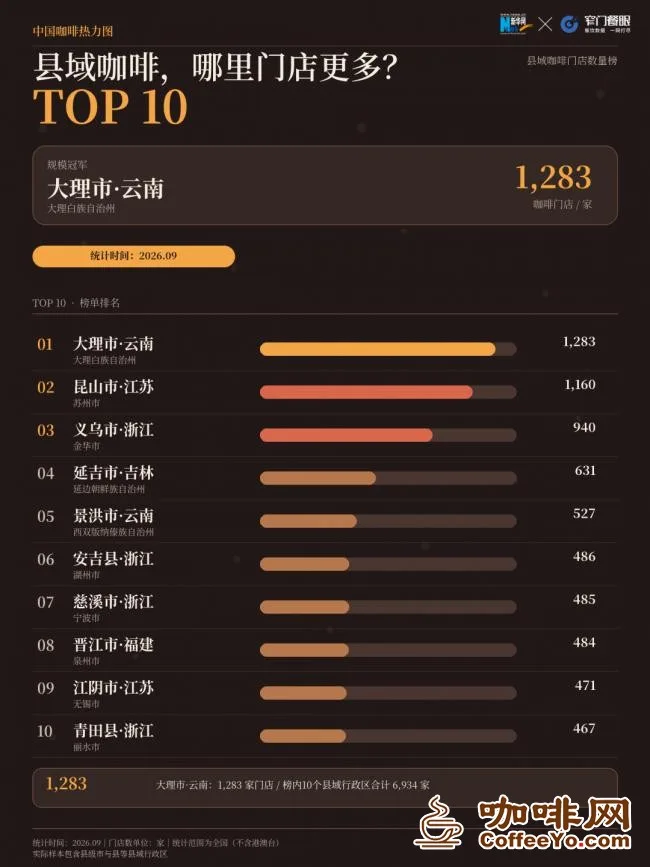
On the county store count ranking Dali and Kunshan lead, both with more than a thousand shops. Tourist destinations and county-level cities with active industry have both nurtured sizeable coffee markets.
The travel scenes of Dali and Jinghong and the residential and working scenes of Kunshan and Yiwu are all worth a closer look. The same coffee shop may see customers buying on the way past, or staying for the setting and the experience.
On the growth ranking, a different set of places comes first.
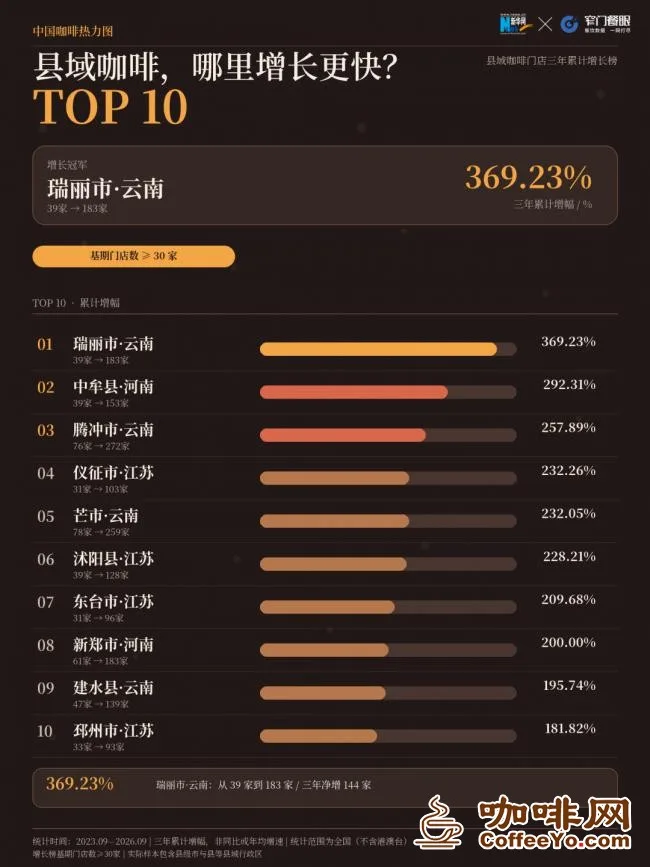
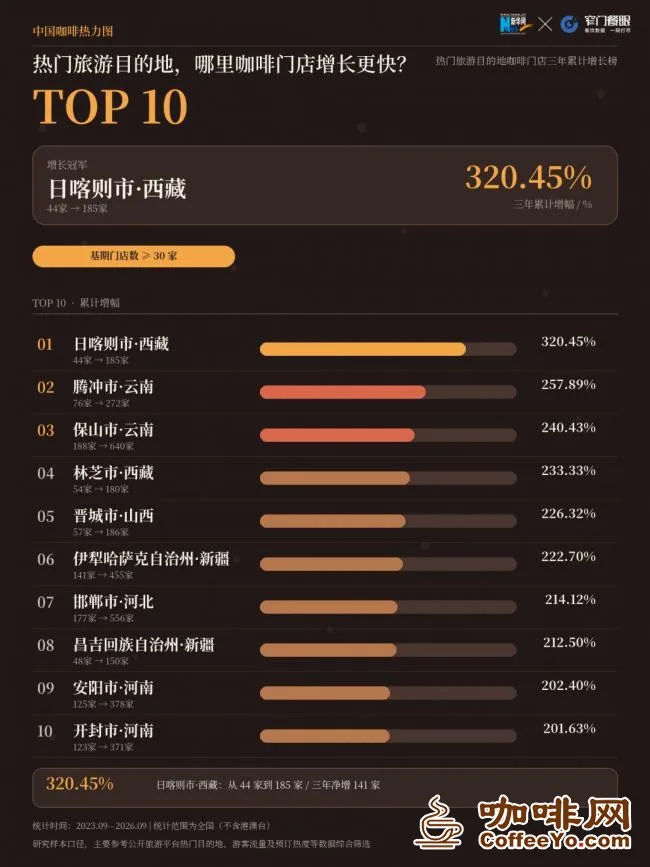
Among county areas that already had at least 30 coffee shops three years ago, Ruili grew fastest, from 39 stores to 183, with Zhongmu and Tengchong close behind.
None of the top ten by number overlaps with the top ten by growth. Dali and Kunshan show existing scale, while places such as Ruili are more notable for recent change.
Yet thousand-store counties remain few. Among county areas that already have coffee shops, more than seventy percent still have fewer than 30. Beyond the bustle of leading counties, the coffee business elsewhere still has broad room to grow.
Where have familiar brands opened?
In more and more county towns familiar coffee chains have appeared along the streets. As demand grows and store networks continue to move downwards, leading brands have become an important force in the expansion of the county coffee market.
Luckin’s store layout in particular keeps extending into a broader county market.
Kuaimen data show that as of September this year Luckin had opened 1,915 stores in 662 county towns nationwide. Anji County in Zhejiang, for example, already has 24; looking further to townships, Yushan Town in Kunshan has 62. Some places with “town” in their name may now have more coffee shops than one would imagine.
Beyond chains, county areas have also grown businesses run by independent owners. Again in Anji, Zhejiang, someone turned an abandoned quarry into a coffee shop. A location that was not on a traditional commercial street has become a place people travel to for the setting and the space.
Chain stores in county business districts, small shops beside neighbours and village cafes in the hills together make up the different faces of county coffee: some serve everyday purchases, others make visitors willing to stay a little longer.
03. On “Coffee Density”, Why Can Lhasa Beat Shanghai?
Shanghai has the most coffee shops, but measured per capita the picture changes.
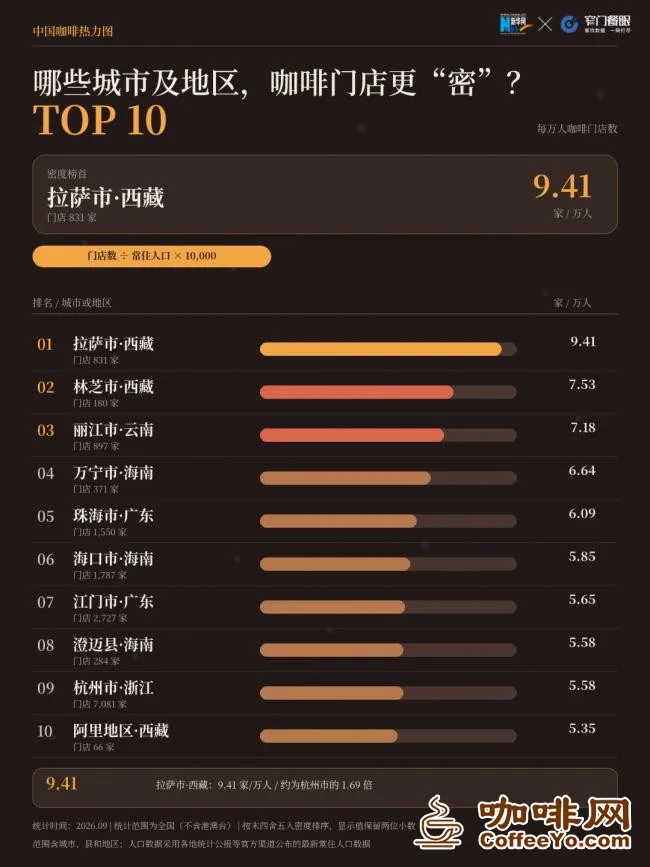
Adjusted for permanent residents, Lhasa has 9.41 coffee shops per 10,000 people against Shanghai’s 4.59, about twice as many.
The difference is not hard to understand. Shanghai has 11,420 coffee shops for about 24.85 million permanent residents; Lhasa has only 831 coffee shops but about 880,000 residents. Lhasa’s total is far below Shanghai’s, yet relative to the local population its stores are more densely distributed.
Similar cases appear in Nyingchi, Lijiang and Wanning, where shops per 10,000 people all exceed Shanghai’s. Even within one province the differences are clear: the coffee density of Zhuhai, Jiangmen and Foshan is higher than that of Guangzhou and Shenzhen.
High store density does not necessarily mean local residents drink more. Especially in tourist cities and areas with high population mobility, visitors, business travellers and cross-city commuters also form an important increment of coffee consumption.
This means a coffee brand entering a city faces not only the local permanent population but more diverse consumption scenes: office areas value speed and convenience, communities carry high-frequency daily demand, and tourist streets layer in needs for rest, views and socialising. Coffee chains including Luckin are also entering these extending scenes through wider store layouts and product supply.
04. What New Flavours Are Coffee Shops in Tourist Destinations Offering?
Now that coffee has entered more travel scenes, visitors taste not only a familiar cup but also the flavour and memory of a city.
Coffee in tourist destinations often carries the local character. The taste of old streets, life in the hutongs and local produce can all become sources of creativity for small shops and chains alike. From everyday refreshment to holiday snapshots, from resting space to local flavour, coffee is becoming a new entry point for more and more visitors to understand a city.
Lhasa: what is it like to have a coffee on the snowy plateau?
Tibet’s rich tourism resources have generated new coffee demand and given chains a chance to join local cultural tourism scenes. Take Luckin: its distinctive stores in Lhasa incorporate Tibetan cultural elements, giving a familiar brand space an extra layer of highland character. Coffee in Tibet is now a new choice for visitors to rest, socialise and experience local culture along the way.
Foshan: how does coffee fit into the city’s character?
In Foshan coffee has blended into the local Lingnan lanes and culture. The Luckin store in Lingnan Tiandi weaves arcades and encaustic tiles into its design and has released Guangdong-themed cup sleeves and a series of Lingnan window-pattern fridge magnets. Strolling the old streets, drinking coffee and taking home a piece of window-pattern merchandise give visitors’ memories of Foshan a more concrete landing point.
Ruili: how does the flavour of a border town get into a cup of coffee?
In Ruili the slow rhythm of a small border town, the China-Myanmar character of its lanes and the check-in point at the national gate all add local colour to a trip. From everyday street life to rainforest hideaways, and the century-old coffee mother trees rooted at the border, coffee has become a new calling card for Yunnan.
Local produce also brings new ideas to coffee. Fragrant lemons from Ruili have become one of the sources of raw material for drinks such as Luckin’s Fresh Cut Lemon C Americano, so the flavour of the border town appears in more people’s cups. What visitors remember may be a flavour, a piece of merchandise, or simply a stretch of time spent sitting with a coffee.
05. You Got All the Way Here and Can Still Get Coffee?
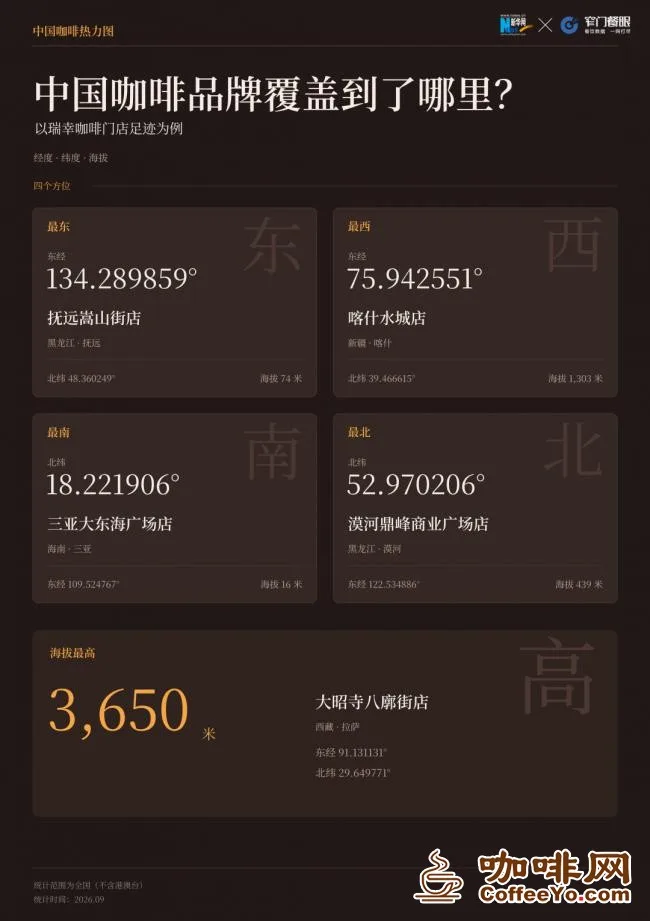
Pull the national coffee map to its easternmost, westernmost, southernmost, northernmost and highest points: which coffee shops will you meet?
Even in these places familiar coffee signs appear. Take Luckin: its stores in mainland China run east to Fuyuan, west to Kashgar, south to Sanya and north to Mohe, while the store on Barkhor Street beside the Jokhang Temple in Lhasa sits at about 3,650 metres, the highest Luckin store in mainland China.
From city centres to borders and highlands, the store map of coffee keeps extending and entering more people’s travels and daily lives.
Where would you like to drink your next cup?
This heat map shows that the map of China’s coffee market keeps expanding: big cities still have huge store scale, county coffee shops doubled in three years, some cities and regions now exceed first-tier cities in coffee shops per head of population, and from old city quarters to border highlands coffee is entering more and more new consumption scenes.
From first-tier cities to county markets, from everyday consumption to travel experience, coffee is becoming part of more people’s lives. As store networks keep extending, the potential of lower-tier markets is released and local flavours keep feeding product innovation, China’s coffee market will keep growing.
On your next trip, look out for the familiar or unfamiliar coffee shops along the way. They connect cities, county towns, scenic areas and distant places, and together they make up the Chinese coffee of today.
Reprint Notice & Disclaimer
- This article was edited and compiled by coffeeyo.com. The information and images come from public channels and the copyright belongs to the original authors. This reprint is for coffee-industry information sharing only and does not represent the site’s position; all data and views are subject to the original. We thank the original authors for their work and sharing.
- If you have questions regarding authorization, attribution, copyright, or any other matter, please contact us promptly and we will verify and cooperate. We also welcome coffee-producing regions, brands and industry media to exchange story leads with us.
- Contact coffeeyo.com: Tel 400-0000-641 (+86-18288016826) | Email 405854472@qq.com | Address: Jinghong City, Xishuangbanna, Yunnan Province / Tieling City, Liaoning Province
Related Reading
 ‘All-Ice’ Coffee Goes Viral! Will the Next Hit Be Your Personal Favorite?
- Hong Kong’s Dyee Coffee Lands in Qianhai, Building a Specialty Pour-Over Outpost
 Ken Yue Coffee Opens Egg-Tart Pop-Up in Hangzhou: Sweet Craft, Reinvented Classics
 World Cup Enters the Breakfast Slot: Can Coffee-Tea Brands Turn Traffic into Orders?
- ICE Agricultural Futures Mostly Rise at Close; Coffee Futures Up 3.28%
- ‘Sleep Cafés’ Become a New Favorite Among Seoul Office Workers





 Liaoning ICP Security No. 21122402000217