
During the National Day golden week just past, a cup of coffee appeared in more and more unexpected places: old streets in county towns, viewing platforms in mountain scenic areas, motorway service stations on the way home.
Coffee no longer belongs only to office towers and business districts.
Xinhuanet, together with Kuaimen, recently released the China Coffee Heat Map, using data to observe the regional distribution and consumption trends of China’s coffee market and to answer a few questions: where is “coffee concentration” higher than expected? Where is there still room for growth? And what industrial capacity supports store expansion?
1. Three Years, 107,000 New Stores: Coffee Moves from Occasional to Regular
Start with a set of macro figures.
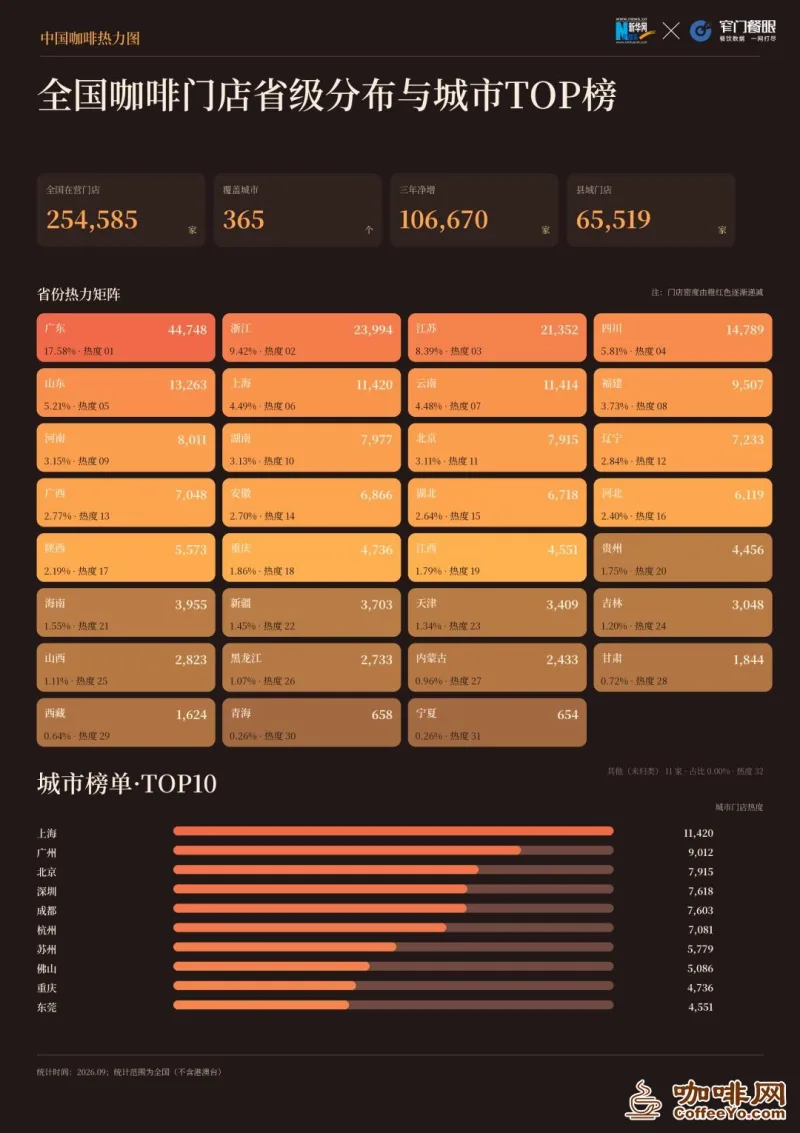
The number of coffee shops nationwide rose from 147,915 to 254,585, a net increase of 106,670 in three years, or 72.12 percent. There are now about 1.72 times as many stores as three years ago.
According to the 2026 China Urban Coffee Development Report, the scale of China’s coffee industry grew from 313.3 billion yuan in 2024 to 354.9 billion yuan in 2025, up 13.3 percent year on year, while annual per capita coffee consumption nationwide rose from 22.24 cups to 28.57 cups.
In 2023 per capita consumption was still 16.7 cups; it is now close to 30 cups, an increase of more than 70 percent in two years. The rise in cup volume reflects a rapid increase in how often consumers drink coffee.
As demand grows, the store network keeps expanding. Kuaimen data show that 93,000 coffee shops opened in the past year, with leading chains such as Luckin Coffee an important force driving the industry’s expansion.
This round of expansion comes with a change in habits: from “going out for a coffee” to “picking one up along the way”, consumers prize convenience and product consistency more than before. Through wide store networks and standardised products and service, chains make a cup of coffee easier to get.
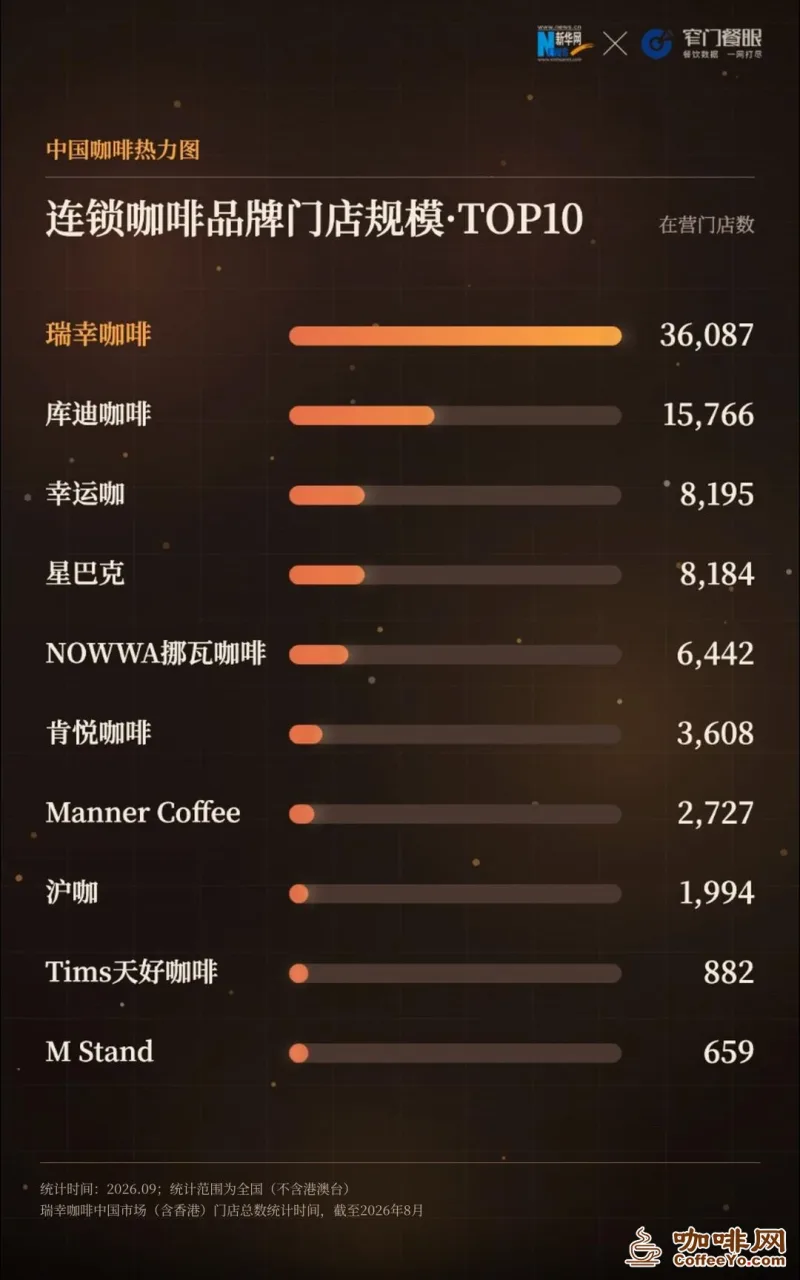
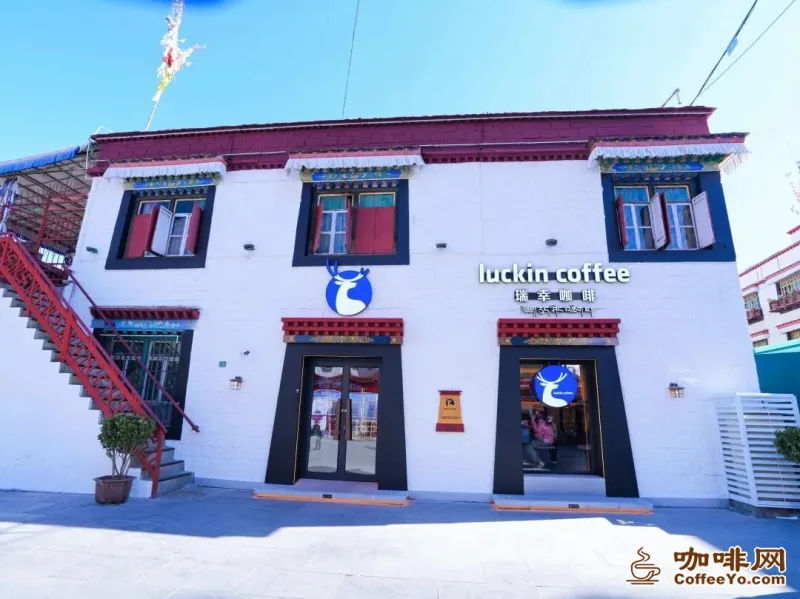
Take Luckin Coffee, which leads on store scale: by the end of the second quarter this year it had 36,087 stores in the China market including Hong Kong. Its domestic stores run east to Fuyuan in Heilongjiang, west to Kashgar in Xinjiang, south to Sanya in Hainan and north to Mohe in Heilongjiang, while its highest store stands at 3,650 metres on Barkhor Street beside the Jokhang Temple in Lhasa, Tibet.
The extension of the store network carries coffee’s convenience from big cities to more places.
As more consumers can buy a coffee nearby, coffee is gradually turning from a trendy purchase into an everyday drink within easy reach.
2. Urban Coffee: High-tier Cities Lead on Volume, Tourism Cities on Density
By region, Guangdong ranks first among provinces with 44,748 stores, followed by Zhejiang with 23,994 and Jiangsu with 21,352.
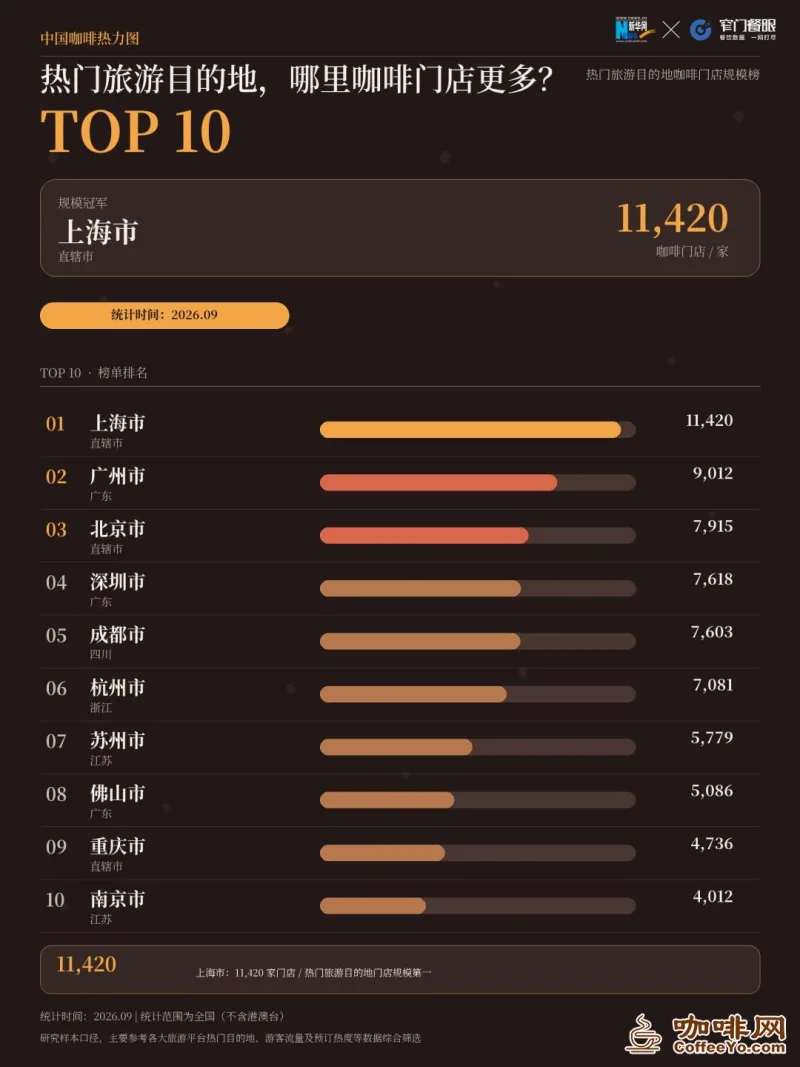
At city level Shanghai leads the country with 11,420 stores, while Guangzhou, Beijing, Shenzhen, Chengdu and Hangzhou all have more than 7,000.
But leading on store numbers does not mean leading on density. Calculated as stores per 10,000 residents, the ranking shifts markedly.
Shanghai has the most coffee shops in the country, 4.59 per 10,000 people, but ranks 20th. Chongqing ranks ninth in total with 1.49 per 10,000 people, placing 116th.
With different population sizes, judgments about whether there are “many coffee shops” differ completely.
Some tourist destinations actually have higher coffee density. Lhasa has 831 coffee shops, 9.41 per 10,000 people; Lijiang has 897, or 7.18; Zhuhai has 6.09, higher than Guangzhou’s 4.72 and Shenzhen’s 4.17.
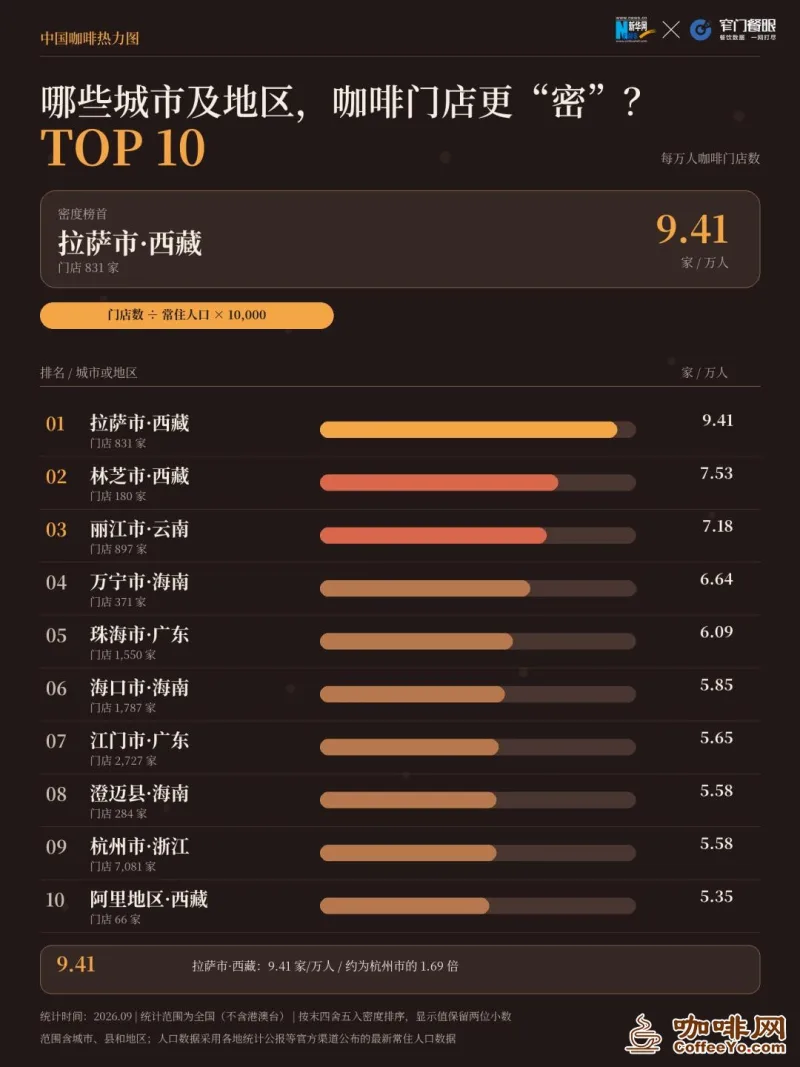
Behind these density differences lie different consumption scenes. The coffee density of Lhasa and Lijiang corresponds to tourism: visitors around scenic areas want a coffee that lets them pause. The density advantage of the Pearl River Delta relates to commuting between cities in the cluster and a fast pace of life.
Zhuhai, Jiangmen, Foshan and Zhongshan together have 11,718 coffee shops, about seventy percent of Guangzhou and Shenzhen combined, while their permanent population is less than sixty percent of the two cities. Per 10,000 people the four cities have about 5.39 shops against about 4.45 in Guangzhou and Shenzhen.
Coffee store density is not fully correlated with city size. For the industry, growth can come both from higher consumption frequency in high-tier cities and from expansion into more cities and scenes. The two paths can advance together.
3. County Coffee: Some Already Clustered, Some Just Starting
The county market is the most noteworthy variable in this round of coffee growth.
New first-tier cities have 58,925 coffee shops and county-level areas 65,519, together accounting for nearly half the national total. County stores already outnumber those in new first-tier cities and grew 103.41 percent in three years, far above the national 72.12 percent.
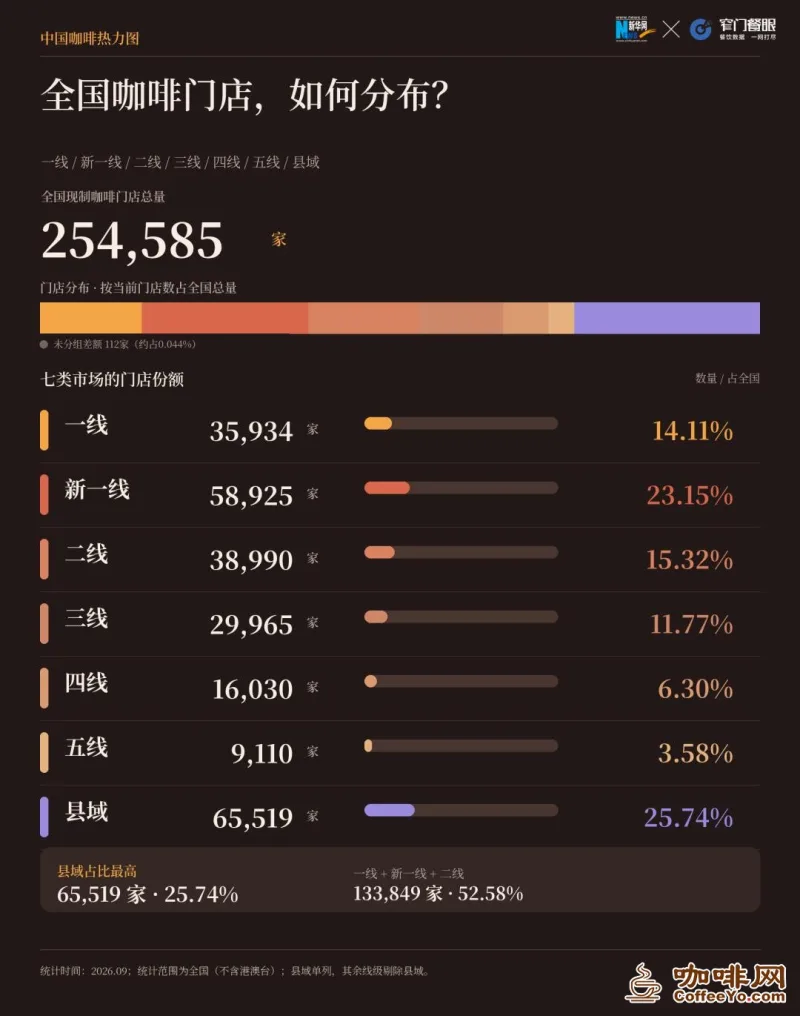
The county share of coffee shops nationwide rose from 21.78 percent to 25.74 percent. About one in every four coffee shops in China is now in a county-level market.
The change is not only that stores appear in more places, but that places which already have coffee shops keep adding more. In county-level cities such as Tengchong, Mangshi and Yining the number of stores rose from seventy or eighty to more than two hundred.
A large county total does not mean balanced development, however. Among the top ten county-level markets by store scale, Dali, Kunshan and Yiwu together have 3,383 stores, 48.79 percent of the top ten total, close to half. Even among leading county markets the gap is obvious.
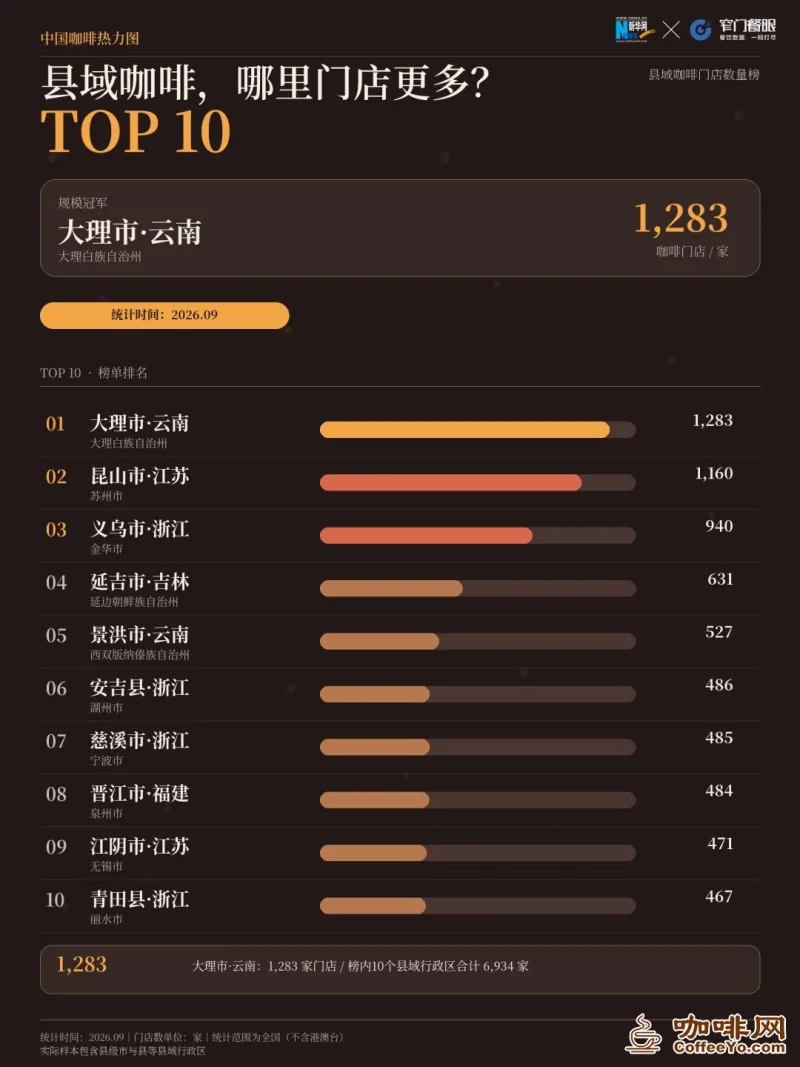
Also worth noting is the “village coffee” phenomenon. Of Kunshan’s more than 1,000 coffee shops, 168 are in villages. A village cafe in Zibo held a mountain market in August this year that drew more than 5,000 visits to the village in five days. A karst cave cafe in Xiuwen County, Guizhou, sells more than 300 cups a day in peak season.
Coffee is seeping into county-town and rural life at different speeds and densities. In some places clusters have formed; in others it has only just started. That unevenness is itself the room for market growth.
4. Cultural Tourism Coffee: A Cup Becomes Part of the Travel Experience
Tourist destinations are another window on coffee consumption.
The top ten tourist destinations by coffee stores are Shanghai, Guangzhou, Beijing, Shenzhen, Chengdu, Hangzhou, Suzhou, Foshan, Chongqing and Nanjing.
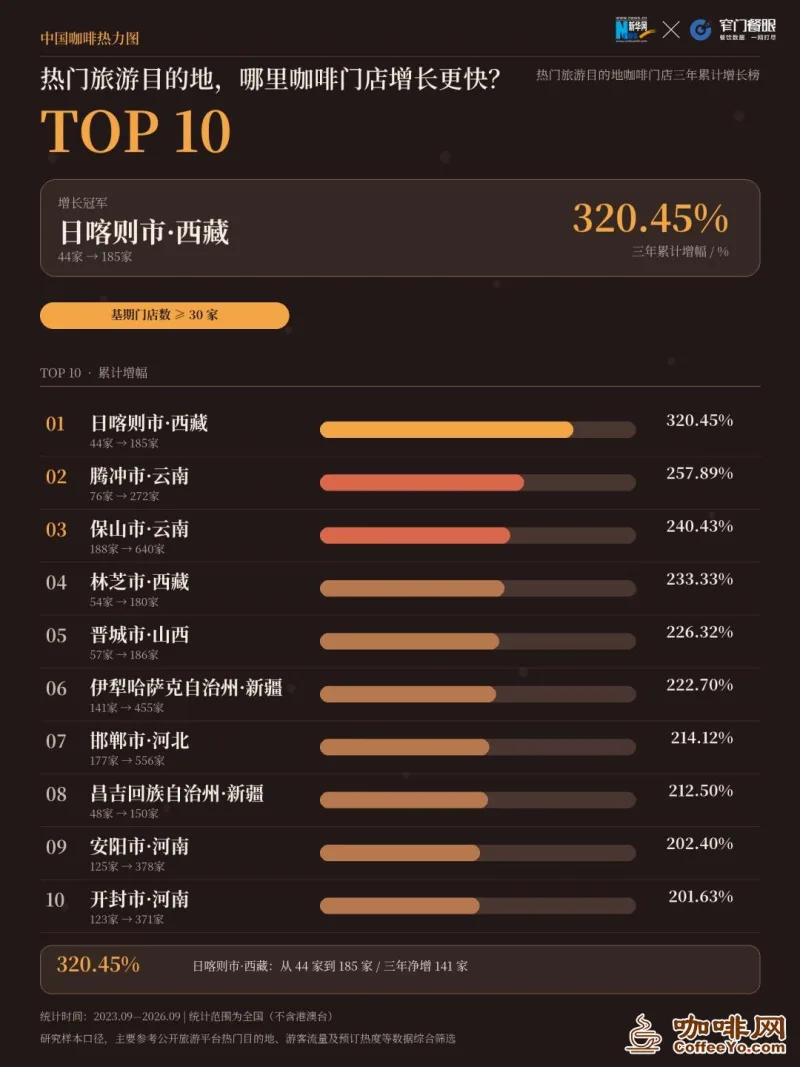
The growth ranking tells a different story: Shigatse grew 320.45 percent in three years, Tengchong 257.89 percent, Baoshan 240.43 percent and Nyingchi 233.33 percent. These cities started from a relatively small base and grew quickly, reflecting how coffee supply is extending to more destinations.
In tourist destinations coffee shops serve both local residents and visitors’ needs while sightseeing, resting and changing transport. Some stores become resting spaces for experiencing local scenery and culture, while others let visitors conveniently buy a familiar coffee on the way.
Luckin Coffee’s distinctive stores reflect these needs: a treehouse store in a Wuyuan valley and a Tibetan-style lounge store beside the Jokhang Temple in Lhasa echo natural scenery and local culture respectively, while the store at the Beijing Universal Resort metro station makes it easy for visitors to buy coffee as they arrive or leave.
From a pause between sights to an everyday drink on the journey, coffee is blending into the travel experience in different ways.
5. Industrial Support: Store Density, Supply Chain Efficiency and Scene Penetration
Coffee’s entry into daily life rests on industrial capability.
Taking Luckin as a sample: by the second quarter of 2026 it had 36,310 stores worldwide and 112.7 million average monthly transacting customers, including more than 7,400 stores in county-level areas covering 1,550 counties and county-level cities.
Store density is itself a kind of “everyday infrastructure”. When a coffee shop is embedded in all kinds of life scenes, consumers can have a cup whenever they want.
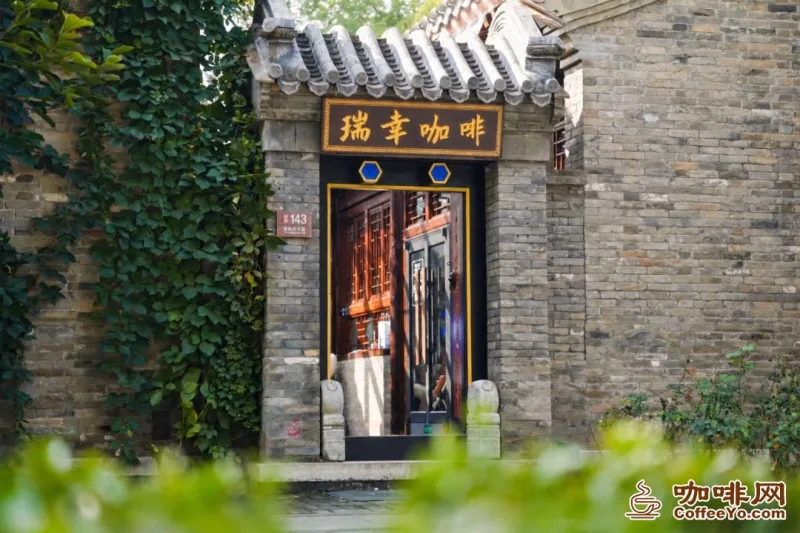
Luckin has signed with Suzhou Metro to open no fewer than 100 metro stores within two years, and with Xiamen Rail Transit Group to open a first batch of 16 covering metro and BRT stations, transit-oriented developments and industrial parks. Embedding stores in commuting routes turns coffee into a purchase made on the way.
The supply chain is another layer of support. In the 2026 crop year Luckin purchased 33,000 tonnes of green coffee in Yunnan for close to 2 billion yuan, with first-grade beans accounting for about half the province’s output of first-grade beans. The dedicated “Luckin Train” for green coffee runs from Pu’er in Yunnan, linking producing areas with roasting bases.
Luckin Coffee has now formed a roasting supply matrix across Qingdao, Pingnan, Kunshan and Xiamen (under construction), with total capacity expected to exceed 155,000 tonnes, a record for roasting capacity in China’s coffee industry.
The point of this supply chain layout is to turn coffee from an occasional novelty into a stable, available everyday purchase. Whether in a Shanghai office tower or a county town in Tengchong, consumers can drink products made to the same standard.
For coffee chains, opening stores further away is only the first step; whether they can consistently deliver stable quality across cities and stores determines whether a cup of coffee can truly enter consumers’ daily lives.
Product innovation adapts to more people’s tastes. As demand diversifies, Luckin keeps meeting consumers’ needs with innovations such as its Baida card health products and all-ice, no-water drinks.
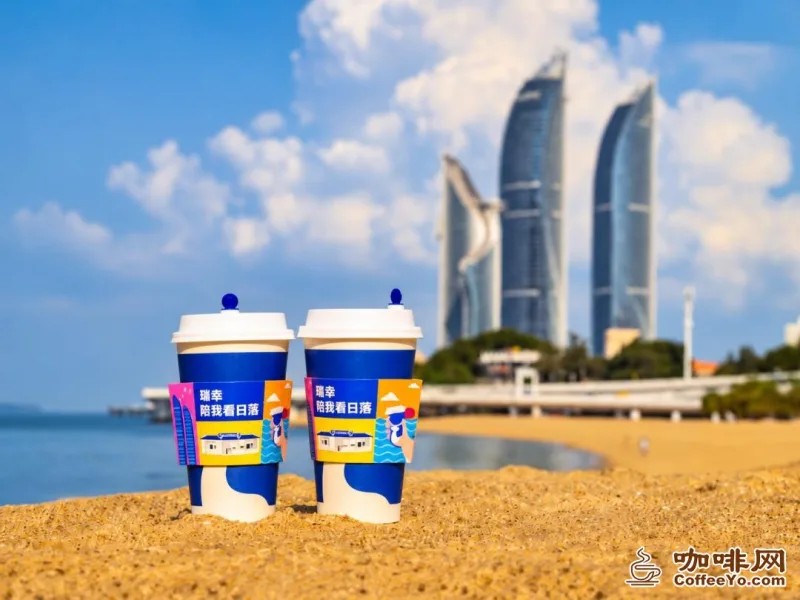
Data show that China sold about 11 billion cups of freshly ground coffee in the past year, of which Luckin sold about 4.1 billion: for every three cups of freshly ground coffee Chinese consumers buy, one comes from Luckin.
During the National Day holiday just past Luckin’s cup sales exceeded 100 million. Behind that strong figure is the combined effect of continuous product innovation, a store network reaching cities and countryside, an efficient supply chain and vigorous holiday demand.
These figures show that China’s coffee market is in a phase of rapid development, that demand keeps being released and that coffee is becoming part of daily life faster, with plenty of potential still to unlock.
Standardised products, sustained product innovation, a mature supply chain and a leading store scale are together pushing coffee from a niche hobby into a mass habit.
Conclusion
What matters most in these figures is not only 107,000 net new stores in three years, or county stores outnumbering those in new first-tier cities, but that coffee is moving from a trend in big cities into daily life in many more towns.
The expanding radius of coffee consumption reflects the continuing resonance between chains’ store networks, supply chain capability and consumer demand.
Over the past few years leading chains have kept extending into city business districts, communities, counties and townships and tourism scenes, making buying coffee ever more convenient.
The store networks, high-quality supply chains, standardised operations and product innovation of brands such as Luckin have also played a part, both raising coffee’s availability and supporting consistent quality across regions and richer consumer choice.
This article comes from the WeChat public account “Kuaimen” (ID: KamenClub), author Yan Zi, published by 36Kr with authorisation.
Reprint Notice & Disclaimer
- This article was edited and compiled by coffeeyo.com. The information and images come from public channels and the copyright belongs to the original authors. This reprint is for coffee-industry information sharing only and does not represent the site’s position; all data and views are subject to the original. We thank the original authors for their work and sharing.
- If you have questions regarding authorization, attribution, copyright, or any other matter, please contact us promptly and we will verify and cooperate. We also welcome coffee-producing regions, brands and industry media to exchange story leads with us.
- Contact coffeeyo.com: Tel 400-0000-641 (+86-18288016826) | Email 405854472@qq.com | Address: Jinghong City, Xishuangbanna, Yunnan Province / Tieling City, Liaoning Province
Related Reading
 ‘All-Ice’ Coffee Goes Viral! Will the Next Hit Be Your Personal Favorite?
- Hong Kong’s Dyee Coffee Lands in Qianhai, Building a Specialty Pour-Over Outpost
 Ken Yue Coffee Opens Egg-Tart Pop-Up in Hangzhou: Sweet Craft, Reinvented Classics
 World Cup Enters the Breakfast Slot: Can Coffee-Tea Brands Turn Traffic into Orders?
- ICE Agricultural Futures Mostly Rise at Close; Coffee Futures Up 3.28%
- ‘Sleep Cafés’ Become a New Favorite Among Seoul Office Workers




 Liaoning ICP Security No. 21122402000217