
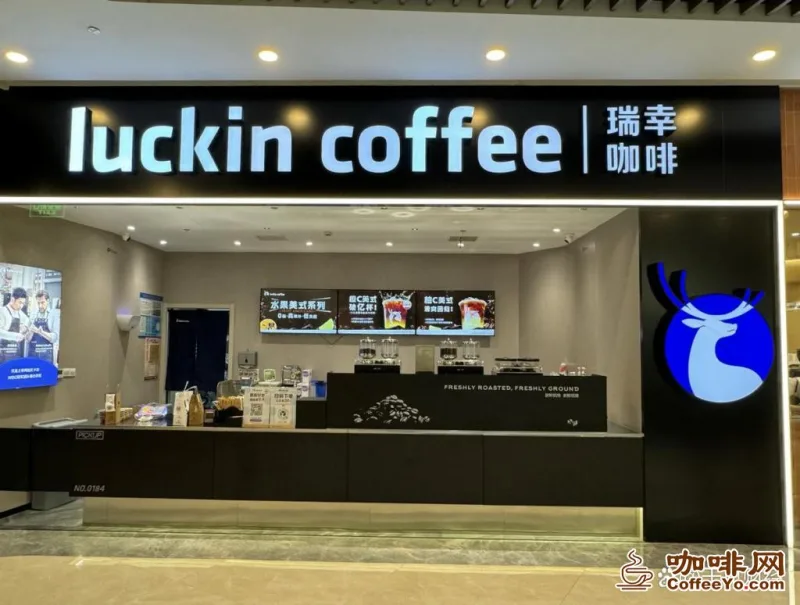
How big a business can one cup of coffee support? Luckin Coffee’s latest answer: total net revenue of 27.881 billion yuan in the first half of 2026, more than 38,000 stores worldwide and over 500 million customers served to date. It is hard to imagine that this is a company which, only a few years ago, was mired in crisis and widely written off.
The man who lifted it out of the ruins is Luckin’s co-founder and chief executive Guo Jinyi. This low-key leader rarely appears under spotlights, yet report after report beating market expectations has made Luckin a rare turnaround case in Chinese business history.
27.8 Billion Yuan in Revenue on 36,000 Stores
In the second quarter of 2026 Luckin posted total net revenue of 15.886 billion yuan, up 28.5 percent year on year and about 460 million yuan above market consensus. For the half year, revenue reached 27.881 billion yuan, up 31.4 percent. Profitability was equally solid: GAAP net profit in the second quarter was 1.486 billion yuan, up 16.1 percent, operating profit was 2.123 billion yuan, and the operating margin recovered to 13.4 percent, a steadily stabilising curve of earnings repair.
What supports these results is a dense store network. By the end of the second quarter Luckin had 36,310 stores worldwide, including 23,625 self-operated stores and 12,462 partnership stores.
In the second quarter alone it added a net 2,714 stores, and more than 5,000 in the first half, an average of nearly 30 new stores a day. By the end of September the number had risen further to more than 38,000.
What does that mean? Across the global freshly made coffee industry, very few brands can achieve this level of store density in a single market.
The denser the stores, the closer the users: a plain principle Guo Jinyi has proved again and again.
In the second quarter Luckin’s average monthly transacting customers reached 113 million, up 22.9 percent year on year and a record high, with more than 25 million new transacting customers in the quarter. Stores within a few hundred metres turn many orders that once relied on delivery into pickup orders, and the delivery expense ratio fell 3.3 percentage points year on year to 10.2 percent.
Scale did not dilute efficiency but spread costs: overall gross margin reached 61.5 percent in the second quarter and the store-level operating margin of self-operated stores reached 21.3 percent.
Observers once worried that Luckin’s growth was built on 9.9-yuan subsidies. The second-quarter results answered that directly: with subsidies clearly tapering off, the actual average ticket rose slightly while the user base grew rather than shrank. Consumers stayed not because it was cheap but because it is convenient, good to drink and within reach.
Price can buy a first try, but it cannot buy 113 million monthly repeat customers. Guo Jinyi understands that better than anyone.
Behind the Hits, a Digital Engine
Luckin’s stores are the skeleton; products are the blood.
In the second quarter alone Luckin launched 28 freshly made drinks and more than a dozen light meals.
The Little Butter Americano went viral again thanks to a customer-invented way of drinking it, ranking among the top two single products, and the Little Butter series has passed 500 million cups. The year’s flagship launch, the Little Green Mandarin Americano, sold more than 10 million cups in its first week.
To date 25 Luckin products have passed 100 million cumulative sales, five of them outside coffee, with new series such as yogurt shakes and iced milk extending the business from coffee to all-day drinks.
The hits look accidental but are the inevitable result of an industrialised approach.
Since its first day Luckin has been a company driven by data. From site selection and product choice to pricing and replenishment, every step runs inside the system.
Data captures subtle changes in consumer taste, and the R&D side can respond at maximum speed. Coconut-based drinks, fruit coffee, tea coffee: Luckin has hit the mark in almost every round of category innovation.
The Fresh Brewed Light Jasmine launched in the first quarter of this year sold a record 1.67 million cups in a single day, a new record for a single tea drink.
Worth noting is the quieter thread of health. In R&D Luckin applies a “four add, four reduce” principle: add freshness, nutrition, function and experience; reduce burden, calories, fat and sweetness. It has also built a coffee health innovation base with the Peking University Health Science Centre, with more than thirty research projects approved.
In June this year Luckin, together with Xinhuanet and the Peking University Health Science Centre, published an analysis of health trends in China’s freshly made drinks, turning health from marketing language into academic backing. At the end of April Luckin also reached into the ready-to-drink segment, formally launching bottled coffee products and eyeing a new slice of the shelf.
Many companies study Luckin’s store-opening speed and frequency of collaborations, but what they cannot copy is the underlying digital system.
During the company’s hardest period Guo Jinyi chose to cut marketing and focus relentlessly on products and the supply chain. In hindsight that was the watershed that separated Luckin from other coffee brands.
While others were still burning money for traffic, Luckin had already put the cost, workflow and taste of every cup into an algorithm.
From Singapore to New York: Chinese Coffee Starts Exporting Answers
The ceiling at home is still far away, but Guo Jinyi’s horizon is already overseas.
By the end of the second quarter Luckin had 223 overseas stores: 89 self-operated in Singapore, 20 self-operated in the United States and 114 franchised in Malaysia. On 28 September Luckin opened its 100th store in Singapore; about three years after entering the market, Singapore has become the first proof that the Luckin model can be replicated, and it is profitable. Malaysia is advancing through regional franchising and passed one hundred stores in little more than a year.
Most closely watched is the United States.
At the end of June 2025 Luckin chose Manhattan in New York for its first US step, positioning the first stores precisely for urban white-collar workers, students and international tourists. Opening a store at the doorstep of Starbucks’ home base is a picture full of symbolism in itself.
More than twenty years ago Starbucks brought coffee culture to China; more than twenty years later a Chinese company is exporting in the other direction with digital operations and extreme efficiency. Wall Street media have described Luckin in their coverage as a rare recovery case in Chinese business history.
Going overseas, of course, is not copy-pasting domestic stores.
New York, with its high labour and rent costs, has a completely different cost structure. Luckin’s approach is steady: first make the single-store model work, build up standardised and replicable operating experience, and only then talk about scaling. This restraint reflects the maturity of the management.
Guo Jinyi said plainly at the results meeting that the company will keep building on existing markets, keep refining the single-store economic model and lay a solid foundation for further international expansion.
No recklessness, no showing off, get the numbers right first: that is the clarity of someone who has been through great ups and downs.
Looking back, Luckin’s recent years are almost a condensed history of the evolution of Chinese new consumption: from lightning expansion to falling to the bottom, from painful surgery to a return to the top, and now to 38,000 stores, 27.8 billion yuan of revenue in half a year and 113 million monthly transacting customers. Luckin has proved with hard results that as long as you make good products, raise efficiency and keep users at heart, the market will give a fair return.
Behind it, chairman Li Hui safeguards the capital side while Guo Jinyi directs operations on the front line; the pairing gives Luckin both drive and steadiness.
The story of China’s coffee market is far from over, and Luckin, with 38,000 stores in hand, and the people steering it are clearly ready to write the next chapter.
Produced by: Yu Jian column, Chaoqi Net
Reprint Notice & Disclaimer
- This article has been edited and compiled by coffeeyo.com and reprinted from Sina, “278 Billion Yuan from One Cup of Coffee: How Guo Jinyi Made Luckin’s Business Add Up”. The copyright of the original text belongs to Sina and the original author. This reprint is intended solely for information sharing within the coffee industry and does not represent the views of this website; all data and opinions are subject to the original article. Our thanks to the original author for creating and sharing it.
- Read the original: Sina, “278 Billion Yuan from One Cup of Coffee: How Guo Jinyi Made Luckin’s Business Add Up”
- For matters concerning content licensing, attribution, copyright or otherwise, please contact us promptly and we will verify and cooperate in handling them as soon as possible.
- Contact coffeeyo.com: Tel 400-0000-641 (+86-18288016826) | Email 405854472@qq.com | Address: Jinghong, Xishuangbanna, Yunnan Province
Related Reading
 ‘All-Ice’ Coffee Goes Viral! Will the Next Hit Be Your Personal Favorite?
- Hong Kong’s Dyee Coffee Lands in Qianhai, Building a Specialty Pour-Over Outpost
 Ken Yue Coffee Opens Egg-Tart Pop-Up in Hangzhou: Sweet Craft, Reinvented Classics
 World Cup Enters the Breakfast Slot: Can Coffee-Tea Brands Turn Traffic into Orders?
- ICE Agricultural Futures Mostly Rise at Close; Coffee Futures Up 3.28%
- ‘Sleep Cafés’ Become a New Favorite Among Seoul Office Workers



 Liaoning ICP Security No. 21122402000217