
An outside look at the money. In recent years China’s fresh-brewed coffee segment has left its niche past behind entirely and entered a burst of mass-market adoption.
The coffee market, once monopolized by foreign brands such as Starbucks, has long since changed. Three homegrown leaders have risen powerfully, completely rewriting the competitive landscape of China’s coffee industry.
According to the 2026 list of China’s Top 500 Private Enterprises, Luckin made the cut on the strength of its nearly 49.3 billion yuan in 2025 revenue, climbing 139 places — one of the biggest jumps on the list — a clear showcase of domestic coffee’s brand strength.
Meanwhile Cotti won the Annual Chain Coffee Brand award, and Lucky Cup, rooted in the down-market tier, rolled out a guofeng (national-style) IP campaign with Henan TV, winning consumers with an approach close to everyday life.
Last year China’s coffee market surpassed 210 billion yuan, and the structure is shifting markedly: foreign brands’ share is shrinking, while domestic players led by Luckin, Cotti and Lucky Cup are capturing the market through differentiation.
36,000 stores and a crushing lead — an unfathomable moat!
Luckin has abandoned rough-and-ready expansion in favor of refined, high-quality scale growth, holding its leading position with multi-layered core barriers.
Its nationwide store network is evenly distributed, creating a scale advantage the industry cannot easily replicate.
Luckin has outlets across the country, now exceeding 36,000 stores — over 35,000 within China — spread across 347 cities, forming an enormous advantage. Data-driven intelligent site selection and balanced distribution across city tiers greatly improve the brand’s overall operational stability and risk resistance.
Full-chain digital operations are in place, accumulating a massive base of sticky users.
Luckin’s cumulative transacting users now approach 500 million, a huge user base. Ordering, dispatch, user-profile analysis and product iteration are all managed through end-to-end digital processes. Moreover, Luckin has read young consumers’ psychology, collaborating across trendy cultural elements to build a series of brand personas that lock onto its core audience.
An autonomous supply-chain matrix has taken shape, with industry-academia collaboration fueling continuous product innovation.
Luckin has built intelligent roasting bases in multiple locations; four major bases working in concert form a leading domestic coffee-roasting supply chain. In the health-beverage space, Luckin has partnered with renowned universities to build health-innovation bases and develop products better suited to the human body. Riding its own innovation, hits such as the “small butter” line have passed 500 million cups, steadily anchoring the mass-market mindshare.
Yet as Luckin expands rapidly, its operational problems are also emerging.
With thousands of affiliated stores across the country, it is hard to keep standardized output, in-store service and staff training 100% consistent; some consumer-complaint incidents earlier stemmed precisely from an imperfect store-control system. In addition, slowing same-store growth at company-operated outlets reflects that, as stores approach saturation, finding the balance between scale growth and per-store profitability has become a key challenge Luckin must now face.
16,000 stores in close pursuit — the affiliate model goes wild!
With a value-for-money, high-quality positioning, a global brand footprint and a flexible affiliate model, Cotti has broken out fast in a red ocean, standing toe-to-toe with Luckin in a close-run contest.
Binding top-tier international resources to build a one-of-a-kind global brand label.
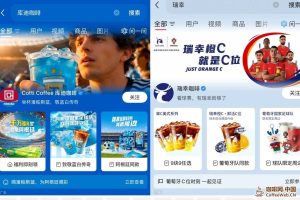
Since its founding Cotti has pursued a globalization strategy, with operations across dozens of countries on six continents and store counts consistently among the world’s three largest coffee chains. Through partnerships with the World Cup, national teams and major international sporting events, Cotti has raised its international profile, forming a competitive edge distinct from its peers.
A modern supply-chain base has landed, and product quality has won international authority recognition.
Cotti poured heavy investment into a large integrated supply-chain center with professional roasting, warehousing and logistics systems; its huge production capacity meets the daily supply needs of stores nationwide, guaranteeing raw-material consistency and stability at the source. The brand’s coffee has also taken gold at international cupping competitions several times, earning global industry recognition on quality.
High-density down-market expansion achieves full coverage of cities nationwide.
Riding a low-barrier, high-flexibility affiliate model, Cotti targets the industry’s white-space markets, focusing on prefecture-level and county-level cities where Luckin’s coverage is thin. Cotti reaches 358 cities — the highest city coverage in the industry — with many stores competing shoulder-to-shoulder against Luckin, making it the fiercest incumbent rival in China’s coffee race.
The rapid franchise-expansion model has brought Cotti scale velocity while also planting many hidden risks.
This year its store-opening pace has slowed, and in some places closures outnumber new openings — a sign that franchisee profitability is falling and store attrition is accelerating. In addition, weak in-store material control and an immature standardized franchisee-training system expose gaps in Cotti’s terminal-management system.
Lucky Cup is a brand under Mixue, holding a place in the value-for-money, high-quality coffee niche of down-market tiers. Relying on its parent’s mature supply chain and rich offline operating experience, it has rapidly captured the low-tier-city coffee market.
Sharing Mixue’s full-domain supply chain, it compresses costs to the extreme while safeguarding quality.
Lucky Cup shares Mixue’s five major production bases and dozens of warehouses, building a fast distribution system from origin to consumer nationwide. Backed by the parent’s billions in supply-chain investment, its raw-material supply speed and procurement cost lead the industry, giving strong support to its high-quality, low-price strategy.
A top-tier celebrity matrix empowers an all-around brand-image upgrade and breakthrough.
Lucky Cup signed both a seasoned best-actor and a top female star as dual endorsers, investing heavily in marketing and in upgrading store hardware. On one hand it has broadened its target audience to include young university students and adult consumers; on the other it has improved the offline consumption environment, gradually shedding the low-end, niche label and moving toward a mass-market, high-quality coffee brand.
It has raised product-making standards, using fresh fruit and fresh milk to reinforce product strength.
Lucky Cup set a “three-fresh, one-freshly-made” product standard, upgrading key ingredients across the board — short-shelf-life coffee beans, refrigerated fresh milk, and fruit picked straight from the orchard — guaranteeing the quality and taste of its coffee drinks. It has also launched a premium selection store format, opening new shops in the centers of tier-1 and tier-2 cities to pursue the brand’s path of progress.
Long deep cultivation of the down-market has let Lucky Cup scale up fast, but also formed a hard-to-break development straitjacket.
Over 70% of its stores sit in tier-3, tier-4 or smaller cities, with very low penetration in tier-1/2 cities and little room left to grow. In addition, the marketing team’s inexperience has shown in some past campaigns handled clumsily or with poor calibration, so its refined operations still need improvement.
The three-way showdown — what is the ultimate answer?
After years of land-grabbing and price wars, China’s coffee market has formed a “one superpower, many strong” pattern led by Luckin. These three domestic brands rose by different paths, yet together they hold most of the industry’s share.
Luckin’s core competitiveness comes mainly from scale effects, digital capability and supply-chain strength; its future focus is stabilizing its base, raising per-store earnings, and moving toward premium, professional and international to hold its lead.
Cotti relies on its global brand advantage and flexible partnership model to fix problems in its franchise system and lift franchisee profitability, thereby securing its existing market and improving terminal operations.
Lucky Cup leverages Mixue’s supply and distribution and the down-market characteristic to raise its brand premium and improve its demand structure, gradually entering the mid-tier market.
With the price-subsidy war over, the coffee market has ended its extensive expansion phase; competing on production efficiency, product quality and a distinctive brand image has become the most important arena.
Conclusion
Luckin with refined digital operations, Cotti going abroad, Lucky Cup rooted at home — the three brands’ competitive trajectories bear witness to the historic shift of China’s coffee market from foreign dominance to domestic brands holding the industry’s voice.
In the short cycle, store management, per-store profitability and brand upgrade are the three passes each brand must break through; in the long cycle, only by holding to a product’s essence, honing one’s own core capability and forming a distinct character can a brand keep its lane in an oligopolistic contest.
As domestic coffee brands keep renewing themselves, Chinese coffee will not only keep cultivating the home market but gradually go abroad, spreading worldwide and achieving the leap from domestic rise to global export, opening a new era for Chinese coffee.
Reprint Notice & Disclaimer
- This article has been edited and compiled by China Coffee Network. The information and images therein come from public sources and the copyright belongs to the original author. This reprint is intended solely for information sharing within the coffee industry and does not represent the views of this website; all data and opinions are subject to the original article. Our thanks to the original author for creating and sharing it.
- For matters concerning content licensing, attribution, copyright or otherwise, please contact us promptly and we will verify and cooperate in handling them as soon as possible. We also welcome coffee origins, brands and industry media to exchange ideas and contribute articles.
- Contact China Coffee Network: Tel 400-0000-641 (+86-18288016826) | Email 405854472@qq.com | Address: Jinghong, Xishuangbanna, Yunnan Province / Tieling, Liaoning Province
Related Reading
 ‘All-Ice’ Coffee Goes Viral! Will the Next Hit Be Your Personal Favorite?
- Hong Kong’s Dyee Coffee Lands in Qianhai, Building a Specialty Pour-Over Outpost
 Ken Yue Coffee Opens Egg-Tart Pop-Up in Hangzhou: Sweet Craft, Reinvented Classics
 World Cup Enters the Breakfast Slot: Can Coffee-Tea Brands Turn Traffic into Orders?
- ICE Agricultural Futures Mostly Rise at Close; Coffee Futures Up 3.28%
- ‘Sleep Cafés’ Become a New Favorite Among Seoul Office Workers



 Liaoning ICP Security No. 21122402000217