
Coffee is completing its identity shift from “niche trial” to “mass daily.” The “Coffee Drink Category Development Report 2026” by Hongcan Industry Research Institute shows China’s coffee drinkers exceed 550 million, per-capita annual cups grew 1.7× in two years, and the ready-to-drink coffee market is projected to reach 159 billion yuan in 2026. Based on the report’s public data, this article analyzes the structural changes in China’s coffee-consumption market.
The big picture: 550 million drinkers and “1.7× in two years”
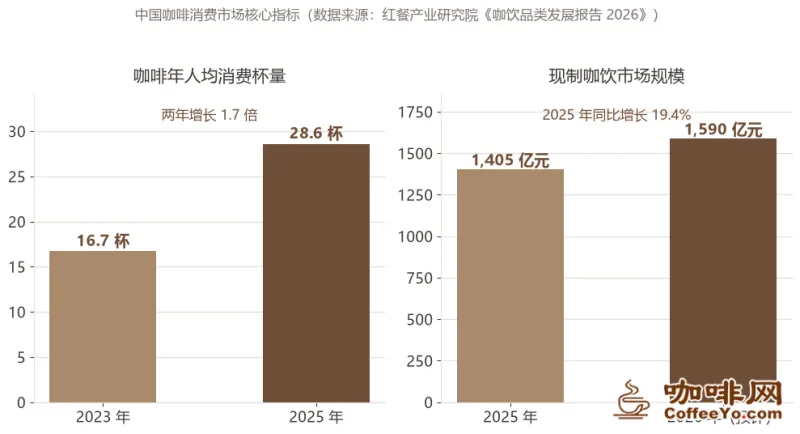
As of 2026, China’s coffee drinkers exceed 550 million. The more critical metric is frequency: per-capita annual cups rose from 16.7 in 2023 to 28.6 in 2025—a 1.7× increase over two years. From the 2018–2024 coffee crop years, China’s consumption CAGR reached 12.4%, versus just 0.6% globally—China’s growth is about 20× the global average.
In total, from October 2025 to September 2026, China’s coffee consumption is projected at 6,420 thousand bags (about 385,000 tonnes). Whether by cups, people, or volume, China is in an accelerating penetration phase.
Market size: 159 billion yuan and 284,000 stores
Per Hongcan big data, the 2025 ready-to-drink coffee market reached 140.5 billion yuan, up 19.4% YoY; 2026 is projected at 159 billion yuan. Supply-side expansion keeps pace with demand: as of June 2026, national coffee-drink stores reached 284,000, up 20.1% YoY, with chain rate 47.3%, up 7.8 percentage points YoY. Store growth (20.1%) exceeds market-size growth, meaning average per-store revenue is diluted—the industry is shifting from “store-opening dividend” to “operational-efficiency” competition.
Scenario fission: from business-social to all-daytime penetration
Ready-to-drink coffee consumption scenarios are breaking the traditional business-social boundary, penetrating office, commute, breakfast, and meal-pairing; the consumer base has expanded from early white-collar to students, blue-collar, and even the silver-haired. On price, per-cup spend has dropped to about 25 yuan; low-price convenient coffee and 30-yuan-plus specialty coffee each form stable clienteles, with the mid-price band the fiercest battleground.
Competitive landscape: multiple players participate
The coffee-drink track has formed a pattern led by coffee-drink brands, with tea brands, other food-service brands, convenience stores, and unmanned self-service coffee machines all participating. The competitive focus has shifted from store scale to back-end capability: supply-chain integration, packaging-tech innovation, and digital operations become core barriers; on the product side, localization and functionalization trends emerge, with tea-coffee fusion and wellness functional coffee moving from marketing concepts to permanent product lines.
Judgment: increment remains, logic has changed
Synthesizing the report data yields three judgments: first, room for China’s coffee-consumption “volume growth” remains, as per-capita cups still trail mature markets; second, the industry’s growth engine is switching from store expansion to repurchase and efficiency, with chain rate up nearly 8 points in a year reflecting this; third, lower-tier markets and multi-scenario channels are the next-phase main increment. For practitioners, capturing structural change matters more than chasing total numbers.
Sources: Hongcan Industry Research Institute, “Coffee Drink Category Development Report 2026” (released August 2026) and public interpretations.
This article is original compilation by coffeeyo.com. Data herein are subject to the report’s public content and are for industry reference only, constituting no investment or operational advice.
Original Statement
- This article is an original work of coffeeyo.com. Without authorization, no media, website, or individual may reproduce, extract, copy, or use it by other means; violators will be held legally responsible.
- Images, charts, and videos herein are originally shot or produced by coffeeyo.com and bear copyright watermarks; copyright belongs to coffeeyo.com.
- For reprint authorization, commissioned writing, interviews, or business cooperation, contact: Tel 400-0000-641 (+86-18288016826) | Email 405854472@qq.com | Address: Jinghong City, Xishuangbanna, Yunnan Province / Tieling City, Liaoning Province
Related Reading
 ‘All-Ice’ Coffee Goes Viral! Will the Next Hit Be Your Personal Favorite?
- Hong Kong’s Dyee Coffee Lands in Qianhai, Building a Specialty Pour-Over Outpost
 Ken Yue Coffee Opens Egg-Tart Pop-Up in Hangzhou: Sweet Craft, Reinvented Classics
 World Cup Enters the Breakfast Slot: Can Coffee-Tea Brands Turn Traffic into Orders?
- ICE Agricultural Futures Mostly Rise at Close; Coffee Futures Up 3.28%
- ‘Sleep Cafés’ Become a New Favorite Among Seoul Office Workers



 Liaoning ICP Security No. 21122402000217