
Abstract:At Fazenda Camocim in the mountains of Espírito Santo, south-eastern Brazil, hundreds of thousands of coffee trees grow inside the Atlantic rainforest. After more than thirty years of replanting to restore the land, the farm tried coffee; today about 70 hectares of arabica share the hillside with citrus, palms and chamomile in a multi-layered agroforestry system. A local bird known as “jacu” eats only the ripest cherries and has become, in the farm’s words, the rainforest’s strictest “coffee selector”.
Rio de Janeiro, 12 October (Xinhua) — By Xinhua reporters Lu Junyu, Zhou Yongsui and Wu Nian.
In late September, spring has come to the mountains of Espírito Santo in south-eastern Brazil, and the warmth of the southern hemisphere has turned the highlands around Domingos Martins green. Fazenda Camocim, cradled by the Atlantic rainforest, is home to hundreds of thousands of coffee trees. High in the liquidambar canopy, pairs of jacu birds — dark brown all over, with a touch of red at the throat — hop from branch to branch.
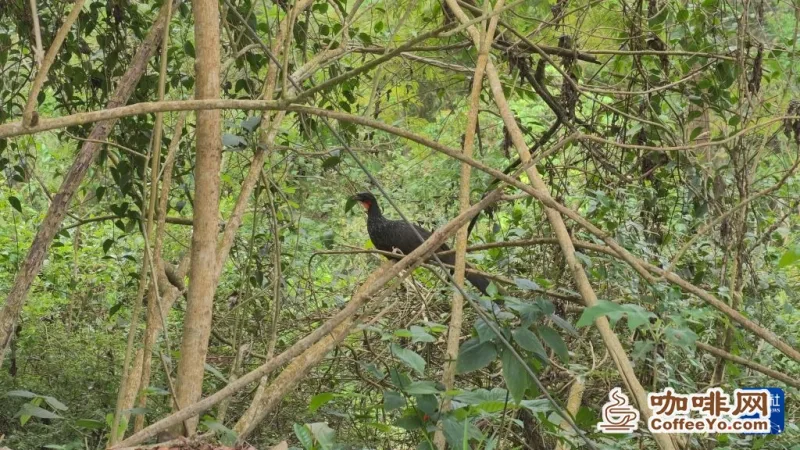
A jacu bird at Fazenda Camocim, Espirito Santo, Brazil, 25 September (Xinhua/Wu Nian)
“Jacu” is the Brazilian name for the guan. Shaped rather like a pheasant and living on fruit, it ranges widely across Latin America and is a native of the rainforest as well as a key species for dispersing seeds. Yet large-scale logging and land clearing over the last century damaged the rainforest ecosystem, and the jacu gradually disappeared.
To restore the soil and improve the environment, Fazenda Camocim began planting trees. Along with continued care for native species, it brought in eucalyptus, Brazilian araucaria and liquidambar.

Jacu coffee being prepared on site in Espirito Santo, 25 September (Xinhua/Wu Nian)
More than thirty years after the planting began, the farm found the temperature and humidity of the hillside suited coffee and tried it. Today about 70 hectares of arabica grow among the trees. Citrus and palms are scattered through it, chamomile and other herbs spread across the ground, and tree, shrub and herb layers interweave into a multi-storey agroforestry system.

Farm manager Rogerio sorting coffee beans in Espirito Santo, 25 September (Xinhua/Wu Nian)
Farm manager Rogerio told reporters that in the face of heat and drought brought by climate change, these plants shade the sun, conserve water and attract birds and beneficial insects. Their fallen leaves and fruit also make natural compost and bio-preparations that replace chemical fertiliser and pesticides. “In our region agroforestry is very important. The trees are the coffee’s natural partners: they protect it from cold, strong wind, excess moisture, pests and disease.”
Year after year, as the trees grew and the coffee fruited, the jacu came back. But their first return was a headache: they were always first to notice that the coffee was ripe, and they ate only the reddest, sweetest cherries. “Yet it was exactly this habit of eating only the best fruit that let us connect the jacu with specialty coffee,” Rogerio says. These picky birds became, unexpectedly, the rainforest’s strictest “coffee selectors.”

Coffee beans grown at Fazenda Camocim, Espirito Santo, 25 September (Xinhua/Wu Nian)
Inspired by Indonesian civet coffee, farm owner Henrique studied the jacu’s habits and began collecting and processing the beans from its droppings to produce a completely new organic specialty coffee. On the farm’s drying yard, the collected beans are spread evenly on raised mesh beds.
“It looks rather like Brazilian peanut brittle — you can see the whole beans clearly,” Rogerio says, picking up a handful and then turning the beans vigorously. Passing through the bird’s digestive tract, the beans undergo enzymatic breakdown, and both bitterness and caffeine content fall. Dried naturally in air and sun with regular turning, the finished coffee carries floral notes and a soft fruit acidity. With an annual output of just one to two tonnes, jacu coffee is now among the most expensive in Brazil at 1,600 reais (“about US$320”) per kilogram — more than ten times the price of ordinary Brazilian specialty coffee — and is exported to Europe, North America and Asia.
Rogerio notes that of the farm’s roughly 300 hectares, less than a quarter is actually planted to coffee. “For us what matters is natural and pollution-free. Beyond the land we farm for coffee, we also plan to build a rural community on the remaining plots, so people can immerse themselves in the farm’s natural atmosphere and taste coffee.”
Reproduction Notice & Disclaimer
This article was compiled and reprinted by China Coffee Network from Xinhua “Reporter’s Notebook: The "Coffee Selectors" of the Rainforest – Visiting an Eco Coffee Farm in Brazil”. All rights in the original work belong to Xinhua and its author. China Coffee Network reproduces it solely to share information within the coffee industry; it does not represent our editorial position, and all data and views are those of the original. Our thanks to the original author for the work and for sharing it.
Read the original: Xinhua “Reporter’s Notebook: The "Coffee Selectors" of the Rainforest – Visiting an Eco Coffee Farm in Brazil”
For matters of authorization, attribution, copyright or otherwise, please contact us at any time and we will verify and cooperate promptly. Coffee origins, brands and industry media are also welcome to write for us.
China Coffee Network contacts: Tel 400-0000-641 (+86-18288016826) | Email 405854472@qq.com | Address: Jinghong, Xishuangbanna, Yunnan / Tieling, Liaoning, China
Reprint Notice & Disclaimer
- This article has been edited and compiled by China Coffee Network. The information and images therein come from public sources and the copyright belongs to the original author. This reprint is intended solely for information sharing within the coffee industry and does not represent the views of this website; all data and opinions are subject to the original article. Our thanks to the original author for creating and sharing it.
- For matters concerning content licensing, attribution, copyright or otherwise, please contact us promptly and we will verify and cooperate in handling them as soon as possible. We also welcome coffee origins, brands and industry media to exchange ideas and contribute articles.
- Contact China Coffee Network: Tel 400-0000-641 (+86-18288016826) | Email 405854472@qq.com | Address: Jinghong, Xishuangbanna, Yunnan Province / Tieling, Liaoning Province
Related Reading
 How ‘Sea-Flavored’ Coffee Blooms Across Dongtou
- Health Guide: How to Enjoy Your Coffee the Healthy Way
 Study: Regular Coffee and Tea May Lower Dementia Risk, but More Is Not Better
 Frontline Story: A ‘Mobile City Coffee Bar’ Arrives by the Grand Canal
 Yantai’s Wind Tastes of Coffee
 In Zhenyuan, a Cup of Coffee and a Waiting Train






 Liaoning ICP Security No. 21122402000217