
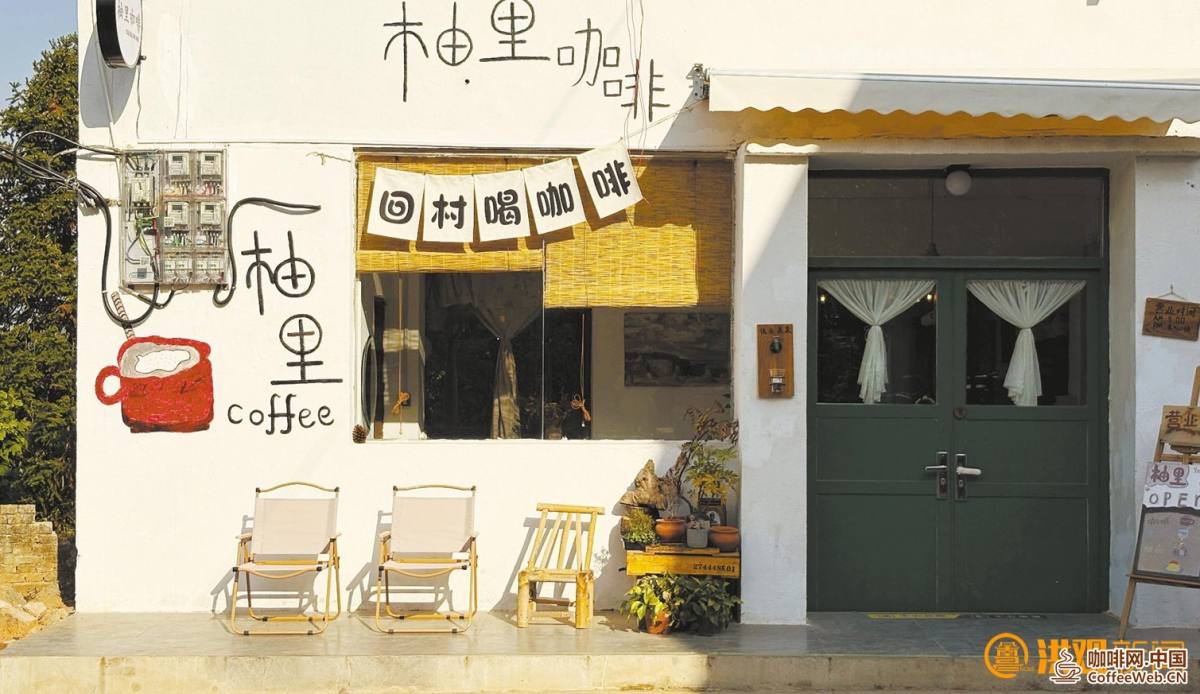
The once idle farmhouses, dilapidated cowsheds, and cluttered warehouses are now quietly awakened by the rich aroma of coffee. In recent days, reporters have visited multiple rural areas in Nanchang and found that the blooming rural cafes have become the new trend landmark of rural tourism in Nanchang.
Pomelo coffee
Old house new life:
Idle farmhouses become the top trend for check-in
On an ordinary weekend afternoon in early June, the "577 Space" located in Weidong Village, Zhaoxian Town, Wanli Management Bureau was crowded with people. This "village caf é" is located at the foot of Meiling Mountain, with terraced fields layered in the distance, misty mountains and clear scenery, full of poetry.
Many young people shuttle between wooden corridors and floor to ceiling glass windows, searching for the best check-in angle. I came across this' village caf é 'online and specifically brought my family from the city. Compared to delicious coffee, the natural scenery here is even more stunning, "said citizen Zhou Lili with a smile.
Song Min, the manager of "577 Space", told reporters that this was originally an abandoned warehouse filled with miscellaneous items and firewood. In early 2024, he rented this old house and started renovating it himself, painting the walls, laying stones, and building a wooden corridor, gradually transforming the abandoned space into its current appearance.
At first, the villagers around didn't understand and spent money here 'fooling around', "Song Min recalled. Nowadays, this "village caf é" has become a scenic spot in the mountains, and even on weekdays, it is extremely popular. In the season when rapeseed flowers are in full bloom, we can receive two to three hundred people a day on weekends
This kind of hot scene is also happening at "Yuzhi Coffee" in Xixia Village, Xixia Town, Xinjian District. This caf é is located next to Xixia Reservoir. Standing at the entrance, you can see the shimmering lake surface and occasional white egrets fluttering in the water, giving you a sense of healing.
Entering the store, a vintage atmosphere is overwhelming. The shelves transformed from old sewing machines, black and white televisions, old enamel cups, and other vintage items are displayed in an orderly manner, preserving the rural memories of a generation. Groups of three or five young people sit around the window, holding coffee and chatting leisurely.
This used to be an empty house, and my husband and I personally renovated and renovated it. We even moved all the old items in the house, "said the manager Huang Wanjun. She hopes to maximize the preservation of rural life charm and create a leisure space that combines fireworks and a sense of the times.
Huang Wanjun introduced that although the small shop is located in the village, it relies on word-of-mouth from customers and spontaneous dissemination on the internet, and the customer flow continues to steadily increase. When the business is booming, the daily turnover can reach more than 3000 yuan. Many customers are returning customers who feel that the environment here is comfortable, the prices are affordable, and they even take the initiative to bring friends here
From abandoned and dusty old farmhouses to popular internet celebrity check-in landmarks, the rural cafes in Nanchang have revitalized dormant rural idle assets through micro renovation and upgrading. The small 'village cafes' not only brighten up the appearance of the countryside, but also bring popularity, bringing new vitality to the quiet countryside.
Youth Returns:
Plant your dreams between mountains and rivers
The birth of these rural cafes cannot be separated from a group of young people who return to the countryside with stories. They used to be real estate agents, investment banking elites, urban white-collar workers… Now they have a common identity – the "village coffee" managers.
Approaching Miaoquan Village, Meiling Town, the green forest winds up and goes up. An old house with french window stands quietly. This is the Niulan Branch of Ruzi Study.
The coffee master Ye Teng, born in the millennium, is the manager of this "village coffee shop". Grinding beans, pressing powder, extracting, milking, pulling flowers… When he handed a cup of fragrant coffee to the reporter, a white leaf floated quietly on the dark coffee liquid. Hua Hua is my strong suit, with over thirty different patterns that I can easily handle, "Ye Teng proudly said.
When it comes to the fate of Niulan Coffee, Ye Teng frankly said, "I was attracted by the beautiful rural scenery here. I fell in love with it at first sight." He vividly remembers the scene of his first visit – everything he saw was green, surrounded by green mountains, and the breeze brushed his face. "I felt completely relaxed
In Ye Teng's view, coffee rooted in the countryside has meaning far beyond just a cup of beverage. It is more like a fashionable expression of rural culture, a reshaping of rural values, "he told reporters." What truly immerses people in 'village cafes' is the scenery gifted by nature, a' special tone 'with a local flavor.
Unlike Ye Teng's "falling in love at first sight", Huang Wanjun becoming the manager of "Pomelo Coffee" is more like a "reshaping" of life. This girl born in the 1980s had worked as a real estate agent for many years, shuttling between high-rise buildings in the city every day. But there has always been a thought hidden in her heart: "I like places with mountains and water, and I want to find a free little world
Huang Wanjun smiled and said that she saw online that "village cafes" in first tier cities were very popular. At that time, there were not many rural cafes like this in Nanchang, so she suddenly had the idea of opening a shop. The rent in the village is cheap, and the cost of trial and error is not high. The most important thing is the freedom of working hours, which is exactly the lifestyle I want
Now, Huang Wanjun has bid farewell to her job as a real estate agent and devoted herself wholeheartedly to the coffee shop. She lives in the Economic Development Zone and drives more than 20 minutes every day to the shop in Xixia Village. She is a typical "urban and rural amphibious" youth. At first, I just wanted to do a side job and switch priorities while doing it, but now it's all up to me, "she joked. Now," I just work for myself, "feeling free and unrestrained.
These young people return from the city, either with a skill or a passion, planting their dreams in the mountains and rivers, and giving their lives a new direction. A small cup of coffee allows talent and creativity to flow in both directions, injecting new vitality into the integrated development of urban and rural areas.
Symbiosis and Prosperity:
A cup of coffee activates the rural ecology
The rise of rural coffee shops has brought not only a flow of people checking in and taking photos, but also the "rebirth" of each village.
In Weidong Village, "village cafes" represented by "577 Space", "Xiaoman Coffee House", and "Shanshan Wanlai" have formed a gathering effect, and the former "Silver Hair Village" has become youthful due to the aroma of coffee. From the natural mountain breeze of "577 Space" to the fresh artistic style of "Xiaoman Coffee House", and then to the tranquil healing space of "Mountain Comes Late", a differentiated development of the "village coffee" matrix has been formed. In addition to coffee, young businesses such as camping sites, restaurants, and handicraft workshops have also landed one after another.
I used to think that the countryside was just about seeing the mountains and water, but now I can still experience drinking coffee, eating bread, and staying in homestays in one go, which is even more abundant than in the city, "said Ms. Huang, a citizen who came to visit with her best friend, with a smile to the reporter.
These "village coffee" managers are still actively connecting channels to share the good things of the countryside with more people. Zhou Zhijian, the manager of Xiaoman Coffee House, told reporters that many of the customers who come to the store are urban white-collar workers who particularly like agricultural products from the mountains. I want to use the coffee shop as a window to open up a channel for villagers to increase their income. "He plans to cooperate with local villagers to introduce local eggs, bamboo handicrafts, and other items to the coffee shop for display and sale," so that customers can take away a bit of rural flavor while drinking coffee
The emergence of new business models not only allows us to see new possibilities for rural development, but also boosts everyone's enthusiasm, "said the person in charge of the Weidong Village Committee. This small village with a permanent population of only 200 people and mostly elderly people has been injected with a different kind of vitality due to the emergence of coffee shops one by one. In recent years, nearly 300 acres of land have been transferred to the village for planting rapeseed, and the ingeniously crafted "Golden Flower Festival" has attracted a large number of tourists to come and enjoy flowers, drink coffee, and taste rural cuisine, continuously extending the rural tourism industry chain.
A small cup of coffee reflects the tremendous changes in rural development in Nanchang. When the aroma of coffee wafts into the mountains, when old houses are rejuvenated, and when young people choose to return, what we see are villages that are being activated, and revitalization stories that are being continued.
Journalist's note
Breakthrough of 'Village Coffee': Rooted in the Countryside Beyond Scenery
The terraced fields of Meiling are shrouded in mist, and the lake lights and heron shadows of Xixia Reservoir… Green mountains and clear waters are the biggest "background color" of rural areas in Nanchang. When these landscapes are framed into cafes through windows, when a cup of coffee meets the scent of the mountains, the countryside becomes a place to stop, sit down, and slow down. It attracts many young people to escape the fast-paced city and relax in the mountains and waters. Village cafes not only sell coffee, but also serve as a healing space for filtering fatigue.
If "village cafes" only rely on clocking in to attract attention, their popularity will inevitably fade. To turn 'traffic' into 'retention', 'village cafes' still need to constantly upgrade. On the one hand, it is necessary to integrate the surrounding mountain and water resources of the village and create a "coffee+" composite experience space. For example, designing hiking trails and mountain bike paths around the Meiling Mountains allows tourists to have more fun after drinking coffee. For indoor activities, incorporating music playing and singing, handmade experiences, nature education, and other content to provide visitors with new surprises every time they come.
In addition, rural cafes should not be "suspended" above the countryside and should be deeply rooted in local culture. During the renovation of the Ruzi Study Niulan Coffee Branch, abandoned ancient bricks from General Liu Cong's mansion during the Wanli period were used, along with old wood and stone, to preserve the local memory of the old Niulan. This enlightens us that every village has its own history, legends, craftsmanship, and charm. Integrating these cultural elements into the texture of a caf é can make it a cultural space with stories and warmth, rather than just a backdrop for photography.
The popularity of "village cafes" is a microcosm of the rediscovery of rural values in Nanchang. When a cup of coffee carries the story of local memories and urban-rural integration, we see that the "village coffee" in Nanchang is no longer a fleeting trend of internet celebrities, but a lasting bright color that empowers rural revitalization.
 Liaoning ICP Security No. 21122402000217