



https://doi.org/10.1002/advs.75380Digital Object Identifier (DOI)
Many families are preparing for pregnancy, and their attention is focused on expectant mothers: quitting coffee, adjusting their daily routine, supplementing nutrition, and being cautious step by step.
And expectant fathers still maintain their daily habits, getting an early glass of iced Americano and an afternoon glass to refresh themselves.
It is generally believed that men preparing for pregnancy only need to drink less alcohol and avoid staying up late, and daily caffeine intake is harmless.
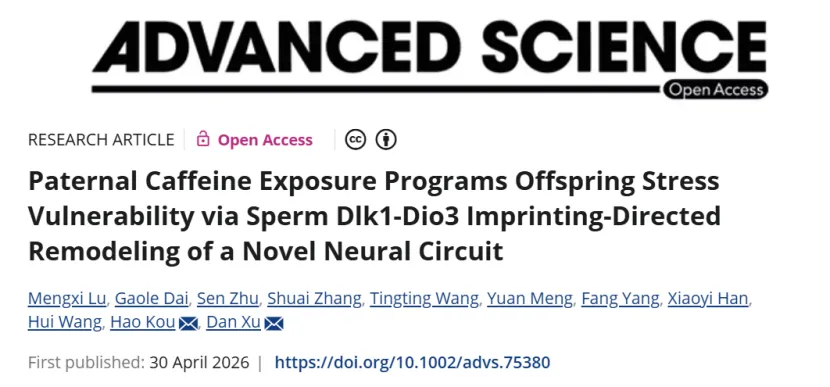
But a heavyweight paper published in an authoritative journal, "Paternal Caffeine Exposure Programs Offspring Stress Vulnerability via Sperm Dlk1-Dio3 Imprinting Directed Remodeling of a Novel Neural Circuit," completely breaks this inherent understanding:
Long term excessive coffee consumption by expectant fathers before pregnancy can alter the genetic imprint of sperm, leading to weakened innate stress resistance and significantly increased risks of anxiety and depression in offspring.
In the past, the public believed that fetal development relied entirely on the mother's body, and that the father only provided the genetic sequence. Therefore, postnatal lifestyle habits would not affect the child's personality and emotions.
Epigenetics has long confirmed that men's daily routines, diet, and beverage intake do not alter the core DNA sequence of sperm, but can modify genetic imprints and directly pass on the physical imprints of life to the next generation.
This study accurately identified the key Dlk1-Dio3 imprinting regions in sperm:
Long term intake of caffeine by expectant fathers can disrupt the normal gene expression of this segment, thereby reshaping the internal neural circuits of the offspring's brain.
Simply put, from the embryonic stage onwards, children's brain's stress regulation system is inherently biased, and their self-regulation ability when facing stress and negative emotions is much lower than that of ordinary people.
After growing up, it is more likely to be sensitive to internal friction, fall into anxiety and depression, and the probability of developing emotional disorders increases significantly.
Many people may panic: Do we have to completely quit coffee before getting pregnant?
There is actually no need for an absolute one size fits all approach.
The study clearly indicates that the damage is dose-dependent: occasional consumption of small amounts of coffee allows the body to metabolize normally without causing abnormal sperm genetic imprints;
The real harm is long-term daily intake of multiple cups and high concentrations of caffeine.
Converted to adult daily standards, if an adult male consumes more than 400mg of caffeine per day, which is 3-4 cups of Americano per day, it will have significant reproductive effects.
For a long time, there has been gender bias in preconception, always believing that the mother determines the overall health status of the fetus.
And this study once again confirms that preparing for pregnancy is never a task for women alone.
The father's dietary habits, emotional state, and daily routine are all silently engraved into the child's body through the epigenetic information of sperm.
It is recommended that expectant fathers try to reduce their intake of strong coffee, functional drinks, and high caffeine tea drinks three months before pregnancy; There is no need to completely quit, just limit yourself to one cup per day.
After all, the best prenatal education is never just the self-discipline of the pregnant mother, but the joint health commitment of both husband and wife.
https://doi.org/10.1002/advs.75380Digital Object Identifier (DOI)
 Liaoning ICP Security No. 21122402000217