
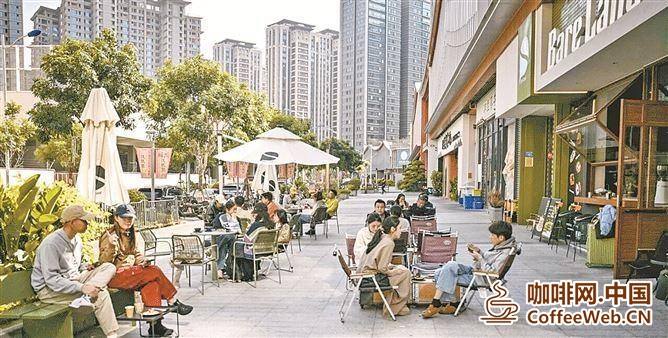
Huli Zhongzhai was once closely connected to the "urban village" and "old renovation". Nowadays, the "Phoenix Lane" open street district is open here, targeting the boutique coffee that young people love. On weekend afternoons, several coffee shops with different styles naturally gathered in the neighborhood, without a unified sign, but became a new landmark on the map of Xiamen's boutique coffee industry.
Phoenix neighborhood
This may be a trend: Xiamen's premium coffee market is extending from Gulangyu and Lujiang Road to the eastern and outer parts of the island. After completing the mission of "popularizing coffee" for chain brands, premium coffee is transforming coffee from a "refreshing beverage" to a "lifestyle", providing talent, aesthetic and scene support for Xiamen to build a billion dollar coffee industry cluster.
The 'lifestyle' embedded in the city
Why does Xiamen have a strong coffee atmosphere? The answer lies in urban culture.
The person in charge of the relevant project of the Xiamen Municipal Committee of the Chinese Democratic League introduced that a hundred years ago, overseas Chinese who returned to China brought back the habit of drinking coffee from Southeast Asia and blended and coexisted with the Minnan tea culture, forming a unique "dual life": brewing tea in the morning and drinking coffee in the afternoon.
Culture has settled in this city – a cup of coffee, a square of space, are all forms of life. According to relevant data, Xiamen Island has an average of over 12 coffee shops per square kilometer, and the proportion of coffee consumers ranks fourth in the country, second only to Shanghai, Hangzhou, and Beijing.
The coffee atmosphere in Xiamen not only impresses locals, but also attracts tourists from other places. Members of the Democratic League research group introduced that many well-known tourism media have produced maps of Xiamen's premium coffee and recommended them to the whole country. It can be seen that Xiamen's premium coffee culture has formed a cross city attraction.
The research team believes that the distinct difference between boutique coffee and chain coffee lies in "taste" and "output value". Lin Tao, the full-time vice chairman of the Xiamen Municipal Committee of the China Democratic League, compared premium coffee to red wine: industrialized chain coffee satisfies daily convenience, while premium coffee carries lifestyle and aesthetic pursuits. Xiamen's over a hundred years of coffee history, tea coffee symbiotic lifestyle, and high-density independent coffee shops are all "nurtured". The Xiamen Municipal Committee of the Democratic League has made coffee a key topic for three consecutive years, with the goal of "making coffee another city card". In their view, Xiamen provides the soil for the growth of specialty coffee, which in turn reflects the temperament of the city.
Talent reserve has become a 'soft infrastructure'
In 2010, Taiwanese compatriot Lin Qiuyi founded the Xiangtou Fine Coffee Academy in Xiamen, which was the first teaching laboratory in mainland China to obtain certification from the American Fine Coffee Association. At that time, people from all over the country who wanted to learn coffee and obtain certification had to fly to Xiamen, "recalled Chen Zhi, founder of the Zhongle Le Coffee Art Festival. Many key personnel from brands such as Luckin Coffee and Kudi came from Xiamen. For over a decade, Xiangtou Academy has planted another "professional spark" for the development of the coffee industry.
At Jimei Industrial Vocational College, a campus caf é operated by members of a coffee club for seven years, successive generations of students have trained to become popular newcomers in the industry from grinding beans, pulling flowers to operation. Teacher Cai Huocan introduced that most of the talents cultivated by the club have entered the coffee industry, and many have already played important roles in boutique cafes. The college is still considering applying for the Coffee Ecological Industry College.
It is precisely these talents who have accumulated and formed the "soft infrastructure" of Xiamen's coffee industry – chain owners are easy to recruit technical backbone, chain coffee brands are willing to set up their headquarters and factories in Xiamen, and the city's image is becoming more prominent.
The 'multiplier effect' of premium coffee
Premium coffee is also unleashing energy in another dimension – cultural and tourism traffic. In 2022, Chen Zhi and his partners self funded the establishment of the Zhongle Le Coffee Festival, and the first two coffee festivals lost over 800000 yuan; By 2025, the single event traffic will reach 150000 to 200000 people, with over 8 million topic views across multiple platforms. Nearly 100 brands from 40 cities will participate, with 70% of them making their debut in Xiamen. This year, world champions from Melbourne, Chinese Taipei, and other places are sitting at the brewing bar. Industry insiders say that "five-year-old" Zhongle Le is widely recognized as a must attend coffee festival in the industry.
One particularly impressive data is that during the annual Zhongle Le Coffee Festival, hotels around Lujiang Road are fully booked early, and the participating teams alone bring hundreds of room bookings. The group of out of town coffee enthusiasts who come to Xiamen specifically for a cup of coffee is growing rapidly. According to the organizer of the Zhongle Le Coffee Festival, based on previous experience, one event can drive about 120000 foot traffic and stimulate cultural and tourism businesses to consume about 8 million yuan.
However, many boutique coffee merchants are small and micro enterprises, and organizing events often requires self financing and seeking sponsorship from various sources. The Xiamen Municipal Committee of the Democratic League suggested in the report that the government move the port of activity support forward – this suggestion was adopted during the Jimei Coffee Season, and relevant departments participated in the hosting, reducing the pressure on merchants. At the same time, promote industry standards, strictly screen participating brands, require physical stores, complete documents, and a trustworthy reputation.
On the day of the opening of Fenghuangli Street, the block manager said that in the future, they will also settle in pet friendly parks and flower and bird markets, "making coffee truly the hub of community life".
(Xiamen Daily reporters Zhuang Xiaojing and Lu Xiaofeng)
 Liaoning ICP Security No. 21122402000217