
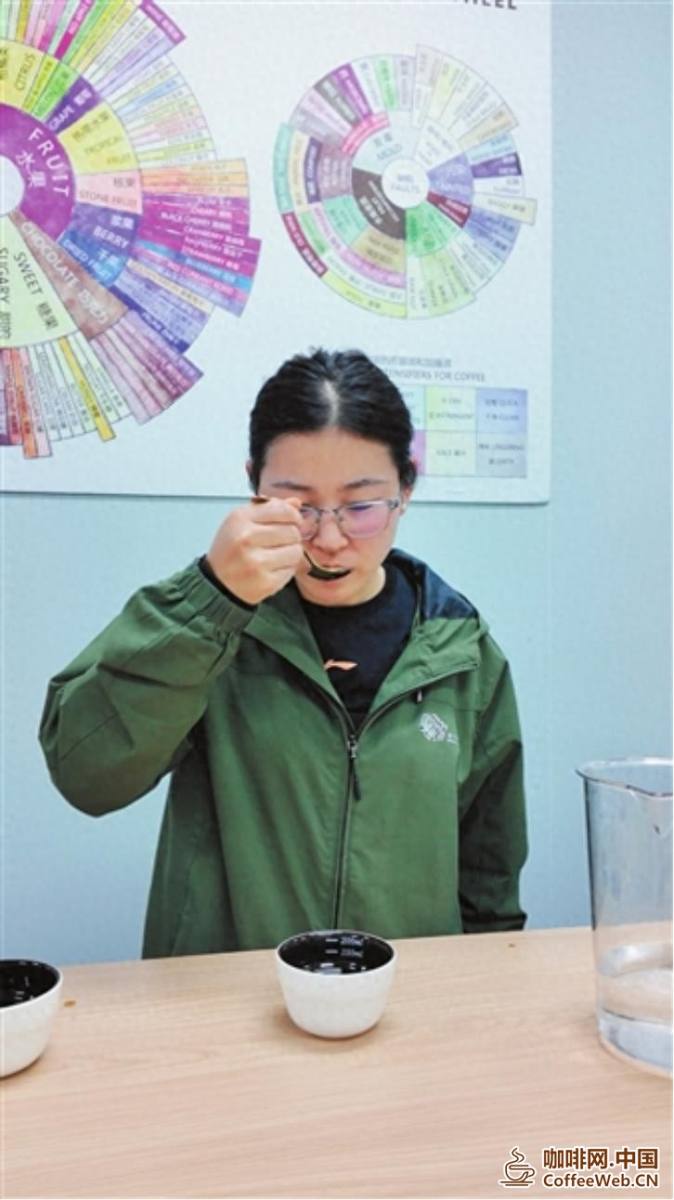
Chen Shumin is tasting coffee.
The Haidongdong Coffee Festival attracts a large number of tourists. reference image
The extraction workshop of Moyin Coffee Chengyang Factory.
There is a "young" factory in Chengyang District, Qingdao City, which will not officially start production until 2024. However, it has become a large-scale enterprise in just two years and has been selected as one of the "Young Eagle Enterprises" in Qingdao City for 2025. The products produced by the company are exported to countries such as the United States, South Korea, and Saudi Arabia, and have established partnerships with multiple coffee brands, supermarket chains, and e-commerce platforms. It is the Chengyang factory of Moyin Coffee (Qingdao) Co., Ltd. (hereinafter referred to as Moyin Coffee). Recently, reporters put on dust-proof clothing and walked into this factory, following the production line to reveal how a good cup of coffee goes from coffee beans to a beverage in the hands of consumers.
More than ten processes unlock flavors
In the 100000 level clean workshop, the machinery operates in an orderly manner, and the aroma of coffee lingers. Under the leadership of factory director Li Ming, the reporter observed the entire process of coffee production, from coffee bean raw materials to finished product shipment, going through more than ten processes including grinding, extraction, blending, enzymatic hydrolysis, enzyme inactivation, centrifugation, filling, pasteurization, packaging of finished products, and shipment.
Raw material processing is the first level of coffee quality, "Li Ming explained. In the early stages of production, staff must first sterilize the coffee packaging materials, then pour the roasted coffee beans into the hopper. With the help of a vacuum generator, the coffee beans are automatically adsorbed to the grinding machine terminal for fine grinding. The fully enclosed operation of automated material conveying equipment can effectively isolate external pollution, while accurately controlling the fineness of coffee powder grinding, laying a good foundation for subsequent extraction.
After grinding, the coffee powder is sent to a dedicated extraction workshop, which is also a key step in determining the taste of the coffee concentrate. Li Ming introduced that there is a spray faucet controlled by an electromagnetic valve above the coffee extraction equipment in the workshop, which uses an intermittent spray extraction process to extract coffee liquid. "This process simulates the principle of manual coffee brewing, and slowly and evenly extracts the essence of coffee, so as to extract the flavor of coffee to the greatest extent." Li Ming said that the extracted coffee stock solution will be collected into the stock solution tank and transported to the blending workshop through closed pipes.
In the blending process, technicians will combine market demand and customer customization requirements to accurately mix coffee concentrate and adjust the aroma and sweetness of the beverage. Natural coffee beans contain trace amounts of protein, coffee pectin, and other substances, which can easily disrupt the taste of coffee and lead to a chaotic flavor. To this end, the factory adopts biological enzymatic hydrolysis technology, which first decomposes impurity components, then activates active substances that improve flavor, and completes enzymatic hydrolysis before performing enzyme inactivation treatment. This process can significantly improve the stability of coffee, optimize the taste hierarchy, and make the aroma of coffee more mellow and long-lasting, "said Li Ming.
After enzymatic hydrolysis is completed, a small amount of solids will be produced in the coffee liquid. The staff uses a centrifuge to quickly separate impurities and obtain clear and high-quality coffee concentrate. Subsequently, automated filling, pasteurization, sealed packaging and other procedures need to be completed in sequence, with low-temperature sterilization throughout the process to extend the shelf life of the beverage while preserving its taste. After multiple quality inspections and screenings, qualified finished products are uniformly stored and ultimately shipped in bulk to the consumer market.
The taster checks the richness and aroma of coffee
Standardized industrial production has given birth to a new profession – coffee taster. Their job is not just to taste the quality of coffee and grade it, they create many innovative flavors of coffee by themselves. Smelling the aroma, pouring water, breaking the residue, sipping… At the Moyin Coffee Chengyang factory, the reporter also met coffee taster Chen Shumin.
Chen Shumin stood in front of the tasting table, neatly arranged with different batches and flavors of coffee concentrate. She adopts the industry's professional sipping and tasting method, taking small sips of coffee to evenly fill her mouth, fully experiencing the acidity, bitterness, and richness of the coffee. At the same time, she carefully identifies the aroma levels and then slowly swallows, recording the tasting data of each coffee. Sipping can fully blend coffee liquid with air, maximize flavor release, and accurately capture subtle taste differences, "Chen Shumin explained to reporters about tasting techniques.
As a full-time taster for the enterprise, Chen Shumin needs to complete dozens of coffee sample tests every day, covering different stages of samples such as raw beans, extraction solutions, and finished beverages. Her job responsibilities include flavor evaluation, defect screening, taste adjustment, new product development and tasting. She not only needs to identify quality issues such as sourness, impurities, and odors, but also needs to cooperate with the R&D team to optimize flavor ratios, balance coffee sweetness, bitterness, and aroma. In addition, she will regularly compare similar products in the market, optimize the taste of our company's coffee, and cater to the public's drinking preferences.
The reporter learned that compared to ordinary baristas, the professional threshold for coffee tasters is much higher. A qualified coffee taster should not only have mandatory qualifications and work experience, but also possess professional qualities such as sensory ability and professional knowledge. For qualification certification alone, more than 20 rigorous tests such as raw bean grading, aroma recognition, and taste testing must be passed. Generally speaking, upgrading from a barista to a coffee taster requires at least 3 years of industry experience. At present, there are about 3000 registered coffee tasters in China.
Build a local high-quality coffee enterprise
Li Yangri, the actual controller of Moyin Coffee, introduced that Moyin Coffee is a supply chain enterprise specializing in industrial solutions for high-quality instant coffee. It provides customized supply chain support for coffee brands, supermarket chains, e-commerce platforms, etc., including coffee roasting, grinding, extraction, freeze-drying, etc.
The company has 15 Q-Grader certified tasters and over 30 professional R&D personnel. It has applied for 65 patents related to extraction processes, freeze-drying coffee cubes, etc., including 19 patents applied for by the Chengyang factory. Li Yangri introduced that the company has established five production networks in Qingdao Chengyang, Jimo, Kunshan, Nanjing, and Xiamen, which can achieve an annual output of 10000 tons of ripe beans, 8400 tons of cold extraction liquid, 1800 tons of hot extraction liquid, and 200 million pieces of freeze-dried coffee. The Chengyang factory can achieve an annual production capacity of 120 million small irregular bags, 60 million small strip bags/square cups, and 100 million self-supporting bags.
The reporter learned that the customer base of Moyin Coffee includes well-known coffee brands at home and abroad, emerging boutique coffee shops, mainstream e-commerce platforms, large supermarkets, well-known chain hotels, etc. The product was showcased at international exhibitions such as HOST2025 Milan International Hotel Supplies Exhibition and 2025 Seoul Coffee and Baking Exhibition in South Korea, and exported to countries such as the United States, South Korea, and Saudi Arabia. It has also applied for trademark protection in countries and regions such as the United States, Malaysia, Singapore, and Hong Kong, China.
In 2025, the research and development expenses of Moyin Coffee reached 1.7 million yuan, accounting for 5.69% of the revenue. Li Yangri stated that in the future, the company will continue to increase its research and development investment, and achieve efficient supply of high-quality and affordable products through more efficient, resilient, and profound supply chain capabilities.
/News Extension/
Coffee Festival ignites new fireworks in the city
On May 14th, a lively coffee festival was held on the lawn of Wheat Island, once again confirming the enthusiasm of island city consumers for coffee. As the "second coffee city in the north", Qingdao is using small cups of coffee to leverage the city's consumption map.
In recent years, Qingdao's coffee festivals have gone from sporadic embellishments to blooming everywhere, with IP featuring distinct Qingdao imprints appearing one after another. Taking the Haidongdong Coffee Festival as an example, in 2021, the first Qingdao Haidongdong Coffee Festival quickly ignited people's consumption enthusiasm upon its debut, and the event was temporarily suspended due to overcrowding and flow restrictions.
Last year, the Shangxiaoka Coffee Season held in Chengyang District attracted over 50000 visitors in three days, including about 20000 Korean tourists, driving sales of over 3 million yuan in the park's stores and 2 million yuan in sales from 60 booths.
Behind the numbers lies the concentrated release of urban consumption power. The value of a cup of coffee goes far beyond its price itself. Data shows that for every cup of coffee sold at a coffee festival, consumers often invest several times or even ten times more in surrounding areas such as dining, parking, cultural and creative industries, and even accommodation. The Haidongdong Coffee Festival has driven a 30% increase in hotel bookings in Laoshan District and doubled the rental business of camping equipment in the surrounding area.
The coffee festival also provides a stage for businesses from all over the world to break through barriers. The owner of a local coffee brand in Shimacheng exclaimed, "In the past, opening an independent coffee shop in the old city area could accommodate up to 2000 people per month. However, this coffee festival received more than 5000 customers in just three days and also received orders for three corporate team building projects." Merchants from other places also gained a lot. Zhang Yan, the manager of 1/4 coffee in Beijing, has been attending the coffee festival in Qingdao for five consecutive years. She told reporters that customers in Qingdao are very knowledgeable about coffee, not only young people like to drink it, but also many middle-aged and elderly people buy hanging ear coffee and coffee beans. Every time they participate in the exhibition, they can receive a large number of repeat customers.
More thought-provoking is that Qingdao has not stopped at the excitement of festivals, but has transformed a cup of coffee into a link connecting diverse consumption scenarios. Targeting different consumer groups, Qingdao has introduced the coffee industry into scenarios such as marriage and love consumption, emotional consumption, and nighttime consumption, allowing a cup of coffee to continuously "roast" the city's fireworks.
Taking the festival held on the large lawn of Fushan Forest Park as an example, the venue gathered "coffee+" categories such as air raid shelter coffee and local craft beer. Citizens and tourists enjoyed their drinks in the natural leisure space, lingered in the market, performance and social interaction area, and greatly increased their willingness to participate in the festival in the future while relaxing and relaxing.
At the same time, Qingdao has extended the consumption scene of coffee from urban commercial districts to between mountains and seas, taking the lead in proposing the "village coffee" brand, combining traditional tea industry with emerging village coffee, and creating a new consumption scene of "combining local and foreign". At present, there are more than 170 rural cafes in Laoshan District alone. Beizhai Street relies on forest resources to create a "courtyard coffee community", Wanggezhuang Street uses the sea view to create a "sea view coffee belt", and Shazikou Street integrates fishing port culture to form a characteristic location
Coffee shops in rural areas are filled with the aroma of coffee, coffee festivals in coastal areas are crowded with people, and spring coffee gatherings are set up in commercial parks… A cup of coffee quietly connects Qingdao's commercial ecology, cultural and tourism scenes, and community daily life. It will not only boost consumer spending a hundred times, but also the vitality and future of the entire city.
Photography for this edition (excluding authorship)
Qingdao Morning Post/Guanhai News reporter Yu Xie
 Liaoning ICP Security No. 21122402000217